
 I first read The Cultural Cold War in 2019. Written by Frances Stonor Saunders, it was highly recommended to his readers by Miles Mathis. I gave my copy away. It is one of those books that should be kept on hand for reference. Saunders is surprisingly (to me) young to have published such a book. She would have been 33 when it was first published in 1999. I am rereading the 2013 edition. (Saunders is currently 58.)
I am only 30 pages into the book. I ordered it while we were in Europe, as the only reading I did over there was of the beach variety, Brooklyn, by Colm Toibin, and The Woman in Cabin 10, by Ruth Ware. I started reading another book by Ware, The Lying Game, but opted not to finish it as I felt it was going to be very dark and depressing. After exposure to those three books, I longed for substance, not looking down my nose by any means, but rather preferring nonfiction over popular fiction.
I will write more about The Cultural Cold War down the road. At this point I am a little distressed, having read the book already and taken eight pages of notes. I thought so much of it and remember so little of it! This happens with books – to me, anyway. I spend a good many hours reading them, and then fearing their impact will be lost, transcribe highlighted passage for posterity. All to no avail, it appears.
About the book, I will briefly recap its substance. As with music, little of art is left to artists. Musicians are trendy and chosen for success, having songs written for their performance by hidden hands. Donovan, a singer popular in the sixties (Mellow Yellow), was asked about the song writing prowess of Lennon and McCartney, and as quoted by Mike Williams, the Sage of Quay, said that they were backed by some “genius” song writers. Asked to elaborate, he said that was all he could say.
Music is the tribal beat, and is far too important to be left to musicians. In my lifetime it has progressed from straightforward rock to what is now called pop-punk-hip-hop – Mr. Williams seems to imply that the ultimate sound of rock will be atonal, and if anyone asked me, that is what I would call rap. Classical music has already been marred by atonal sounds (I sat through Stravinsky’s Rite of Spring and gasped when it got a standing ovation from the audience at the Colorado Symphony. The conductor went to great lengths to describe what was to come before the orchestra played, and all I could think was that the audience did not want to be rubes and so pretended to like it. That’s all I can make of that response. It was crap.)
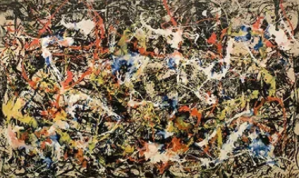
Back to art: I stood before a painting by Jackson Pollock at MOMA, the Museum of Modern Art in New York City, a Rockefeller project. Excuse my naiveté, but I looked at his painting through the eyes of a child, for a young boy was standing between us and the Pollock painting to the left. What must the boy be thinking? “Is this art?” “I think I could pull that off.”
I think what I am going to relearn from Saunders in rereading her book is that the purpose of the Congress of Cultural Freedom, heavily funded by the CIA in the postwar era, was to remove the ability to express meaningful ideas through art. The piece shown here has no intellectual substance, and is not a work of beauty. It is chaotic and empty. Pollock, born in Cody, Wyoming, and pretending all of his short life to be a cowboy, was not that. He never rode a horse and left Cody as a young child. His work was fueled by alcohol. While some of his work has images that can be distinguished from the nonsense above, none of it has any meaning or substance. In my view.
And that appears to have been the mission of the Congress of Cultural Freedom, featured in the Saunders book, to destroy meaningful art.
I normally don’t do this, but hereby recommend to anyone who likes long complicated tracts to read The Cultural Cold War. I would lend you my copy but will not make that mistake again. There’s more, much more to cover. I will close with an opening remark by Saunders:
“There was exhilaration… moments of people-thumping joy at some unexpected treasure thrown up by a piece of paper to which I was paying only cursory attention. These accidental findings are a compelling argument for the importance of primary over online research. If I can advertise one serious advantage to being welded to a desk in an archive, while all the world seems to be sunbathing outside, it is this: the thrill of connections made, of strings pulled in the tangle that resulted not in loose ends or Gordian knots but in “evidence” and strong lines of inquiry.”
I am troubled by the idea of Internet research, as web pages can disappear or their substance be altered. Nothing preserves ideas better than paper.
I have wondered now and then what prompted Saunders to write this book. It is itself a form of art, unique and inspired, deeply researched and loaded with pearls. That she wrote it at a time when research was being replaced by Internet searches is an impressive feat, a throwback to pre-1995 times when writing and research were labors of sweat and love.
This link will take you to a one-hour presentation by Saunders.
 Piece of Mindful
Maybe moreso than “meaning or substance” I would say it’s about removing skill and artistic ability as a requirement to enter the field.. Demonstration of great skill in any field, music, sport, art, literature, etc can be inspiring, exalting the audience, lifting them out of the mundane and creating a feeling of transcendence, a feeling for beauty, human potential, etc. It can evoke “noble” impulses, love of beauty, truth. Modern art by contrast rubs your face in modern anomie, despair, nihilism, the human condition as a brute animal thing. Man is not a god, there is no glory, we are faceless numbers in brutalist cell blocks of ugly architecture, in some gnostic hellscape ruled over by a sadistic creator who caged us here.. or something like that, haha.
LikeLiked by 2 people
Well said.
LikeLike