
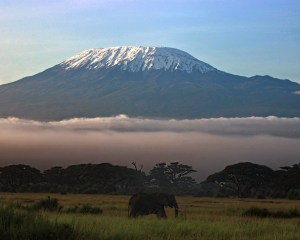
The above photo is of Mt. Kilimanjaro, which is (mostly) in Tanzania, Africa, but on the Kenyan border. At 19,341 feet (5,895 meters), it is the tallest mountain on the African continent. Our guide, Joseph, pulled a sharp U-turn and told us to get that photo with the elephant in the foreground. Guides are very good that way.
Kilimanjaro is often not visible, but we caught it on a good day. Climate alarmists say that the snow is depleting on the summit, but truth is a little more revealing – it is human caused, but due not to warming. It is due to deforestation of the parts of the mountain below the summit, meaning less moisture making its way up there.
Several years ago when we lived in Boulder a group sponsored an evening photo show of a Kilimanjaro expedition. They did not warn us in advance of the horrible accident they encountered. The trail, which circles to the summit, had encountered heavy rains which dislodged some boulders. Out of the blue they came rolling around the bend, unseen until too late. At least one member was killed, others injured, going on memory. I am told these days when it rains heavily, they shut it all down.
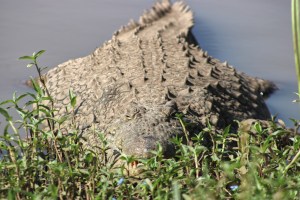
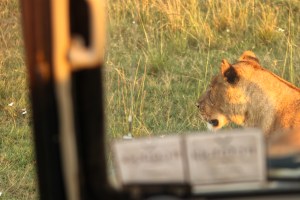
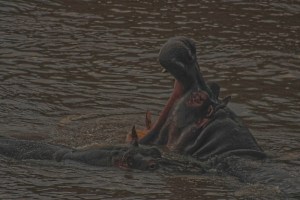
Anyway, below are a few more of our African photos, and then no more. I brought over 400 home with me, and am working them 20 at a time, tedious. Enjoy. Where necessary I’ll insert a description, but most are self-explanatory. (The hippopotamuses, seen at dusk, were in a river, and camera can do no justice, but there must have been 75 of them visible. The guide told us that they do not feed in the water, merely go there to stay cool. At night they come out of the water to feed. Not a good place for boating.)


 Piece of Mindful
Thanks for posting Mark, these are nice photos. The Kilimanjaro picture is a little pixelated though, it’s not possible to post a higher resolution version is it?
LikeLike
The version I have is this one, but once filtered through WordPress loses quality. True of all of them.
LikeLike
I changed out the Kilimanjaro photo, adding some richness by removing haze, but when it gets to WordPress, quality changes. In my original, the elephant is lighter and you can see his spine.
LikeLike
Here’s one our guide, Joseph, pointed out to us, a hyena sleeping in a culvert.
LikeLike
Some nice photos there, thanks for sharing. One thing that separates the standouts from the more perfunctory ones I would point out, is something any art or design 101 class will cover – symmetry vs asymmetry. Generally the latter is more visually “interesting” and dramatic. There are exceptions, as in the elephant photo, where the symmetry underlines how the shapes echo each other, while their size contrasts. But being aware of that can make even less exotic subject matter compelling.
LikeLike
Thank you TimR. Anyone who knows me knows I do not claim mastery, or any special expertise in photography. The accountant doesn’t have an artist’s eye, but I know when I see the work of a photographic artist, as I am usually in awe.
What follows is just a funny story … nothing to do with my skills. A friend of mine and I enjoy birding, and one time as we travelled together up in Yellowstone, I mentioned to him that I had seen a goshawk flying above the rimrocks in Billings one time.
“You didn’t see no goshawk!”
“I think I did. I know what they look like.”
Goshawks are usually only seen in forest settings, and you pretty much have to stumble on one to get a photo. Later I had to endure teasing as he asked if I had seen the red breasted Goshawk, the blue-bellied one, etc.
Some time after that trip I was sitting at my desk, which sits above our long driveway, and I saw in the distance a large bird land in a tree. I grabbed my camera (at the point a Nikon CoolPix) and went to our front porch and fully extended the lens. I really needed a tripod, but took a whole bunch of photos anyway. Then I went back to my work.
A few weeks later I was downloading photos and came across the ones I took that day, most sloppy and useless, but one perfectly centered, not even a slight cropping needed.
That’s a version I framed in barnwood, as I cannot find the original print in my hard drive, though I know I have it. It is clearly a goshawk. When I realized what I had, I sent a copy to Kevin, asking snarkily what he thought I had.
“You son of a bitch! I spend years hoping to get a photo of a goshawk, and you stumble out on your front porch and get one by accident?”
A little whisper of schadenfreude on my part, I admit. Kevin, a much better photographer than me, as since gotten his own goshawk photo.
Anyway, bottom line, I occasionally take a good photo, but only by accident.
LikeLike
I know you consider it just a hobby, just offering it as a hobbyist tip sort of thing. Even for pros it’s always a “practice” where you continue to learn or consider new things.
Most art classes I ever took were not very helpful at least in terms of the instruction.. but the “critiques” when students and instructor would put up all the projects and discuss, was among the more helpful things.. which is a common observation of art students, that critiques are sometimes almost the only thing useful from art classes.
LikeLike
And of course you know I’m sure pros also take thousands of photos and only use a few.
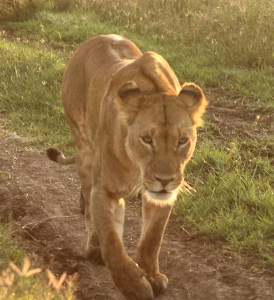
To me the strongest in this group, in terms of “could be a Nat Geo photo,” are the lioness, the giraffe, and the elephant. The others have subject interest, but are sort of like illustrative encyclopedia photos.
LikeLike
The lioness has interesting composition/ asymmetry as mentioned, and the dramatic backlighting creates an interesting value pattern/ shapes.. if you think of in abstract terms of white, light and dark gray.. might be interesting to look at in b&w, to see that more clearly.
LikeLike