
This interview addressed below (link) is with Massimo Mazzucco, a photographer who, while speaking with an Italian accent, is very good at English too. Consequently, I can understand his words without the annoyance that comes with having to parse and think at the same time. His business is to debunk the debunkers – to claim that the moon landings were a hoax. There’s nothing new to discover, and no new ground broken, so Petra, our friend, please, this is not about that. I wanted to link to Fakeologist and Ab Irato since a while back I took a shot at Lynn Ertell, a regular there whom I find terribly annoying. This is a way of apology for me, to link to some of Ab’s good stuff.
So as not to single out Ertell, I am of a bent that very quickly gets annoyed at supposed experts on any subject who practice the art of obfuscation:
- Pose as an expert.
- Never answer a direct question directly.
- Control the forum. Interrupt as needed, talk over, misdirect, drone on endlessly.
- If you don’t like the question asked, answer another.
That first, control of the forum, has to do with a phenomenon we’ve all seen too often, that when a speaker speaks, s/he opens the mouth, and words roll out in a mesmerizing and monotonous fashion, so that we cannot interrupt even as we do not absorb anything. We should interrupt, but such interruptions are only temporary. The person occupying the forum knows to keep on blabbing. Another aspect of this phenomenon is that such people never appear in a controlled debate forum, never allowing opposition views to be aired.
My own personal shortcoming is that I do not have the patience to sit through such interviews, and also that I get more annoyed with women than men. Call me whatever that word is that we use for men who look down on women. On my surface, I try not to be that guy, but down a layer or two, I am that guy. Empty-headed women annoy me more than empty-headed men.
That’s not why I write here. The Mazzucco interview is very interesting, and allows for give and take and short questions followed by short and direct answers.
However, at regular intervals we are interrupted by fast talkers doing advertising at us, rat-a-tat, no time to mute it. It is so goddamned annoying! The forum in use does not allow for fast-forwarding 10 or 30 seconds, an easily-accessible technology, and not used for that reason. They do not want us skipping advertising. I moved the bar ahead on this one, and probably missed a few minutes of Massimo, but also as a result have no idea what the ads might be for. It does not help that one of the ads is a fast-talking woman. Again, break out that word used on people like me.
This goes back decades, as we all began to use the Internet in 1995 and are all witness to advances in technology. But early on, the idea that advertisers could rudely cut in on us right on our computers was a new technology. They were just then using the pop-up, and people were getting annoyed. There was so much annoyance, in fact, that a journalist, to use the term loosely, went to a Madison Avenue agency that was doing pop-ups, and asked a spokeswoman, (yes, a her) how she could justify such lack of manners. Her answer, which anyone who has read this blog for the last twenty years knows, was
“Hey! It’s our job to get your attention!”
And my response, again not new: “She was then taken to a nearby alley, and shot. A jury refused to convict.”
If only that, but advertising is far more subtle and intrusive. They know they annoy us, and don’t care – they try to minimize the annoyance with humor and sexual images, lately virtue-signaling by being all green all over, but they’ve a job to do. At the center of all advertising is behavioral psychology. I know someone who was in the business, and he would let slip now and then as they did their creative work on pitches that it all boiled down to the central theme of an advertisement, and that all pitches had to conform to that theme. It came from deep in the bowels of the agency, a psychology department.
The central thesis of that theme is that people lie. Advertisers, if they trusted us, would make direct appeals to our intellects. But they know better. Few products are new or different or as useful as claimed. Consequently, they have to make that appeal on the surface, but the message has to be layered, and the real message embedded in images that go directly to our brains while bypassing filters. Thus is all (professional) advertising a layered lie.
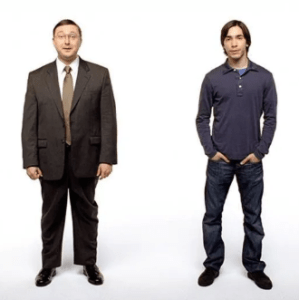
The image above is a famous campaign for Apple PCs from long ago, titled “I’m a PC I’m a Mac.” The message was layered, and the object as well. The message was that dorks and geeks used PCs while cool people used Macs. But it goes one layer deeper … Apple had only a small slice of the market, and needed some help. It needed a sales force far bigger than what it had available, and so recruited its users to sell its product. Every Mac user became an annoyance, smugly thinking they were using a better product than a PC, in effect saying “I’m smart. You’re not.” It was smashingly effective, probably won tons of awards not for its creativity, but for its subversive impact.
Who the hell cares if an ad is cute or funny? Does it work? That’s all that matters. After all, to this day, Macs and PCs are the same product using the same technology.
It was 2013 or so, and I purchased a Mac. Right away I got annoyed. The introductory video told me that Macs were superior to PCs because when you scrolled the screen using the bar on the right, you moved it up instead of down. It insulted my intelligence. One of the complaints about PCs of that time is they they took too long to become usable after we started them up. They clicked and whirred incessantly. Apple claimed to have solved that problem, but what I found was that indeed that screen with those familiar click-boxes would appear, but that the keyboard would not function for the exact same amount of time that it took a PC to warm up.
But worst of all, our advertising creative friend asked me, in a condescending tone as I stupidly sat aside my Mac, “So advertising doesn’t work. Right?” I never said it did not work. I only maintained that advertising is dishonest and subversive. There’s a difference.
In our living room is a chair that, if you place our TV at 12:00, is facing 2:00 PM. If I am watching something that is interrupted by advertising, I hit the mute button, and look away. As I do so, I always know when the ad has finished. They flash. The screen changes every second, or two seconds. I can see that out of the corner of my eye. When the screens stops flashing, I know the ad has ended. They spend billions constructing ads, and each second’s image is carefully crafted for a reason. But they do not want us thinking about anything, so they do not give us a chance. They change the image in rapid eye-flicker fashion so that the images, which are the true messages being conveyed, bypass our internal censors and go straight to our subconscious. That’s what I mean by “subversive”.
(Does advertising still work on me as I look away, via the flickering images, subconsciously? Possibly. Leaving the room helps too. However, in my defense, I, like most everyone I know, watched the recent Superbowl. I cannot tell you anything about either the advertisements or halftime show.)
I gave away my Mac, went back to my PC, which is so much easier to use. The technology behind the screen is far beyond my comprehension, but the interface is constructed in such a way that we can all use and understand it. If there is genius involved, it is those people making a machine useable for the average bloke. Understand, the technology behind Apple, Google, Lenovo, HP, Dell, Asus … all of them, is identical. Knowing that, it is only logical to assume that all manufacturers got it from the same source.
Dare and reveal please, again.
It was suggested to me recently in a comment that we don’t have real science or scientists anymore, and I was stumped to think of one area where real scientists are hard at work. If it can be called science, psychological manipulation by advertisers is it.
 Piece of Mindful
Your’re close to the answer. Think subliminal, as in all advertising is built on very basic human anatomy, visually. Then disguised and layered. What used to be done with paint and pencil, light and shadow, moved with technological advances. Like what my father used, in the 70’s, airbrushing. Then, after computers, pixel manipulation. But everything is, at the subliminal level, based upon love, fear, sex, and death. When advertisment is both visual and sound, there are sub-light and sub-audible threshold technology. You literally can’t consciencely see or hear anything. However, your eyes and ears take it all in. A great book, but and out of print is Clam Plate Orgy. Maybe found on archive.org. Some say it’s all BS.
LikeLiked by 1 person
I read a book back in the 1970s, Subliminal Seduction, by Wilson Bryan Key, same guy who wrote Clam Plate Orgy. In it he highlighted such messages in advertising art work, most often hidden in ice cubes in liquor ads. I went looking for it, but never found any such thing on my own. One thing I got out of the book was to quit using deodorant and antiperspirant. That’s a product built on social insecurity, that people are afraid of sweating and smelling bad. Sweating is natural, but we don’t stink. We need a shower every day. Sweat has pheromones in it that attract the opposite sex, or whatever, but it is a natural odor, and not offensive. But social insecurity wins every time. I’ve not used deodorant in over 50 years now, and if people have complained, it was not to my face.
Here’s another thing, which our friend in advertising denies would ever happen. Long ago Bud Light would run TV ads that contained juvenile humor, like a fridge that opened on the front and in the back on the wall of another apartment. We listened to a gal at MSU Bozeman speak on the subject, and she said that that humor was targeted at kids, 14-16 years old, and for a reason. They don’t want them drinking at that age, necessarily, but when they do come of age, they want them to choose Bud Light. The ad agency was preprogramming the kids.
That reminds me of Ellul, who spent a lot of time in his book Propaganda talking about “pre-propaganda”, or readying us to accept propaganda as a normal thing. It appears to be a large function of schooling at all levels.
LikeLiked by 1 person
I haven’t worn deodorant for a long time either although on some occasions …
The kind of deodorant I really loathe is the spray kind and I used to go nuts at a friend I lived with for wearing it and at times have asked people to apply it outside – to me spray deodorants are simply evil. The funny thing is that one of my favourite ads was the Spray Fresh ad from the 70s which had the tag line “Don’t waste a wash.” I looked it up and I remember it being a little different but I don’t know if my memory is wrong or there’s a slightly different version.
https://www.youtube.com/watch?v=wiPgHzgVVtg
LikeLiked by 1 person
LOL!
I have never worn any kind of deodorant. Got more ass than a toilet seat.
LikeLike
Antiperspirants (as opposed to deodorants) contain aluminum chlorhydrate … to shut down sweat glands. Can’t possibly be good for us, though I’ve never seen evidence it’s harmful.
LikeLike
Key had three books, Clam Plate Orgy, Subliminal Seduction, and Madia Sexploitation. I had and read those. You’re correct. Advertisers need and promote perpetual adolescents. Personally, I think advertisment peaked with the world’s fastest talker guy lol
LikeLike
There’s also product placement, in movies or TV, as I’m sure you know. And sometimes in news stories too – noagenda podcast catches some of these. Or many entire news stories that are probably paid spots, eg about new drug studies, the wonders of these horrific weight loss drugs, etc, presented by the anchors with fawning credulity.
This morning the local talk radio covered the Nancy Guthrie kidnapping. They played a clip of the police spokes hole or whoever, describing how the suspect caught on doorbell cam was wearing a backpack – brand, such and such, probably from Walmart. So did Walmart sponsor this op, I wonder..?
LikeLiked by 2 people
Have you ever seen a person on a TV show using a computer where the computer was not a MacBook Pro? Have you ever seen a star using a PC?
LikeLiked by 1 person
It’s funny you mention that. I went to see “Melania” and in one scene she is prominently using a Mac computer to talk to a French woman dignitary about creating a coalition to help children more. Here we are two days later and that Mac still sticks out in my mind.
LikeLike
Just to make the point, Mark, that my seeming obsession with the moon landings isn’t about the landings themselves it’s about the mind control used to make people disbelieve them – especially as it seems I’m the only one who recognises it. While some believers of the moon landings recognise that people such as Bart Sibrel and Dave McGowan don’t simply get it wrong on the moon landings but tell deliberate lies they don’t recognise that these people are intelligence agents who are paid to tell those lies.
In case anyone watches the Mazzucco interview and is persuaded by his arguments this is a debunking of them:
https://petraliverani.substack.com/p/american-moon-2017-superficially
LikeLiked by 1 person
Damn! I really liked Weird Scenes Inside the Canyon! 😁
LikeLike
Hey Petra are you all excited about the new Phallus launch at the moon, the Artemis 2 or whatever it’s called. They got a woke crew and everything.
maybe this is a stupid question but if they moon landings are real why does the film and video look like shabbily done studio work? Was it a double fake where they faked the footage and landed for real?
LikeLiked by 1 person
“… why does the film and video look like shabbily done studio work?”
The danger of being an independent thinker is that you tend to place greater value on your opinion than on irrefutable facts.
You think the film and video look like shabbily done studio work. I don’t.
This is a fact though: there is no imagery from the moon landings that betrays multiple sources of light with multiple shadows.
LikeLike
Petra, you state in your link, “People in their seventies do occasionally forget things.” I object strenuously to that remark. Remove the word “occasionally” and we are in total agreement.
LikeLiked by 2 people
There’s a name for this fallacy, which I cannot think of, which we in the U.S. fall for constantly: if one side is evil, the other side must be good. That’s how Democrats and Republicans control our politics, by allowing the good label to shift back and forth. My point, again, with the Moon landings, is that there is a possibility that the same people are managing the debate on both sides. They want us at each others’ throats so that we don’t ask … if not that, then what? If they did not go to the Moon, what on Earth were they up to, really?
LikeLike
I think the fallacy you mean Mark is the Argument from fallacy (also known as the fallacy fallacy).
Logical structure of the error
The conclusion doesn’t follow.
However, I am a very careful arguer and I don’t believe I use fallacies in my argument.
My argument isn’t merely that because the propagandists only have false arguments against the moon landings (and in some cases are clearly lying) means they must have happened, my argument is based on a combination of facts:
1. The propagandists only have false arguments against the landings (and in some cases are clearly lying).
2. No disbeliever (despite some at least being well-acquainted with the phenomenon of controlled opposition) has detected that there is a moon-landings hoax propaganda campaign and the propagandists only have false arguments and are telling deliberate lies – and, in fact, propagate these arguments themselves including you. For example, I’ve seen you say that there should be stars in the photos which is an easily- and many-times-debunked claim originating with the propagandists – just do a search on “Why aren’t there stars in the Apollo imagery” and see how many responses show.
3. The fact that no disbeliever has detected the false arguments and deliberate lies means they haven’t done due diligence and thus have no credibility.
4. No one has provided a single fact that refutes the reality of the moon landings.
LikeLike
so some clowns said they didn’t go to the moon so it then necessarily follows that they did?
LikeLike
A ridiculous strawman argument.
LikeLike
Yes. It is a ridiculous argument. I’d never claim such a thing
LikeLike
Are you being deliberately obtuse or are you simply naturally so? “Strawman argument” refers to your statement “so because some clowns said they didn’t go to the moon they necessarily did” as if it’s my argument when it clearly is not my argument – I go out of my way to make the point, in fact, that it isn’t my argument. That’s what “strawman” refers to.
LikeLike
your first 3 points were about the clowns again and the 4th is nonsense.
the explorer 1 launch is fact enough for me that they didn’t dead reckon some Hollywood walk of fame dorks to the moon.
LikeLike
No the first point was about the propagandists. Points two and three were about the disbelievers.
LikeLike
what do they have to do with the price of tea in China?
I didn’t need them to watch the explorer 1 launch with me.
LikeLike
We are Moon landing “Disbelievers”? Should you not instead call us “Moon landing deniers”? As long as it is propaganda, keep the propaganda terms straight. The terms “denier” and “debunk” are part of the vernacular.
LikeLike
I think, rather, Petra, it is called the fallacy of the missing middle. We are given two choices, and so choose one or the other, when in fact there is a whole array of possibilities, one being my suggestion that they used the moon landings as misdirection to point us away with something they thought so important that it could not be revealed, not then, not now.
You might suggest I have to put something up as what we are being misdirected from, but my frame of reference is very small. I can only think in terms of space activities, and indeed it appears that rockets did travel in Lower Earth Orbit. Why? I’ve suggested space weaponry and spy craft, but there the technology would have to advanced to the state that in 1969 it was ready to put into use. (Of course, the Space Shuttle Program would also have served as a fine-tuning and repair platform.)
But that’s as far as my limited abilities take me.
LikeLike
Not arguing using the fallacy of missing middle (or false dichotomy) either, Mark.
Oh, I’m very, very familiar with how they use the false dichotomy and used it superbly for 9/11 – we were given:
A. Terrorists
B. Rogue elements within US govt and its collaborators
when it was C:
Rogue elements, etc but they staged the death and injury.
Quite a number of my substacks address the false dichotomy strategy either directly or indirectly, eg, “Are false flags a thing?”
https://petraliverani.substack.com/p/are-false-flags-a-thing
In order for the false dichotomy to apply you need to show that both arguments are false. That hasn’t been done.
For all I know, the moon landings were used as some kind of misdirection … but that doesn’t mean they didn’t happen. True things can be used as misdirection. As George Orwell said:
“All propaganda is lies even when one is telling the truth.”
Bottom line is item four in my previous comment:
No one has provided a single fact that refutes the reality of the moon landings.
LikeLike
I do not have to prove anything. I only suggest that there are many possible explanations for the behaviors we have seen. It could be unknown unknowns.
There are a whole array of suspicious unlikelihoods surrounding the Moon landings. Hundreds, actually. In propaganda they use the term “debunk” when they deny the unlikelihoods or offer weak explanations. It has a sense of finality about it. That’s why they use that term. It’s just how propaganda is done.
LikeLike
When there is clear evidence for something and no contradictory evidence, judgements relating to implausibility have no place. What results when you follow the implausibility / improbability path is the logical fallacy argumentum ad speculum or Hypothesis Contrary to Fact. If the evidence says the moon landings happened then what you might consider implausible or improbable is irrelevant.
On the ConspiracyTest.org site they call on the improbability argument of “too many people would have to keep their mouths shut” but the evidence clearly contradicts many official narratives and people DO keep their mouths shut while the very few that don’t are ignored, vilified and suppressed.
Another trap is that what often what seems improbable only seems improbable due to ignorance and there you risk the Argument from Ignorance fallacy.
LikeLike
Never underestimate the monetary value of a hoax. That is something that hit me recently: many hoaxes can be at root big scams, for easy money from the masses. Like dinosaurs, as an example. Space is another one. Hey Petra: no one had evidence that NASA and Space are not a giant scam operation faking shit to sell to the gullible masses. I see idiots everywhere wearing NASA gear, and there’s endless science fiction movies and TV shows fueled by the bullshit of garbage like the moon landings. One whiff of the moon landings being a real hoax would evaporate a lot of that market for space gazing morons. Even my mom said she likes to watch the space shit shows on NOVA – space obsession is a disease IMO.
LikeLike
Of course, hoaxes are massive money spinners … and they’re the gift that keeps on giving in many cases … they just go on and on and on and keep spinning money as the myth is perpetuated.
No one is more ready to recognise a hoax than I am and I do in fact recognise part of the moon landings story being a hoax – Apollo 13 explosion (and pretty sure Apollo 1) – so no one could be more willing to say hoax … and very often I do call hoax just catching a headline sideways.
The evidence simply says they landed on the moon. End of.
LikeLike
What evidence? None real, Apollo gatekeeper.
LikeLike
Petra wants to think the moon landings were real, and that’s fantastic, she should keep thinking that way. The article that was posted on this blog about the moon landings, and it appearsf the comment section was pages longer than the actual article. Everyone was posting the facts given to us by official reports and their opinions. Why bother continue to debate the topic when after all of that, nobody has changed their minds…yet.
The Epstein and Covid hoax. A reminder that an issue and event can be introduced and repetitiously displayed on mass media to convince the populace that something is real and actually happened. When it was all made up and didn’t happen.
“It wasn’t a lie while you believed it” George Costanza
LikeLike
In general, I disliked Seinfeld et al because they were all very much wimp characters. Wifey loves it, and I watched with her occasionally. However, one episode had Kramer pitching [baseball] and Mickey Mantle was at bat (presumably a million years old). Kramer brushed him back with an inside fastball. Jerry was incredulous. Kramer correctly noted: “He was crowding the plate!” GOLD!
Also, Wifey was watching an episode that featured the substitute for christmas – “Festivus” or some such. That in itself wasn’t so hot, but the line from George’s father: “You’re not leaving until you pin me [wrestling]”, was good. Best yet were the outtakes that had Jerry Stiller (George’s father) repeating different renditions of “You wanna piece of ME?!”. Absolutely hilarious.
That is all; carry on.
LikeLike
If they did not go to the moon really, what were they up to – multi level things I’m sure, but one major plank would be establishing scientism as a replacement religion for the mass public. With experts and scientists as the new priesthood. Better esotericists than myself have pointed out how the imagery and narrative around it maps onto religious archetypes and mythology.
And in that case it fits that many of the early names involved in it had a heavy interest in theosophy and esoteric mumbo jumbo. The Jet Propulsion Laboratories, JPL, with same initials as.. I’m drawing a blank, but he was a major early backer and player. With connections to, I want to say, Crowley and L. Ron Hubbard and those sorts, but correct me if I’m wrong. But in general, a very strange background for actual rocket scientists to have, who are usually far from interested in religious myth.
LikeLike
you’re typing about marvel parsons. Story goes who blew himself up working on a movie prop. The administrator of NASA was a movie studio exec of course.
LikeLike
I like your answer. I’m not inclined to answer Petras question about there never having been evidence against moon landings. Well I could say the same thing about everything that Jesus supposedly did, however to a skeptic the whole thing sounds like bullshit. Those moon capsules with basically zero insulation, traveling into a near vacuum for days, hopping around on the moon for days in playtex suits. As someone who has done a fair amount of mountain climbing and camping in uncomfortable places, I find it rather preposterous they could head out and camp on the moon six times without incident, no injuries, deaths. At least with mountaineering you know it’s real because you can try it, and see how dangerous and/or impossible certain claimed feats are. And the technology was completely primitive then compared to today, yet no one has gone back.
LikeLike
marvel worked for the karman line guy at cal tech. Karman was the Hungarian martian descended from rabbi loew of golem fame. He hung out at rudolf’s alchemical court in bohemia of course…
LikeLiked by 1 person
Jack Parsons, that’s it.. thanks for the background-
LikeLike
Petra – I know you dismiss certain lines of questioning (eg rockets in a vacuum) because you say you aren’t interested or don’t have the background for it, and can prove your case with the elements you do focus on.
But just putting aside all the Randian A=A type logical focus for a moment.. say you’re just talking about it over a beer with someone and they ask you to comment on all that mystic hoodoo type background of the early players – Jack Parsons and all his connections and associations – and you’re asked for your comment on that – how do you reconcile it with your “real Moon landing” view?
Granted it’s just circumstantial evidence, but if you’re being honest don’t you have to admit (albeit it’s an admission against interest if your goal is to “win” the argument) that it’s strange to find all that theosophical mumbo jumbo in the background of “real” physicists and rocket scientists, who really were interested in actual science and rocketry and so on? Is that honestly what we would expect to find, nothing to see here, move on? I’m not saying it’s dispositive, just curious if you have blinders on about anything that doesn’t jive, or you have some rationale that reconciles it to your view.
LikeLike
Never heard of Jack Parsons until I just looked him up now. Interesting character … but how many people in early rocketry were like him? It’s not out of the realm of possibility that he and a few others (some of whom may well have been influenced by him) were also interested in occult stuff.
The thing is though it’s the evidence that says the moon landings happened.
What needs to be understood is that the moon is completely alien and you can’t fake lunar conditions on earth no matter what you do, especially not in the volume of evidence we are presented with.
— You can’t fake a vehicle going through dusty terrain without a long dust cloud behind it on earth – and no one would have thought of even trying to.
— You can’t fake the brightness of sunlight across a significant expanse (well you probably can now but you couldn’t then).
— You can’t fake the sharpness of shadow delineation where there is no atmosphere.
So many things you see that so closely align with the lunar conditions that people wouldn’t even think of trying to fake let alone actually try.
Also, no disbeliever immerses themselves in Apollo information to learn anything. Rather than constantly trying to find things that are wrong with the narrative why not be open-minded, why not show some curiosity? It’s really quite interesting even for someone like me who essentially has no interest.
Take a little look, for goodness sake.
https://petraliverani.substack.com/p/apollo-resources-and-refutation-of
LikeLike
Thanks for commenting on Parsons. It’s a fair point, not necessarily a big deal just seems telling to me, bit of a red flag.
I’m not hugely biased toward fake, I’ve always felt too inexpert to assess the physics and other scientific or engineering matters.. just the overall gestalt from the thing tilts me that way. And there’s a million things to study, limited time for each. Anyway I should check out your side of it and your evidence. I agree it’s an impressive level of detail they’ve assembled, if faked. Although insane detail or effort is a technique of fakery – eg, no one imagines the lengths the magician will go to, because they wouldn’t themselves.
LikeLike
“What needs to be understood is that the moon is completely alien and you can’t fake lunar conditions on earth no matter what you do, especially not in the volume of evidence we are presented with.”
sometimes my favorite informal fallacy is no defense against gullibility.
LikeLike
It is so frustrating to see that disbelievers cannot see how they’ve been fooled by the propagandists and how those in power so clearly show that they understand us better than we understand ourselves.
Disbelievers cannot make facts mean what they must mean:
LikeLike
Nobody expects the Spanish Inquisition! Geez Petra, aren’t you a little sure of yourself? I mean I do give a small chance to the moon landings being real, but then you get into all that secret space program tripe. I recently saw a friends post on Facebook on conspiracy theories showing a chart of “all” the big conspiracy theories, with only a few of them being realistic, like staged school shootings. The rest were full of space conspiracies.
Which led me to another answer to Marks question: Why fake the moon landings. Answer: To give credence to the idea life forms, such as ours, can safely travel through space to other worlds. That is the basis upon which 99% of science fiction, and fantasy, and conspiracy theories like ancient aliens – beings traveling through great distances of space and surviving – have any experimental basis in reality. When any reasonable scientist, who really understands biochemistry well, would understand that the physical extremes of traveling to any place beyond Earth are virtually impossible, without a serious well shielded spaceship, and lots of guinea pigs who would die in trying to leave Earth.
In reality we have no idea where we came from, and the space propaganda further muddies any real inquiry into our origins.
LikeLiked by 1 person
I recognise space fakery, Ray, no problem with space fakery – Challenger disaster (although not technically space exactly) is the most in-your-face psyop of all time and as I’ve already said Apollo 13 explosion and pretty sure also Apollo 1 explosion.
Yes space stuff is faked, NASA is obviously a big fat liar. Yep, got that, but that doesn’t mean the moon landings were faked too.
The two simple questions are:
— Did they want to land on the moon?
— Were they able to?
Both answers are yes so regardless of any space fakery with the answers to those two questions being yes, there’s no problem believing they landed on the moon.
Sure, going to the moon was a massive engineering feat only remotely made possible by the fact that the lack of atmosphere in space means they were able to travel “astronomical” miles on a relatively small amount of fuel but it wasn’t impossible. They wanted to go, they could go, they went. Pretty straightforward really.
I asked ChatGPT how much fuel was used within earth orbit and how much outside it. Get this:
Final Comparison Fuel Used
Within Earth Orbit ~2,563,000 kg
Outside Earth Orbit~122,000 kg
This is very simplified – more interesting response here:
https://chatgpt.com/share/6992823b-bd54-800a-8faf-d64f18e9ed4e
Disbelievers simply don’t know anything about going to the moon. They know nothing – the important thing is though that they don’t know they know nothing. I, on the other hand, know I know very little but at the same time I know enough to know that no stars in the photos aligns perfectly with expectations, shadows can seem non-parallel while being parallel, the loss of telemetry data was insignificant and only applied to Apollo 11 in any case, etc.
LikeLike
Indeed if you’ve never heard of jpl.
LikeLike
Ray, I’ve wondered now and then what the hell we are doing on this planet. It has many wonderful aspects, and we humans have much to offer in the way of intelligence, and esoteric things of beauty like art, love and sheer clever intelligence. But I am hard-pressed to use evolution as an explanation for any of that. There was never any reason for us to advance beyond food gathering. Kubrick dealt with this conundrum symbolically with his monolith. OK. It’s better than anything our science can offer.
LikeLike