
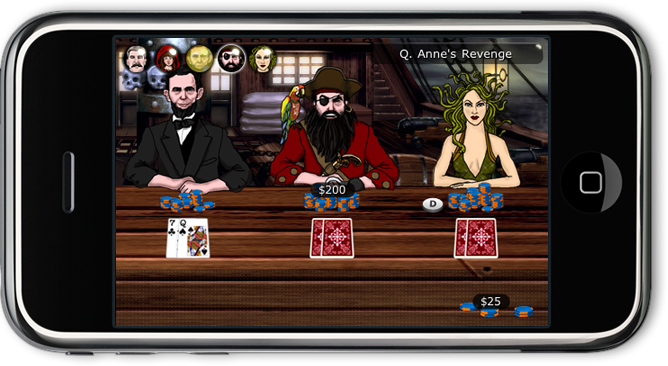
 I have a game on my ITouch that simulates Texas Hold-em poker. It’s put out by an outfit called Candywriter, and is called Imagine Poker. As far as I can tell, the game is not rigged – it allows real odds to play themselves out. There are a host of characters that you play against, most taken from history, and each exhibiting playing characteristics different from the others. Napoleon takes too may risks, Little Red Riding Hood is too timid, and Medusa is always in your face with a challenging bet, forcing you to take a hard look at your king-nine-suited.
The game is five levels, and if you win at every level you win the tournament. I have been playing for over a year, and have won one tournament. I have lost a couple of hundred times.
Am I a bad player? Probably. I will never find out in real life, as there are two possible outcomes from a real tournament: I win some money, or I lose some money. If I win, I’ll surely go back and try again. If I lose, well, I lose some money. So both outcomes are bad.
Worse than that, a simulated game allows me to play with funny money. The risk-taking, while it seems real, is not, and I know this. In a real game, challenged by a real player who knows more about odds and people than I do, I would be burnt toast in a big hurry. So I’ll stick to the ITouch, or watch those tournaments on TV where you get to see the hole cards.
Here’s what is interesting – my son, who is very perceptive, played the ITouch one time and won a tournament. How did he do it? He went all-in on every hand every time. Most times this caused the others to drop out, but often enough when they stayed in he drew the right cards to win.
As I said, I think the game allows real odds to play themselves out. So I need someone to explain this phenomenon to me. If I went to Vegas and played Texas Hold-em, and went all-in on every hand every time, would I stand a better chance of winning? Or did my son merely find the glitch in the programming where it stopped simulating real life, and became a farce.
Or a larger question – is skill at poker an illusion? Is it just random chance with random winners continuing to play while the losers go into other pursuits, like accounting or investment advice?
 Piece of Mindful
Mark
Probably, since the vast majority of players are bad.
Just like drivers, 95% say 95% of other drivers are bad, but 95% of drivers say they are good drivers.
A person cannot objectively judge themselves – they are too subjective!
But at least you’ve admitted it, unlike 95% of other people! 🙂
The fact in poker is you will lose more hands then you can win – simply because most hands are not good hands.
The key to poker is money management.
Lose a little quite a lot of times, but win a huge amount a few times.
Poker is not a game of outcomes.
It is a game of means.
If you play “good” poker, you will win over the long term, though you may lose over a short term.
You measure poker success over your lifetime, not just one night at the table
Exactly. It is the risk that changes the game.
Mike Caro told a story where he would challenge anyone to any amount of money -because money didn’t matter as much to him as it did to others.
He ran into a guy who up the stakes – the loser gets castrated. Mike left the table!
Risk changes the game.
Nope, you’d leave with no clothes.
“All in bets” are powerful – they commit a player’s tournament to 7 cards. As such, other players will not commit to the play unless they have good odds of winning.
BUT – the All In player is committed – once he is in, he can’t fold.
So, the tactic will be that the other players have to do is fold to the All In until they have a monster, and then take the pot and knock out the All In player.
Consider it like you would an investment.
The pot is, say, one BB and one SB, (40/20), for $60. Your stack is $1500. You go all in. You are risking $1500 to win $60. Do you think this is a good investment?
From my side. I am faced with a bet of $1500 to win $1560 – (your all in, already in the pot, plus the blinds). Whereas your risk is 60/1500, mine is 1560/1500 – or slightly better than 1/1.
For you to be successful you need to have the table fold to you 25 times without a call.
For me to be successful, I need to call with only a better than 50/50 chance.
You will not get 25 “folds” in a row without me calling 🙂
————
Your son got lucky – remember Poker is not a game of outcomes – that is, it is PROBABILITY.
If I have 3/1 chance of winning – means that 1 out of 4 times I still lose.
But if you are giving me even pay while I get to claim 3/1 odds – I’ll take that bet every time without a second thought.
I win, I win, I win, I lose, I win, I win, I win, I lose …. over time, I end up with +2 wins over you… I will own your house in a couple of weeks play 5/10 No Limit.
Luck vs Skill
So, let’s review Poker, which has a substantial luck factor, by reviewing Chess, which has no luck factor.
Yet in Chess, you can get lucky – by your opponent not observing a particular, strong move.
So would you thus argue Chess is skill or luck?
Obviously, the better at Chess you are the less likely you will not miss the move and decrease the “luck” factor.
So, let’s add dice into Chess.
If you roll a “6”, you get to move twice in a row. That changes the game – where an inferior player who happened to role “6” and get’s a double move may increase his win/loss ration to a better player.
But even in this scenario, the better you are at playing Chess, the more games you will win over losing.
Of course you can increase the skill by saying “4,5,6” get’s a double move… but wait!
The better player also gets to roll the dice, and get a double move as well occasionally.
…and a better player will use his opportunity of a “lucky” double move to overwhelm a weaker player even more!
So even if we add substantial luck to Chess, the better Chess player will overcome, eventually, a weaker Chess player.
And same in Poker.
Luck is a factor in the short term, skill is the factor in the long term
LikeLike
Mark,
I’ve been playing poker for 35 years, but seriously since 2005.
In that time, I’ve entered -brick and mortar and online- over 1,956 tournaments, from Head-to-Head tourneys (my favorite) to 10,000 person tourneys.
As of today, I have won 835 of them.
I am very profitable.
LikeLike
I am a bad driver too. Once I came to realize this, I stopped getting mad at other people making driving errors, and concentrated on the fact that I see maybe 120 degrees of 360, and am not thinking about what I am doing anyway.
Good analysis, and thank you.
My son, by the way, did not get lucky. He merely exploited that hole in computer programming where it cannot simulate real life. He found the glitch in the program.
LikeLike
Mark,
Re: glitch.
Maybe – maybe not. Let’s see after 1,000 games.
LikeLike
Mathematician/Businessman Andy Beal went to Vegas with a form of Steve’s strategy. A book was written about it (The Professor, the Banker, and the Suicide King). Last time I checked he was behind.
Here’s a blurb about it from a review: High-stakes poker players have always inhabited an alternative universe in which money has no meaning except as a way of keeping score, and what you do with your chips–when and how you bet or check (i.e. pass up your opportunity to bet or raise)–is simply a form of communication. The goods and pleasures those chips could buy in the real world are of no interest to the high-rollers until they get up from the table. When Andy Beal come to town, however, the stakes became so high that the real world reappeared in their calculations and they began to fear for what Doyle Brunson calls “the poker economy.”
LikeLike
Rightsidefred,
Indeed, that is the edge a “pro” has over a tourist.
He throws $1,500 in the pot, it’s only plastic chips to him.
To you, it’s a mortgage payment. You fold.
LikeLike
Mark,
….I have to laugh….
I ran into a Head-to-Head opponent who was a strong believer in the “All in” strategy.
At 10/20 level, I folded 10 times in a row. #12, he was down to ~$300 vs my $2700.
By Hand #14, I was $1500 richer 🙂
I admit, I won the last hand by a runner-runner flush 🙂
LikeLike