
Our science and our technology have posed us a profound question. Will we learn to use these tools with wisdom and foresight before it’s too late? Will we see our species safely through this difficult passage so that our children and grandchildren will continue the great journey of discovery still deeper into the mysteries of the Cosmos? That same rocket and nuclear and computer technology that sends our ships past the farthest known planet can also be used to destroy our global civilization. Exactly the same technology can be used for good and for evil. It is as if there were a God who said to us, “I set before you two ways: You can use your technology to destroy yourselves or to carry you to the planets and the stars. It’s up to you.” (Carl Sagan, Cosmos TV Series)
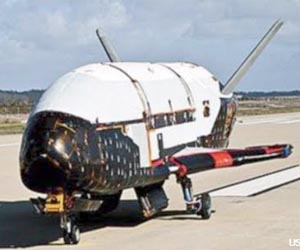
A US Air Force unmanned spacecraft blasted off on Thursday from Florida, amid a veil of secrecy aboutM its military mission. The robotic space plane, or X-37B, lifted off from Cape Canaveral atop an Atlas V rocket at 7:52 pm local time (2352 GMT), according video released by the military. “The launch is a go,” Air Force Major Angie Blair told AFP. Resembling a miniature space shuttle, the plane ims 8.9 meters (29 feet) long and has a wing-span of 4.5 meters. The reusable space vehicle has been years in the making and the military has offered only vague explanations as to its purpose or role in the American military’s arsenal. Space Daily, April 22, 2010
What else do they need? (Fidel Castro, Granma, April 26, 2010)
In his many writings, Carl Sagan at one time pondered that perhaps the Apollo moon landing program was really disguised military spending, the purpose of which was to perfect the ability to deliver nuclear weapons across continents via ICBM’s. The moon landing produced little of value for humans beyond enthusiasm for the future of the species, not to be discounted. It was unceremoniously dumped with no follow-up. But the limits on our ability to explore space are daunting and unrealistic. Perhaps … just perhaps there might one day be a human on Mars, but … why? Can’t go any further.
Over the years since I read (or heard – I had a cassette version of Pale Blue Dot at one time) Sagan’s words, I have suspected that the Space Shuttle program was also just another military program, and that militarization of space, even while being negotiated in treaties and debated, was going on, hidden in plain sight. What was the value of the on-board experiments in a weightless environment? Cost-benefit analysis anyone? (I concede that fixing the Hubble was a worthy doing. I am glad we had the ability to do that.)
The U.S. has now developed a new “super-bomb,” a non-nuclear device that yields as much destruction. So powerful are these bombs that the Russians insisted in the Start 2 treaty negotiations that the U.S. dismantle one nuclear warhead for every super-bomb deployed. The problem, as always, is delivery – how quickly can we unleash this monster on some perceived enemy? The goal is one hour.
Has the Space Shuttle program solved that problem? Is that why all of the classified activity aboard? Is the X-37B mini-shuttle part fo the solution? Is that the purpose of its nine-month missions? Just as we used moon-landing technology to perfect Werner von Braun’s dream, have we used Shuttle technology to militarize space? If so, the world is now a much more dangerous place than ever before. While the Bush Administration offered assurances, no doubt echoed by Obama, that China and Russia will be given advance notice before launching of a non-nuclear device … how can they know?
The X-37B is a military weapon, and the announced goal of the military is “PGS,” or Prompt Global Strike. We are closer now than ever to that dream.
Maybe the purpose of the Apollo program was to build a safe moon-haven for America military officials in the post-apocalyptic world. Now that would make sense. But our unyielding drive to dominate the planet is a greater danger to the planet than posed by any other activity in human history.
 Piece of Mindful
Ok, first to dispel a few myths. There is no doubt that Apollo was primarily military spending. It was a reaction to a Soviet threat: space dominance. Apollo was nothing more than another front on the Cold War. And all along, NASA has had a large component invested in military applications.
That’s not the interesting part of the story. Neither is the fact that NASA has shed much of its on-the-surface non-military functions like the Space Shuttle, and possibly a Mars mission, leaving those functions to future private sector, or collaborative efforts. And NASA obviously is heavily invested in continued military purposes, like the X-37B.
But where I differ, is from people who would say things like
and there are a lot of people who say this, and variations on it (I had a variation of this argument with Jay Stevens over at the pre-Kailey’d LitW).
And there is nothing wrong with enthusiasm for the future. Apollo changed my career path when I watched the first man step on the Moon (at least if you don’t believe the landing was a hoax) when I was 13. Likewise it changed many millions of others direction–which I must say is a major accomplishment, given what “hope and change” brings today.
But it is wrong. While the actual landing produced little research of value, and the symbolism of it–which prompts arguments like yours–misses what Apollo accomplished.
Apollo was a joint military/private enterprise explosion in research and design, manufacturing and deployment, the likes of which have never been seen, or probably will ever be seen again. Kennedy’s decision to embark on Apollo changed the future in huge ways.
Material science in metals and composites, electrical, mechanical and chemical engineering, computing, physiology and medicine, remote sensing and on and on were all given thrusts in new directions.
Apollo changed the fundamental makeup of American technology and engineering and a whole host of other related specialties. It spurred on industries that have led to the types of innovation that once earned American the exceptionalist banner.
And Apollo was wildly successful as a military operation in the Cold War. The world would have been a far different place if the accomplishments of the Soviets and the Americans had been reversed.
Any attempts to weigh the value of the Moon landing on what was garnered from actually being on the Moon miss the larger picture. While people can weigh whether or not the same outcomes could have occurred without the tandem military/private mission, that is just another exercise in historical nostalgic “what-if” scenarios.
Kennedy changed the world with his decision to embark on Apollo. 60 years later we can debate what that decision really meant–but not if we just look at the mission of Apollo as just another rock-collecting excursion.
LikeLike
OK, food for thought there, but I gotta rag on you a bit here.
One, you admit that these things are disguised military programs with side benefits, and say that the side benefits justify the military aspects. I think I mentioned something about the U.S. military threat presenting the most profound threat to our existence in human history. I see that as more important than any side benefits.
Two: You say the program inspired you as a youth. That is true of many of us, but was it that or nothing? Please compose a list of five other ways to inspire youth, and I’ll do the same, and we’ll have ten.
The technological advances are of the nature of “blue sky” investment, which the private sector cannot do, as there is not a perceived payoff down the road. This is the nature of a great deal of military spending, and the side benefits are all around us, including “science in metals and composites, electrical, mechanical and chemical engineering, computing, physiology and medicine, remote sensing and on and on …”. It is the nature of NASA to justify its existence by taking credit for advances that probably would have happened anyway. You forgot Tang.
And far too much credit to the Kennedy
mythmystique, in my humble opinion. Had he not died in such dramatic fashion, I doubt his legacy would be so romantic.LikeLike
First, the easy one: there are many ways to inspire youth: music, art, nature, social justice, environmentalism. And actually, when I was 21, I decided I didn’t want a career building nukes for the military, so I did something else. But the inspirations to study science, and applied technology didn’t leave me because I had a moral dilemma over building bombs. I didn’t become a reactionary Luddite. I became a revolutionary technologist.
Next, weighing military threats to our existence is a valid one. The whole history of MAD (mutually assured destruction) is a good place to start with that discussion. Going back in history and weighing the benefits of technological spinoffs vs. MAD is a good debate to have–but MAD was heavily entrenched before Kenneby embarked on Apollo. And of course, the kicker is if we can tame our military power and our quest for empire, then the question is moot.
But similarly, we could go back and debate the value of the internal combustion engine. As the impacts of releasing unprecedented levels of stored carbon into the atmospheric carbon cycle promises to be as mutually destructive as anything our military can accomplish. Nuclear winter vs. global warming. Maybe the two will balance each other out in the long run, sans humans (and a lot of other species)…
But in 1960, one couldn’t weigh the threats our military was going to have 60 years hence. Foresight in decisional matters of presidents is not omniscient.
I don’t dispute that NASA uses the “blue sky” investment to justify its existence. Nor that military spending has spinoffs in the private sector–in fact that is the point I was trying to make, is exactly that: Apollo had a huge impact on the private sector. And sure some of that would have happened anyways. Much of it would not have. And all government programs have built in survival mechanisms. Just look at all the special interest military spending going on now to pander to corporations and local economies.
I don’t buy into the Kennedy “mystique”. All presidents make decisions. Some of them are more or less consequential than others. Kennedy’s decision was major. If he had not chosen to proceed with Apollo, the world would have been a far different place–consider a world where the Soviets win the Cold War. It was a turning point in history. What that means in all of the different ways it could be looked at spins off endless conversations, “what-ifs”.
In 50 years we may make the determination that Bush’s decision to send Colin Powell to the UN to lie to them about weapons of mass destruction may have been the largest contributing factor to fall the the American Empire. BUsh could turn out to be the most influential president in American history since Washington. Not for any reasons he or any of his compatriots would embrace 50 years from now. But infamous nonetheless.
And Tang? It gave us Emergen-C… just kidding (maybe) 😉
LikeLike
We agree mostly, of course, but even in 1960 it was easy to see that nuclear technology threatened our existence, and developing better delivery systems, and the arms race, were a contributing factor. I suspect that JFK saw Dr. Strangelove, and did not need to look ahead 60 years.
And I support blue sky research – it is the only reason we have the Internet. I was not being critical of that aspect of NASA. It, like DARPA, is doing things that private industry cannot contemplate due to the need to show profit potential to investors.
I do diverge from your thinking in that the Soviets could not have “won” the Cold War – it was mostly a fantasy of our making, and something we could have stopped at anytime. The Soviets merely tried to keep up, as their own existence was jeopardized by the American threat, but at no time did they contemplate conquest. They had their empire, we had ours, and each used the other to justify aggression within their sphere. Notice the the Cold War “ended” when Gorby merely decided not to play anymore.
LikeLike
Well, Gorby wasn’t president of the USSR in 1960. So if we wouldn’t have embarked on Apollo, who knows what the Soviets would have done.
Of course arguing counterfactuals pits your projections of “what if” against mine, neither of which is more accurate than any other.
But it is good to look at tipping points, and think about counterfactuals as they can inform good policy decisions in the here and now.
It is easier to look at the counterfactual of what would have happened if we had not gone to war in Iraq, instead having focused on Afghanistan. Or, what would have happened if the SCOTUS vote had been 4-5 in favor of Gore?
Again, arguing counterfactuals is only productive if it can influence good decision making at critical tipping points in time.
LikeLike
A lot of people think things would have been different with Gore, and I agree he’s a better man from a personal character standpoint. But the power of the office pales against that of the oligarchy, the M.I.C., the Pentagon, so that often times the president is merely appearing to be in charge.
But we’ll never know. You’re right about that type of argument, which I don’t think I am making. I used Gorby to demonstrate that frailty of the concept of a Cold War. He merely decided not to play, and the whole of the illusion vanished.
If it is the case that the Cold War was mostly fiction, then it would follow that the War on Terror is merely a continuation of the fiction in a new costume, with terrorists replacing communists.
That’s not a counter-factual, but a real argument that requires evidence and counter-evidence, but from which we can draw a probability of truth or fiction. It is my opinion that there is no Muslim threat, and that if we stopped fighting them today, we’d be at peace tomorrow.
LikeLike
And we are in total agreement with that.
Way back when, in the Rev. Wright “chicken’s coming home to roost” foofaraw, it was apparent that attacks on the U.S. were direct retaliation for American imperialism. Of course try to make that argument in most crowds, and you’ll get drowned out, if not shunned.
LikeLike
As evidence, I suggest you consider that we hold a threat of force and violence against scores of countries, while no country threatens us.
LikeLike
Now, Russians have lots of oil, and we have our defense industry. Business is business, especially when taxpayers can pick up the expenditure tab.
LikeLike
There is no international collective security. It is still essentially the law of the jungle. While it may be true that we are an aggressor country I would submit that is primarily true because we find ourselves in a position of supremacy. We as a nation or security unit (US + EU) can do what we want (within limits) to get what we want. There is nothing unique about us as a country other then the fact we currently have more power than others due to a variety of geographical and historical factors . Because the law of the jungle rules and because of human nature I am at least glad to reside in a nation that does things to others instead of having it done to us. Becoming static in the area of defense research is the surest way to send us back to the bottom of the totem pole. I would not want to ‘trust’ that the next super-power to replace the United States would be the 1st such benevolent power in history. I would rather take my chances living in the place that has the the technology to be the aggressor and not the abused. As you said these things will eventually be discovered or developed by someone somewhere.
LikeLike
Well-worded and logical, hard to dispute the cold reality of this: Power corrupts. And it is nice to live in the land of the aggressor rather than its victims.
Is there a place for moral judgment in your outlook?
And I will offer a couple of sobering thoughts: one, self-encirclement. We may be top the heap right now and spend more than the rest of the world combined on military hardware, but short of anhilization, we don’t have the power to fight wars everywhere. Even now we are stressed as Arab dictators are threatened – maybe we can qput down all those uprisings, but who can be sure. We are sure to be stressed for many years to come.
And secondly, the nucleaer threat is quite real – Israel presents a real prospect of a rogue power that might actually use the bomb, not to mention Pakista and India.
I don’t feel as safe living here as you, I guess.
LikeLike
I dont neccesarily disagree with any of that. As to nuclear war, as professor Falken would say ‘the only way to win is not to play the game’ right? I fear nuclear war more then anything in the world. At the same time the existence of nuclear weapons has brought us security and stability in a way that did not exist prior to 1945.Whether it ends up destroying us as a species is an open question.
Lots of small wars since the first bomb sure but no cataclysmic total war as in WW2 and 1 (the war that was supposed to end all war). In a base sense the threat of retaliatory destruction is the only thing that keeps us from attacking each other on a large scale. The big powers are limited to predatory attacks on the smaller ones. If you want to talk hypos as you were above..what if we had the A-bomb in 1939? What if Germany had it and we didn’t? Or perhaps if both developed essentially simultaneously. Or what would happen if the whole world did decide to try and put the genie back in the bottle and destroyed all nuclear weapons? Probably then the aliens would come down and conquer us using a board with a nail in it as in the simpsons episode.
LikeLike
Can’t disagree. mutually assured destruction was reality, and not just words. And at the time that only one power had the bomb and no one else did, indeed that power did use the bomb, and for that reason.
These “small” wars, however, are not small when view from the other side of the lens. Iraq has been devastated. Afghanistan has suffered as the imperial powers continue to play the great game on its soil. Vietnam is, 46 years after the invasion and 15 years after lifting of sanctions, still in recovery mode. Indonesia had a similar internal rebellion brutally crushed, and a murderous thug kept in power for decades by … Us, of course. These are not small wars on their end, and this is why I wonder why there seems to be no room for moral judgment of the Superpower.
LikeLike
Sure they are only small wars in relative terms. There is room to make a moral judgment on our government’s foreign policy. And it is clearly immoral in many many ways.
If other nations…and mankind in general…could be trusted to reciprocate a moral foreign policy then the world would be a much safer place. But to me it seems pretty clear its in our nature to try and benefit ourselves. When this can be done by mutually benefiting others as well (or at least not harming them) that is great. But when it can only be done by harming others and the party doing it can get away with it…well that is immoral but its never stopped nations or mankind in general before.
The only realistic solution to this as I see it is the dreaded NWO..one world government or at least reliable collective security. Don;t see that happening in my lifetime though.
LikeLike