

Before anyone jumps on me, in terms of the quality of health care delivered it is much better now than then. We have more cures and better technology. My interaction with the system is very limited, but the personnel I encounter are efficient and even seem to care about doing a good job for patients.
Technology and personnel are not an issue. Accessibility is. If we have a marvelous toy but are not allowed to play with it, what’s the point?
It appears as though investors saw a profit opportunity back in the early 1990’s, and decided to move in on the health care system. Private insurers entered the markets in force and set the terms for the for-profits and not-for-profits alike.
“Preexisting condition” once meant something quite rational for an insurer: People cannot wait until they get sick to purchase insurance. Under the new regime the term was perverted and now means “we will not insure anyone who has any of a list of hundreds of conditions that might cost us money down the road. They will not be our customers.”
Once the for-profit insurers set those rules, the not-for-profits had to follow along. If they didn’t, they would end up with only the sick people, and would quickly go broke.
What happened to our health care system is known as “enclosure.” In order for a business enterprise to be profitable, it has to offer something that people want. If everyone can have that product, there is no reason to provide it, as it cannot charge a premium to sell it. If everyone has access to health care, there is no business incentive for private companies to enter the market. They can only be profitable if they can build a fence around the system and charge for entrance. Exclusion follows enclosure as surely as the little lamb follows Mary.
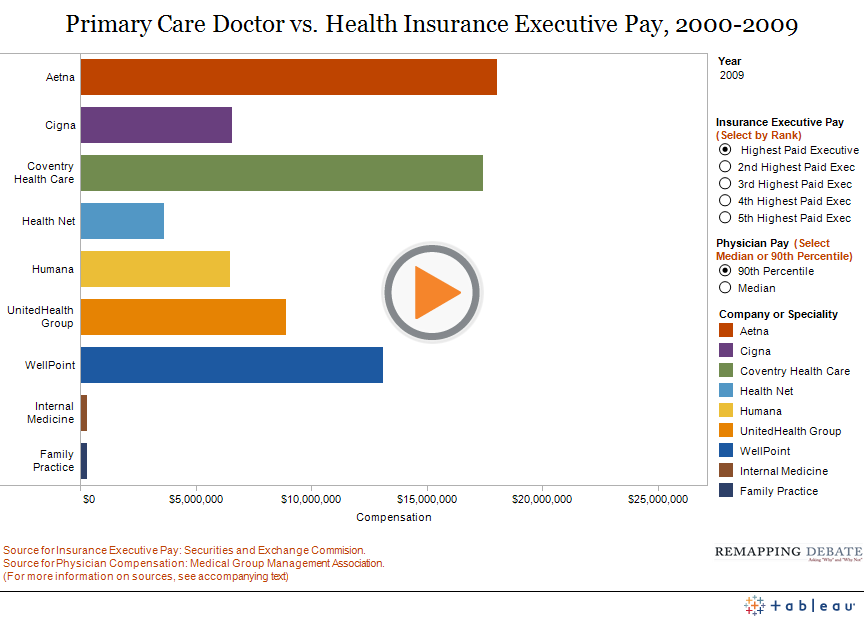
Health insurance is now wildly profitable in the United States. Health insurance executives are paid billions of dollars each year, and some individuals make hundreds of millions off the system. It is not because they are somehow magically gifted with business acumen. They are merely harvesting the benefits of enclosure. They are now able to divert much the money that was previously used to provide services into their own pockets. Private health insurance companies typically divert 20% of each insurance dollar to non-health care purposes.
For-profit health insurance cannot work efficiently in the delivery of health care. Most of the problems we have with uninsured and under-insured people are due to the profit motive.
President Obama gave us what he called “reform,” and there appears to be a morsel or two in that package that might benefit us. But he did not address the enclosure problem. He exacerbated it by forcing us into paying exorbitant fees to get into the system. He did not mandate a basic level of coverage that must be provided, and did nothing in the area of cost control. We will have more people with insurance after 2014 (the insurance lobby is hard at work to maintain as much exclusion as they can between now and then), but far from solving the problem, Obama has merely given the insurance companies a lever by which they can extract even more wealth out of the health care system. The “public option” was our only chance at real reform, and he worked from the beginning to thwart that objective.
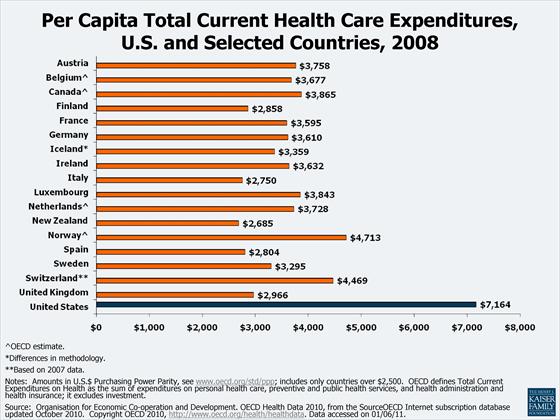
How does private health insurance affect our overall costs? Why are we so damned expensive compared to other countries? Better care indeed costs more money, and the we are continually coming up with better ways to treat diseases. Insurance companies have no part in that.
Beyond that, one factor is overhead – Harvard University put total system overhead at 31%a few years back (Medicare operates at about 3.6% but also endures huge private sector fraud … another story). Each insurance company has its own requirements, and there is incredible infighting within the system as companies try to dump as many costs as they can on hospitals, doctors and government. The profit motive is the underlying problem.
The result of all of this is a vortex as more and more dollars are sucked into the system without a corresponding increase in health care delivery. It is not government that causes health care inflation, and it is not the so-called “moral hazard” of people abusing insurance when they have it.
It is enclosure that lies at the root of our problem.
_________________
*I sort of promised Swede I would do this. I know. It’s all rehash. Have a nice day.
 Piece of Mindful