
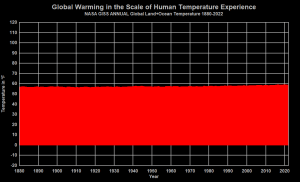
If you are sharp of eyesight, you will note a slight uptick in planet temperature from 1880 to 2020. There is a word for this change from 57 degrees to 59 degrees over that 140 year period: Imperceptible. The human body cannot distinguish such slight temperature anomalies.
So why all the scare, gloom and doom, and wild graphs like the one below?

Note that each graph presents the same data. Note that the above graph makes the ever-so-slight series of upticks as a flame.
Part of the reason, which Climate Liars are well aware of, is that people do not know how to interpret graphic presentations. Those who wish to use such presentations to tell lies are not going to offer any help. But each graph is showing temperatures within the 57-59 degree Fahrenheit band over 140 years.
Side note: What is being shown in the graphs? Average planet temperature is a measurement taken from grid boxes in both northern and southern hemispheres. From the period 1300-1859 or so, we 1) sank into, 2) bottomed out, and 3) began to rise back to normal from a period called the Little Ice Age. From 1860 or so the planet has been warming at this imperceptible rate so that yes, 2016 might have been the WARMEST YEAR ON RECORD!!!
So what. It only stands to reason when all temperatures are rising that most recent temperatures would be higher than those before. Lying liars know how to use information like this to distort reality, scare children and adults alike .
You might suggest that the first graph showing an almost flat line is a distortion of reality. The Y axis temperatures were selected not at random, but in such a manner that the barely perceptible changes between 57 and 59 degrees would be as unnoticeable by sight as by feel. True enough, and what truth can be gleaned from this exercise can only arise from a comparison of two methods, one to minimize, one to maximize fear.
Fear is the key word. Michael Crichton’s last (and seemingly unfinished) work before a young death was called State of Fear. He hit the ‘fear’ point hard and often, that the whole of our Climate Crisis is meant to scare people and inhibit thought processes.
Think about this: I was born in 1950 in Billings, Montana, a hot prairie town that occasionally had very cold winters (“Canadian Fronts” we called them then, “Polar Vortexes” now). If I could be magically transported back to that time from now (not that I want to be) I would not see any difference in “climate”. Spring would be delightful, green and rainy, July and August unbearably hot, and in some winters we would be playing kickball in the street in shirtsleeves, in others unable start our cars due to freezing cold.
Any of us can step outside of our indoor comfort zones and stand outside and see that weather is the same, and that “climate” cannot be measured because it happens over extended periods. The best we can do is think “Hmmm, seems pretty much like always.” That would be an accurate observation. But power of suggestion makes people think that a hot day is hotter than before, that floods never happened, and that weather variability is an indication if long-term trends, i.e., climate.
I stood in a store in Yellowstone National Park a couple of years back, and a clerk and I discussed the hot day we were having. The clerk told me that it seems hotter now than ever before. It is not. P of S is all. At higher altitudes like YNP, the direct rays of the sun bear down and we suffer from heat, but ambient air temperature only rarely goes beyond 75. Solution: A cap.
As such, we are easily manipulated by people with agendas having nothing to do with weather and climate. As adults, we are charged with thinking for ourselves. Most of us know that things are as things have always been. But children cannot know these things, and children are being subjected to the unspeakable cruelty of placing them in a state of fear and robbing them of optimism about their future.
For this I hold three sets of people in contempt: 1: Climate “scientists”, either deliberately lying to us or too stupid to know better; 2: Teachers, themselves too stupid to be exposing their ignorance to children, and 3: Journalists.
That last one, journalists, well I have nothing but contempt for them anyway, but their refusal to report honestly about our climate “emergency” makes me want to see them burning in their own imaginary hell of imperceptibly rising temperatures.
 Piece of Mindful
Mark:
I have never dug in as deep as you have here (PoM) regarding Climate, maybe you would comment on a few things.
Temperature volatility: short term, VERY short term. In my half-century plus of temperature awareness (didn’t care or notice as a young kid), it SEEMS that the temperature fluctuates a great deal more… cold week, then a hot week – no matter what season. AVERAGE seems to remain close to normal. I never experienced such strange short-term rollercoaster weather in all my years. Burn my plants, then drown them… I spend a lot of time outside.
The Old Sun: my memory says YELLOW all through but the last decade maybe. Yellow-White now, and the burn HURTS in short order. I have read somewhere of the actual evolution of the sun, and that it IS changing. Two possible mitigating factors: 1) I am much older, and maybe my skin is shot; 2) THEY are always fucking with our atmosphere. Wifey and I driving home yesterday from 300 miles out, bypassed Indy then entered Chicagoland under a clearly crisscrossed sky of unknown white line (non-natural) shite.
LikeLike
I do not know for sun color [or white lines]. There might very well be a natural explanation. That would be my first impulsive guess.
Memories are not reliable … I am not saying that yours is faulty of course, but were you aware of taking note of cold and warm cycles before now? Were you wondering if it would change? It is like the old saying that it used to snow every Christmas up until seven years ago.
I don’t know these things … where we live it seems each year is something different … 12 feet of snow some time after we moved here (our neighbor Andy tracks this stuff) and then hardly any the following year, eight feet of snow last March, just a couple this year. While gone this year we got a soaking, 25% of annual precipitation in two days. Is this unusual? No. We were prepared for it. It happened several years back and we spent our mornings that June building a retaining wall, which apparently held. The last time this happened the entire hillside in the south side of our house collapsed.
Things do change. I read that some stars (and Venus) used to be visible in daytime. Now there is too much atmosphere to see them. Whether the change is fast enough to be perceived is the question.
LikeLike
I found this website, may be of interest to you, Mark:-
https://notrickszone.com
LikeLike
Sydney Harbour, then and now.
image.jpeg
LikeLike
Sorry, WordPress does not allow photos. Try a link instead.
LikeLike
When someone tells me that the Earth’s temperature is xºC, I like to ask them if they took an oral or an anal reading. Alarmists find this facetious approach infuriating.
But the point I try to make is that temperature itself is defined as a measure of the average kinetic energy of the particles in a system, such as a substance (like a bar of iron) or a space (like my living room). It tells us how much thermal energy is present in a system. To clarify the distinction between these two measures of energy, thermal energy is a macroscopic quantity that describes the total energy of a system due to the movement of its particles, while kinetic energy is a microscopic quantity that describes the energy of individual particles due to their motion.
Since temperature is a measure of average kinetic energy in an area of limited extent and consistent enough to be described as a system, average temperature is a measure of an average of an average. To attempt to calculate the average temperature of the surface of planet Earth, one would need to combine multiple average kinetic energy values into a single value. Also, it would be impossible in practice to measure all the bars of iron, living rooms, and other “systems” on the surface of planet Earth that contain kinetic energy, and even the temperature of a single bar of iron or a living room will differ by several degrees depending on the point on the bar or in the room that the measurement is made. So instead, what happens with surface-based readings is that a limited number of measurements are made in a limited number of places or points, and the average of these averages (with suitable weighting) is taken to represent the Earth’s average temperature.
The actual process is more complex than that, but the added complexity increases rather than decreases the scope for the inaccuracy of the exercise.
Spaced-based readings may be more accurate since the entire globe can be measured using remote sensing techniques, but there are problems with resolution. Even using a one square kilometer grid, a single temperature would be measured for the entire square kilometer, when there would be considerable temperature variation in an area that large. Also, factors such as the level of humidity/water vapor in the atmosphere, clouds, dust storms, and ice caps can also affect the measurements.
To make a long story short, the public are presented with a very precise figure for the average temperature of the Earth, but in fact it is impossible to measure the planet’s temperature that precisely, and in any case the concept of the average temperature of something as large and varied as the Earth’s surface is fuzzy at best. But without that rising average temperature in their armory, the alarmists would have a lot less to scare the public with, so they will never willingly give it up.
LikeLike
That’s well said.. the whole premise of Earth’s global temperature is a kind of thought stopping absurdity.. it’s intuitively ridiculous, but many Very Serious People treat it as matter of fact and unproblematic, so everyone just nods and goes along with it.
LikeLike
The data is (as currently gathered) tropospheric and by satellite. This is not airport tarmac stuff. Accurate or not (I think it is as it does measure relative change over time. I don’t have a problem with it.
This idea that nothing can be trusted is a kind of nihilism. I am not that. MM’s most recent reprinted paper on boycotts was riddled with nihilism. There are people working who are not part of the climate propaganda campaign who do turn out good work while keeping heads down.
LikeLike
I’m happy to be wrong if tropospheric or satellite data is somehow different. I just meant as far as a common sense understanding of how temperature varies from region to region, moment to moment, season to season, etc, as the comment above describes, it’s hard to fathom how they’d be able to capture it all (accurately) in one number…
LikeLike
They have done it as best as technology allows. I suggest you look into it as they do explain methodology.
LikeLike
Mark, it’s a good few years since I followed climate science closely, but I believe that there are still both temperature measurements are taken by weather stations located on land and buoys in the ocean, and satellite measurements taken by instruments on board Earth-observing satellites, and global averages are still calculated using both of these measures. In general, calculations of average Earth temperature based on the surface measurements and those based on the satellite measurements tend to agree fairly closely, and both show modest warming. For the surface record, the warming is about 1 degree Celsius (1.8 degrees Fahrenheit) since the late 1800s. The satellite measurements, of course, don’t go back that far.
For the record, I accept that earth has very probably on the average warmed a little since the late 1800s. And I would give as evidence rising sea levels and shrinking glaciers as evidence supporting this contention. At the same time, I am not impressed with the choreography employed in order to come up with precise average temperatures for the surface of a globe the size of the Earth. I think this amounts to meaningless precision because the true average would be impossible to calculate accurately using data acquired by current measurement techniques. So we must ask, how big are the error bars.
Interestingly, one the top organizations involved in the global warming/climate change project is NASA, and I assume you are not too impressed with NASA’s honesty given your opinion on the Apollo program—which I share by the way.
NASA’s position on global warming is consistent with the views of the broader scientific community, as expressed in reports such as the IPCC’s Fifth Assessment Report, which concluded, quite dramatically, that “it is extremely likely that human influence has been the dominant cause of the observed warming since the mid-20th century.” But as NASA also agrees that, since 1880, average global temperatures have only increased by about 1 degrees Celsius (1.7° degrees Fahrenheit), there hasn’t been enough observed warming for a dominant cause to have been identified. Essentially, both NASA and the IPCC are “talking us past the sale”.
Moreover, if you check with NASA and ask them the right questions, they will probably tell you that estimates of the temperature of Mars or Venus typically have a degree of uncertainty ranging from a few degrees to several tens of degrees Celsius, depending on the specific measurements and methods used. Officially, measurements of the surface temperature of Mars by NASA’s Mars Curiosity rover have an uncertainty of about ±5 degrees Celsius, while estimates of the surface temperature of Venus based on data from the European Space Agency’s Venus Express mission have an uncertainty of about ±10-20 degrees Celsius.
While we would expect estimates of the surface temperature of Earth to have smaller error bars than this, it may be that the uncertainty range for these measurements is greater than the claimed change in temperature over the past century. At least, it’s worth bearing in mind. Anyway, apologies for going on ad nauseam about what may seem insignificant details.
LikeLike
While we are on this subject, let me offer a couple of facts that should be general knowledge in any scientifically literate society but not lot of people will have heard of them in our society, notwithstanding the huge amount of concern expressed about climate change/global warming.
Interestingly, the Earth’s average surface temperature varies markedly according to the time of year. When I say “markedly”, I mean by a much greater amount than the sum total of all the global warming since the depths of the little ice age.
More interestingly still, the Earth’s average surface temperature is at its highest around the time of year when the planet is approaching its farthest from the Sun (when it is receiving the lowest insolation) and at its lowest around the time of year when the planet is approaching its closest to the Sun (when it is receiving the highest insolation).
I learned about this from John Kerr’s 2011 book on climate, The Inconvenient Skeptic, which a pure pleasure to read and contains numerous very clear and fascinating graphs that clarify a lot about the dynamics of the climate and its history over the last few million years.
Regarding his chart “Annual Temperature of the Earth and the Northern and Southern Hemisphere’s, John wrote:
“The average temperature of the Earth is different for each month of the year.
“This graph provides a different perspective to demonstrate that a single value for the Earth7s temperature is not a useful description. Knowing the average temperature for a given day is not as useful as knowing how cold it will get. It also shows that the temperature of the Earth is ALWAYS changing. Depending on the time of year, the average “correct” temperature is always going up or going down, much like the temperature changes during the day. The morning is cooler than the afternoon.
“Is it surprising that the temperature of the Earth is always changing? Once I saw this it made sense to me, but before I thought about it I would not have thought that the average temperature of the Earth wold change so much. If I had been asked about it I probably would have thought that the changing seasons would have balanced the overall temperature so that it generally stayed the same. I was certainly surprised by how much the average temperature of the Earth changes over the course of each year.
“In January the average temperature is 12.0ºC (53.6ºF) and in July it is 15.8ºC. That is almost a 4ºC change that takes place in a period of six months, twice a year. That means that the entire change in the past 150 years is much less than the amount that the temperature of the Earth changes naturally each year. To put this in perspective, the average temperature of the entire Earth goes up more during the month of March than all of the theorized global warming. It is correct to say that this natural global warming happens each March–May and natural global cooling happens each September–December.”
I would post a link to the graph, but it seems to have disappeared, or been disappeared from the Internet. But the book is available and is well worth getting your hands on. For somebody interested in the actual science of climate, it is no exaggeration to call it mind-blowing.
LikeLiked by 1 person
Thanks for the input, valuable top to bottom. I will get hold of the book, as I love that kind of reading.
Go to WattsUpWithThat (https://wattsupwiththat.com/), a blog run by meteorologist Anthony Watts, and a go-to for me as it is an on running clearing house of information from a wide variety of skeptical sources. You can soend weeks there. On the right hand side (I am using an iPad) you will find where I got my graphs. WUWT expounds quite a bit on the sources of data and the associated difficulties. They run a daily surface temperature measurement of the lower 48 from the University Of Alabama at Huntsville. run by John Cristy, for instance. The whole enterprise is widely reviled by the Climate Scare crowd.
For instance, this source, UCAR, offers up background on the two graphs I presented, which are anomalies magnified over the past 120 years using the “temperature anomaly method”:
https://scied.ucar.edu/image/measure-global-average-temperature-five-easy-steps
Once explained, you will see that all the variables are acknowledged. UCAR does not claim that there is one measurement for the whole planet of any meaning.
From my view, the two graphs I presented merely highlight how differences in methods of presentation can make data look either alarming or mundane. It is the latter.
LikeLike
Thanks Mark for your kind words and for clarifying the main point of the post. I agree with you about WUWT. I have followed that blog for well over a decade and found many of the contributors and commenters alike to be extremely well informed. They include a lot of working scientists and they often argue passionately among themselves about climate-related things that are way beyond my ability to follow or judge.
LikeLike