
We’ve had an unusual last few days here, with high winds blowing off the east slope of the Rockies. When we lived in Montana, they usually happened after a cold snap, and we called them “Chinooks”.
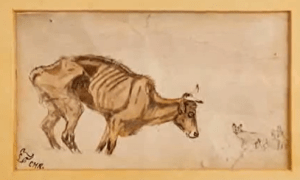
That’s a famous Charles M. Russell painting called Waiting for a Chinook. I had to grab it from a video put out by the Buffalo Bill Museum in Cody, Wy, as there are no still images of it available. I’m not sure I’m allowed to use it. It all makes sense, as artists have to protect their property, even dead ones (Russell: 1864-1926). But it’s ironic too. My dad grew up in Great Falls, Montana, and said that Russell was known to give out pencil and charcoal drawings in exchange for someone buying him a beer. Think, had someone the foresight, what they might be worth now.
Billings, Montana, my home town, once had a mayor named Willard Fraser, and even as I remember no other mayors, I do him. When he took office he noticed that City of Billings stationery had embossed on it Charlie’s Waiting for a Chinook. He decided that the city needed to get rid of “That damned cow!” Who wants to visit a city (or state) that advertising a cow starving and freezing to death? Whose idea was that?
Down here in Colorado, these winds are, while not routine, not uncommon. We do not call them chinooks. The Marshall Fire in 2001 was a grass fire aided by winds up to 115 mph – over a thousand homes burned and two people died. It was a grass fire, and so spread rapidly. Rescue workers did a remarkable job getting people out of harm’s way, a mass evacuation with little time. People were not allowed to take their pets with them, so the death toll was two humans, and god only knows how many dogs, cats, rabbits, and horses. After things had settled down, many of the residents got together and held an emotional memorial service for their lost pets.
We were without electricity for several days just passed. I broke out the camping equipment, and we are fortunate to have natural gas for heating and cooking. The baseboard heat does not work during electrical outages, but a fireplace insert in our living room does, and our cooking stove needs only a struck match to work. We also have a wood stove, so we were quite OK. But the reason for the outage was a decision by the local power provider to shut off the power during high winds. The reason was Paradise, California. From sometimes reliable Wikipedia:
The town of Paradise, California, has been significantly impacted by multiple wildfires, most notably the Camp Fire of 2018, which remains the deadliest and most destructive wildfire in the state’s history. The fire began on November 8, 2018, near Camp Creek Road in Butte County, likely due to a failure of a fatigued metal hook on a Pacific Gas and Electric Company (PG&E) transmission tower during strong winds. In less than 24 hours, the fire had burned over 31 square miles (approximately 20,000 acres), destroying nearly all of Paradise and adjacent communities, including Concow and Magalia. The blaze consumed 153,000 acres (61,900 hectares) and destroyed an estimated 19,000 structures, including about 11,000 homes. The fire resulted in 85 fatalities, making it the deadliest wildfire in California’s history and one of the deadliest in recorded history.
Since that time, twice now, we’ve had to endure power outages lasting two days or so due to downed trees and the threat of fires if they cross power lines. They turn off power during high winds. It makes sense. I am not complaining.
However, I refuse to attribute these winds and outages to anything other than natural weather variability. We are enduring what is being called an “insurance crisis” up here in the Foothills above Denver due to the risk of wildfires and hail. At the root of it is a lie well told, that fires are getting worse, as are storms. Roger Pielke, Jr., formerly a professor of the University of Colorado at Boulder, is now a fellow at the American Enterprise Institute, and writes a popular Substack called The Honest Broker. I am often at odds with him, as he seems too easily to buy into the narrative that CO2 poses a danger to humans. But who cares about that? His overall output is quite good. He has written about hurricanes, concluding here that there is no “climate signal” in them, and has not been for the past century. He also published in 2005, along with others, Hurricanes and global warming—Potential linkages and consequences. Bulletin of the American Meteorological Society, 87(5), 623-628, a scientific paper claiming that there was no climate signal in hurricane landfalls then either. Speculation about it was said to be “premature,” a word I would have avoided, using instead “dead wrong”.
Pielke Jr. is now writing about our (manufactured) insurance crisis, which I find to be hard reading. It’s not overly complicated or containing too much jargon. Rather, climate alarmists do not need to be scientific in their prognostications. There are no rigorous standards that they must honor. It seems that anything they say carries weight, while the real scientists on the sidelines hardly have a voice. Pielke et al have set aside the notion that hurricanes are getting worse, using scientific evidence. But that does not matter, and will never make the news. All we get instead are windy airbags talking about climate change and extreme events on the increase, all false.
We are now suffering from that “crisis” at a time when insurance profits are at all time highs. I’ve suggested to my wife that we may have to move, and she says wait and see. The alarming thing about this crisis is that it does not exist. Like all of climate change, it is perception management combined with absence of a burrowing news media. It’s a big lie, but a lie that sticks because no one can counter in in popular media.
Anyway, back to basics: We live in an area that carries with it the peril of wildfires and hail. It’s always been that way. My temperature/precipitation/drought data says it has not changed since the 1950s. Insurers have never shied away from offering coverage up here (at higher premiums than non-urban interface areas) until recently, as we are now down to two insurers writing policies (along with USAA for military people). State Farm claims that we are in a time of increased peril with increased wildfire and hail risk. State Farm is full of shit, but they have power, we don’t. So crisis or no crisis, they are sticking it to us during a time of huge profits for their industry.
That’s a long road to travel from Charlie Russell and chinooks to crooked insurance companies reaming their customers.
 Piece of Mindful