“Exclusion” is the driving force behind “free markets”

The front page of this morning’s Denver Post has an unintentionally revealing headline:

Audits cut costs in health coverage.

Have they discovered new efficiencies? Have insurance companies cut back on sales commissions? Have executive salaries been slashed?

No. Not at all. The article merely says that insurance companies are now doing audits to be sure that dependents are really dependents. If they are not, then they are excised from the system. They save costs by shifting the burden somewhere else, usually government.

The article really only highlights the principle of the “exclusion zone.” Insurance companies are able to extract a fee to let people into their system. If they could not exclude people, getting in would carry no benefit, and the companies would not exist.

Private health insurance companies can only make money if they exclude the elderly, the poor, the already sick. That’s why public systems in the thirty or forty other countries that use them manage to cover all their people at half our cost: They exclude no one.

Ipilimumab

We’ve had some experience with melanoma in relatives – it was caught early and hasn’t returned. It’s an especially dangerous type of cancer if it “metasicizes” – that is, penetrates the protective skin layers and enters the blood stream. The cancer will quickly spread and infect other organs. It usually overwhelms the body with death shortly following.

So I was glad to read of the development of a new drug that helps people in whom the cancer has spread. It’s called ipilimumab, and is being “developed” by Bristol Myers, whose stock has responded favorably to recently released findings of clinical studies that found the drug effective.

But it is confusing. An article in Medical News Today reviews the findings of the study.

Early results of a trial found that a new drug that targets a genetic mutation found in over half of melanoma cases and some other cancers caused tumors to shrink and patients to live around 6 months longer without their disease getting worse, including those whose cancer had spread to the liver, lung and bone.

Current treatments can generally extend life expectancy around two months. Is this progress?

I suppose. And I don’t know how to read these studies. Perhaps the important point is that they have hit on an entry point into a new means of treating the cancer that will lead to an eventual cure.

Or maybe it is just hype. But it is fodder for those who tell us that large pharmaceutical companies are doing important research that is bringing real benefits to the human condition, and that this is what justifies the protection from competition that we grant them. Are we not seeing some return on investment here?

Not really. Bristol Myers did not invent the drug. A company called Medarex did. Bristol Myers merely bought Medarex.

And this is typical of the business model of large pharmaceutical companies. They take the research of others (most often, NIH) and leverage it into marketing bonanzas.

To illustrate: People often think of Nike as a shoe company. It is not. It is a marketing company. They know how to exploit sweatshop labor to make a shoe. That’s for sure. But their real talent is “adding value” to a $5.00 shoe, converting it to a $150 Air Jordan. That’s their specialty.

In the same manner, Bristol Myers markets drugs.

Take Avapro, for example, aka irbestaran. It’s a fairly modestly priced drug by PhRma standards – only about $120 a month. It is used to treat high blood pressure, and kidney problems in diabetics. It has an important side effect: It doesn’t work.

A large randomized trial following 4100+ men and women with heart failure and normal ejection fraction (>=45%) over 4+ years found no improvement in study outcomes or survival with irbesartan as compared to placebo test.*

Bristol Myers annual sales of Avapro: $1.3 billion.

Will ipilimumab be a life-saving drug for metastasized melanoma patients? Or, will it be a cash cow for Bristol Myers that buys some end-of-life time for Medicare patients? Is it yet another tap into the public health care coffers for big pharma?

The early bet appears to be marketing winning out over science. This hype around this drug, the purchase of Medivex by Bristol Myers, and the clinical trial that doesn’t seem to offer much hope beyond four month for people with a death sentence … all smells like another Pharma con game.

I hope I am wrong.
____________________
* Massie BM, Carson PE, McMurray JJ, Komajda M, McKelvie R, Zile MR, Anderson S, Donovan M, Iverson E, Staiger C, Ptaszynska A (December 2008). “Irbesartan in patients with heart failure and preserved ejection fraction”. N. Engl. J. Med. 359 (23): 2456–67. doi:10.1056/NEJMoa0805450. PMID 19001508.

Living in Nebraska

The reality of the health care “reform” bill is settling in now. The fight is over, and the employees are sweeping up the popcorn and empty cups. Democratic functionaries have obviously been told to emphasize that Obama “got it done,” and that health care reform is now a “reality.” That perception seems to be sinking in. (Bumper sticker they are circulating for the faithful: “Yes we did!” No yellow ribbon discernible. Has a subtle fragrance of “Mission Accomplished” about it.)

I think I was mentally prepared for this as it started, as I lived through the Clinton years and saw the power that The Party has over its members. They will not think for themselves. It produces discomfort, also known as “cognitive dissonance.” We are mostly rational in our everyday lives, seeing that certain things are in our our interest and others not. We are leery of sales people in cheap suits and politicians of the “other” party. We somehow survive in a very tough world.

Yet when it comes to their own party, the members drop their vigilance. Any fool can easily see with a modicum of “research” (as Googling is called these days) that the health care reform bill consolidated the power of the health insurance industry over us. They used the opportunity provided by a storm of negative public opinion to do some classic jujitsu moves. They used our energy to their own advantage. There was deft perception management and political theater, impressive to watch. They guided us to a bill they wrote before the “debate” even started. We had tea parties and renegade senators and a president who “sat on his hands,” supposedly unwilling to interfere in the debate.

And when the congress people all settled on a horrible bill, which happened to be the bill written before the debate started, our president sprung into action. Indeed he did have power and indeed he was persuasive. Indeed he could maneuver and threaten and cajole and bribe people to fall in line.

But he only acted after the sheep had been penned.

What did I expect? If I say that I got what I expected, I’ll be called a cynic. But I got what I expected. The process in motion right now is the clean-up, the “shit=Shinola” part. People are internalizing defeat, convincing themselves that something good happened. Victory is being consolidated on the lower levels, with people putting the dissonance to the back of their minds. If party leaders say it is a good deal, who are they to argue? And anyway, where are they going to go? The other party?

When I was a kid a friend of mine convinced me that I should join the Boy Scouts. I was suggestible, and thought that it must be something good. I went to meetings, and my parents, who indulged me just a little too much, bought me a uniform. I remember sitting at a card table with my older brothers around Christmas one year , wearing my uniform and waiting to be taken to a meeting. They kind of looked at me funny. I felt weird outside the Boy Scout setting.

I was part of the “Burning Arrow” patrol. As I now realize, our patrol was a bit like the Delta Tau Chi Fraternity in Animal House – a ragtag group of misfits. The other patrols had kids who seemed a better fit for leadership, tall and handsome, hair in place and minds right.

Towards the end (I never quit – I just drifted away) we were at a meeting, and were told that we were to break into groups for games. We were asked to suggest games to play. I said “How about Ring Around the Rosie”? That brought a stern rebuke, not from our Scoutmaster, but from another patrol leader: “We don’t talk like that around here.”

Outsider status is its own validation, I suppose, though not too many people pay compliments for it. It gets easier with advancing age. I was never a group-groper, though I was impressionable like all. I went down this path and that, got sucked in, bought in, but always backed out at the end. Here I am now, about to turn 60, and I realize that I am still that smart-ass Boy Scout, laughing at group behavior.

The only difference is that now I look back on that smart-ass Boy Scout and admire him. At that time I thought there was something wrong with me. It took years to understand that there was something right with me.

A message for Democrats and Republicans: It’s like living in Nebraska. You’re just doing it because you don’t know there are other states.

Please take this message to heart: You are free to leave. You have always been free to leave.

Knee surgery, here and abroad

I recently had arthroscopic surgery on my knee to repair a torn meniscus and clean out the joint. Here’s some data on the cost and insurance coverage:

Total Cost of surgery: $15,966
Amount paid by me: $2,359 (15%)
Amount that Anthem BCBS refused to pay, forcing doctors and clinics to absorb: $9,269 (58%)
Amount paid by Anthem BCBS: $4,338 (27%)

The amount that Anthem did not pay results in large part from “in-network” versus out-of-network. Those numbers could be mere perception management, as Anthem highlights on their settlement statements how much the insurance saved me. It could be that the cost is inflated to make it seem as though I got a bargain. That is Marketing 101.

However, if I did not have insurance, I would have been billed the full $15,966, and they would use all of their muscle to enforce payment.

Insurers are in large part responsible for the high cost of health care because of their refusal to pay claims in full. Doctors and hospitals, not being stupid, merely raise the overall cost of all services to make up for those parts that insurance will not cover. The result is the famous $30 aspirin, which is unique to American medical care. In addition, insurers inflict high overhead on the whole system – the cost of commissions for salesmen, all of the elaborate schemes to filter out unhealthy clients (like eHealthInsurance.com, whose sole function is filtering), and all of the costs involved in dumping costs on government, hospitals and doctors, and patients and defending themselves in court. (Return on investment to stockholders encourages investors to sink their money into this pointless activity, this private for-profit health insurance, and further adds to our burden.)

I looked around a bit, as I am quite sure that in other countries this type of surgery would cost nowhere near $15,966. Here’s what I found:

The average for arthroscopic knee surgery in the US is about $8,600. The doctor told me afterward that my knee was pretty messed up, so my surgery could have been more extensive than average. I don’t know that $15,966 was out of line for this country and my procedure.

Other countries average the following costs for the comparative surgery that costs $8,600 in the US:

Mexico $4,446
Costa Rica $2,800
Norway $1,228
Belgium $2,366
Spain $6,699
Germany $2,115
Argentina $2,400

In other words, if I felt like traveling, I could have the procedure done in any number of countries for approximately what I paid out-of-pocket, likely with the same expertise and professionalism, as good doctors are everywhere. (Norway would have been nice, and the savings would have paid for the ticket.)

Recently-passed health care legislation does nothing to bring down our costs to be more reasonably in line with the rest of the world. We are uniquely expensive. Insurance companies surely play a large part in this, with their Cadillac overhead, and the costs they impose on doctors and hospitals, all of which could be eliminated with no suffering to any of us but them, about whom I care not.

But that is not all of it. I do not know what other factors make us so expensive. I’m all ears.

The Reagan tax on the elderly, and free-riding on Medicare

From the desk of the lonely tax preparer, here are a couple of items that need fixing, but never seem to be on any agenda – least of all AARP’s:

1. Tax on Social Security recipients: Ronald Reagan was a man for the little guy – that is, whenever he got a chance, that’s who he stuck it to. One of his legacies is the income tax levied on Social Security benefits. For single people, the tax starts at when a person’s income (without excruciating detail) reaches $25,000, and for married couples, $34,000. Up to 85% of benefits are taxable.

The Reaganites in 1983 were upset that employees were never taxed on that 1/2 of FICA payments that the employer pays. After much negotiation they compromised, and levied a tax against benefits for only the wealthiest people of that time – those making more than $25,000 or $34,000 or so. The tax, which IMHO should not even exist in the first place, has never been indexed for inflation, and today reaches just about every senior citizen who has any income outside Social Security. To keep pace, the thresholds today should be $53,750 single, and $73,100 married.

I just did a 2008 tax return for an old gent who got a bill from the IRS for $1,334 for failure to report Social Security benefits. Every dollar of that amount represents a Reagan tax increase. (And before J’accuse, my bill was $0.00.)

(Interestingly, and again without excruciating detail, it is also a back door way of taxing supposedly “tax free” interest – to calculate the amount of taxable income, you must add in any “non-taxable” interest you earned. That is, they are taxing it.)

There is no talk of fixing this anywhere – AARP doesn’t discuss it, nor do those representatives that are responsive to ordinary citizens in other areas. It’s an onerous tax on those least able to afford it, and ought to be eliminated in full, in my opinion. I’ve done too many tax returns for seniors who are perplexed that after retirement their Social Security gets taxed. At the very least, it should be indexed back to 1983. (I tell them to thank The Gipper.)

2. Medicare supplemental insurance: Insurance companies were not as powerful in the 1960’s as they are now, but at the time that Medicare was passed they did manage to wrangle out a provision that Medicare would only cover 80% of medical costs for seniors. To get the other 20% covered, seniors have to buy supplemental policies from private companies.

As you might expect, seniors now spend more on Medicare supplements for the uncovered 20% than they do on Medicare itself. Medicare supplemental insurance is a major profit center for health insurance companies – they now have “Medicare Advantage” – a heavily subsidized private alternative to Medicare – that is even more lucrative. (Even though it’s technically illegal, insurers work subtly and slyly behind the scenes to peel the healthiest seniors off Medicare to M.A.)

Here’s why Medicare supplements are a joke – all of the screening for reimbursement of costs is done by Medicare. If Medicare approves 80%, they will pay 20%. If Medicare does not cover something, neither does the supplemental policy. Their overhead is virtually nil.

I hate to say this about our noblest legal persons, our health insurance corporations, and few would believe it, but they are free-riding on Medicare. (AARP makes a pile on these policies too, partnering with United Health against the best interests of its own members.)

Health care fixed, Democrats now take on slavery

We are all familiar with the concept of parallel universes, each of us having doppelgängers on other Earth-like planets. Imagine a place that was faced with the problem of slavery, as was the United States in the nineteenth century, but that rather than Abraham Lincoln and the pre-corporate Republicans, Barack Obama and the Democrats of 2010 confronted that problem.

Washington (AP) President Obama, with House and Senate Majority Leaders Nancy Pelosi and Harry Reid at his side, today signed legislation that he called “a landmark end to slavery in the United States.” The president posed for photographs with other congressional leaders, who had earlier been photographed triumphantly walking down the steps of the Capitol Building.

The legislation was long and hard-fought, and is scheduled to go into effect in four years. Those states that want to immediately free slaves are prohibited from doing so for seven years. President Obama called slave owners “perhaps our most misunderstood citizens, patriotic and proud of their heritage. Not one of them likes slavery – not one. Each is bound by market conditions to own them. This bill at last sets them free.”

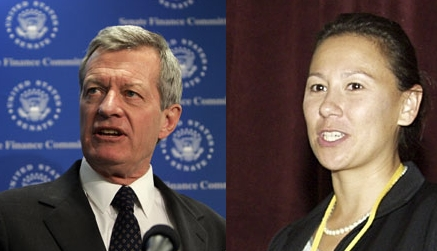
The bill creates a new class of citizen, the “unpaid employee,” and mandates that all Americans employ such citizens by 2014. The classification was hard-fought. Abolitionists faced entrenched opposition, some even being arrested after demanding of Senator Max Baucus (D-Mars), head of the Senate Slavery Committee, that he allow the negro freedom system to be considered with other options.

“Negro freedom is off the table,” said Baucus.

With Republicans threatening to filibuster if certain marginal Democrats got their wish that Negroes simply be set free, President Obama stayed out of the fight. His mother was a slave and was beaten to death by her owner, a deed he often mentioned during the presidential campaign. The candidate Obama said in campaign addresses that he favored freedom in general for Negroes, but changed course after election, saying that he had never embraced the idea of total emancipation. “I never said the words ‘Negro freedom’ during the campaign”, he said.

Both Democratic and Republican legislators enjoyed financial support from the slave-owning industry, and Obama met with slave owners repeatedly throughout the debate. Many in the Democratic Party favored the “free state option,” where Negroes who managed to make their way to non-slavery states would be allowed to stay there as free citizens. Under a compromise brokered by Sen Baucus, those slaves would be allowed to stay in free states, but only if employed as unpaid citizens. States harboring unpaid citizens would be required to pay plantations for lost labor.

But Obama apparently struck an agreement in secret meetings months ago that such an option was not “politically feasible,” and dropped the demand in exchange for a plantation industry promise not to run a “Jermain and Shashawn” – type ad campaign against the legislation. (The legendary ads are credited with having stopped abolitionist legisation in the early 1990’s.*) As before, those states that harbor fugitive slaves will be required to return them to their plantations, but under their new “unpaid citizen” status.

Democrats throughout the country are celebrating the landmark victory. Political blogs have widely praised the legislation as a sense of achievement settles in. Many wanted to see Negroes set free, but in the end realized that it would create competition in the job market. “It’s not really in the best interest of Negroes to be thrown into the competitive job market”, said Markos Moulitsas, proprietor of the widely read Daily Kos blog. He said that Representative Dennis Kucinich, who fought hard for freedom for Negroes until yielding to pressure at the end, “needs a primary opponent.” Presidential adviser Rahm Emmanuel, himself a slave owner, called abolitionist senators and representatives “retarded” and “niggers in whiteface.”

Others hailed the legislation as landmark, and claimed that whatever defects contained in the bill could be “fixed later.” Dissenters, who claim that that the legislation actually strengthens slave owners, were cautioned to “not let the perfect interfere with the good.” Slave-owning Democratic Senator Evan Bayh of Illinois reminded Democrats in an email circulated to state central committees that “80 per cent is better than nothing.”

As querulous Democrats slowly began to assimilate and internalize the legislation, there was a sense of relief that the fight was finally over, and that they could move on to solving other problems. Said John Firehammer, a real person who is a Democratic spokesman in Montana, “at last we can move on. Slavery is fixed. Now we need to concern ourselves with child labor.”

_______
*Slave owners did in fact run television ads against the legislation in the waning days of the congressional battle, but the ads were seen as weak an ineffective, even driving some anti-slavery citizens to support the bill.

Too much tail wagging

In the wake of health care defeat, a couple of movies come to mind. I can’t do any linking so I hope the reader may have seen both.

One is The Sting, from way back. I would urge Democrats to see that movie if only to learn about false agents. People can be very smart – so smart in fact that they can hire other people to pose as things they are not. The various roles played by Obama, Lieberman, Baucus, Nelson, and at the end, Michael Bennet, ought to be examined.

Remember when the Senate parliamentarian said that the insurance rates oversight panel had to be ditched? Turns out that all that needed to be done was for the President of the Senate, Joe Biden, to overule the parliamentarian. Funny it didn’t happen.

But the thing I remember most about The Sting was that, in the end, the “mark” could not know he had been stung. Otherwise he might seek revenge.

Democrats do not realize they have been stung, and so will repeat this pattern again. So it is important now for them to feel victory. They really have to believe they did something meaningful.

The other movie is less popular, kind of a “dog whistle” movie where you either realized that it was not far from reality, as I did, or just thought if was goofy entertainment. It was called Wag the Dog. There the lesson of The Sting was even more emphatic. Dustin Hoffman’s character was so impressed with himself and the work he had done in selling a phony war in Albania that he was going to talk in public about it even though he had been warned not to. They had to kill him.

The sting has to stick. If Democrats question authority or realize they were led like sheep to a predetermined destination, they might rebel.

Fat chance, I suppose. But next year, when the tax cuts are on the table, and party leadership starts the whole song and dance all over again, wouldn’t be nice to think that they actually learned from defeat?

The deal was made months ago

Miles Mogulescu reports at Huffington Post today that Obama made a deal months ago with the health insurance cartel that there would be no public option in the health care bill.

Actually, it’s something that Mogulescu reported last August and that ran once in the New York Times and nowhere else. Ed Schultz picked it up on his TV show, which really ought to stifle these complaints around that Schultz is “managed opposition.” There is enough of that around, but Schultz is not part of it.

Just two thoughts: One, this exposes the lie that there has been any kind of “process” to the packaging and selling of this bill. It’s been theatrics from the start, all done for our benefit. That’s why Joe Lieberman is and will continue to be head of the Homeland Security and Government Affairs Committee. He was merely an actor playing his part.

Secondly, Colorado Senator Michael Bennet made great show of collecting signatures on a letter demanding a public option in the bill. It was a Kabuki dance. Bennet has a primary opponent and is running scared. Bennet is not red and black, and is no friend of Jack. (Red touch yellow kill a fellow – I know a poisonous snake when I see one.)

Bennet, a recipient of Wall Street and health insurance money and a Rahm Emanuel appointee, knows what is up.

h/t: Lb

Power … raw naked power

It’s an incredible show of corporate power over our elected representatives. Shock and awe, defeat so thorough that all we can do cry for a while, and then start over. The worst provisions of this bill do not kick in until 2014.

A year ago 77 members of the House of Representatives pledged that they would not support a health care reform bill that did not contain a public option. (I said 87 somewhere else on this blog – numbers ain’t my strong point.)

Nancy Pelosi laughed out loud when she heard this, and now we know why. Since that time, 75 caved. Two were left standing: Eric Massa, and Dennis Kucinich.

Make of that what you will.