Flatliners

I’ve been meaning to do this for a while – I have been following several health care stocks, not to buy or anything like that, but rather because I think they are a good gauge of how much “reform” is really in store for us.

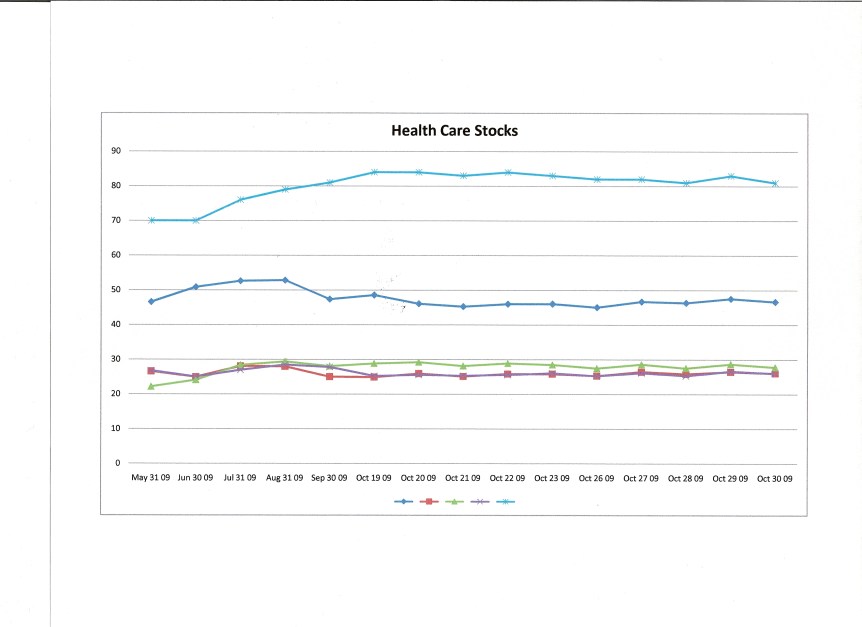
Other people do this sort of thing better than me, but below are five lines – the DJIA – I converted May 31, 2009 to $70 from $8500 so that it would fit on the graph, just to give an idea of the relative movement of several selected health insurance stocks to the overall market trends.
scan0001

The light blue line at the top is the Dow Jones Industrial Average. The dark blue line is Wellpoint, and the other three, relatively interchangeable, are Aetna, CIGNA, and United Health. Their stocks trade at very similar prices.

On October 26, Harry Reid announced that the public option would be in the Senate bill. On October 27, Joe Lieberman said he would help filibuster it. And today, the House announced their health care bill.

The market response? Flat line.

I take my cue from that. Nothing going on in Washington is going to affect the health insurance business, and from that I conclude that we will continue to be screwed.

On Lieberman …

Is anyone (including Harry Reid) truly surprised (except some rank and file Democrats)?

CNN reports that there are five or six Democratic senators who will not support a public option – even in its current shabby form where it might reach 10% of us in seven years. The idea of attaining 60 votes is unachievable. They could, and always have been able to to it with 51.

Why don’t they?

Sophistry, Natelogic, and Baucus’s Bitches

Ah, timing. Sweet motherf****** timing. Things have heated up, gotten really interesting. Electric City Weblog fell for a bit of sophistry, and Natelson is doing his usual “I’m right, I’ve always been right, and here’s an example to prove it” highly exclusionary reasoning, and over at Left in the West they are having an orgy over the crumbs being thrown out by Congress using the name they stole from a broad public benefit we once called a “public option”.

And my modem crashes. Qwest will supply a new once, I suppose, but I think I have to pay for it, and I’m sure someone has better ones for less money, so I’ll go find one today. In the meantime, I’m in a coffee shop, and soon they will tell me to move along, make room for paying customers.

Here’s an interesting comment buried way down below that popped up this morning, from Rick Meis of Montanans for Single Payer. I had written with some amazement that the Bozeman Daily Chronicle, in paragraph 48 of a piece on health care reform (July of 2009) had actually allowed some criticism of Max Baucus to seep through. The Montana press has for years been his bitch, and is again, apparently.

Here’s Meis:

Interestingly, the reporter who wrote the article was new to the Chronicle, and she is already gone. They don’t print anything that does not support the industry view except letters. None of our press releases have been picked up or our calls returned. Yellow journalism is old school; where’s-the-green journalism is now.

The writer was Gail Schontzler, and I don’t know what happened to her – maybe greener pastures. Maybe she’s really good and got a better job. More likely she was really good and had to find another way to make a living. Reporters who are confrontational, who do real journalism in the old sense (“find out what powerful people are doing and report back to us”), generally don’t last in journalism.

But I don’t know. I Googled her name and didn’t get anything beyond her tenure at the Chronicle. Maybe she is still there and is still hammering away at power. But I doubt it.

Spinning the Numbers

This article, FACT CHECK: Health insurer profits not so fat, by AP writer Calvin Woodward, has turned up in a few places now. It is a well-researched piece that doesn’t begin to tell the truth. But it’s very convincing and well-argued. I think that is otherwise known as sophistry.

Here’s a few select quotes:

Health insurance profit margins typically run about 6 percent, give or take a point or two. That’s anemic compared with other forms of insurance and a broad array of industries, even some beleaguered ones.

Profits barely exceeded 2 percent of revenues in the latest annual measure.

…Health insurers posted a 2.2 percent profit margin last year, placing them 35th on the Fortune 500 list of top industries. As is typical, other health sectors did much better – drugs and medical products and services were both in the top 10.

The railroads brought in a 12.6 percent profit margin. Leading the list: network and other communications equipment, at 20.4 percent.

HealthSpring, the best performer in the health insurance industry, posted 5.4 percent. That’s a less profitable margin than was achieved by the makers of Tupperware, Clorox bleach and Molson and Coors beers.

Disraeli, Mark Twain … someone mentioned the three kinds of lies … lies, damned lies, and statistics. That’s never so well demonstrated as in this article.

That’s because profit margin, or the cents of each dollar of sales that ends up as net income, is not a particularly meaningful figure. Investors look at it, to be sure, but usually compare it to some standard – industry average, for example. Standing alone, it has very little significance.

The reason is that different industries have to achieve different levels of sales to churn different levels of net income. Some have to do more dollar volume to achieve a dollar’s worth of net income than others. Health insurance is one of those industries. Retail groceries are another. Safeway’s profit margin in 2008 was 3.6%. That small margin, however, was enough to return over 12% on its equity.

Investors want to know a whole lot more about a company than its gross profit percentage, as Woodward must surely know. They look at a whole spectrum of measurements, including EPS, or earnings per share, and EBIDTA, earnings before interest, depreciation, taxes and amortization. Warren Buffet has a mere twelve tenets of investing, one of which is indeed gross margin (a company must make some money for each dollar sales, he says), but certainly not the most important.

Here’s Woodward’s opening line:

Quick quiz: What do these enterprises have in common? Farm and construction machinery, Tupperware, the railroads, Hershey sweets, Yum food brands and Yahoo? Answer: They’re all more profitable than the health insurance industry.

It is true, Tupperware (34% ROI) and Hershey (98%) did very well last year. These are very small companies with outstanding returns. What relevance that has to the health care sector is beyond me. Why not instead look at the actual numbers for health insurance companies? Why the suspicious comparisons? (By the way, Yum Brands and Yahoo both lost money last year. So much for research.)

Does profit as a percentage of sales give us a meaningful picture for health care? I looked at three companies:

Wellpoint: It’s 2008 net income was $2.491 billion, it’s profit margin is 4.1% on sales of $61.251 billion. ROI: 11.6%.

United Health: It’s 2008 net income was $2.977 billion, it’s profit margin is 3.7% on sales of $81.186 billion. ROI: 14.3%.

CIGNA: It’s 2008 net income was $292 million, it’s profit margin is 1.5% on sales of $19.101 billion. ROI: 8.1%.

CIGNA might be considered anemic. Wellpoint and United Health are doing swimmingly well. Woodward’s point is rather hollow. He chose to look at a number, profit as a percentage of sales, that did not convey much information.

That’s how sophists do their sophistry.

Research project: Since 2005, public companies have had to report executive stock options as an expense on their income statements. Before that time, they were merely a footnote. Dollar Bill McGuire, former CEO of United Health Care, at the end of 2005 reported that he had accumulated $1.6 billion in options, making him perhaps the highest paid executive in history.

Companies were given the option of restating prior earnings to expense stock options. How many health insurance companies did so?How much of the reputed earnings decline mentioned by Woodward is due to stock options turning up as an expense?

Medicare at a disadvantage

This article, Questions and Answers: Medicare Cuts May Fund Overhaul, appeared in the Denver Post about a month ago. There is, so far as I can see, very little understanding out there about “Medicare Advantage”, or the private sector part of the Medicare program. At one time, President Obama openly talked about cutting it back.

Medicare Advantage came about in 1997 (it was then called “Medicare Choice”) when Medicare beneficiaries were given the option to receive their benefits via private insurance companies instead of through Medicare Parts A and B. (The private plan was known as “Part C”, which is why the drug benefit passed in 2003 was called “Part D”.)

When the Medicare Part C was first offered, care was offered through Health Maintenance Organizations run by the private sector, and HMO’s were reimbursed by funds given the insurers by the government. Given the choice between traditional Medicare and private HMO’s, most Medicare recipients chose the former.

To remedy the problem, private insurers in 2003 sought and got from Congress a huge subsidy, and “Medicare Advantage” was born. Private insurers are typically paid around $800 a month for their Medicare patients, far more than the federal government pays to cover the average Medicare patient.The premium can go as high as $2000 depending on the risk status of the patient. The additional premium is used by insurers to lure clients out of Medicare and into Medicare Advantage. In essence, we subsidize their marketing.

Medicare Advantage generally offers better benefits than traditional Medicare. Even so, the private insurers do not want Medicare’s expensive patients, and are so doing the usual cherry-picking and claim denial. And again, as usual, there are a dizzying array of plans, and patients are being funneled into fewer choices of facilities, treatments and doctors than traditional Medicare offers.

Drs. David Himmelstein and Sidney Wolfe talked about insurance company marketing practices for Medicare Advantage on the Bill Moyers Journal back in May:

Himmelstein:…the private insurers have all kinds of tricks to avoid sick patients, who are the expensive patients. So, you put your signup office on the second floor of a walkup building. And people who can’t navigate stairs are the expensive people.

Wolfe:Get rid of the heart failure patients.

Himmelstein: Or you have your signup dinners in a rural area at night, where only relatively healthy people are able to drive and stay up that late. So, there’s a whole science to how you sign up selectively healthier patients. And the insurance industry spends millions and millions of dollars on that. And would continue to as they’ve done under Medicare. Selectively recruiting healthier patients, who are the profitable ones, leaving the losses to the public plan.

And there’s really, despite regulations in Medicare that says you can’t do that, that’s continued to happen. And it means that every time a patient signs up with a private plan under Medicare, we pay 15 percent more than we would pay if that same patient were in the Medicare program.

Essentially, Medicare Advantage was a plan to undermine Medicare by stripping it of the healthy patients that are the bulwark of any viable health insurance plan. Medicare would be left with the expensive patients, and would eventually sink.

At one point President Obama talked about undoing Medicare Advantage, saving the larger Medicare program $27 billion per year that currently subsidizes M.A. (I am citing that from memory from one of his speeches, and could be wrong on specifics.) I haven’t heard him talk about it lately, although the right wing and private insurers have menaced seniors with the idea that Democrats want to cut Medicare.

From the Denver Post story first linked above:

Benefits under traditional Medicare won’t be cut. But seniors who’ve signed up for private insurance plans through Medicare Advantage could lose valuable extra benefits, according to the Congressional Budget Office.

For years, the government has been paying the private plans more than it costs traditional Medicare to deliver similar services. The plans used the money to provide extra benefits — mainly lower copayments and deductibles. Seniors on tight budgets responded by signing up, and now nearly one-fourth of Medicare recipients are in private plans.

…After accounting for proposed Medicare improvements, the House plan would reduce net spending on the program by $218 billion over 10 years, according to an analysis by the Kaiser Family Foundation. The Senate Finance Committee proposal would decrease net spending by $377 billion over the same period.

Kaiser found that the House cuts amount to 3 percent of projected Medicare spending from 2010-2019, while the Senate reductions are about 5 percent.

On the other hand, there would ideally be improved coverage under traditional Medicare:

Coverage for preventive care would also get better. The House and Senate bills eliminate copayments and deductibles for prevention. The House would also increase subsidies to help low-income seniors with copayments and deductibles.

“When you look at the improvements in traditional Medicare — filling the doughnut hole, free prevention, help for low-income seniors — I think all of those things narrow the gap between what Medicare Advantage has been providing and what traditional Medicare provides,” said John Rother, top strategist for AARP. “In effect, they are improving the benefit for everyone.”

Medicare Advantage was carved out of Medicare to create a profit center for private insurers, and has managed to take 25% of the Medicare base – the healthiest 25%. Reforms as proposed would take back some of that advantage and apply it to the regular base. But industry does not easily give back subsidy.

In general, private health insurance is a leach on the health care system. Insurers in the 1960’s struck a deal with reformers to allow Medicare to cover only 80% of costs, with private insurance picking up the other 20%. It created a profit center for private health insurance companies – United Health Care, for the third quarter of 2009 reported that 36% of its $21.7 billion in revenues came from Medicare Advantage and Medicare supplements.

So while we like to think of Medicare as the efficient part of our health care system, private insurers have made significant inroads and have carved out significant profits for themselves out of the public purse.

Proposed “Cuts” to Medicare are really cuts to private industry, which is why insurance companies (and AARP – which works with the private companies and takes a cut of the subsidy) are using that feature of reform to scare seniors into opposing it.

Not rocket science …

I have been saying for a long time that the only way we will get single payer is to bypass Obama, Baucus and the Democrats, and just do it. I thought California the logical place, post-Arnold. But apparently it’s going to be Pennsylvania.

If the Democrats in Washington won’t pass single payer.

Then maybe the people of Pennsylvania will.

I just returned from McConnellsburg and Harrisburg.

Where a grassroots movement is growing.

And fast.

Demanding nothing less than a strong, enlightened, universal state single payer.

A bill has been drafted.

Hearings have been held.

The Governor has vowed to sign it — if it passes the legislature.

Legislators are being lined up.

On Tuesday, I was with more than 1,200 people in the state Capitol building in Harrisburg.

Rallying for single payer.

It was such a joy to be with people who were saying loudly, clearly — and without hesitation:

Single Payer.

Now.

No Democratic Party waffling.

No wavering.

No watered down public option.

Just plain old single payer.

Everybody in.

Nobody out.

As I told the single payer activists from all around Pennsylvania:

Obamacare is a fraud on the American people.

If it becomes law, the American people are not going to be happy.

Obamacare will force them to buy health insurance from corporations with a track record of ripping them off.

Jim Ferlo — the state Senator from Pittsburgh who is sponsoring the single payer bill — put it this way:

“My single payer bill is 26 pages long.”

“In large print.”

“In Congress, you have a 1,000-page plus piece of legislation.”

“It is downright gobbledygook.”

“It is gobbledygook because they want to keep the American people in the dark.”

“We want an expanded and improved Medicare system for all.”

“It’s not rocket science.”

“And if you are a member of Congress and you can’t understand that —
then get the hell out of Congress.”

Today, we are calling on those 89 members of the House who have signed on to HR 676 — the single payer bill in the House — to take a stand.

Just say no to Obamacare.

And vow to pass single payer for the nation.

This will stop Obamacare in its tracks.

Put single payer on the front burner.

And trigger a national debate on what Dr. Marcia Angell – former editor of the New England Journal of Medicine — called “not only the best health care reform – but the only health care reform that will both control costs and cover everyone.”

Single payer national health insurance.

Everybody in.

Nobody out.

No matter what the Democrats and Obama do —

Single Payer Action is in it for the long haul.

Until we secure single payer for all of the American people.

Earlier this year, you helped us launch Single Payer Action.

Since our launch, we’ve been arrested, jostled, screamed at — most obscenely by viewers of Fox TV who didn’t like our call on the Greta Van Sustern show for “everybody in, nobody out.”

But we will not back down.

Until single payer is a reality.

With your help, Single Payer Action will continue to agitate, mobilize and organize nationwide.

In all the ways we can.

At the state, national and federal level.

And report back to you on breaking developments.

So, please — donate now — whatever you can — $10, $20, $50, $100 – whatever you can afford — to Single Payer Action.

Ralph Nader.

And now for something completely different…

Congressman Alan Grayson is mixing things up pretty good. It’s kind of a man-bites-dog story – Republicans are all over the page with insults and smears, death panels and granny dying off in a waiting queue. Some pundits, like Ann Coulter and Glenn Beck, earn their paychecks by being outrageous. They are mediocre at best, hardly worth a mention. They surely know that their stock goes up with each insult.

Grayson got up on the floor of the House and merely said something true – that Republicans have no health care plan. Therefore, their plan must be “don’t get sick”. Or, if you do get sick, “die quickly”.

Screams of indignation followed. Republicans demanded an apology. Instead, Grayson countered by apologizing to the 44,000 plus who (according to a Harvard study) die each year due to lack of health care.

Rachel Maddow noted the other night that Grayson’s opponents are not to be found, and that the Florida Republican Party is barrel-bottom-scraping to come up with an opponent for Grayson. I don’t know what poll results show, but I’d be very surprised if Grayson’s numbers did not shoot up for saying something true. That sometimes happens – politicians sometimes say something that is true, that is. Polls alwasy shoot up in the aftermath.

Which highlights the frustration of being a Democrat. They are such wimps and weasels, many coached to be that way, others merely filling the role of the ratchet. The health care debate was theirs to win- they started out ahead by two touchdowns and a field goal. They had the numbers, they had public support. But because they have Emmanuel’s and Baucus’s and Reid’s instead of Grayson’s for leadership, they have blown it. The very best we can hope for a this point is co-ops, or as Steve W. calls them, “co-opts”.

Anyway, Grayson has made a high profile for himself. Let’s hope the Democrats don’t try to cut him off at the knees in 2010.

P.S. Grayson has an impressive biography (courtesy Wiki, no doubt supplied by Grayson’s people):

Grayson was born in the Bronx, New York and grew up in the tenements. He graduated from Bronx High School of Science and worked his way through Harvard University, graduating in three years, summa cum laude and Phi Beta Kappa. He worked as an economist for two years, but then returned to Harvard for graduate studies. Within four years, he earned a law degree with honors from Harvard Law School, a masters in public policy from the John F. Kennedy School of Government and completed the course work and passed the general exams for a Ph.D. in government.[3][4]

After writing his master’s thesis on gerontology, Grayson founded the Alliance for Aging Research, and served as an officer of the organization for more than 20 years.

Power

Rep. Charles Rangel, D-Harlem, may or may not be guilty of the charges now being levied against him. I want to make that clear at the outset, and will repeat it at the end. That’s beside the point.

Rangel cannot be beaten at the ballot box, and sits in the middle of the health care debate, an advocate of strong and meaningful reform. The fact that these charges are rising above the Mendoza line of credibility at this time is telling a story, but few outside the halls of Congress will hear it.

It’s the story of power. Daily political dabblers that I deal with simply do not understand power. Many of them will express concern about money in politics, but none will do anything about it, as their favorites are major recipients. Corruption is rarely known to heal itself.

But power is more than money. It is a threat. Money can remove a man from office by financing his opponent, but Charles Rangel is immune to that threat. He holds office at his pleasure, always reelected since the days of Watergate.

He is vulnerable, however to exposure of nefarious deeds.

And any man or woman in Washington, with few exceptions, can be found guilty of something. So-called “evidence” can be real or planted, but real is better. The decision about whether a person misdeeds are exposed is not arbitrary. It depends on whether a person is cooperative or not.

In Rangel’s case, exposure of his alleged misdeeds at this time points to an overt threat, not only to him, but to every person in the House and Senate who will vote on health care reform. Each must realize that he could be next. So removal of Rangel from office, or at least loss of his chairmanship of Ways and Means, serves two purposes: Removal of an opposition force, and an example to everyone else who might be guilty of something.

There are many, many guilty people in those chambers. Opportunities for procurement of money and property abound. For the men, gay or straight, the chances for frequent and easy sex are abundant, and any partner can turn up at a press conference with photos. Entrapment is easy, and hard-driven, narcissistic men are usually easy prey.

The key is this: Once the guilt is established, the evidence in place, it need not be exposed. It is merely leverage.

And, if the man or woman plays ball, it will never see light of day. In fact, the opposite. Money will follow, and campaign coffers will be stuffed, lucrative employment will follow tenure in office.

There are very, very few people who can rise above this, and stay tenured and clean.

Rep. Charles Rangel, D-Harlem, may or may not be guilty of the charges now being levied against him. That’s beside the point.

Senator Max Baucus (D-MT) has been slavish in his devotion to the health insurance industry, to a degree that far surpasses any ideology (he’s never been accused of being ideological). He has angerred and puzzled his base, maybe even burned some bridges. But he has not wavered in service of power.

Rep. Charles Rangel (D-Harlem) has not shown any devotion to the health insurance industry. In fact, he has openly opposed them. He is under pressure now to step down. Baucus is secure in his chambers, free of threat of removal, well-financed. He was unopposed in his last election bid. That’s likely no accident.

I suspect Charles Rangel to be innocent of wrongdoing. I could be wrong. There are few saints among us.

I suspect Max Baucus to be guilty of something. I don’t know what, but someone has something on him. Men of that caliber are easy prey.

And that, dear student, is how power works. It’s money, for sure. But it is so much more than money. It’s wiretaps, secret bank accounts, planted evidence, real dalliances, and most important: Rewards for service go on even after leaving office.

And if you think such power exerts itself only in Washington, or in politics, I beg you take a trip to your state capital. Or city hall.

The circle closes …

In October of 2007 I sat in a family room in Boulder, Colorado watching game four of the World Series between the Boston Red Sox and the Colorado Rockies. I had a sense of impending doom, and felt powerless. The Sox were crushing the Rocks. It would be a four game sweep.

We had tickets for game five. That’s why we had come to Colorado.

I read now that there is a growing consensus on health care and the chances for passage of “reform” is growing daily. A somewhat liberal Republican, Arnold Schwarzenegger, has endorsed the “Obama Plan”, and others will fall in line.

Reform is dead. Barring some brave resolve by the House Progressive Caucus, we’re screwed. Health insurance companies are about to score a major victory.

Here’s what we are going to get:

    Community rating
    No refusals for preexisting conditions
    Regional co-ops, or insurance “exchanges” where we will be able to choose among various private insurers.

Here’s what we are going to give up:

    Single payer
    Public option
    Elimination of the subsidy for Medicare Advantage
    Elimination of the subsidy for big pharma under Medicare D
    Cost controls
    Regulation of insurance companies
    Universal coverage
    Reform of the health care system

This is, in other words, what Democrats might call a “sweep”. It’s total victory for the insurance companies. There’s no control of pricing other than a wispy notion that insurers might “compete” when they have no incentive to do so. The important corporate subsidies are still in place. We’ll have no choice but to purchase private insurance, and those of us who cannot afford their whacked-out prices will be used as conduits for yet more subsidy.

The Democrats are talking like this is some sort of victory. I think they are thinking about Game 5.

—————-

Read on from here only if you want real reform of a decrepit non-functioning democracy. The rest is about a much broader topic – elimination of the tyranny of the Democratic Party.

In 2000, Al Gore supposedly lost Florida, though we’ll never know for sure, as what happened there that year, in this silly system, cannot be regarded as any kind of meaningful forum. Nonetheless, the official tally had George W. Bush winning by 537 votes.

Here’s some other tallies:

    Patrick Buchanan, Reform Party: 17,484 votes
    David McReynolds, Socialist Party: 622
    Harry Browne, Libertarian Party: 16,415
    Howard Phillips, Constitution Party: 1,371
    Ralph Nader, Green Party: 97,488
    Monica Moorehead, Workers World Party: 1,804
    James Harris, Florida Socialist Workers Party: 562
    John Hagelin, Natural Law Party: 2,281

Guess who, in the above list, the Democrats decided was the “spoiler”.

Here’s further breakdown, courtesy of Sam Smith: The following constituencies voted for George W. Bush in the following percentages:

    Blacks: 9%
    Voters under 30: 46%
    College educated: 49%
    The poor: 37%
    Working mothers 39%
    Democrats: 11%
    Union members: 34%
    Self-described liberals: 13%
    Gays: 25%
    1996 Clinton voters: 15%
    Pro-choice: 25%

Again, guess who the spoiler is. Ralph Nader.

Democrats, in the years since 2000, have demonized Nader and taken special pains to marginalize any who voted for him. Nader voters present a real threat to Democrats – we are natural liberals and progressives. The purpose of the Democrat(ic) Party is not to advance liberal and progressive voices, but to quash them. Consequently, even though Al Gore beat himself in so many ways, Democrats have seized on the opportunity to put any nascent threats of a progressive uprising down.

And we must now live with the results. A majority of the American public wanted single payer, even more a meaningful public option in health care. The Democrats stuffed us.

Further, in 2008, Democrats campaigned on a wide range of progressive issues beyond health care reform – ending the war in Iraq, closing of Guantanamo, the end of torture, the end of rendition .. all of these have been carried forward by President Obama. He has even given us a bigger and better war in Afghanistan (the real purpose concealed) and managed to drive everything else off the radar screen. There has been no meaningful reform. It is as if George W. Bush won yet another term.

Oh yeah, and there’s that bailout thing. Oh yeah – and he’s ratcheting up tensions with Iran, playing the jingo card, just like Bush.

There are no progressives in the Obama Administration. His Chief of Staff, Rahm Emmanuel, is a right winger. Obama is to liberals as Reagan was to conservatives – a muse, a Pied Piper, one who looks good, sounds good, and smells bad.

Obama and the Democrats used the community organizing group ACORN to roust up votes among the underclasses. They have now unceremoniously dumped them.

We need to fight back, of course, and there is always hope, as party politics has never been the well from which we draw progressive change. But the first step in meaningful reform is to turn people against Democrats, and towards reform movements outside that party.

Doing so, you might say, will only result in the election of Republicans. Maybe so, but as the record shows, election of Democrats makes not a dime’s worth of difference. Why should we care about that?

Was Hillary Care a corporate power grab?

Wendell Potter did an interesting interview several weeks ago – he is the former CIGNA insurance PR executive who quit the business and now works for insurance reform. The interview is wide-ranging and can be downloaded as a Word document. (Click here and scroll down to September 6.)

The part that interested me most is this:

Potter: Back in the 90’s, the largest number of people, more people, were enrolled in non-profit Blue Cross Blue Shield plans back then. CIGNA was certainly around, and Humana was around, and they were big companies, as was Aetna, but by and large the Blues dominated. Those Blues at that time were largely non-profit.

So long as the market was dominated by non-profits, the problems we have now were not so apparent. There were uninsured, but nothing like now. There was an administrative overhead burden, but nothing like now.

Since that time a lot of the Blues have converted to for-profit status. Many of them have been bought up by Wellpoint. Wellpoint is now one of two very large health insurance companies. Its largest rival is United Health Care. They both, between them, insure about sixty million people. After that, you’ve got Aetna and CIGNA, and then you drop down and you’ve got Humana and Conventry and Health Net. So you’ve got these very large insurance companies to the point that now there are about seven insurance companies, all for-profit, that dominates the industry. One out of every four Americans is now enrolled in a plan that – excuse me – one out of every three Americans – is now enrolled in a plan that is managed by one of those seven companies. So you’ve got, essentially, a cartel of very big companies that are publicly traded – they’re owned by investors.

Now, the free market people will tell you that the domination of the market by for-profit insurance companies will introduce efficiencies. The market will do its magic. Not so. In fact, in deliverance of basic health care, market forces work against the goal of delivering health care to people.

The consequence of that – I don’t think people realize the consequences – what that means. Every three months a pubic company has to report earnings to investors. And investors look, certainly, at earnings per share – that’s a number they look at for any company – but in the health insurance industry they look for something they call the “medical loss ratio”.

In 1993, the medical loss ratio was about 95%. What I’m talking about here – that means that ninety-five cents out of every premium dollar that insurance companies took in it paid out in claims from people who went to the doctor, went to the hospital, or picked up their medicines. Now it is down to about eighty cents. And it fluctuates sometimes above eighty and sometimes below eighty on the average for these big companies.

And that means that now just eighty cents of every dollar that we send to these insurance companies are paid out in claims. The remainder goes toward what they all “administrative” expenses, to pay for advertising, sales, marketing underwriting, executive compensation. Also, profit. A large percentage of the dollar now goes to reward shareholders.

The result of introduction of for-profit domination of the market was the diversion of fifteen cents of every health care dollar from actual health care to administration, executive salaries, and profit. This does not count the administrative burden that private insurance puts on hospitals and doctors.

So that is a big change and it continues. There is constant pressure on these companies to make sure that every time they announce earnings, every quarter, that that medical loss ratio does not inch up. Investors want it to go the other direction. They want the insurance companies to pay less and less every quarter on medical claims.

No current proposal for reform affects the basic problem we face: The pressure on for-profit insurance companies to divert premium dollars away from heath care and to investors. The answer is simple: Eliminate the profit motive, as every other industrial country has done. It’s not rocket science.

Footnote: I was surprised to hear Potter say that the health care system in this country was so much more efficient in the early 1990’s than now. That was the time when the Clinton’s proposed Hillary Care.

Her plan, as I understand it, would have turned the country into one giant HMO run by Aetna, Travelers, and Humana, all on a for-profit basis.

The insurance industry supposedly killed Hillary Care with a devilish ad campaign centered around Harry and Louise. While it was indeed insurance companies that sponsored the ad campaign, I doubt that Aetna, Travelers, or Humana were behind it. They had far too much to gain. The ad campaign was most likely a product of smaller companies that were dealt out of Hillary’s game.

That would make Hillary Care look more like a corporate power grab than health care reform. Failing there, they took another route to domination, buying up the Blues, and forcing all companies, for and not-for profit, to compete on the same tilted playing field.

In Montana, for example, Blue Cross is technically non-profit, and has about 70% of the market. It behaves just like a for-profit company. It’s Gresham’s Law applied to health care – bad business practices force out good ones. Non-profits either behave like for-profits, or they wind up with all of the for-profit rejects, forcing them out of business.