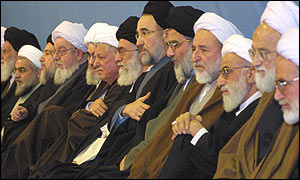
The Supreme Court will rule today on the Affordable Care ActThis falls under the heading “water is wet,” but the very idea that nine mullahs get to rule on every law passed by (somewhat) democratically elected representatives is the very definition of tyranny. Iran has a similar system. Their mullahs are religious clerics. Ours are Wall Street barons and wealthy families.
Oh, I know – we’re in laugh-about-it-shout-about-it election time, and people are going to select from limited pre approved choices. That is the extent of representative rule, but man it does suck up the oxygen! I think that is the only real purpose of national elections – to give us the illusion of self-rule. Continue reading “Waiting on the mullahs”→
We’re sitting in a coffee shop in Billings MT, my home town. My only remaining connection here is my mother, 95 and hopelessly memory-deficient. We visit her, and she pretends to know me. She does not, although staff says that in a lucid moment recently she referred to “my boys,” as in “they don’t visit much, do they.”
It all starts and ends hereThe Supreme Court is going to rule on “Obamacare” in the not-too-distant future. Just a note or two:
1. The very idea that these nine people are acting as our Mullahs, our ruling council, is offensive. They were not set up in the constitution as the final arbiter of all laws. They took that power unto themselves in Marbury. So we are governed in effect by two sets of supreme rulers – Wall Street and the Final Nine.
2. What is called “Obamacare” ought to be called “Obamainsurance”, as “care” has little to do with it.
3. And anyway, it is really nothing more than “Romneycare” written after that experiment had some good fallout. The only reason we even had a health care debate was that AHIP was ready at last with their remedy. We could have had a health care debate in 1996, 2000, 2004 and did not.
4. And anyway, it’s not really “Romneycare” but rather “AHIPcare,” as both bills were written by American Health Insurance Plans, the lobbying group for the insurance industry.
5. Romney are Obama are third-rate men who fronted for AHIP, as did Baucus, and in their time and as scripted, did Joe Lieberman, Max Baucus, Ben Nelson and others.
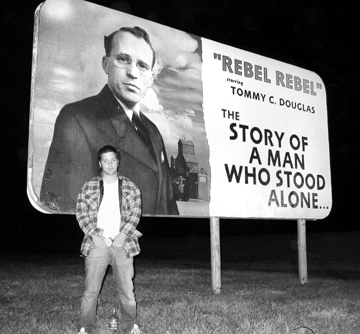
The California legislature missed an opportunity yesterday to save thousands of lives and improve millions of others by passage of single-payer health care. The state could have been our Saskatchewan, and any one of of five “moderate” [sic] Democrats could be our own Tommy Douglas.* However, four of them abstained, one vote “No”, and the bill failed 19-15.
Thanks Democrats. You scored another victory for two-party politics. With you on our side, there is no need for Republicans.
_____________
*Douglas, grandfather of Kiefer Sutherland and father of the Canadian health care system, was voted the “Greatest Canadian” in Canadian history in 2004.
Blue Cross Blue Shield
PO Box 4309
Helena, MT 59604
Attn: “GS”, “illegible” (see attached signature page)
Michael Frank, President and CEO
Gentlemen:
I become indignant every time I have to deal with an American health insurance company. The power you have taken upon yourselves to exclude people from our health care system was usurped, and not given to you. You abuse it every day.
I am the new majority owner in a business in XXXX, XXX, Inc. I recently urged our two long-time employees, XXX and XXX, to seek out health care coverage, for which the company will reimburse them in full. In this country it is the responsibility of employers to provide health insurance for employees. I take that responsibility seriously. Former owners did not.
You rejected XXX, and rated XXXX. I get that, I know why. With XXX – you are afraid xhe might not be a profitable client, and so are dumping hxx on the government. With XXXX – ditto, but you see some profit potential there, and so are accepting hxx for coverage.
Your behavior, your life and death power over people, is unconscionable. No private entity should ever have that kind of power. And yet, when we tried to reform our health care system in 2009, you stepped in and made sure that we would be forced to buy policies from you, and prevented us from having a public option.
That is despicable. Your behavior, in the more civilized industrial countries, would land you a jail sentence. Here, it is just good business practice.
Please read this and understand that you do not serve us, but rather leach off us, and prevent us from attaining quality health care.
When WIN wins, patients loseAmerica is indeed the land of opportunity. A Wyoming health insurance company, WINhealth Partners, saw an opportunity to stick it to a woman, and jumped on it.
Kimberly Shaffer’s physicians recommended breast reduction surgery due to neck and back pain. Her insurer, Great West Healthcare, covered the surgery. She notice signs of infection later, and indeed she had methicillin resistant staphylococcus aureus, a life-threatening bacteria that required aggressive treatment to save her life. Continue reading “Only in America”→
Dollar Bill McGuire made $125 million in one year as UnitedHealth CEO. He's not that talented. Back in the “good old days,” the American health care system was cheaper and served more people. Doctors were not royalty, and most health insurance was not-for-profit. Other systems in other countries were better by far, but our system was better than now.
Before anyone jumps on me, in terms of the quality of health care delivered it is much better now than then. We have more cures and better technology. My interaction with the system is very limited, but the personnel I encounter are efficient and even seem to care about doing a good job for patients.
Technology and personnel are not an issue. Accessibility is. If we have a marvelous toy but are not allowed to play with it, what’s the point?
It appears as though investors saw a profit opportunity back in the early 1990’s, and decided to move in on the health care system. Private insurers entered the markets in force and set the terms for the for-profits and not-for-profits alike.
“Preexisting condition” once meant something quite rational for an insurer: People cannot wait until they get sick to purchase insurance. Under the new regime the term was perverted and now means “we will not insure anyone who has any of a list of hundreds of conditions that might cost us money down the road. They will not be our customers.”
Once the for-profit insurers set those rules, the not-for-profits had to follow along. If they didn’t, they would end up with only the sick people, and would quickly go broke.
What happened to our health care system is known as “enclosure.” In order for a business enterprise to be profitable, it has to offer something that people want. If everyone can have that product, there is no reason to provide it, as it cannot charge a premium to sell it. If everyone has access to health care, there is no business incentive for private companies to enter the market. They can only be profitable if they can build a fence around the system and charge for entrance. Exclusion follows enclosure as surely as the little lamb follows Mary.
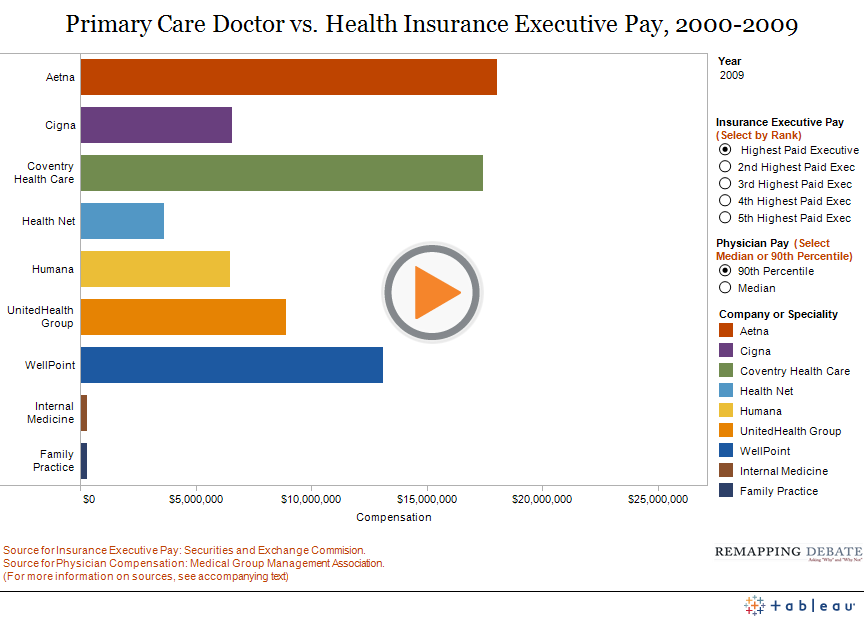
Health insurance is now wildly profitable in the United States. Health insurance executives are paid billions of dollars each year, and some individuals make hundreds of millions off the system. It is not because they are somehow magically gifted with business acumen. They are merely harvesting the benefits of enclosure. They are now able to divert much the money that was previously used to provide services into their own pockets. Private health insurance companies typically divert 20% of each insurance dollar to non-health care purposes.
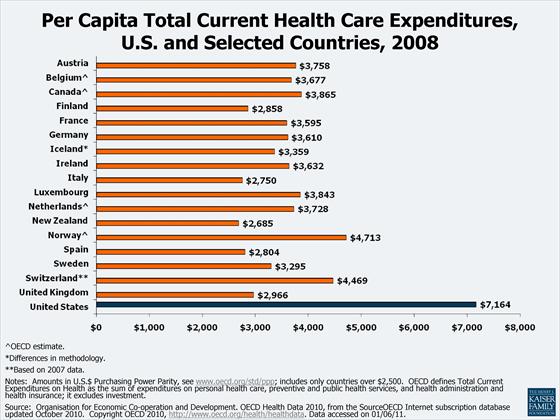
Source: OECD, 2010This is a system of perverse incentives, or conflicts of interest. As the old saying goes, a man cannot serve two masters, and the profit motive and and health care delivery are at odds with one another. Each dollar spent on health care is one less dollar available to the investors and bureaucrats who run the enclosed system. So they fight like hell to 1) exclude anyone who might be unprofitable; 2) avoid paying claims for people who have insurance; 3) pay as little as possible to health care deliverers and 4) rescind coverage for people who make large claims.
For-profit health insurance cannot work efficiently in the delivery of health care. Most of the problems we have with uninsured and under-insured people are due to the profit motive.
President Obama gave us what he called “reform,” and there appears to be a morsel or two in that package that might benefit us. But he did not address the enclosure problem. He exacerbated it by forcing us into paying exorbitant fees to get into the system. He did not mandate a basic level of coverage that must be provided, and did nothing in the area of cost control. We will have more people with insurance after 2014 (the insurance lobby is hard at work to maintain as much exclusion as they can between now and then), but far from solving the problem, Obama has merely given the insurance companies a lever by which they can extract even more wealth out of the health care system. The “public option” was our only chance at real reform, and he worked from the beginning to thwart that objective.
How does private health insurance affect our overall costs? Why are we so damned expensive compared to other countries? Better care indeed costs more money, and the we are continually coming up with better ways to treat diseases. Insurance companies have no part in that.
Beyond that, one factor is overhead – Harvard University put total system overhead at 31%a few years back (Medicare operates at about 3.6% but also endures huge private sector fraud … another story). Each insurance company has its own requirements, and there is incredible infighting within the system as companies try to dump as many costs as they can on hospitals, doctors and government. The profit motive is the underlying problem.
Private health insurance executives do not create wealth. They enclose and then harvest it Doctors and hospitals have responded to insurance company reluctance to pay claims by padding those claims. If it really cost $15,000 to do my knee surgery, but only $4,200 actually changed hands, then what happened to the other $10,800? (It was all padding. $15,000 was the cost for an anyone excluded from the system to get that surgery.)
The result of all of this is a vortex as more and more dollars are sucked into the system without a corresponding increase in health care delivery. It is not government that causes health care inflation, and it is not the so-called “moral hazard” of people abusing insurance when they have it.
It is enclosure that lies at the root of our problem.
_________________
*I sort of promised Swede I would do this. I know. It’s all rehash. Have a nice day.
Post-speech progressivesI listened to President Obama’s speech again, and found it soothing. And that created internal turmoil.
There are certain maxims in politics, such as “they lie, they lie, they lie,” “if it’s worth fighting for, it’s worth fighting dirty for,” “the facts, although interesting, are irrelevant,” and “‘no’ is only an interim response.” It is wise to keep those concepts in mind, to use them as an orientation point as we wander through the hall of mirrors called American politics.
The most important maxim of all is one that progressives need to have tattooed on the inside of their eyelids, that “a porcupine with his quills down is just another fat rodent.” Since Obama’s election, the pwoggies have lived with quills down and suffered a significant weight gain.
After I listened to Obama’s speech, my quills were down, and not too long after that I realized why this man is a successful politician. He was patting me on the head, speaking soothing words, telling me to go to sleep now, little boy, and tomorrow will be a brand new day. Obama the candidate had re-emerged.
In American politics words uttered in public are usually meant for effect, and do not contain policy. So it follows that Obama’s message yesterday was intended for effect. What effect? Well, I’m fairly typical. I voted for him once. What effect did it have on me? It relaxed me. It reassured me that he is looking out for my interests. I put my quills down.
I took away three messages – three lines that stuck with me:
1: Social Security is not causing the deficit. I’ve known this from the beginning, but as easy a concept is it is to grasp, those words are rarely, if ever spoken in public policy debates. Why now?, President Candidate Obama? Why now?
2: Medicare and Medicaid recipients will not be turned over the the private insurers via private vouchers. Obama version 1.0 talked about single payer. This was before he was thought to resonate presidential timbre. Candidate Obama supported a public option. President Obama gave the insurance cartel everything it wanted in the health care debate. Why has President Candidate Obama now turned on them?
3: The wealthy among us need to step up, endure a tax hike, do their share. President Obama had his chance last year when the Bush tax cuts were being debated. He didn’t even try. The teams have left the field, the stands are empty and wind is blowing wrappers around. Why, after his total capitulation, is he calling for a do-over? Why now, President Candidate Obama?
Every possibility is always available. It could be that every word was genuine, that he has spent time with the Oracle and has returned to be our general. It could be that what the progressives like to call the “real” Obama has returned. But we’ve had two years of him now, and if these past two years are not real Obama, then these past two years have exhibited one of the weakest men ever to hold that office.
The odds say that it is a good time to have quills up, and not down.
I kid you not - this is their slogan!Aetna is one of our major health insurers, and a company that vividly demonstrates why private for-profit companies cannot deliver quality health care products.
The health care reform bill was a mixed bag – the insurers mostly got what they wanted: There is no public competition allowed, and there is no regulations on costs. They got a mandate that individuals citizens be forced to buy their products, and only a scintilla of regulation of the quality of coverage offered. In the coming years, their intent is to push us all into expensive and crappy high-deductible high co-pay products.
But there are some parts of the bill that have merit. One is a prohibition against denying coverage to children with preexisting conditions. Another is the elimination of lifetime caps on coverage, and still another that they spend at least 85% of premiums in small-group markets on actual health care.
And there is another part, one that leaves me a bit confused: Effective in 2014, insurers will not be allowed to deny coverage to anyone based on a preexisting condition. I have not taken that part of the law seriously, as that part of the insurance business model is sacrosanct – in order to be profitable, insurers have to be able to avoid unprofitable clients. So I assumed that there is some way around that, and settled on the idea that in 2014 we who have preexisting conditions would still be rejected coverage, and instead forced into the local exchanges, where adverse selection would create unaffordable premiums. This is what is now happening in the state exchanges where insurers send their rejects.
The devil is in the details. Much of the law was left deliberately vague, with the 2014 regulations to be written by the executive branch. The assumption is that if it is Obama people that write the regs, they will be more charitable than say Romney or Huckabee people. I have no idea why anyone would think that.
Back to Aetna: Here in Colorado, and I assume nationwide, the company is pulling out of the private placement market. They will no longer offer individual policies in Colorado, and those in existence will be terminated on their anniversary dates. Before now, they stopped offering policies to children, and also to small-groups. Now anyone who is not part of a large group need not apply to Aetna.
Anjie CoplinThe latest move is evidence that perhaps there is a tooth or two in this mostly toothless, industry-friendly law, that perhaps the preexisting condition rule would bind them. Why else would they leave the very market to which it applies?
Anjie Coplin, Aetna’s regional director of communications, did not specify in an email to the Denver Business Journal why the company had decided to end its presence in Colorado’s individual health market.
But she noted that the company will continue to sell large-group plans and dental and life products and said that officials “believe we remain competitive in these markets.”
And in a Dec. 21 letter to the Colorado Division of Insurance, Aetna General Counsel Mary Anderson said that Aetna “can no longer meet the needs of its customers while remaining competitive in the Colorado individual health insurance market.”
And blah blah blah. Read: Delivery of health care interferes with the business model. The problem with for-profit health insurance will not go away. It is not hard to understand. It is “the profit motive.”
4.29% of Colorado residents have been unceremoniously dumped. But thank God we don’t have Canadian-style health care.








 Piece of Mindful