People have encouraged me in the past to subscribe to the Wall Street Journal for better news coverage than is available from other sources. Investors, after all, need real news. I have subscribed in the past, but it is very hard to keep up with such a large newspaper, and we leave so much unread that it seems like a wasted expense. They tend to pile up, we never get caught up, and eventually give up.
But there are two other sources of news that offer a counter to the highly filtered U.S. outlets.
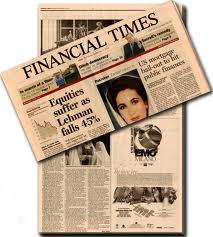
One is the Financial Times, which is delivered to us daily with our Denver Post (which does an excellent job of covering the Denver Broncos, and not much more). FT is a thin newspaper, and carries many news stories that U.S. sources don’t. Just yesterday, for example, it carried a front page story of China’s having developed an anti-aircraft carrier missile that is a “game-changer” in the Pacific, according to prominent U.S. military officials. The only other U.S. sources that covered that story were Stars & Stripes, AOL News, and Business Insider.
FT also had a story about the rising of the minimum wage in Beijing, China, and throughout all of China during 2010 to spur demand and add equality to wealth distribution. The only other U.S. source that I found covering this story was the Wall Street Journal. Minimum wage is frowned on in the U.S., and so doesn’t get much ink.
That’s just one day’s news from one source – two stories of interest in the U.S. not available for general consumption.
Another good source of news is Al Jazeera, seen all over the world, and available in the U.S. on Link TV (Direct TV channel 375, and Dish 9410). In a propaganda system like ours, we are conditioned to automatically disbelieve any statements made by our enemies. Al Jazeera is just another news outlet, but since it has an Arab name, is automatically distrusted here in the land of the free. Fair enough – we should watch it anyway, and apply the same distrust to American news outlets.
I want to get this up for consideration, as it makes sense to me. Thom Hartmann, the liberal radio chatterbox, has speculated that the financial attacks on Wikileaks did not start until the group announced that they had collected a large cache of documents on a Wall Street bank, thought to be the Bank of America. The day after that announcement, in short order, Amazon, PayPal, VISA, Mastercard and others pulled the plug.
Someone is obviously lying, and my initial gut reaction was that it must be the State Department. Everyone lies all the time about everything – that’s not my concern. But consider the possibilities:
PP telling truth, SD lying: This would mean that the U.S. government is orchestrating the attack on Wikileaks. Since Wikileaks has committed no crime, this is tyranny.
PP lying, SD telling truth: This would mean that the attack on Wikileaks is orchestrated from another source, possibly Wall Street, and Hartmann’s speculation factors in.
PP and SD both telling the truth: This would indicate a scam or covert operation against PayPal.
PP and SD both lying: This is unlikely but would indicate a covert operation with involvement by both PP and SD.
Wikileaks is doing important work, and I find it hard to imagine how they can be stopped short of executions and imprisonment. That would really expose our government’s true nature. As it stands, however, and totally out of the blue, a huge blow has been struck for freedom of speech. That the guy that did it is in jail? Read history. Rights are never given. They are taken, and it usually requires force. (The only exception I know of to this rule – a peaceful transition from tyranny to representative government, was the fall of the Soviet Union. Factor that into your thinking, report back.)
WikiLeaks coined a new type of journalism: scientific journalism. We work with other media outlets to bring people the news, but also to prove it is true. Scientific journalism allows you to read a news story, then to click online to see the original document it is based on. That way you can judge for yourself: Is the story true? Did the journalist report it accurately?
The cables also contain a fresh American intelligence assessment of Iran’s missile program. They reveal for the first time that the United States believes that Iran has obtained advanced missiles from North Korea that could let it strike at Western European capitals and Moscow and help it develop more formidable long-range ballistic missiles.
From Counterspin, December 3, 2010: (I’m summarizing, as it is an audio broadcast): The Times faithfully gave the U.S. side of Iran’s weapons program, as cited in the leaked memo, but failed to tell the whole story. In the memo, which the Times refused to publish, representatives of Russian intelligence doubt that Iran has such missile capability, and note the North Korea has never successfully tested such a missile. Other news outlets cite American sources that downplay any Iranian missile threat.
In other words, the New York Times, in giving only half the story, is again lying to us about the weapons capability of a country that, as it so happens, our government (and the military-industrial complex behind it) want to attack. Seems we’ve been through this before.
If, as the jailed Assange asserts, “scientific” journalism should now show us the source of stories being reported on, the Times story would have immediately been seen as a lie. Ergo, the Times refused to allow access to the memo, which Counterspin obtained at the Wikileaks site.
The committee noted that the CIA had moles in most of our large newspapers, and even then, pre-Bush, maintained surveillance of members of congress, the White House and cabinet departments. They plant stories in the media (a favorite technique is to plant a story in a foreign newspaper so that it can be “discovered” by an American news source).
The Times' Miller: She lied, she lied, she liedThey have “journalists” who work as operatives for them, and operatives that work as journalists. (No doubt the Times’ Judith Miller, who fed a pipeline of lies to us about Iraq before the invasion, is such an operative. The Times, which noisily beat its breast in public about its integrity in firing low-level journalist Jayson Blair for plagiarism, never repudiated Miller.)
The Church Committee found 500 editors, journalists and publishers to be supported by the CIA. The CIA had subsidized publication of hundreds of books, and even owned wire services, newspapers, magazines, a publishing complex. It had recruited 5,000 or more academics around the country as spies and researchers, secretly financing them as they present themselves as independent scholars to the media.
As the Church Committee fades into history, the New York Times carries on with its disinformation, and Julian Assange is in jail for a broken condom.
Until the Obama people shut it down, it is still possible to make contributions to Wikileaks via Xipwire.
Said co-founder Sibyl Lindsay today,
“We do think people should be able to make their own decisions as to who they donate to. The fact that people can’t donate to where they’d like to and make that decision for themselves does bother us.
The company has offered to process all contributions to Wikileaks free of fees. I just made a donation, and (hee-hee), charged it to my MasterCard.
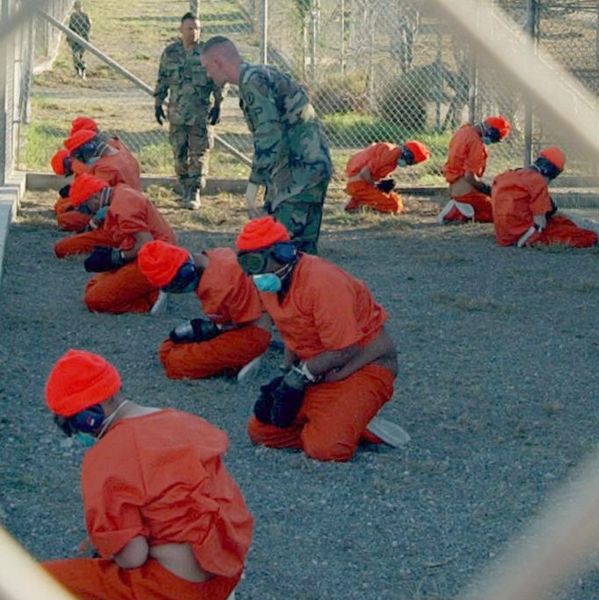
Taking his cue from Chinese dictators, Senator Joe Lieberman is said to have immediately called for Lindsay’s arrest. There is also talk that she might be hauled up on a jaywalking charge in Milwaukee from 2003 – city authorities there, who say it is entirely coincidental that the matter is coming up now, have issued arrest warrants for her in Federal District Court. Attorney General Holder is said to have taken an interest in the case, saying “far too often scofflaws are allowed to walk free. I only want to see our sacred laws upheld.” Conviction could involve time at Guantanamo, and torture.
“When the people fear their government, there is tyranny; when the government fears the people, there is liberty.” (Thomas Jefferson)
Wow – have you ever seen such a flexing of fascist muscle as with Assange and the Wikileaks affair? Imagine what is going on behind the scenes – death threats, trumped up “rape” charges, arrested in London, and Amazon.com, PayPal, and now VISA* trying to shut down his cash flow. Assange is fighting extradition to Sweden, as he believes that that country is merely acting as an intermediary for the Obama Administration, which wants to bring him here and imprison him. Said Assange’s attorney, Mark Stephens,
‘It doesn’t escape me that Sweden was one of those lick-spittle states which used its resources and facilities for rendition flights.
And I say “fascist” not because I like to hurl epithets, but rather because we are witnessing the results of the “marriage of corporation and state, ” Mussolini’s definition of that benign form of governance. Assange exposed state secrets that should not be secret, and the government is hounding him, including the “black-ops” people who are slamming his websites. And now come the corporations, as if they and government are the same entity. (They are, Benito. They are.)
Did any in the mainstream media take note that Obama’s recent Asian trip included forty aircraft, six armored vehicles, and 200 corporate executives? If indeed the junket did cost $200 million a day, it’s just another subsidy.
If Wikileaks achieves nothing else, it is the exposure of this unholy inbreeding that has always been going on, but has happened in spades during the last thirty years. We all know now that the corporations and the state act as one to shut down freedom of speech, because the former now controls the latter. And for that we can thank the soon-to-be-imprisoned Assange.
________
Just to toss in a little optimistic news, there are cyberhacks all over the globe, and the best that can happen with the current Obama crackdown on Wikileaks is to enrage them, to organize them. “I am Wikileaks” is encouraging people all over the globe to stand up and be counted. (Will Facebook take them down?)
Raw Story has revealed that one of Assange’s accusers in the Swedish case has CIA connections. (He is not accused of rape, but rather, for failure to use a condom, a unique Swedish interpretation of rape).
The web is a cranky beast, hard to cage. In the United States, net neutrality is a dead letter. Corporations cannot shut down annoying websites due to the first amendment, which still has window-dressing force. But they can marginalize them. And that has been the whole battle – an equal playing field … you know, liberty and justice for all. Quaint.
_____________
_____________
*VISA went after Ralph Nader in 2000, forcing him to take down an effective TV ad that portrayed Bush and Gore as part of the same apparatus. He used VISA”s word, “priceless,” and laughed afterward at the high absurdity of suing over ownership of that word.
And then, there’s this: Operation Payback threatens to hack any company’s website that acts against Wikileaks, and has already shut down the Swiss bank PostFinance, which froze Wikileaks funds. They are threatening to go after PayPal as well. Can’t wait.
The Swiss government is resisting pressure from Obama and the French government to shut down the Wikileaks.ch site running in that country. Perhaps they have leverage via their banking laws by which so many American criminals hold secret accounts there.
The website of the Swedish prosecutor’s who is going after Assange was taken down today. Too funny.
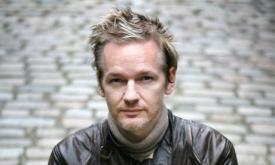
Julian Assange participated in an on-line interview that I found gripping. I don’t mean to lionize the man, but he has become the face of Wikileaks, which is the work of over a hundred thousand people*, many of whom are risking their lives, fortunes and our sacred honor.
The organization offers hope that democratic governance can reassert itself due to the Internet. Obviously the U.S. government wants to shut it down and murder Assange, but he seems to have anticipated this, and more encouragingly, says that the organization will go on without him should be be imprisoned or killed.
Read and judge for yourself, of course. Here are a few snippets that gave me that surge of warmth in my belly as I read:
tburgi: Western governments lay claim to moral authority in part from having legal guarantees for a free press. Threats of legal sanction against Wikileaks and yourself seem to weaken this claim. (What press needs to be protected except that which is unpopular to the State? If being state-sanctioned is the test for being a media organization, and therefore able to claim rights to press freedom, the situation appears to be the same in authoritarian regimes and the west.) Do you agree that western governments risk losing moral authority by attacking Wikileaks? Do you believe western governments have any moral authority to begin with? Thanks, Tim Burgi Vancouver, Canada.
Julian Assange: The west has fiscalised its basic power relationships through a web of contracts, loans, shareholdings, bank holdings and so on. In such an environment it is easy for speech to be “free” because a change in political will rarely leads to any change in these basic instruments. Western speech, as something that rarely has any effect on power, is, like badgers and birds, free. In states like China, there is pervasive censorship, because speech still has power and power is scared of it. We should always look at censorship as an economic signal that reveals the potential power of speech in that jurisdiction. The attacks against us by the US point to a great hope, speech powerful enough to break the fiscal blockade.
In hiding ... Indeed, we should look to states like Ecuador, Turkey, or Venezuela for our modern-day examples of free speech and voting actually impacting the behavior of governments. The word “freedom” has been debased in this country. It has no substance or meaning. People who talk about it have no clue what it really means.
When speech matters, power tries to suppress it. Wikileaks matters, and accordingly, the U.S. government wants it shut down.
rszopa: Annoying as it may be, the DDoS seems to be good publicity (if anything, it adds to your credibility). So is getting kicked out of AWS. Do you agree with this statement? Were you planning for it? Thank you for doing what you are doing.
Julian Assange: Since 2007 we have been deliberately placing some of our servers in jurisdictions that we suspected suffered a free speech deficit in order to separate rhetoric from reality. Amazon was one of these cases.
See how it works? Amazon.com kicked Wikileaks off its servers at the behest of the U.S. government. The company seems to exist in a free speech environment, but when some meaningful free speech actually broke out, Amazon.com shitcanned it.
Finally, this:
distrot: The State Dept is mulling over the issue of whether you are a journalist or not. Are you a journalist? As far as delivering information that someone [anyone] does not want seen is concerned, does it matter if you are a ‘journalist’ or not?
Julian Assange: I coauthored my first nonfiction book by the time I was 25. I have been involved in nonfiction documentaries, newspapers, TV and internet since that time. However, it is not necessary to debate whether I am a journalist, or how our people mysteriously are alleged to cease to be journalists when they start writing for our organisaiton. Although I still write, research and investigate my role is primarily that of a publisher and editor-in-chief who organises and directs other journalists.
This is perhaps the most exemplary Orwellian exchange I have read in all of the days since I first learned how to use the word “Orwellian.”
Assange is 28 years old. How does a man become so world-wise at such a young age? I wonder, if Alexis de Tocqueville were to re-visit America in 2010, what he might call his book.
_____________
*Various cables heretofore unreleased are in the hands of this many people, and will be released if the bodies of people like Assange or others turn up in a gutter one morning. It’s an insurance policy, but the U.S. is very powerful, so it is at best weak protection.
PS: Amazon.com is now joined by PayPal in cooperating with the U.S. Government in shutting down Wikileaks. I don’t do business with the former, and just canceled by PayPal account. I’m nobody, but principles matter.
Wikileaks is stirring it up again, and getting bolder as they go. Julian Assange has become a celebrity, but I am guessing he is smart enough to make a network that functions without him. The Pentagon wants him either dead or imprisoned. That group is pretty good at getting their man.
It occurs to me, and many others too, that what Assange and Wikileaks are doing is both strange and unrecognizable … but then like a flashback we realize that it is called journalism. Good journalists are not liked or admired by people in power. Quite the opposite. Real journalists don’t get invited to parties or get called upon to question politicians in phony debates or do talking-head interviews. Real journalists piss powerful people off. That’s dangerous to livelihood, and for Assange, perhaps even his life.
Real journalists find out what powerful people are doing, and report back to us. Right now it seems as if Wiki is teasing, embarrassing people, tantalizing power. That is fascinating. They are even threatening to go after a Wall Street bank, where real power resides. Banksters could force Elliot Spitzer out of office, but Assange and Wikileaks are an international operation, and mere bad press won’t harm them.
Like I said, it’s either prison or murder for Assange. He’s toying with real power, real killers.
__________ Footnote: I feel Lily Tomlin’s pain. She said “”No matter how cynical you get, it is impossible to keep up.” The tentacles of U.S. power reach into Sweden, which has issued a warrant for Assange’s arrest, and now to Interpol, which is likely conducting a global manhunt. The man is dangerous, as seen in this Mother Jones discovery – that none other than the Obama Administration saw fit to pressure Spain to back off of investigation of Bush Administration crimes – right off the bat. There was never any prospect of Obama offering anything remotely resembling “change.”
Richard Mellon Scaife is one of the financiers of the right wing, one of the men behind organizations with impressive sounding names like Committee on the Present Danger and The Center for Strategic and International Studies. He, along with the Koch family and Joseph Coors, are responsible for much of the takeover of the intellectual culture and the media by right wing hacks. It all happened after the late 1960’s and early 1970’s, when democratic movements flowered and popular power got out of hand. Pandora had to be put back in the box.
(People like William Kristol and his father Irving get [got] paid very large sums of money, hundreds of thousands of dollars, by the likes of Scaife and Coors, to be right wing hacks. They are not prominent by accident. They are bought.)
(The Democratic manifestation of the right wing takeover is the Democratic Leadership Council, whose roots actually go back as far as 1972.)
I was just reading a piece by Alex Cockburn this AM from the 1990’s, the early Clinton years, about how the media was put back in its box after its supposed Watergate triumph. Scaife was one of the financiers. He was asked about his support for all those right wing outfits by Review’s Karen Rothmyer, and replied (turn away, children)
You fucking communist cunt, get out of here.
Of course, we’d have to update that if he were asked the same question today. He’d say “You fucking terrorist cunt,” using the agitprop-appropriate fear-engendering buzzwords of the current time. We are no longer scared of communists. We are scared of terrorists now.
Richard Mellon Scaife: July 3, 1932 …. death by natural causes – I wish no violence on him, but think the planet will be a much better place when this miserable cocksucker leaves. Unless, or course, he’s spawned.
The above video is a panel discussion on the use of fear of terrorism in this country to quash civil liberties. It is over an hour long, and I would not put it up except for the exchange that takes place at 53:00 between Glenn Greenwald and a dumb-ass reporter from NPR, Dina Temple-Raston. She snaps at Greenwald, says she has seen things he hasn’t (but oddly doesn’t report on). She tells him that he “doesn’t do national security for a living.”
Greenwald disassembles her, and also says that actually, national security is what he does report on for a living. But the upshot is this: Temple-Raston is just another “journalist” being managed by the National Security State, fed information and told to report it as fact. Someone slips her a note, and she feels the part of the insider, and winks and carries on with her stenography, and calls it journalism, and calls herself a “national security reporter.”
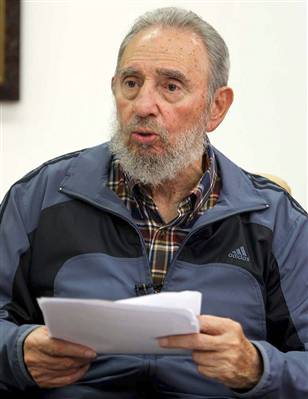
I reprint below an article by Paul Haven, Associated Press Chief in Havana. Like anyone else interested in U.S. history in the Caribbean, I read it carefully looking for hints and clues of what is going on with Fidel. I am also interested in his world view.
There isn’t much there – that is, the interview lasted over an hour, but Castro is quoted only once. The article speculates on his health, and the reporter did go out in the street to get reactions to the TV appearance, one negative, one positive.
Overall, the reporter did a credible job, though the “worthy of contempt” phenomenon is at work. This is facet of American journalism that keeps reporters restrained when reporting on powerful Americans, but unleashes them when they report on weak Americans or powerful enemies of the state. Castro, along with Hugo Chavez, is a legitimate target then for confrontational reporting in a way that, say, Ronald Reagan was not.
American journalism critiquedImagine that Reagan in his final years in office was scrutinized for hints of his advancing Alzheimer’s disease. Imagine the reporters critiqued him on his stuttering or loss of train of thought or misplacement of various countries.
It wasn’t done. Reagan was surrounded by powerful people, and any reporter who got aggressive with him would have been punished. He was presented to us as lucid to his final day in office, at which point he disappeared from view, never again interviewed or photographed. He ceased to exist.
Political prisonersI wonder what Castro talked about in that hour and fifteen minute discussion. In the American press, we’ll never know. The reporter did strain to take note of Cuba’s pending release of 52 “political prisoners,” a phrase never used to describe U.S. detentions of anyone anywhere in the world, least of all at a place on the island of Cuba, occupied by force by the U.S., called “Gitmo.”
___________________________________
Fidel Castro warns U.S. against war with Iran
HAVANA — A relaxed and lucid Fidel Castro returned to the limelight Monday after years spent largely out of public view, discussing world events in a raspy voice in his most prominent television interview since falling seriously ill four years ago.
The 83-year-old former president talked about how tension between the United States and both North Korea and Iran could ultimately trigger a global nuclear war, in an interview on “Mesa Redonda” — or “Round Table” — a daily Cuban talk show on current events.
The conversation ranged widely, from Pakistan’s need for energy to America’s out of control defense spending and China’s decision to lend Cuba money to buy energy efficient light bulbs.
One thing Castro did not discuss were events in Cuba, where the government on Monday released and sent into exile the first of some 52 political prisoners they have promised to free in coming months.
The interview lasted about an hour and 15 minutes — but much of that time was spent with either Castro reading essays by someone else or having his own words read back to him by presenter Randy Alonso.
The scene at a sparsely lit office at an undisclosed location was slightly surreal, even in a country that often feels stuck in a 1950s time warp. It was even unclear whether the interview was live or when it might have been taped.
At one point, Castro referred to a July 5 article as having been published six days ago, which would mean the show was taped on Sunday. Later, however, the program’s host read from an essay published Sunday evening, referring to it as having come out “last night.”
The revolutionary leader wore a dark blue track suit top over a plaid shirt as he took questions. Three academics sat silently nearby as Castro spoke, sometimes nodding in agreement.
Castro warned that an attack on Iran would be catastrophic for America.
“The worst (for America) is the resistance they will face there, which they didn’t face in Iraq,” he said.
As the interview progressed, Castro at times showed flashes of his prowess as a powerful speaker. At other points, however, he paused for lengthy periods and shuffled pages of notes he kept in front of him. Later, he listened as the host read back long tracks from essay’s Castro himself wrote recently.
The former Cuban leader has shunned the spotlight since undergoing emergency intestinal surgery in July 2006. The illness forced him to step down — first temporarily, and later permanently — and cede power to his younger brother Raul. His recovery has been a closely held state secret, and his health has been the subject of persistent rumors among exiles in Florida.
Castro remains head of Cuba’s Communist Party and continues to publish his thoughts on world events in opinion pieces.
While Cubans have become accustomed to reading Castro’s writings, he has stayed largely out of the public eye since ceding power, helping Raul Castro solidify his place as the country’s leader after a lifetime spent in his more famous brother’s shadow.
Monday’s highly anticipated interview was announced in a front-page story in the Communist-party daily Granma earlier in the day. Castro has appeared in videotaped interviews with Cuban television in June and September 2007, but Monday’s appearance was the most advertised and extensive.
Cuban media later showed footage of workers watching the elder Castro on large screens set up at their workplaces.
Photos of the elder Castro greeting workers at a science center were published in pro-government blogs and on state media over the weekend, the first time he has been photographed in public since his illness.
Cubans reacted with surprise to word of Castro’s relative media blitz.
“I think it will have a positive effect on people,” 21-year-old student David Suarez told the AP. “It will give hope that once again he will help to solve our problems.”
Magaly Delgado Rojo, a 72-year-old retiree in Havana’s Playa neighborhood, said the appearances must have been carefully thought out by Cuban leadership.
“The photos and now the ‘Round Table’ appearance are meant to send a message: ‘I am here and I am on top of everything. … I am a part of every decision that is being made,'” she said. “This is not casual at all. This is calculated.”
The two Castros have ruled Cuba since overthrowing dictator Fulgencio Batista in 1959. Fidel’s health has for years been the subject of frequent rumors — particularly among exiles in Florida, and his television appearance will undoubtedly be scrutinized for signs of his aging.
The photographs of Fidel published this weekend were taken on Wednesday at a scientific think tank in Havana. He is shown smiling and waving at workers, appearing relaxed and happy, but somewhat stooped. Granma republished the photographs on Monday under the story about his upcoming television appearance.
Cuba has occasionally released pictures showing Castro in private meetings with dignitaries, most recently during a visit in February by Brazilian President Luiz Inacio Lula da Silva. But he had not been photographed in a public setting since 2006.
Castro appeared in a 50-minute taped interview with Alonso of “Mesa Redonda” in June 2007 to discuss Vietnam and other topics. He also appeared on Cuban television for an hour-long interview in September of that year, knocking down a slew of rumors of his death.
A month later, he phoned in to a live broadcast featuring Venezuelan President Hugo Chavez, a close Castro ally who was visiting Cuba. Castro sounded healthy and in good humor, but he was not seen.
Castro has appeared with other visiting presidents and dignitaries in video clips and photographs.

 People have encouraged me in the past to subscribe to the Wall Street Journal for better news coverage than is available from other sources. Investors, after all, need real news. I have subscribed in the past, but it is very hard to keep up with such a large newspaper, and we leave so much unread that it seems like a wasted expense. They tend to pile up, we never get caught up, and eventually give up.
  Another good source of news is Al Jazeera, seen all over the world, and available in the U.S. on Link TV (Direct TV channel 375, and Dish 9410). In a propaganda system like ours, we are conditioned to automatically disbelieve any statements made by our enemies. Al Jazeera is just another news outlet, but since it has an Arab name, is automatically distrusted here in the land of the free. Fair enough – we should watch it anyway, and apply the same distrust to American news outlets.


 Piece of Mindful