The above video is a panel discussion on the use of fear of terrorism in this country to quash civil liberties. It is over an hour long, and I would not put it up except for the exchange that takes place at 53:00 between Glenn Greenwald and a dumb-ass reporter from NPR, Dina Temple-Raston. She snaps at Greenwald, says she has seen things he hasn’t (but oddly doesn’t report on). She tells him that he “doesn’t do national security for a living.”
Greenwald disassembles her, and also says that actually, national security is what he does report on for a living. But the upshot is this: Temple-Raston is just another “journalist” being managed by the National Security State, fed information and told to report it as fact. Someone slips her a note, and she feels the part of the insider, and winks and carries on with her stenography, and calls it journalism, and calls herself a “national security reporter.”
I reprint below an article by Paul Haven, Associated Press Chief in Havana. Like anyone else interested in U.S. history in the Caribbean, I read it carefully looking for hints and clues of what is going on with Fidel. I am also interested in his world view.
There isn’t much there – that is, the interview lasted over an hour, but Castro is quoted only once. The article speculates on his health, and the reporter did go out in the street to get reactions to the TV appearance, one negative, one positive.
Overall, the reporter did a credible job, though the “worthy of contempt” phenomenon is at work. This is facet of American journalism that keeps reporters restrained when reporting on powerful Americans, but unleashes them when they report on weak Americans or powerful enemies of the state. Castro, along with Hugo Chavez, is a legitimate target then for confrontational reporting in a way that, say, Ronald Reagan was not.
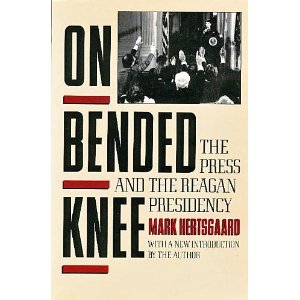
American journalism critiquedImagine that Reagan in his final years in office was scrutinized for hints of his advancing Alzheimer’s disease. Imagine the reporters critiqued him on his stuttering or loss of train of thought or misplacement of various countries.
It wasn’t done. Reagan was surrounded by powerful people, and any reporter who got aggressive with him would have been punished. He was presented to us as lucid to his final day in office, at which point he disappeared from view, never again interviewed or photographed. He ceased to exist.
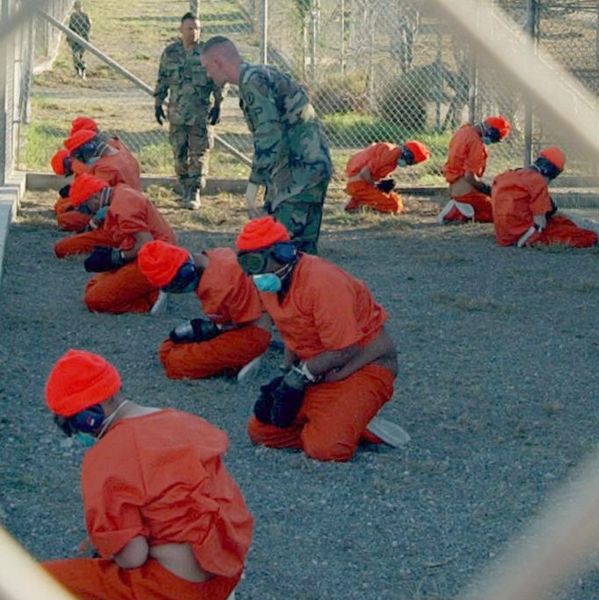
Political prisonersI wonder what Castro talked about in that hour and fifteen minute discussion. In the American press, we’ll never know. The reporter did strain to take note of Cuba’s pending release of 52 “political prisoners,” a phrase never used to describe U.S. detentions of anyone anywhere in the world, least of all at a place on the island of Cuba, occupied by force by the U.S., called “Gitmo.”
___________________________________
Fidel Castro warns U.S. against war with Iran
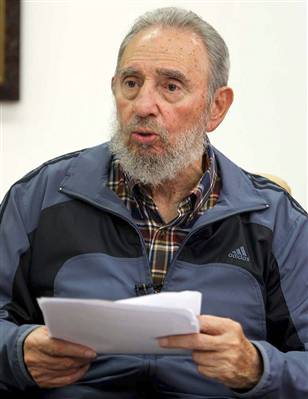
HAVANA — A relaxed and lucid Fidel Castro returned to the limelight Monday after years spent largely out of public view, discussing world events in a raspy voice in his most prominent television interview since falling seriously ill four years ago.
The 83-year-old former president talked about how tension between the United States and both North Korea and Iran could ultimately trigger a global nuclear war, in an interview on “Mesa Redonda” — or “Round Table” — a daily Cuban talk show on current events.
The conversation ranged widely, from Pakistan’s need for energy to America’s out of control defense spending and China’s decision to lend Cuba money to buy energy efficient light bulbs.
One thing Castro did not discuss were events in Cuba, where the government on Monday released and sent into exile the first of some 52 political prisoners they have promised to free in coming months.
The interview lasted about an hour and 15 minutes — but much of that time was spent with either Castro reading essays by someone else or having his own words read back to him by presenter Randy Alonso.
The scene at a sparsely lit office at an undisclosed location was slightly surreal, even in a country that often feels stuck in a 1950s time warp. It was even unclear whether the interview was live or when it might have been taped.
At one point, Castro referred to a July 5 article as having been published six days ago, which would mean the show was taped on Sunday. Later, however, the program’s host read from an essay published Sunday evening, referring to it as having come out “last night.”
The revolutionary leader wore a dark blue track suit top over a plaid shirt as he took questions. Three academics sat silently nearby as Castro spoke, sometimes nodding in agreement.
Castro warned that an attack on Iran would be catastrophic for America.
“The worst (for America) is the resistance they will face there, which they didn’t face in Iraq,” he said.
As the interview progressed, Castro at times showed flashes of his prowess as a powerful speaker. At other points, however, he paused for lengthy periods and shuffled pages of notes he kept in front of him. Later, he listened as the host read back long tracks from essay’s Castro himself wrote recently.
The former Cuban leader has shunned the spotlight since undergoing emergency intestinal surgery in July 2006. The illness forced him to step down — first temporarily, and later permanently — and cede power to his younger brother Raul. His recovery has been a closely held state secret, and his health has been the subject of persistent rumors among exiles in Florida.
Castro remains head of Cuba’s Communist Party and continues to publish his thoughts on world events in opinion pieces.
While Cubans have become accustomed to reading Castro’s writings, he has stayed largely out of the public eye since ceding power, helping Raul Castro solidify his place as the country’s leader after a lifetime spent in his more famous brother’s shadow.
Monday’s highly anticipated interview was announced in a front-page story in the Communist-party daily Granma earlier in the day. Castro has appeared in videotaped interviews with Cuban television in June and September 2007, but Monday’s appearance was the most advertised and extensive.
Cuban media later showed footage of workers watching the elder Castro on large screens set up at their workplaces.
Photos of the elder Castro greeting workers at a science center were published in pro-government blogs and on state media over the weekend, the first time he has been photographed in public since his illness.
Cubans reacted with surprise to word of Castro’s relative media blitz.
“I think it will have a positive effect on people,” 21-year-old student David Suarez told the AP. “It will give hope that once again he will help to solve our problems.”
Magaly Delgado Rojo, a 72-year-old retiree in Havana’s Playa neighborhood, said the appearances must have been carefully thought out by Cuban leadership.
“The photos and now the ‘Round Table’ appearance are meant to send a message: ‘I am here and I am on top of everything. … I am a part of every decision that is being made,'” she said. “This is not casual at all. This is calculated.”
The two Castros have ruled Cuba since overthrowing dictator Fulgencio Batista in 1959. Fidel’s health has for years been the subject of frequent rumors — particularly among exiles in Florida, and his television appearance will undoubtedly be scrutinized for signs of his aging.
The photographs of Fidel published this weekend were taken on Wednesday at a scientific think tank in Havana. He is shown smiling and waving at workers, appearing relaxed and happy, but somewhat stooped. Granma republished the photographs on Monday under the story about his upcoming television appearance.
Cuba has occasionally released pictures showing Castro in private meetings with dignitaries, most recently during a visit in February by Brazilian President Luiz Inacio Lula da Silva. But he had not been photographed in a public setting since 2006.
Castro appeared in a 50-minute taped interview with Alonso of “Mesa Redonda” in June 2007 to discuss Vietnam and other topics. He also appeared on Cuban television for an hour-long interview in September of that year, knocking down a slew of rumors of his death.
A month later, he phoned in to a live broadcast featuring Venezuelan President Hugo Chavez, a close Castro ally who was visiting Cuba. Castro sounded healthy and in good humor, but he was not seen.
Castro has appeared with other visiting presidents and dignitaries in video clips and photographs.
This is the nature of democracy: You send in the planes and drop the bombs. Then you gather in the journalists and tell them to applaud. We need to study that.
-Russian General Alexander Lebed, commenting on US air strikes in Iraq, 9/96
It is painfully obvious that that the United States and the Soviets were mirror images of one another. Each projected itself on the other. Lebed seemed to grasp that concept. (He died in a helicopter crash in 2002, sadly. I hope it was not murder. Aeronautical crashes killing important people are always suspect.)
Christians and Muslims project themselves on each other. Neither has the answer. Both were likely founded by charlatans.
Here in America we have two political parties comprised of groups who projectthemselveson one another. Party leadership is unified in objectives while the people below fight their fights.
Russians should study that. When it comes to organizing the masses, two parties work better than one.
Years ago when the U.S. first attacked Iraq, in 1991, a courageous reporter named Peter Arnett was working for CNN and reporting from the Al-Rashid Hotel hotel in Baghdad. Arnett, with Vietnam credentials under his belt, was a lingering reminder of a time when journalists went to battle scenes and reported back to us on what happened there. CNN at that time was the only news outlet capable of relaying pictures to the outside world of the effects of the U.S. attack. There were forty others in the hotel, but all left, leaving Arnett by himself.
The CIA approached Arnett and asked him to leave the hotel, as they intended to destroy it. He refused. It was Alexander Cockburn who connected the dots, who realized that the reason for the need to destroy the hotel was due to the pictures and reports by Arnett. Cameras are considered weapons, honest reporters enemy combatants.
These days we all have phones that take pictures and the Pentagon allows journalists to be embedded with American troops. And yet … we see fewer images, and there is less honest reporting of our aggression than ever before. Those that do roam free often end up like Saeed Chmagh and Namir Noor-Eldeen, two Reuters employees shown in the video above: Dead. The pair was murdered in cold blood by U.S. troops from an attack helicopter high above. Their apparent crime was assembly in an open square, and their weapons were cameras.
About a dozen people were killed that day, and two children seriously wounded. The soldiers who committed the crime blamed the “insurgents” for the wounded children, saying that they were at fault for bringing kids to a battle zone. (The kids were inside the minivan that was attempting to rescue a wounded man trying to crawl to safety.)
No doubt the Pentagon is investigating this event. The want to know who leaked it. There will be blood.
This is not for the faint-of-heart. This is no video game. This is murder.
A couple of things we heard on BBC as we traveled this week:
First, Russian billionaire and former KGB agent Alexander Lebedev and his son and Evgeny have purchasedThe Independent, a UK newspaper, for one pound sterling. Lebedev’s job as a KGB agent was to read British newspapers. He has pledged to “in-depth investigative reporting and campaigns which promote transparency and seek to fight international corruption.” His reputation as owner of Russian newspapers and the the London Evening Star is quite good, according to BBC.
Secondly, the British have announced that they will no longer use, produce or store cluster bombs. Said British Prime Minister Gordon Brown, “Cluster munitions cause immense suffering to civilians caught in conflict zones and leave a deadly post-conflict legacy for future generations. I am hugely proud that with this bill receiving Royal Assent, Britain is leading the world in banning the use of these munitions and moving to end the harm they cause.”
I was curious to see what kind of coverage this announcement would receive in the U.S., as our country is among just a few left in the world still using the bombs (Russia, China, Pakistan and Israel are among the others). The bombs are designed to release thousands of bomblets that tear people to shreds. If that were not enough, many of the bomblets are left unexploded and are attractive nuisances for children, who are drawn to their bright yellow colors. Wherever the U.S. and Israel have gone, there are stories for years to come of children losing arms, limbs and sight, if not being killed, by the residue bomblets from these nasty devices.
There is virtually no coverage in the U.S. that I could find. CNN International has it, as does Moon-owned UPI. That’s about it.
I ran across a footnote this morning that referenced an out-of-print publication and an article published in 1954: Saturday Review, “Who Tells the Storytellers”, by Elmo Roper. I vaguely remember a thing called a”Roper Poll.” Elmo Roper was a leader in the field of market research and public opinion polling. The article is not available, and (maybe a comment on modern culture) the rights to it and all of the old Saturday Review articles is owned by Penthouse publisher Bob Guccione.
The footnote caught my eye because it was an observation about American society from 56 years ago:
Elmo Roper’s classification of influential groups in the United States is well known: about 90% of the population is “politically inert”; they become active only accidentally, when they are set into motion, but they are normally “inactive, inattentive, manipulable, and without critical faculty.”
In other words, only about ten percent of us are paying attention. Once every two years the 90% are shaken awake and inoculated with intense agitation propaganda otherwise known as the “political ad” – sound and image-bytes meant to appeal to prejudice and emotion, constructed to manipulate, carrying no substance, and made with the understanding that the viewer is clueless but will soon vote. We then head in masse to the polls and present our views to our leaders, and our media dutifully analyze what the public “thinks.”
Let’s be honest – we can talk freely here, as that 90% of public will not be found reading political blogs. I noticed this as I went door-to-door night after night in 1996 in my run for state legislature – the faces were vapid, the “issues” meaningless, and the arbiter of all that was going to happen on election day was the television, always in the background. That 90% is a whale on the beach, breathing but unable to move.
The “public mind” is a joke – it “thinks” in the same manner as a voice recorder. It plays back the opinions of leaders (with a great deal of background interference). The methods by which opinions spread are subtle and covert. Only rarely does a voice on television say something meant for the value of its content. Virtually all news and commentary is meant for subtle effect. (Thus we have the apparent contradiction wherein most of the American public, and virtually all of the Fox News viewership, thought that Saddam Hussein was behind the 9/11 attacks. It was no accident – that message was sent out in subterfuge and coded clues, very deliberately. That is how public opinion is formed. There is virtually no useful information dispersed by television.)
There is manipulation going on right now – agitprop and an angry segment of the voting public being activated – to what purpose I do not know. But the “Teabaggers” are about as spontaneous as a prom dance. They are interesting not for the content of their message, which is typically muddled and incoherent. They are interesting because some group, some moneyed interest, plans to use them for some nefarious purpose. Stay tuned.
The Citizens United decision tosses another spice into our stew. It is based on the premise that “advertising” and “speech” are synonymous. That is a ludicrous notion. Advertising is subversion of the individual, psychological manipulation. It has power because it is effective to the exact degree that we think it is not. If we think ourselves immune to advertising, we are its slaves.
Now given the power to spread their message with virtually unlimited funds on a population that is “politically inert, inactive, inattentive, manipulable, and without critical faculty,” we are pretty much screwed. Public opinion is now owned by corporate masters, and by extension, so are all virtually politicians (with the exception of odd and out-of-the-way places like Boulder, Missoula, and Vermont).
Citizens United is a master stroke, a calculated pandering to power masked as reasoned jurisprudence. It will plunge us into darkness.
Where is hope, oh gloomy one? Certainly it is not in that 90%. C/U merely formalized the ownership of them and electoral politics by the corporations.
But we are still left with the 10%.
But who are “we”? We are intellectually alive, diverse, and stuck in the mud. Assume that every living is ideology expressed to some degree within our numbers. What is the mainstream of thought among the thoughtful? Right now it is “free markets,” but that cannot last as it relies on the fictional man as its mainstay. We are not the simple economic beings they think us to be. Soon to return is the community man, the generous and caring citizen, the man willing to give of himself in return for the good of his family and friends and community. That is our better nature. These are indeed dark times, but that nature does not change. We have been sidetracked by free market economics, but will get back on track after another economic disaster or two. Takes time …
In the long run we are all dead, and yet, in the long run, there has always been progress towards a better society.
Steve made a bold prediction a short while back, saying that media reports of released Guantanamo prisoners being behind the curious case of the explosive Christmas Day unperpants were likely “bullshit.” (Here, and here). Now Dan Froomkin, a serious man with a critical eye (and therefore marginalized by the Washington Post), says the same thing. (“Media being fooled over and over again“, Huffington Post.)
First, let’s deal with absurdity. Meet me on camera three.
[Pssst! Folks, there’s no danger! There’s no “Al Qaeda”, just a ragtag group of dissidents unable to pull off meaningful revenge for the things that are happening to them. Even the name itself, “Al Qaeda,” is an American invention. They take these isolated incidents of attempted revenge, and make it out to be a huge conspiracy with evil dark-skinned bearded people wanting to blow up our darling blond children.
Remember Sean Connery as Jim Malone in the Untouchables?
They pull a knife, you pull a gun. He sends one of yours to the hospital, you send one of his to the morgue. *That’s* the *Chicago* way! And that’s how you get Capone.
It could be rewritten for the current script:
We drop a bomb, they set a shoe on fire. We send a million of them to the morgue, they set their underpants on fire. *That’s* the *Al Qaeda* way. And that’s how you get the Great Satan.
Please, Americans, get a grip. These people fight back now and then, but look at where they come from! It’s always place that we are attacking and/or occupying. Just sayin’.]
Now, about the American media and its tendency to uncritically repeat Pentagon lies and then fail to follow up when the truth becomes available: It’s not a recent phenomenon. It transcends wars, decades and centuries. The press, owned by the Warbucks corporations that finance the politicians as well, is fulfilling a function: it is advancing the story line. It’s a play put on to keep us in fear and off balance, never giving us time to reflect on what is really happening.
In the Italian loafer world of the media hierarchy, this is probably understood, though these people are most likely focused on earnings per share. They are not about journalism. But in the lower levels, where our eyes meet theirs, we are dealing with the clueless. That’s why they have a job, these pretty people who give us our news, while the Washington Post set Dan Froomkin adrift.
It’s propaganda. It’s the air we breathe. These gray little men and women are unimaginative cogs in the big machine. These supposed “journalists” are dreary wretches. They uncritically repeat Pentagon lies because they have no souls.
At least the people at the Pentagon who write the lies have to come up with fresh ideas, but those whose job it is to repeat these lies and never think critically have no life force within them. They are nothing.
————————
Jim – he’s worse than dead. His brain is gone!
————————
PS: I pass on an observation by one Thom Hartmann, a radio host and run-on talker. He’s an introvert. He says that most radio hosts are that way. On the other hand, he says most TV personalities are extroverts. I tend to prefer introverts, as they tend to be a little more thoughtful, taking gratification from internal resources, where the exxies have to get it from outside sources.
I am often harshly critical of the profession of journalism, but mostly when I write that stuff I am thinking about the pretty TV people who are the primary source of news for the American public.
I listened in part to an interesting interview this morning on the Sirota show out of Denver. His guest was Jay Rosen, a professor of journalism at New York University.
One snippet sticks with me. He said something kind about bloggers. Most journalists hold us in low regard. And I don’t hold blogging to be anything important, but I guess there are national blogs that do command attention.
But what he said was more local in color – he said that there had always been bright and thoughtful people who saw through journalism and its pretensions. But they were never organized – just a voice here and there, and we all know what the lone voice who speaks out of turn more than once is: a crackpot. So critics of journalism were always demeaned. In their tight circle, journalists could self-gratify. They looked on us with some mild amusement.
The Internet and blogging has allowed us to band together, and now all the cacophony is sounding more like a chorus of complaints about journalists, who can no longer hide behind the green curtain. They are getting called out daily, and the voices, distant in the beginning, get louder every day.
I recognize the shortcomings of blogging – we don’t report on events, but rather comment on them. We don’t do primary research. We are, in short, not journalists. I cannot argue with those points, as they are simply true.
But who is there to talk about the shortcomings of journalism? When they get together, it is invariably to hand out awards to one another and talk about how precious they are to our republic. Do they talk about their own failure to report on events or do primary research? Do they talk of sycophancy? The replacement of hard-nosed reporting with detached (and safe) neutrality?
In the past, it was an occasional letter to the editor, and we all know, snark snark, that LTE’s are not to be taken with the gravitas of true journalistic endeavors. Blogs are the new LTE’s I guess, with one exception – we do not need approval to appear in print.
The world is changing. Newspapers are changing. Time magazine is edging towards People, the best news reporting is done on comedy shows. True journalists – those who work their trade, investigate powerful people and report back to us – the current model does not support them. What will we do for news?
A new model will form. The glimmerings out there – Huffington and foundations financing investigative journalism – it has potential. Like health care, journalism and profit don’t mix well. Investigative reporting never did threaten paycheck-signers or advertisers.
For the time being, how nice it must be to run a government or corporation without having to answer to the news media.
The removal of inhibition can be liberating as well as criminal. Recently, a Reuters reporter expressed frustration that American soldiers stationed in Iraq would tell him nothing until he went to the latrines. “You have to go to the Port-o-Potties. For some reason, they talk there. You can read how they really feel – all the anti-Bush stuff, all the wanting to go home – in the writing on the shithouse walls.
Rose George, “The Big Necessity”


 Piece of Mindful