The Veg-O-Matic took Butte, Montana by stormI was reading Malcolm Gladwell’s “The Pitchman,” about the Popeil’s, a name that any of us in the Boomer generation know well. Ron Popeil was both an innovator and a salesman, with his success attributable in equal portions to each. His Veg-O-Matic was a huge hit, and in reality a very useful product. The Pocket Fisherman was crap, but as Ron said, intended as a gift, and not to use.
The Pocket Fisherman, a piece of crap, the angler's version of right wing economicsIt is fascinating, as is all of Gladwell’s writing. What kept popping into my mind as I read was that there was not a word about tax structure, disincentives, or politics in the piece. Ron Popeil gets a psychic payoff from his life and work. His best work happened during the 1950’s, when the top tax rate was 91%.
I’m just sayin’ – the right wing has twisted economics into a Randian pretzel. They don’t know jack about people. There is a small percentage that is driven by financial return, nothing more. They are always with us, called by various names, including “Wall Street” and “the financial sector.” They are our facilitators, but not our innovators. They need to be put in a cage, handed green eye shades, but never let out into real sunlight. When they become our masters, when their needs become our driving force, we have … what we have – boom and bust, bubble and pop, and grand inequality of wealth.
____________ Oh-oh: I realized while on the treadmill that this post is classic confirmation bias. Perhaps the Catholic Church can use my services in finding that elusive second miracle for JPII. How easily I fall into it.
My bias is this: That right-wing economics takes that behavior of a small minority of us, sociopaths, and presumes that we all not only should, but want to behave that way. It then seeks to look to government as stifling our natural impulses to behave as they think we should. I am always in search of evidence.
Part of the new right wing majority in the senateI’ve been chuckling about this and scratching my head at the same time, to the point where I am now partially bald – so I’ve discovered. I do not often get to see the back of my head.
But why are the Democrats in the Senate only now talking about fixing the filibuster rules?
Here’s how it shakes out: The Democrats took control of the House and Senate in 2006, but there were two obstacles in place to stop any progressive legislation: the filibuster rule in the senate (which could have been changed), and a Bush veto. Consequently, the House of Representatives was free to do anything of its pleasing, as it had no real power.
The Democrats increased their hold on both House and Senate in 2008, but still allowed the Senate filibuster rule to be used to stop any progressive legislation. Again, the House was free to act as it pleased, as it had no real power.
The word for Democratic behavior in allowing the filibuster rule to stand is “complicity.”
Now that the Republicans have gained control of the House, it is being let back in the game. The filibuster rule in the Senate will be weakened, and Obama, for whatever far-fetched reason his aides can imagine, will sign some pretty nasty legislation. The pathway is being cleared.
There was a time to change the filibuster rule, but it has passed. That it is being done now, when it is too late? Again, the word, I think, is “complicity.”
“The more outrageous the Republicans become, the weaker the left becomes.” Ralph Nader
This line from a longer interview with Nader by Chris Hedges sums up nicely the triangulation phenomenon that we are now caught in. We have right wing Democrats in office who are carrying forward with the corporate agenda, and no organized resistance. The left has been sucked into the Democratic party, and had its balls cut off as a consequence.
But how many times have you heard some Democrat say “Yeah – but look how crazy those Republicans are!”
Like a fox. Right wing craziness is aimed both at its crazy Tea Party wing and at the progressive left. For the TP people, it’s music to soothe the soul. For the lefties, it’s frightening enough to cause a stampede into the Democratic Party.
Republicans are not crazy. They know the impact of their words. The sound effects are measured and calculated to create the effect we are seeing. I have long said that the public pronouncements of politicians do not carry useful information. I am more in tune with Josef Goebbels, JC’s main man, who said words to the effect that everything that is done in public is done for effect.* I cannot find the actual quote, and hope that someone out there possibly reading this can do so.
______________
Here it is, courtesy of Ellul, Propaganda, page x footnote 1: Goebbels said:”We do not talk to say something, but to obtain a certain effect.” And F.C. Bartlett states that the goal of propaganda is not to increase political understanding of events, but to obtain certain results through action.
The odds were never in my favorI have been chastised on occasion for having a less-than-universal focus here, as if my little light could actually shine more than a few feet in this vast universe. I do have many thoughts that go beyond the mundane, but also a deep sense of absurdity, as if to sit here and comment on the larger affairs of our country and world could possibly matter to anyone but me. The fact that I have a small forum, and that I get the nominal number of “hits” that a minimally credible blog gets (200-300 daily, most just passing by and who have not read this far), only means that there is some power in the Internet. It has nothing to do with me – it is the vehicle, nothing more, that is on exhibit here.
Early pioneers deeply influenced meThere was once a thing called the “alternative press,” and it was a rich source of reading for me – I read all I could of Covert Action Quarterly and so many others long since gone under. I slowly let the subscriptions expire, the last one to go was the Anderson Valley Advertiser, where a very smart man who is also a good writer, Bruce Anderson, did some great work for 2-3,000 readers in pot/wine-infested Boonsville, CA. (Alexander Cockburn, who now manages Counterpunch, allowed his weekly column to be published in AVA for a nominal $25 per week, and advertised himself as a “weekly contributor to the Anderson Valley Advertiser” when he had a weekly column in the Wall Street Journal in the early 90’s. It was, as I see now, an inside joke. AVA still has 2-3,000 subscribers.)
This web site, Piece of Mind, was fashioned on the premise that we are constantly being threatened by hobgoblins. But it has failed to take hold. In a country where propaganda is so sophisticated that none realize it even exists, my point of view will never be anything more than a quirky sideshow. Sort of how I pictured myselfI thought this would be a launching pad to a career in writing, that by this time I would have thousands of readers, but it never developed. Worse yet, I never managed to break out of the narrow Montana community in which I was bred. As a Colorado resident, I have come to realize that Montana blogging is what it is because it is a small state. There is no “Colorado blogging community” as such. That atmosphere can only exist where the patrons are few. By definition, the impact is nil and has no reach, no effect on politics.
It’s been fun – I met some nice people – Ladybug and Bob Garner, and have come to know some more complex people – this guy “Max Bucks” actually wants to be seen as off-kilter. This allows him the freedom to say whatever insulting thing comes to mind. I really like that. Big Swede and Dave Rye are as dense as any two people I have ever met, but I came to like each on his own terms, as they bear no ill will and have sensitive feelings.
Blogging should be an expression of multiculturaism, but some how, it failsThen there is the chorus … the affectations and egos of liberals who imagine themselves enlightened, and Randians and libertarians who just don’t travel well and so cloister and talk among themselves. (Yeah, you, Budge.) Without this medium, blogging, we would never know each other. It’s a trip through the garden of life – many blooms and colors. It is not an outlet that has any effect on the movements of power and politics – that part is silly. (Newspapers don’t have impact either, as they are owned by the very people they should be reporting on. Those folks are silly as well but take themselves so seriously! Any blogger who takes himself seriously ought to quit too.)
It is fun just to butt heads. That’s all this was ever about. And it’s over. I’ve bruised too many egos, and I’m no longer welcome in the right places. I should have known to be gentle – the larger the ego, the quicker the reprisal. But that’s not my style – the larger the ego, the more I am disliked. It was a badge of honor. I take that badge with me into retirement from blogging. I am proud to be disliked by Natelson and Crisp, Budge and Kailey/Kailey, Kemmick and Fleischman, J-whatever-girl … all of the pretension, the demand to be taken seriously as a cover charge for debate … I can’t take it anymore. Too much ego in those places, too little knowledge. I can’t take it anymore!
(Hint: He's fucking with you)Anyway, I’m signing off now. Odd as it may seem, it’s been a pleasure. I really, really enjoyed the debates, tests of skill and feats of strength, the harsh feelings and false sentiments, the massive egos and fake identities that are far more interesting than the actual people behind them. Good bye, and be well.
(If you made it through this tripe, you are one of the three who make blogging worthwhile. Quitting is not an option.)
Chris Hedges speaks at an anti-war rally in DC on Dec 17. He (and Daniel Ellsberg) were arrested. There was no media coverage of the event. I was listening to Chris Hedges being interviewed by Bob McChesney this weekend (his Sunday, December 19, broadcast), and am not quoting him precisely but have his meaning – he said that the reason that Noam Chomsky is so despised by liberals is that Chomsky spends so much time exposing liberals.
LiberalThat is one of the truly hard concepts to grasp about our nation – that our “liberals” are as much spear-chuckers for power as our right wingers. Neo-liberals and neo-conservatives are the same animal. They are totally in the game.
Thomas Friedman is a liberal, as are Bill Clinton and Barack Obama. They are somewhat reserved about certain actions – for instance, they might think that the Iraq invasion was not well carried out, tactically. But they would never, ever go so far as to say that the Bush people had dishonest motives. LiberalThat would be offensive, and would quickly move them to the margins with those who are true dissenters. Like Chomsky, they would never be heard from again.
This is why, when Bill Clinton took office, he closed the door on the crimes of Bush I, and why Obama has slammed closed the door on those of Bush II. As “liberals,” they represent the furthest we are allowed to go to the “left” in dissent. Those who go further are automatically marginalized. LiberalThose Democrats who hoped that Obama would haul up Bush Administration officials for torture, preventive and aggressive war, and other crimes, should have adjusted their perceptions to instead understand the American liberal.
LiberalWe need to relieve the term “liberal” of all its baggage. Liberals are not concerned about mainstream social issues, nor are they in any sense pacifists. They have no problems with the use and abuse of American power, whether it is used to attack innocent people and countries or be used righteously. It is safe to say that most American liberals are pro-legal abortion, but beyond that it is not safe to say that they differ much at all with conservatives or right wingers.
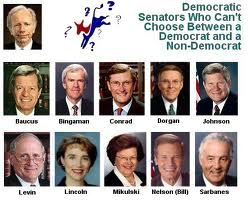
Liberal I chuckle when I hear someone call an extreme right-wing “liberal,” like, say, Joe Lieberman, a “moderate.” Perceptually, that’s the only way we can describe him that makes any sense within our two-party structure. He’s not in the Republican Party, but he acts as if he is. Because, there is only one ideology.
To say that our liberals and right wingers are all the same overstates the case. But not by much. From this vantage point, then, it should come as no surprise that Barack Obama won the 2008 election because he had more money to spend that John McCain, and that this was due to a shift on Wall Street from right wing Republicans to “liberal” Democrats. They have no problem backing either party. (Obama’s largest bundle of corporate contributions came from Goldman Sachs.)
LeftyThis is Carl Oglesby speaking at the SANE march on Washington DC in 1965 to protest the Vietnam War:
“Think of all the men who now engineer that war, those who study the maps, give the commands, push the buttons, and tally the dead: Bundy, McNamara, Rusk, Lodge, Goldberg, the President [Johnson] himself. They are not moral monsters. They are all honorable men. They are all liberals.”
It was not any different in 1965. It has not changed since then. We are not a different country now than we were then. Journalism has not changed. American foreign policy has not changed, and does not change when we switch from one party in power to the other. And this gives the lie to the ultimate fraud: We are not comprised of two major parties.
There is only one. And it has been that way throughout the entire post-war era.
We are past the portal now and well into our new world, which isn’t new at all. Corporatism goes by many names, the oldest being feudalism. It’s a natural regression to the mean when we cease to be constantly vigilant: a few who have accumulated wealth and power presume to know that they “earned” it, and for that reason believe themselves to have superior wisdom. From there it’s a quick succession from superior wisdom to superior essence, from a big house to a big house on a hill to a gated community.
From that insulated viewpoint, all of us become rabble, outsiders, sometimes glimpsed at through the window of a limousine. Somehow their eggs are on their plate in the morning, somehow their garbage is carted off, but in the meantime they are going on about the important business of amassing more wealth. In their lexicon, which their pet economists are trained to repeat, it is called “creating jobs.”
In fact, didn’t I just hear this from Obama? Didn’t he even say that economists had told him if he kept the Bush tax cuts in place, that our employment picture would improve? (AP restricted story: Yes, he did! He said that “Economists predict higher job growth in 2011-2012 if tax deal passed!” Yes, we can!)*
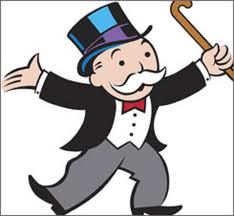
The best expression of how unregulated and untaxed economies function is the board game MONOPOLY. There are strategies at play that can help, but the important life lesson to take from the game is this: once a player reaches a certain critical mass of wealth, it takes on a life of it own, and it builds on itself. And the “economic driver” on the board and in real life and is a set of dice.
In corporate world, post Citizens United, we are all of us going to be second class citizens. As I awoke this Christmas morning, as my mind began to focus, I found myself wondering if us white folks are going to be very good in the roles we used to assign to non-whites.
Will we accept our Wal-Mart jobs with good grace? Will we accept that most medical conditions just can’t be dealt with on Wal-Mart income? Will we easily give up this high-falutin’ notion that education will improve our lot in life?
Life in a gated communityWill we too begin to drop out of high school in droves? Will we join the underground economy – the drugs and crystal meth one? That too is mere capitalism, free enterprise of a sort that lands one in a different type of gated community.
My suspicion is that us white folk will not be very good at being black folk, or Hispanics or whatever other color we look down upon. I fear we will turn hateful, and having been taught that there are none to hate above us, will turn our hatred outward and downward.
This is the function of the Tea Parties. They are a product of the public relations industry – no doubt the idea sprung up in a Hill and Knowlton office in DC, or some other such place. They are a political device, but also serve for misdirection. They take our discontent, which is real and reasonable, and direct it away from the real cause of the problems.
Welcome to corporate world. Merry Christmas to all.
_______________
*[Note to self: Economists don’t know much about the past or the present (what’s a cause and what’s an effect and all of that), and so restrict themselves to the future.]
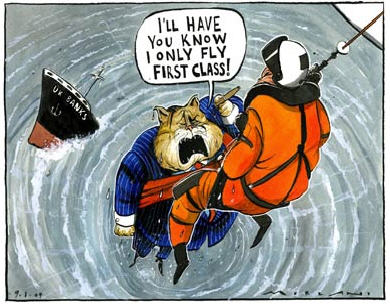
A visual representation of market failureI am regularly visited here by two ghosts – people unknown to me who present themselves as skillful and successful entrepreneurs. Each assumes suggestive names and persona that mask their real identities. (This leaves open room for speculation that such success would not require anonymous blog identities to advertise their success. But leave that aside – even if they are fictional characters, they present a great opportunity to throw ideas around, and are fun to boot.)
(One of the two is supposedly off in the Southwest now doing reach-arounds for millionaire investors, and so isn’t able to access the Internet, which is not available in that part of the country, and which millionaires know nothing about anyway. But I’ll leave this hanging for his return.)
Here’s what troubles me – each of these literary devices posing as humans preaches the infallibility of market mechanisms in guiding us towards proper outcomes in all areas of life. Government is a negative force, and where governments and markets operate together, the former always screws things up, while the latter picks up the pieces. Our long term survival depends on the elimination, or at least minimization, of government, so that markets can work their magic.
According to one of these Jungian dreamscapers, all of life is about economic transactions. Humans know of no other way of dealing with one another than to exchange value for value. Where we act without economic motivation, we inevitably end up in disastrous consequences. Further, any transaction that enriches one at the expense of another is theft. So the concepts of social insurance, or even private insurance, are forms of theft, as are, of course, taxes and transfer payments. Economic regulation is, even if seeming effective, redundant, as markets self-correct, so that even when regulation appears to have worked, it is just an illusion. Regulation, by definition, interferes with market efficiency.
Econ101 tells us that people acting for their own benefit inadvertently help all of us, so that selfishness is a virtue. We are free from any care or concern for our fellow humans, as by merely creating wealth, we are charitable. Government, which can only exist by expropriating wealth created by private individuals operating in markets, is by definition intrusive, overbearing, and even evil.
That’s my take on my two regular visitors. If I’ve put words in their mouths, I apologize.
I only have two questions:
1) When human transactions are reduced to an economic exchange, not everyone affected by that exchange has a say in the matter. As a thought experiment, place two people in a cold room with a wood-burning stove. One person has control of the wood supply, and so offers to sell the heat from burning the wood to the other. They agree, and one builds a fire, and both benefit from the heat and survive the winter. But the fire also produces smoke, which the owner of the wood conveniently vents into an adjoining room, where people choke and eventually die. They have no say in the exchange, as they are not part of the economic transaction. Is this not market failure?
2) We often don’t know the outcome of our economic transactions for years, sometimes decades. Yet we need to be paid in the present to survive. So, as another thought experiment, imagine bankers from a place called “Wall Street” create elaborate financial instruments, free of government oversight. Because these instruments appear to be immediately profitable, they pay themselves huge rewards for that profitability. Later, when the instruments prove defective (in fact, destructive and harmful), these same bankers refuse to repay their bonuses. Is that not market failure?
Just as a thought experiment, suppose that we changed the measuring period for profitability of economic transactions from one year to, say, twenty. Suppose that our retirements hinged on the long-term consequences of our current affairs. Add one more step – suppose that we measure profitability by including all outflows from transactions, whether the people affected are involved in the financial exchange or not.
Would the world be better, or worse off?
These two questions are fundamental. Obviously I have my opinions, and I’ll put them out there right now so there is no guessing. In my view, market economies and “free” markets are destructive of wealth, societies, positive human values, and in the end, the planet.
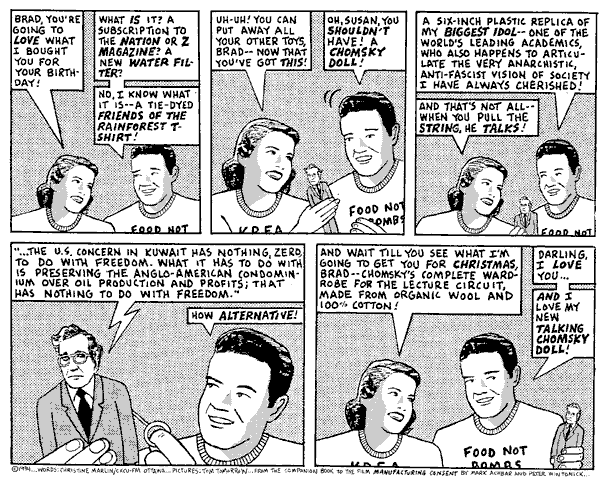
Cartoon from circa 1991, the first attack on IraqI thought he had vanished form the scene, and had long since packed away his other works too. But Noam Chomsky is still alive and hard at work. His recently published Hopes and Prospects is, like his other works, a collection of essays that are continually updated.
I first ran across Chomsky in 1988 – I’ve run across many, many authors, but this guy has the ability to reach across the divide. I was then a right-winger, but one in turmoil, as things didn’t seem right to me. He said things that others don’t say, and they resonated. I suspect that power is a good part of the reason for keeping him out of view in American media.
And probably for that reason too, he is reviled in proper circles, as the Georgetown cocktail circuit, but especially in the economics profession. The reason why is easily seen in the words that follow, from pages 75-76 of this most recent work.
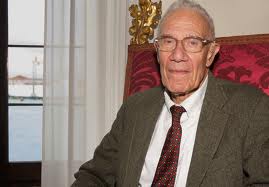
Whether neoliberalism is the enemy of development is debatable, for a simple reason: the economy – particularly the international economy – is so poorly understood and involves so many variables that even when close correlations are found, one cannot be confident about whether there are causal relations, or if so, in which direction. Robert SolowThe founder of the modern theory of economic growth, Nobel laureate Robert Solow, commented that despite the enormous accumulation of data since his pioneering work half a century ago, “the direction of causality” is unknown. It is not clear, he concludes, whether capital investments causes productivity, or productivity leads to capital investment; whether openness to trade improves economic growth, or growth leads to trade; and the same problems arise in other dimensions. One prominent economic historian, Paul Bairoch, argues that protectionism, paradoxically, has commonly increased trade. Ha-Joon ChangThe reason, he suggests, is that protectionism tends to stimulate growth, and growth leads to trade; while imposed liberalization, since the eighteenth century, has fairly consistently had harmful economic effects. The historical record provides substantial evidence that “historically, trade liberalization has been the outcome rather than the cause of economic development” (Ha-Joon Chang), apart from the “development” of narrow sectors of great wealth and privilege who benefit from resource extraction.
From an extensive review, Bairock concludes that “It is difficult to find another case where the facts so contradict the dominant theory [as the theory] concerning the negative impact of protectionism.” The conclusion holds into the twentieth century, when other forms of market interference become more prominent …
The “dominant theory” is that of the rich and powerful, who have regularly advocated liberalization for others, and sometimes for themselves as well, once they have achieved a dominant position and hence are willing to face competition on a “level playing field” – that is, one sharply tilted in their favor. This stand is sometimes called “kicking away the ladder” by economic historians: first we violate the rules to climb to the top, then we kick away the ladder so that you cannot follow us, and we righteously proclaim: Let’s play fair, on a level playing field.”*[emphasis added]
Even as an amateur observer, I cannot help but notice that proponents of “free markets” don’t know anything. Things don’t work they way they say. Their results are always theoretical, and years away, but sure to work if only given a chance. But markets are like fire, which can keep us warm, or burn our house down – as seen in the most recent collapse.
There are “free markets” indeed, but they are not at all what proponents say they are. Sweatshop laborers are subject to the whims of markets, as are all common laborers not protected by unions. Generally speaking, the less powerful one is, the more exposed one is to market forces. And those forces are devastating, which is why most large and “successful” business enterprises have found ways to insulate themselves (protectionism, incorporation, tax shelters, monopoly/oligopoly, preferred tax status, protective regulations, access to the commons, and control of government itself).
Twenty years [after the Kennedy tax cuts], when tax rates were cut even more under Ronald Reagan, federal tax revenues again soared with the “rich” paying an increasingly greater share of the income tax burden. Since it was now a Republican initiating this policy, Democrats branded it “Reaganomics” and mocked it as half-baked, “trickle-down” economics.
The problem: It’s not true. Federal tax revenues did not “soar” after the Reagan tax cuts. They shrank, precipitously, and then headed up on the same incline as before. Federal tax revenues after the Bush tax cuts exhibited the same behavior. But this is standard right-wing talking-the-talk: merely to assert that which is false to be true, without evidence. Rosen has access to the public via a large-city newspaper, and never has to document a goddammed word of what he says.
And that is true of right wing economics in general – as Chomsky notes, where relationships exist, it is hard to define causality, and where causality seems to be indicated, it is in the exact opposite direction as wealth-financed economists say. So those countries that avoid neoliberalism (or colonialism, as it was once called) tend to develop (the United States, Japan, China, the Asian rim), and those who stick to the resource/cheap-labor export model (Latin America, Africa, India) experience massive poverty and violence, and never quite seem to develop.
And this is what initially attracted me to Chomsky – in 1988, I was in limbo, trying to understand events in Nicaragua and El Salvador, among other things going on then, and along he came laying out a completely different framework than official truth laid out for us. And his version of events had explanatory power that the others lacked.
_____________
[Chomsky foonote]: *Solow, “Interview,” Challenge, January-February 2000. Bairoch, Economics and World History (Chicago: University of Chicago Press, 1993). Chang, Kicking Away the Ladder. See also, Shahid Alam, Poverty from the Wealth of Nations (New York: St. Martin’s Press, 2000). An enduring classic is Frederick Clairmonte, Economic Liberalization and Underdeveloped (New York: Asia Publishing House, 1960).
A third-rate man schools a second-rate man on the riseThere’s a nice little discussion going on under a post by Duganz at 4&20. It’s the kind of thing that I love – intrigue. Duganz starts out wondering why he cannot get either of Montana’s senators, Jon Tester or Max Baucus, to answer the simple question, “Why are we fighting wars in Iraq and Afghanistan?”
Duganz says in the post
I remember sitting in my high school computer lab when we started shocking and awing Iraqi civilians, and soldiers into oblivion. Some of my classmates were cheering.
This would have to be the 2003 shock and awe attack. There was another attack in 1991, equally as barbaric, but not called “shock and awe.” If he was 18 in 2003, he is now 25. That’s young. At that age I could hardly tie my shoes. So he is attaining some wisdom at an early age, and I hope the process goes forward.
I have learned, at age 60, that people must come into wisdom on their own. Simply imparting it upon them has no effect, as we are all caught up in our own moment and self-assured that we have some understanding of events. So when Duganz wonders why he cannot get a straight answer out of his elected representatives, it does no good to say what I said – that they are mostly powerless and have to go along with these things merely to stay in office. That’s why politics attracts second and third-rate people. They are at best poseurs.
That is too big a jump – one cannot go from 3 to 6 without first going through 4 and 5.
I simply encourage Duganz to keep asking those questions. The one about why United States senators cannot give a straight answer about our involvement in foreign wars is a good one, and once answered will lead to a new level of knowledge. And so forth and so forth. I did not get started until I was almost 40. He’s got a huge jump on things.
Playing the part of Joe Lieberman in tonight's performance is ... This gem from “Mr.Benson” at 4&20:
It’s true, I admit. Those damn Republicans, that idiot Ronald Reagan. If it had been up to the liberals, we’d have surrendered to the Soviet Union long ago and only one side would have warheads.
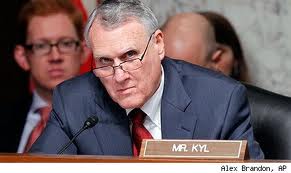
The subject at hand is the new START treaty, and the reduced number of warheads that the U.S. and Russia would be allowed to deploy. It’s in the process of being shot down. Senator John Kyl of Arizona appears to the point man for this affair.
There are 57 Democratic senators, and two independents who caucus with them in the lame duck session. To ratify a treaty would take all of them plus eight Republicans. John Kyl, prior to this time, has been reasonable on the subject, wanting only to make sure that we continue to spend untold billions on our warhead stock to keep it spit-polished. (Our nuclear stock is offensive in purpose, and the U.S. would never willingly give up an advantage.)
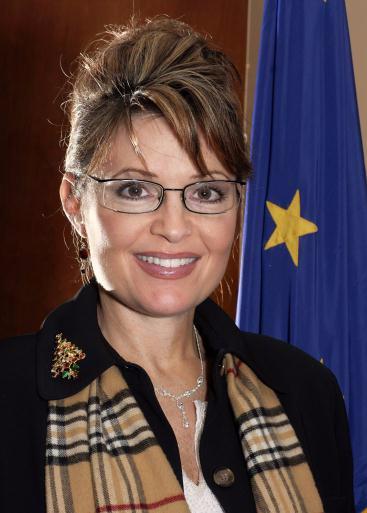
Dr.Sarah Palin from the 2010 movie "Foreign Policy Advisor", as played by Denise RichardsThe assumption behind all writing I have seen on this subject is that all 59 in the Democratic caucus would support the treaty. But how do we know that? Since Obama took office in 2008, Democrats have allowed the Republicans to filibuster anything they want, using that as a convenient excuse for the Democrats’ amazing legislative failures.
Far more likely is mere politics – there are too many conservative Democrats to get anything worthwhile passed, and so they work with the Republican caucus in the back room. Republicans take heat for filibusters, and the Democratic base focuses on the Mean-Old-Other-Party, forgetting that they have the power with 59 and an ounce of cleverness to do anything they want.
Behind all of this is an “Obama” proposal to spend an additional $84.1 billion on the nuclear complex in the next ten years, out-Bushing the Bushies by 20%. [Note: He has since offered to pad this with an additional $4.1 billion.] There will easily be enough votes for that. So the result of all this maneuvering is no treaty and increased spending on nukes under Obama, with John Kyl the point-man for the theater of distraction. Clever, eh?
Dr. Christmas Jones in the 1999 movie "The World is Not Enough," as played by Denise RichardsOther interesting features of this debate: the nuclear threat from Iran, which is no threat at all, is prominently mentioned as a reason for continued build-up of the U.S. arsenal. That’s ludicrous, but it gets worse. This is from a Washington Post article:
Former Alaska governor Sarah Palin has told newly elected Republican lawmakers not to “listen to desperate politically motivated arguments about the need for hasty consideration” of the treaty.
Sarah Palin, a very stupid woman who doesn’t read and cannot think properly, is now advising lawmakers on foreign treaties. There are no words available in the language to describe this. Perhaps someone fluent in French or Spanish or Swahili can give me the appropriate phrase.













 Piece of Mindful