Interesting history, but nothing in it for us

There is so much of history that is hidden – it’s more a filtering process than actual censorship. Chomsky and Herman did a nice job of describing media filters in 1989 – there were five: 1)The size, ownership and profit orientation of media outlets, meaning that only big enterprises gain credibility; 2) advertising as a license to do business, giving advertisers de facto control of news; 3) sourcing, meaning that special access is granted to those news outlets that report in an acceptable manner (Tim Russert, for instance); 4) flak and the enforcers – negative fallout to unacceptable content (which is why Dan Rather lost his job); and 5) anti-communism as the dominant social control mechanism (since replaced by anti-terrorism).

With those filters in place, it is not even necessary to censor news (even though heavy censorship is accepted as normal in the name of vaguely defined “national security”). People who live within the upper echelons of our news delivery system internalize all the concepts and even think of them as normal. And, of course, the people down below who report to us haven’t a clue what goes on in the suites above.

That in mind, here’s a passage from David Harvey, author of A Brief History of Neoliberalism*:

There’s a very interesting story to be told … and I’m not sure it has been fully elaborated upon yet. With the OPEC oil price hike in 1973, a vast amount of money was being accumulated by the Saudis and other Gulf states. And then the big question was: well, what’s going to happen to that money? Now, we do know that the US government was very anxious that that money be brought back to New York, to be circulated back into the global economy via the New York investment banks, and persuaded the Saudis to do that. Why the Saudis were persuaded to do it remains a bit of a mystery. We know from British intelligence sources that the US was actually prepared to invade Saudi Arabia in 1973, but whether the Saudis were told: recycle the money through New York or you get invaded … who knows?

Now, the New York investment banks then had vast amounts of money. Where were they going to invest it? The economy wasn’t doing very well at all in 1974-75, as, all over, it was in depression. Citibank and Walter Wriston came up with the comment that the safest place to invest the money is in countries, because countries can’t disappear – you always know where they are. And so they started to make the money available to many countries like Argentina, Mexico – Latin America was very popular – but also places like Poland** even. They lent a lot of money to those countries.
[These words are taken from an interview of Harvey by Sasha Lilley.]

What follows is somewhat well-known – Mexico goes bankrupt, and is bailed out by Washington, in effect circulating taxpayer money back to Wall Street. Sound familiar? Mexico is not a richer country today as a result, but wealth is distributed differently. Mexican billionaires pop up on the Forbes list, peasants are dispossessed (further aggravated by NAFTA), and migrate north looking for sustenance.

In Argentina, military personnel work in league with Chile’s Pinochet to conduct terror operations, and take the country deep into fascism and later bankruptcy. The country is still recovering.
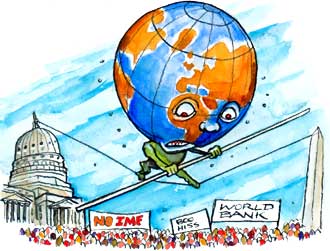
The "Washington Consensus" emerged from the reclyling of Mideast petrodollars
It would be interesting to know whether the US in 1973 actually threatened to invade Saudi Arabia or whether the Saudis intuitively knew to play ball. It would be nice to know of secret communications between fascist regimes and Washington, but that type of investigation is never undertaken due to the filters in operation above.

It’s complicated, of course. There is no one narrative that lays out history for us, that is, unless you follow American news. But there is always hope for gradual progress. The first filter, the size of media outlets as a prerequisite for entry into the business, is evaporating before our eyes. Newspapers are collapsing, media is heavily fragmented (though still centrally owned), and it is not difficult at all for a naturally curious person to research unreported events in foreign media and alternative histories. And if we lose the big newspapers – if the New York Times goes down, for instance – what replaces them? I do not know. It might be better, it certainly cannot be much worse than that state-subservient rag.
__________
*Neoliberalism and neoconservatism to me appear to be the same animal, but according to Harvey differ in that the Neolibs tend to want to leave markets alone to perform their magic (amassing of resources in a few hands). Neocons are less tolerant of markets, which can indeed be volatile and dangerous, and want to impose order from above. In this case there might indeed be differences between Neoliberal Democrats and Neoconservative Republicans, but neither has any good outcomes for ordinary people.
**It was around this time that Gerald Ford was pilloried for commenting in televised debates with Jimmy Carter that Poland was not part of the Soviet bloc. Gerald Ford was not a stupid man, and his statement that evening probably reflected a better understanding of world affairs than Carter possessed, and certainly more than the media that covered the event.
Boobies

Progressives are of one mind on this matter
I used to participate in Audubon’s Christmas Bird Count in Billings, Montana each year. Our group of three or four would walk the Yellowstone river from Huntley to the Exxon refinery, and part of the route was a narrow passage between the river and hillside that had a railroad track running through it. When trains came we had to stand aside and watch the massive engines and listen to the deafening roar. I remember one time thinking of the stark contrast, maybe even the absurdity of counting little gray rosy-crowned finches and nuthatches while feeling the massive power of the industrial system that so taxes our environment. I realized then, as a wilderness advocate, that I depended on those trains to support my lifestyle. I thought to myself “I am part of this.”

There’s been a pipeline leak under the Yellowstone River near where we counted dicksissels, godwits and peewees. (We never saw those particular birds – I just like the names.) ExxonMobil is a massive state-supported capitalist enterprise that operates against nature to provide for my lifestyle. It has fouled Prince William Sound and was surely in on the meetings wherein the invasion of Iraq was planned. It has financed the junk science that has led to climate change denial. But it is hard to grasp the notion of “massive” in our finite brains. People who work for Exxon, all the way up to Rex Tillerson, current CEO, merely occupy slots. He is as much guided as he guides. If he were to say tomorrow morning that climate change is real and human-caused, the word “former” would precede “CEO” tomorrow afternoon.

CBS News photo of spill
These people know what’s up, and cannot stop it. Capitalism is a seed-eating enterprise, and the motives that drive it are impervious to rational behavior. The choice of the CEO’s and Wall Street types is either to participate or not, to accumulate wealth and power to to elect to be powerless. They internalize the contradictions as they must to prosper, and their glorification of the system is a form of denial.

The matter of a small pipeline spill in the Yellowstone River was not intentional, and the people who built and monitor the pipeline are not political hacks going through the motions. While ExxonMobil is powerful enough to control government, it is also concerned about public opinion to a degree. It is not in their best interest to be cavalier about transport of oil. The company is many things, but the tiny people at the bottom of the ladder in Billings, Montana, are neither evil or incompetent.

What we have here is an accident. Time to say “Oops!,” and clean it up and get on with our lives. The sneering and moral indignation that I see from the pwoggies and Democrats is quite distasteful and unintentionally revealing.

Bad weather ahead

Senator Bernie Sanders cast a disheartening note yesterday, even for those of us who realize that President Obama is a wolf in sheepskin. He said that as he hears it, Obama is negotiating for preservation of the National Weather Service in the great Kabuki “showdown,” the manufactured crisis over the debt ceiling. This means, he says, that he has probably already sold the farm on Medicare.

A new war! A NEW WAR!

Making babies
It’s official now! The baby is adopted, and is gurgling and spitting up, but will soon be up and walking. The US has adopted Somalia! Add that to Iraq, Afghanistan, Pakistan, Yemen, Colombia and Libya; add to that the loving glances we cast at Syria, Venezuela and Iran, and we are the Pitt-Jolie of the warmongers!

These are, of course, just the ones we know about.

Drone strikes, as I understand it, are managed from Texas. I sincerely doubt that President Obama has any control or any say over these matters. It’s above his pay grade.

A screwball system of fake democracy

The post down below led to an exchange with Polish Wolf that programmers might call the “endless loop.” My point was that we are subject to tyrannical rule by lifetime-appointed judges, and that their decisions are so hard to overturn that few even try. Impeachment is a futile enterprise – just ask the John Birch Society. This is his last comment partly redacted:

Well Mark, we don’t know who Gore would have chosen, that’s true. But here’s the thing – on most of the decisions you hate the most, there are two sides, and justices on both sides. Not one justice who voted in favor of Citizen’s United was appointed by a Democrat. Thus, the idea that Gore would have appointed two justices who voted with justices appointed by Reagan and Bush, rather than justices appointed Carter and Clinton, is absolutely absurd and kills your entire contention that Presidential election aren’t important. George Bush holding office created a situation wherein Citizens United was possible – thus, the election of 2000, far from being ‘Kabuki theater’, was instrumental in increasing the power of the wealthy in the United States. … People who voted for Nader or stayed home that day allowed Bush to be elected.

One, I did not say that the 2000 election was Kabuki Theater. The current “debate” about the debt ceiling is that. The 2000 election was rigged, for sure, and the outcome tilted to elect the Bush cadre, and part of the infinite loop is our incessant bickering about whether we are better off with weasel Democrats or self-assured Republicans. The larger point contained in the post is that the United States Supreme Court acts as a Guardian Council, just like those who are the real government of Iran, unelected, robed, mystically imbued with profound wisdom, and completely submissive to the oligarchy. Jefferson angrily complained after Marbury v Madison that decision had turned the constitution to “wax.” Until we alter this system to remove tenure for judges and/or make is feasible to quickly and easily overturn corrupt decisions like Citizens United, we are a fake democracy.*

But we were fake anyway, as even the pre-CU campaign finance system used to support the “two” parties assures that outsiders like Nader are kept out of power.

But your contempt for Nader exposes you in ways that you do not intend. LB spoke of the fear factor – that Democrats are simply afraid of leaving the playground because the task of imposing real change on this screwball system is daunting. Nader brings your fear to the surface, and you react with bitter disapproval not of the corrupt system in which you participate, but of Nader.

Finally, to the more mundane matter of the failure to elect savior Gore, a man who refused to take leadership on progressive issues, who ran a weak and uninspiring campaign, and who, in the face of the James Baker-led theft of the office meekly backed down, Sam Smith reminds us that while Nader got only 3% of the vote, exit polls showed that 9% of blacks; 46% of those under 30; 49% of the college educated; 37% of the poor; 39% of working mothers; 11% of Democrats; 34% of union members; 13% of self-described liberals; 25% of gays and lesbians; 15% of Clinton voters in 1996; 25% of those supporting abortion … all voted for Bush. That is the percentage of those who actually voted. Most eligible voters seem to recognize that it’s a rigged system, and don’t bother. Gore did not reach that segment either.

Those are people who by your imperial standard should have voted for Gore! They betrayed you! And yet, your focus, your anger and indignation, is directed only at Nader.

What gives, Polish Wolf? Eh? Eh?
_____________________
*A third aspect of our screwball system that needs change is ten-year redistricting. As one Englishman observed, our system is odd in that we allow voters to elect office holders, but then turn around and allow office holders to select voters.

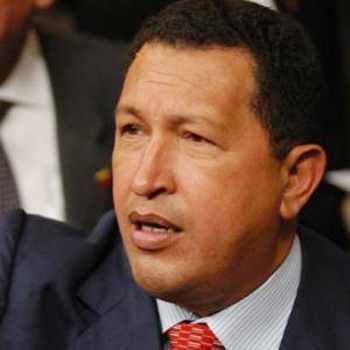
The status of Hugo Chavez

Got uppity
We returned from vacation and away from news to learn from Swede in comments down below that Hugo Chavez was dead, and that he had died in a Cuban hospital. I had no way of checking that out at the time, but was deeply saddened. I’ve since followed up, and don’t know his status. It does appear the the jackals of the Venezuelan oligarchy, supported by the US, are circling the camp down there. The grand experiment in representative democracy might soon end, and the oil giants will once again control that country’s oil.

Chavez’s greatest offense was to offer assistance to other Latin American countries by use of oil wealth. He offered loans and direct assistance without strings, allowing some countries to get out from under the jackboot of the IMF.

Swede loves to run on fumes, assertions without evidence stated with arrogant assurance. That’s a long-winded way of saying he’s a right winger. The Cuban hospital quip was meant to say, in his way, that Cuban health care is inferior to American health care. He has no way of knowing that, of course. If he is an insider here, that is, one who actually has access to our health care system, he might have a point. If he is an outsider, and has access only through emergent care, he’s full of shit.

This much I can say with some certainty: Chavez was surely better off in a Cuban hospital than an American one. The US government, which tried to overthrow him in 2002, still wants him gone gone gone, and American health care might well have been his demise. He surely knew this.

Politics as theater

Interest on public debt as a percentage of gross domestic product:

1980 2.70%
1985 3.96%
1988 4.23%
1990 4.52%
2000 3.66%
2005 2.80%
2010 2.82%

Interest on public debt is 2/3 now of what it was when Reagan left office. All things being relative, if this is a crisis, then was a worse one. But this is no surprise – the current “fiscal crisis” is manufactured for political purposes. Unfortunately, both parties are doing the business on us, the debt ceiling “standoff” mere Kabuki Theater.

Obama will back down, as he always does, not because he is weak, but merely because he is a player on a stage, playing his part.

The crime of journalism

Information in the US is tightly controlled, an amazing feat given our perceived freedom of the press and easy access to information.

The means by which this is accomplished appear twofold: a media environment where even the incurious are overfed with useless information, and journalists who are rewarded for servile behavior.

Americans are no more or less intelligent than anyone else in the world, but we are provided with an abundance of distracting information daily. Even if we are naturally curious there are discouragements in place: Subversive information is not easily available. We have to know what we are looking for. We’re not going to stumble upon it in USA Today. And anyway, there are a thousand other interesting things going on in media. Distractions abound. It’s easy not to know anything and still be busy as hell about it.

Mainstream media outlets are rigidly controlled. Naturally curious journalists are dispatched over time. They leave either by outright dismissal or or for perceived failings such as “lack of objectivity” (code for natural curiosity). It’s easy to predict that the editor of the local newspaper will be the least intellectually curious person there, and the most willing to submit to the dictates of the publisher or owner. Mediocrity is the trait that leads to advancement – it’s the “Russert syndrome.”

You’d think that the Internet would solve these problems and free us up to know anything we want to know. It has indeed, and those who are naturally curious can now surf the world. It’s a glorious revolution. But the Internet is mostly a source of distractions. It is dominated by cheesy entertainment, pornography, gambling, social networking, music and movie piracy. People scanning the globe for information are relatively few. The Internet has introduced the naturally curious to one another, and that is revolutionary. It’s a hard thing to manage – the only real threats I’ve seen to Internet freedom are government and corporate hacking to shut down pesky websites, “net neutrality” battles, and routing of massive amounts of data through a few outlets, which allows for shut-down of service when there is a threat to entrenched power.

A correspondent whom I only know because of the Internet forwarded an AlterNet piece by Rania Khalek called “5 WikiLeaks Hits of 2011 That Are Turning the World on Its Head — And That the Media Are Ignoring.” That tone … “and that the media are ignoring,” is a tiresome cliche’ in left wing journals. It implies a failing in the American media. But in not covering the stories in Khalek’s piece, media are merely doing their job.

And anyway, Alternet is part of the media, and the information is there for us. Only a few seek it out.

Khalek
Here are Khalek’s five WikiLeaks-driven events of 2011:

1) The Arab Spring*: Information is power. It all started in Tunisia, where existing unrest was exacerbated by WikiLeaks revelations of government corruption, well known. Add an immolation, and presto! Uprising.

2) The ‘worst of the worst’ included children, the elderly, the mentally ill, and journalists. These are Guantanamo detainees, horribly abused, most guilty of nothing even beginning to justify their treatment. (Terror and torture are never justified anyway.) Since our perceptions are carefully managed in the US, most of us think that Guantanamo detainees are both guilty and well-treated.

3) US allies are leading funders of international terrorism. These would be Saudi Arabia and Pakistan. It is not surprising if one understands that the US itself is engaged in terror and torture, does not care about – even fears – democratic governance.

4) World leaders practically lighting a fire under the Arctic. Far from having any concern about the consequences of global warming, The US, Canada, Russia, China, Norway and other countries intuitively understand that the Arctic will be the source of resource wars in the coming decades. (I’m having a hard time conjuring up a Norwegian demon to justify bombing that country. Will we learn to hate the scourge of the Norseman as we do Muslims? Will we be told that Bjørnstjerne and Sonja are forming cells?)

5) Washington would let them starve to protect US corporate interests Hugo Chavez has control of oil, and uses it to promote relief of hunger and poverty and to free Latin American countries from the oppressive interference of the International Monetary Fund. The rotten son of a bitch. Venezuela and Haiti had an agreement whereby the latter saves $100 million a year, a tenth of its budget, on the cost of oil.

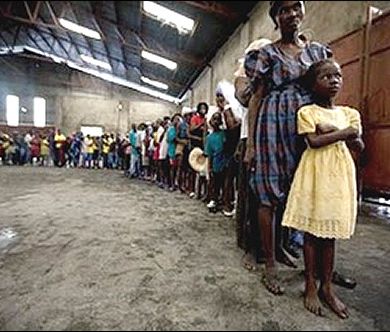
Haitians getting uppity
Exxon and Chevron were pissed about that, and as the little lamb followed Mary, the US State Department has intervened and interfered in that agreement. WikiLeaks also exposed how the US interfered in Haitian government attempts to raise the minimum wage there from 24 cents to 61 cents per hour. This, according to a US official, did not reflect “economic reality.”

It’s not hard to understand the dynamics here, why Julian Assange is under house arrest in England, why the US (via Sweden) is trying to bring him here for a show trial which will be followed by imprisonment, even death. He’s committed a crime that is rarely seen here in the land of the free: Journalism.
_____________
*How’s that Arab spring going? Egypt is out of the news, but the US must be making some progress in restoring the old order. For a brief period of time, Egyptians were letting Gaza’s de facto prisoners escape via the Rafah border into the Sinai, but the gates have shut again. Bahrain is subject to brutal and violent suppression, with aid from Saudi Arabian troops trained by the UK. It is, after all, home of the US Fifth Fleet, so the revolution is not being televised. Libya is under attack by NATO, supposedly to aid the rebellion, but more likely to merely get rid of Gaddafi’s government and replace it with one friendlier to US oil companies. Yemen’s rebel forces are currently being bombed by the US, as we open up a fifth war, four of them against Muslims. (The fifth, Colombia, is also not televised.) The US has long wanted regime change in Syria, so that revolution is being televised and widely covered here, even in Time Magazine! Abuses, which are real, are routinely exposed. I watched with horror a couple of days ago to the news that there are refugees leaving Syria. Then I remembered that the US caused some two million refugees to flee Iraq, not covered here, and then remembered too that all US news is bullshit read from teleprompters and transcribed in newspapers by toadies and lackeys.

ht/lb (PS: Woke up with an extreme case of attitude today.)

Who knew?

Carl Sagan made science accessible to me and so many others. Much of his appeal for me was his humility. He did not denigrate ignorance, only willful ignorance. He did not look down on religion. In his Shadows of Forgotten Ancestors, he expressed admiration for the people of past ages whose only tool for understanding the world was religious mythology. Since no other tool existed, what they were doing was reasonable. Their minds were no less capable than our own. Our modern science is just a tool for understanding reality, as was the religious outlook. But science is not “truth.”

Sagan had “respect for wisdom of the past,” said to be a tenet of conservatism. Those in this country who call themselves “conservatives” are really something else. (“Radical reactionaries” works for me.) But as we look at the past, there are some really ugly things that went on that we don’t do as much anymore. Things have gotten better.

Slavery, though still practiced, is no longer defended. Racial prejudice, still rife among us, is submerged into the subconscious.

The modern "conservative"
(It is there inside me, but I quickly suppress it when I feel it rising up.)

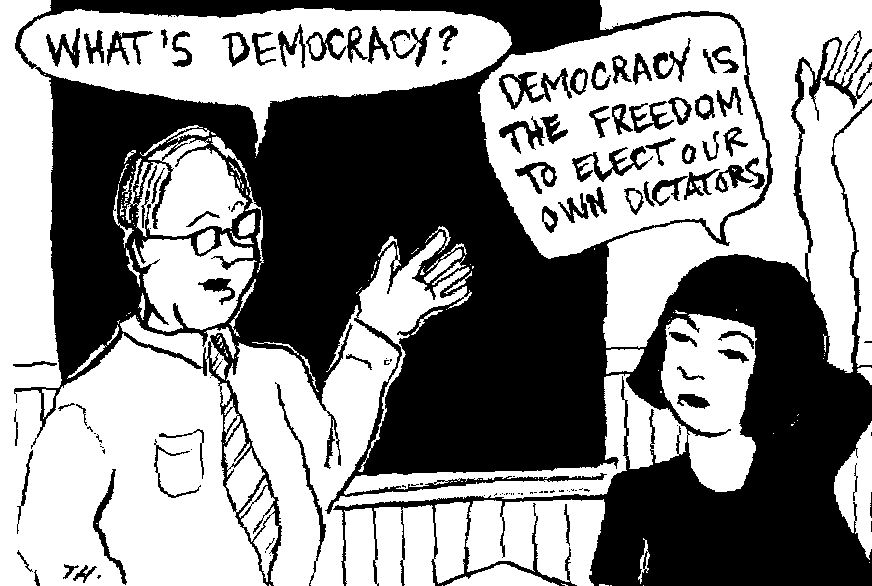
And, “democracy” is the guiding principle of our age. But like a beautiful loaf of bread that has no salt or sugar, it should sit in the bakery window and not be eaten.

Technology is real, and our knowledge continually expands due to better tools and the scientific method. But people have not changed. Not an iota. True, we no longer jeer at and lynch Negroes, and Jews are now employed in daily life and in our universities. But all that hatred we used to unload on them has merely moved over to Muslims. It has to come out somewhere, and Abdul has replaced Hymie and Jimarcus as the whipping boy of the age. Progress is an illusion.

I wish to express something that many of us feel but are not free to say openly: Voting is not democracy, and not everyone is qualified to vote. Our ruling class knows this. Elections merely reinforce our belief in voting while at the same time rendering it pointless. People need to feel that they have a voice, but that voice cannot be heeded. Have you looked around you? Have you listened to talk radio? Have you heard the conversations on the bus? People are not born stupid – far from it. But the absence of meaningful dialogue does foster the growth of an idiot culture. Is that what we want running this country?

Around the time of the founding of this country, people were less circumscribed about their attitudes toward the “common man.” Voting in most states was reserved for men, and only to men of property. Attitudes about women are hard to fathom, of course, but the ownership of property implied an education. It did not rule out thoughtless people, but it did minimize their impact.

These were not stupid people who set up those rules. They expressed Enlightenment ideals, and believed deeply in them. “The Rights of Man” was not an inauguration speech, but rather a real outline of concrete goals. And yet voting, which we now believe to be our most profound expression of the democratic ideal, was reserved to just a few people.

Bertrand Russell did not try to undo the modern impulse to let every fool have a vote. He merely reduced it to its essence. He said that the only real importance of voting is the prevention of aristocratic rule. Office holders are forced to step down on a regular basis. But it hasn’t really worked out that way here in the United States. Because we allow money to rule politics, we’ve been reduced two parties that are really one. The people who step down after each election are replaced with mere clones, either themselves aristocrats, or tools of that class. Democracy in this country is an illusion, even in Russell’s sense.

When I was forty years old, I felt that my most useful purpose was to join the struggle to preserve a few wild lands in their natural state, and so devoted my spare energy to wilderness causes. That is a worthy cause with many serious and dedicated people hard at work on it, but I moved away. It’s been hard to replace that ’cause’ with anything more substantive, but I realize now that something else had taken its place when I worked for Ralph Nader: meaningful democratic governance. It goes back to Russell again – we should have democratic rule, and voting should matter, even if only to force people to move on. With the two-party system, the ruling class never has to move on or move over. That needs to change.

Here is another tenet of conservatism: change should be gradual and done through laboratory experiments. States and cities need to run experiments in things like fusion voting, charter schools or single payer health care. The results of successful experiments will spread, just as Tommy Douglas’s Saskatchewan health care system took over Canada.

Meaningful democratic governance is a good cause. It’s a good way to spend my remaining days (not to sound morbid – I hope I have a lot of days left).

So I’m really deep-down a conservative! Who knew? It was hard to see, as there are so goddamned few of us, and we often go by other names.

Mind prisons

I was put into Little Flower Catholic grade school in Billings, Montana, at age six. I also attended Billings Central Catholic High School. My teachers in grade school were Dominican nuns. That order would not normally have come to Billings, but my maternal great aunt, “Sister Faith,” was the Mother Superior of that order, and so had the power to send her foot soldiers our way as a special favor to our family. This is what my mother told me, anyway.

Catholics at that time were protective of their youth. Deep religious indoctrination was a common practice, and thought to be a good thing. It protected us from worldly influences. Our school had its own special bus, even though public school buses were available. They scheduled the school day so that we did not get out at the same time as Garfield, the public school one block away. They did not want us mixing with the public school kids on a daily basis.

It all seems innocent, and the nuns I had for teachers were wonderful people. They had the best of intentions. We were taught that the Catholic faith was the “one true faith,” and that once we became aware of that fact our choices were to stay in the faith or leave the faith and face eternal damnation. There was a real place called “Hell” that had real fire that really burned, forever.

It scared the shit out of us.

Most kids I went to school with are still Catholics. Even as mature adults that fear-based indoctrination resides in our subconscious. Leaving the Catholic faith, which I did at age 38, was stressful. I was afraid that I was going to be punished and that my life might be destroyed. I took a leap of faith, so to speak, to the other side.

As it turns out, the “other” side is a nice place. But I could not know that. Youthful indoctrination kept me in the faith for twenty years after the end of my Catholic education.

That’s a common experience, but perhaps my family was more religious than most, so I got a heavier dose. That lock they had on me – a child’s fear of burning – is extremely powerful. Richard Dawkins has gone so far as to call it child abuse, and I tend to agree, but only to to a degree. Most people who lead the mainstream religious faiths are not bad people. They love their flocks, and recognize the flaw in human nature: The need to follow and obey authority. To the extent that they lead people to better and happier lives, they can be forgiven. To the extent that they use this power to take our money, bugger our children or taint our world outlook to their political liking, they should burn in hell.

All of this leads me to what made me sit down here – thought prisons. Over the past few blogging years I have had numerous encounters with both Democrats and Republicans, and have found the former resolute and certain of their beleifs. Most Republicans are not conflicted by party adherence. Being a Republican appears easy, and these folks generally have no trouble punishing leaders who do not adhere to the faith. Also, they don’t much question the faith. That’s really comfortable.

Democrats are different. They are faced daily with contradiction, as their leaders behave like Republicans even as they talk like Democrats. This creates internal discomfort, or cognitive dissonance. So the party is constantly torn apart by internal dissension. Will Rogers’ lament that he did not belong to an organized party, but was rather a Democrat, hints that this is not a new phenomenon.

If not a Democrat, what am I? I have but two choices. If I leave the party, there is … nothingness, a void, a form of hell without flames. So party faithful are caught in a mind prison not much different than the conflict of the captured Catholic child. Staying is comfortable, but thinking is not allowed. Leaving is scary, and thinking is hard, even painful.

So, to my Democratic friends and enemies alike who continually ask me “If not this, then what?”, I answer “Uncertainty. Can you deal with it?” It’s not easy not belonging, to have to think and judge independently. Abstaining from casting a vote for either party seems nihilistic, but if neither offers anything productive, is that not nihilism as well?

The two-party system is a natural byproduct of money-control of politics, as no third party can amass the resources to gain critical mass and challenge it. But we don’t have to belong. It might appear that outside the two-party system there is nothing. But it is inside the two-party system where nothingness resides. Outside that system is eternal optimism of the spirit coupled with pessimism of the intellect. There is life out here, just as there is life for young Catholics if only they are willing to take a leap of faith, and leave the faith.