Liberals Not Allowed

From Bloomberg:

Senators from both parties said the Democratic president should avoid filling the [Supreme Court] vacancy with an “ideologue.”

Allow me to translate: No liberals, please. Roberts and Alito, ideologues, are conservative ideologues, and therefore not ideologues. Are you getting this? It’s easy once you understand how we talk without saying what we really mean.

Here’s more: It is said that conservatives cannot handle nuance. Here is Senator Richard Shelby (R-AL) on the coming appointment:

“I think the criteria should be to follow the law, not to make the law.”

Once again, translating: “Don’t upset the existing power structure.”

But the idea that the Supreme Court should “follow the law” is absurd. Cases come before the court because of differing interpretations of the law, which is vastly complex. If “the law” were written down somewhere so we could look it up when we needed to, we wouldn’t need a Supreme Court.

Where is Power?

This is an academic exercise, but I think worth doing. It is a contrast between our perceived system of governance, and the real one. Here’s perceptions:

The people are all-powerful. We elect representatives who write and execute laws, and who appoint judges who interpret those laws. We have three branches of government, each held in check by the other two.

Obama recently said that in approaching Iran, it is important to know that “Iran is a very complicated country with a lot of different power centers.”

True about Iran and true about our country as well, as Obama well knows. What I am trying to do here is to recognize various power centers that exist in our country, and put them in order of the amount of power they exercise. It’s a useful thought exercise.

The corporations – these are a wide variety of entities that operate in different sectors (finance, oil, communications, etc. ) but who often enough support one another. Their power extends far beyond our borders, and our military often does their bidding under the guise of humanitarian interventions.

The mainstream media Since it is owned by the corporations, it is a merely subset.

Military and intelligence agencies – these are vast, mostly secretive, and are largely funded in secret.
The president, or the executive branch. It is powerful, but submits to the will of the corporations and the military. Mainstream media, owned by the corporations, ‘vets’ presidential candidates and determines who is “viable” and who is not.
Wealthy families and individuals these are people with massive fortunes who exercise great sway over tax policy and are usually virtually in control of the localities where they live. Most people do not recognize their names, for instance, ask any Montanan who Denny Washington is.
Think tanks These are intellectuals who are funded by and serve corporations and wealthy families. They are a safe harbor for government officials while they are out of power. They also have large sway over favored opinions of government officials, providing pseudo-science to support public policies that favor their funding sources.
The Senate – more powerful than the House because its members have longer terms, and because a minority there can usually thwart a majority in the lower house. Cannot be ‘gerrymandered’.
The House of Representatives Our most democratic body, and most susceptible to swings in public temperament. Gerrymandered.
Large land owners This is odd, as they could also be called a subset of “wealthy families”. Ownership of land conveys power, as in Montana, where though ranchers are a minority, and not our wealthiest citizens, they usually hold a large share of seats in the state legislature, often the governorship, US Senate and House seats as well. They are, in Montana, also known as the “Department of Livestock”, an unelected organization the elected governor never trifles with. Interesting.
The “courts” Oddly, ordinary citizens still have the ability to challenge power centers through the courts, and often do so. Corporations are trying to bring this source of power under control with their campaign to demonize “trail lawyers”, that is, people who sue corporations.
State Governments Powerful, but no power beyond their jurisdictions, and little sway over federal officials.
Municipalities Mini-fiefdoms having locally focused power, but little beyond city limits. These tend to be very democratic.
Public opinion As of this moment, public opinion means virtually nothing in our democracy, as it is easily swayed and manipulated by the other powers. But if it is focused and enraged, it can thwart every other power center. Witness: The USSR. Not the USA, however. Odd that the USSR was more democratic than us.
Other communication sources This would include the “alternative media”, the Internet, town halls and public meeting forums. Note that the Internet was once seen as a great source of organizing power, as when protesters used it to upset the corporate apple cart in Seattle in 1999. But it has largely been neutralized, and corporations are hard at work to bring it under their control.

That’s all I can think of right now. I expect that others would add others, such as state and local police, labor unions, and the NFL? You tell me. Also, I expect everyone would re-order and re-word what I wrote.

Add: Organized crime -not sure where it fits, but it exists everywhere. As noted in comments below, I overlooked religious institutions, academia, lobbying groups. Academia is largely subordinate to other power groups, as it is merely training the next generation of managers of the existing institutions. (There is constant pressure exerted on colleges to avoid dabbling in freedom of expression – i.e. – Horowitz.) Non-corporate lobbying groups exert their power on Congress, but Congress itself is subordinated to other more powerful forces. But they are very good at getting money out of the treasury. Religious institutions don’t appear to me to have much power over government, though fundamentalists that vote en masse to exert more influence than those that merely attend to spiritual needs of followers.

Journalists: You lead, we’ll follow

An entry at MetaFilter provides the following quote, but does not give its source:

“The reason many people worry that the written form is dying, and the reason most writers consider online publication second-rate, is that no journal has yet succeeded in marrying the editorial rigors of print to the freedoms of the internet.”

It then links to a new online literary magazine, the Wag’s Revue. It looks interesting, and I hope it satisfies the gist of the quote leading us there.

Those words capture some small part of truth. Another field, journalism, has long endeavored to install professional rigor on the business of collecting news. They are serious people. However, they have largely failed. And more so than any other profession that I’m aware of, journalism seems on the far edges of fogginess about itself, almost completely lacking self-awareness. They give out more awards to one another than Carter’s famous pills.

At the same time, they fail to do the one thing we hired them for: To report to us what powerful people are doing. The reason is obvious: They must answer to those powerful people, and not us. As a result, most news, even in the vaunted print media, is a distraction.

Many people have noted how shallow TV news coverage is, how they operate like pack animals and pounce on trivialities instead of important stories. There’s a reason for that – it’s like squeezing a balloon – the air goes to the place where there is least resistance. Bush/Cheney et al … desk murders, torture, illegal invasions, wiretapping all of us and all of the news media … don’t go there. OJ? All over it! The New York Times used a woman who appeared to be no more than a CIA plant – Judith Miller – as their lead reporting on the attack on Iraq. They sat on the wiretapping story in 2004 – a story that probably would have changed the outcome of the election that year. Not only are they not reporting to us, they seem in league with the powerful.

News reporters chose not to challenge Bush on Iraq. (Better said: They knew better.) They brought in the generals, fired Phil Donohue, and before that Bill Maher (who are not journalists but who are willing to say things that might be true). They didn’t question the motives of the leaders. Instead, they repeated lies. They failed us, utterly and miserably.

On some level, they know this. That’s why they have awards for door stops. They do what most of us do in response to anxiety-causing problems in their lives … compensatory behavior. Award banquets.

That’s broad-brushing, I know. There are many people of integrity in the business. Probably most of them. The paradox is this: How do they put that integrity into print or on air? The answer is that mostly, they can’t. So they dance around the the edges of power, mostly looking outward, and intuitively understanding their own failures. They affirm! their integrity to one another. Pass the salt, please, and the Pulitzer too. I’ll have a Peabody while you’re at it.

I work in a less glamorous profession that is riddled with similar conflicts of interest. Accountants are called upon to audit public corporations, yet those corporations are allowed to hire and fire auditors at will. As a consequence, the early part of this century was littered with accounting scandals like Enron, Global Crossing, and WorldCom. It’s a principle known by all to be true, yet systematically ignored: “conflict of interest”: we cannot serve two masters.

In the case of journalism, they cannot both report on powerful individuals and corporations and yet be owned by them. And when powerful corporations have a stranglehold on government, we have a double-conflict: Not only do we get no reporting on the corporations, but none either when governments are serving the corporate will, as with the Wall Street bailout – perhaps the Iraq invasion itself. Instead, government reporting is reduced to the slavish, drooling White House press corps.

So when I read about the web failing to live up to journalistic standards, of failing to marry the “editorial rigors of print to the freedoms of the internet”, I can only agree. All I can say in response is please, show us the way. You start, you lead. We’ll follow.

Today would be a good day.

Free Markets at Work

Wilson is a city in North Carolina of about 48,000 people. Its residents were fed up with Embarg, a Time Warner company, and the poor service it was providing for internet, TV, and wireless phone signals. They decided to do for themselves what Embarg would not do for them – provide low cost high-speed wireless services.


Brian Bowman, the city’s Public Affairs Manager: “I have a 10Mbps up/down connection at my house. Can’t get half that from the cable company. I buy it directly from the City of Wilson. After less than a year of residential service, almost 3,000 Wilson citizens are subscribing to Wilson’s fiber optic network. Local businesses can get up to one Gbps.”

Here’s Embarg’s reaction:

Embarg: “We would love to deploy DSL everywhere. We try to make smart financial decisions not only for shareholders but customers. In the very rural areas, sometimes it would take two, three or more years to even pay for the investment.”

This is odd – two or three years to pay for an investment is not outlandish. But Embarg is up against it, in that Wilson can quite easily do for itself what Embarg will not do. It’s not new technology, not rocket science. It’s something any community in the country can and should do. But right wing economics demands that if a private concern cannot make money providing a public utility, the public has to suffer.

So, Embarg and Time Warner did what any free-market loving company would do – the went to the state legislature to shut down Wilson’s city-provided services.

Rather than admit defeat to the pesky local service and go quietly, Time Warner Inc. and Embarq decided to take the fight to the state government, lobbying for several years to get the state government to pass laws to try to destroy the local effort. And sure enough, thanks to a lot of hard work (and money), the cable companies are close to getting their wish — North Carolina’s State Senate have proposed bills to not only effectively crippling or banning the local service, but also to prevent such services from getting funds under the broadband portion of the national Stimulus law.

Says Bowman:

“If the cable/phone companies really want a level playing field, they’d open their books just like we do in the spirit of open meetings and open records law. They don’t want a level playing field. They want to be the only team on the field.”

This is not untypical right wing thinking – private companies know all about free markets, and don’t much like them. They use their money and influence to 1) get regulations protecting themselves from competition; 2) prevent regulations that affect them negatively, and 3) buy access to the commons.

It should come as no surprised that Wilson could provide itself with better service than Embarg, and at a lower price. The rest of the world is years ahead of the American telecommunications industry in providing high speed wireless services. Our companies are too busy in a turf war to think much about customers.

The Magic Bullet

Arlen Specter has switched parties, and is now a Democrat. He was one of two or three remaining moderate Republicans. Since the Democratic Party has a whole wing full of moderate to rightist Republicans, he’s in good company.

I wondered for years about Specter – he’s the man who originated the “Magic Bullet” theory in the JFK assassination. It’s plainly ludicrous, but since it’s official truth, it’s probably in all the kids’ history books now, and Lee Harvey Oswald will officially be the assassin forevermore.

Lately I came to understand the nature and need for a cover-up of the true events of 11/22/63, and realized that Specter was operating on a higher plane than I ever gave him credit for. So no more mystery.

The switch is politically motivated, and hardly philosophical. And liberals are a far cry from holding any kind of majority in the senate, so sixty or 59 votes means nothing. It’s mostly a move designed to save the career of an aging senator, a good and smart man who will probably die in office.

A Game

The object of this game is simple – creative writing. Just let it flow. Come up with the most disjointed logic you can to get to a totally offbeat song that you really want to hear anyway, and do it by writing a special request to Kasey Kasem.

I’ll go first:

Dear Kasey, Last week I was playing ‘go fetch’ with my dog Sinbad. We play in the street here in front of our house in Millard, Arkansas. Sinbad is an Irish Terrier, and I got him for my tenth birthday. He’s ten now, and I’m twenty.

Sinbad enjoys running after the stick – in fact, he’ll do anything to get that stick. He’ll run in front of a truck or go down a sewer drain. One time he even went through the open window of a passing car. Boy was that scary. The driver stopped and threw Sinbad out and then said some very bad words before driving on.

Yesterday we were playing fetch. I had a new stick, maple. It had just come in the mail. Sinbad was anxious, like something was wrong. I threw the stick, but he didn’t run after it. I went and got it myself, and threw it again, and he still didn’t go after it. I thought something was wrong. I looked into his mouth, checked his paws. Nothing. I sniffed around his rear end. Nothing unusual. Then I heard it. Next door at the Hamilton’s, there was a loud pop.

Sinbad barked and went running off, and I followed. He went to the front door of Mrs. Hamilton’s house and barked some more. No one answered. I knocked. Nothing. I opened the door. There on the floor was Mrs. Hamilton, covered with blood. The back door was open. The garage door was too. I heard a car speeding off. Sinbad went to the body and sniffed around her face, and sure enough, Mrs. Hamilton was alive! I called 911, and the ambulance came and took her to the hospital. She’s recovering now, and is going to be all right. And we owe it all to Sinbad.

Kasey, would you play “Lady Godiva’s Operation” by the Velvet Underground? It’s for Mrs. Hamilton, who’s lying in her bed today recovering from her wounds. I think she’d really like it.

And Sinbad is fetching again, just like before. Sinbad, go fetch!

…eeeek! Socialism!

Elizabeth Warren is a Harvard law professor and currently chair the five-person Congressional oversight panel for the $700 billion bailout fund. She was on the Daily Show

Jon Stewart: Why isn’t the first thing we do is to say that no one will be allowed to be too big to fail. That is a license to commit poor banking practice.

Warren: So what you’re asking is if we can get this bus pulled out of the ditch – the economy – what does the road look like going forward? This really is the big question.

Let me start that question in 1792. Young country, George Washington is in his first term, and we have a credit freeze. There’s a financial panic. Every ten to fifteen years, there’s a financial panic in our history. You can just look at it. And there’s a big collapse, big trouble, people lose their farms, wiped out. Until we hit the Great Depression. We come out of the Great Depression, and people say you know, we can do better that this. We don’t have to go back to this boom and bust cycle.

We come out of the Great Depression with three regulations: FDIC Insurance, it’s safe to put your money into banks; Glass-Steagall, banks won’t do crazy things; and some SEC regulations. We go fifty years without a financial panic, without a crisis …

Stewart: A couple of recessions in there, some down times …

Warren: But no crisis, no banks failing, no big crisis, that sort of thing …

Stewart: S&L…

Warren: Now wait a minute. I said fifty years. Because then what happens is we say regulation is a pain, it’s expensive, we don’t need it. So we start pulling the threads out of the regulatory fabric. The first thing we get? We get the S&L crisis. 700 financial institutions fail.

Ten years later what do we get? Long term capital management, when we learn that when something collapses in one place in the world, it collapses everywhere else.

Early 2000’s we get Enron, which tells us that the books are dirty.

And what is our repeated response? We keep pulling the threads out of the regulatory fabric.

We have two choices. We’re going to make a big decision, probably over the next six months. The big decision we’re going to make – it’s going to go one way or the other. We’re going to decide, basically, hey, we don’t need regulation. No, it’s fine … boom and bust, boom and bust, boom and bust and good luck with your 401K. Or alternatively, we gonna say you know, we’re going to put in some smart regulation, it’s going to adapt to the fact that we have new products. And what we’re going to have going forward is some stability and some real prosperity for ordinary folks.

Stewart: And that’s socialism.

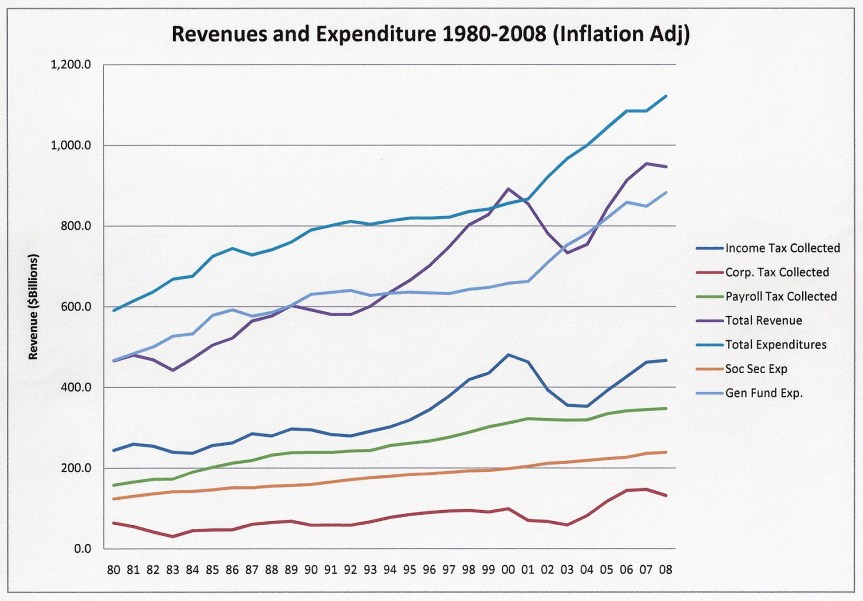
A Brief Glance at Tax Collections and Expenditures

scan0003

This has been a work in progress today as I do other things. This is the third graph I have done – each requires that I input data into Excel, draw a graph, scan the graph and load it into WordPress. I hope I am done with that.

The lines are, top to bottom:

Total Federal Government Expenditures (Gay blue)
Total Revenue (Purple hue)
General Fund Expenditures (Navy Bluish hue)
Income Tax Collections (Dark Blue)
Payroll Tax Collections (Green)
Social Security Expenditures (Tan)
Corporate Tax Collections (Brown)

All are inflation-adjusted – 1980 = 100.

Conclusions:

1) The more lines, the harder to interpret, and the narrow space allotted by WordPress makes matters worse. The colors assigned by Excel are too close together in the blue range.

2) Total revenue (purple) has taken serious hits in the early 1980’s and early 2000’s, due to tax cuts. After taking those hits, it climbs back up to the same line it was on before the tax cuts took effect. In other words, we are on the left side of the Laffer Curve. Furthermore, tax cuts do not produce increased revenue. Never have. That’s Reaganist mythology.

3) Social Security revenues (green) and expenditures (tan) run a straight line. Revenues outpace expenditures consistently, though not so much as indicated on the chart, as “Payroll Tax” (green) also includes Medicare receipts.

4) Corporate revenues have been relatively flat – that sector is carrying less and less of the burden. The “corporate tax is paid by consumers” set has had their way, no matter popular opinion. Corporations have a lot of power, I might add.

5) At one time, in 1999, we ran a true surplus – it is that little purple point you see above the blue line around 1999. It means that revenue from all sources exceeded all expenditures. That was probably an accident, dot-com bubble and all that. Clinton didn’t plan it, I’m sure. It’s even perilous, as people begin to clamor for thing like health care and infrastructure spending when there is a surplus. That’s why the surplus was quickly undone in the 2000’s.

6) Income taxes shot up in the 1990’s, and this was after a tax increase during a recession. This confounds the right wing, as the tax hike should have had the opposite effect.

7) Dave Budge says “You can’t draw any conclusions from this. Too many variables. (He was commenting on an earlier version I put up, but still, I take that to mean that it did not demonstrate that he is correct in his economic outlook. Otherwise, it would be highly demonstrative of practical use of right wing economics.) As it is, it pretty much shows that right wing economics is the result of flat-earth thinking.

PS: Anyone who wants to play with this some more, let me know in the comments below and I will email the Excel file to you.

Triangulation Redux

I have a problem with Obama, and it goes back to the day after he was elected. True to form for Democrats who appeal to liberals to get elected and then veer right again, he very quickly brought in Rahm Emmanuel to be his Chief of Staff. That meant that liberals were officially shut out. Emmanuel, a pro-war Democrat, is largely given credit for the 2006 takeover of the House by Democrats. In truth, most of his candidates, who he selected because they were pro-war, lost. The Democratic takeover happened in spite of him, and not because of him.

I just got done criticizing Republicans down below for their herd mentality and blind following. That’s target practice. Republicans are as Republicans are, and who really cares anyway. But Jeremy Scahill, a true progressive, has written a nice piece, Rahm Emanuel’s Think Tankers Enforce ‘Message Discipline’ Among ‘Liberals’, at Common Dreams. Emmanuel is gathering in the sheep to back Obama’s rightist agenda, and of course, they are following.

There were no blogs back in the 1990’s when I first became aware of this phenomenon. Bill Clinton led liberals over to the right and governed from the right, using what his adviser Dick Morris, now a FOX news analyist, called “triangulation”. Basically the strategy was to attack liberals from two angles, both to the right of them – Clinton and the “new Democrats”, and Republicans. It worked. Democrats supported Clinton as he starved kids to death in Iraq, bombed the place for eight years, and attacked Serbia, gave away large chunks of the commons, “reformed” welfare, sent guns and missiles to right wing paramilitaries in Colombia, sent massive aid to Turkey to aid them in a counterinsurgency against Kurds. A partial list. He had plans to privatize Social Security, but had to back off because of the Monica scandal.

Right wingers do as right wingers do. Not much we can do but sit back and enjoy the antics. It’s the art of roping liberals to follow right wing Democrats that annoys me most. Here’s Scahill:

Over the past several weeks, independent journalists and anti-war activists have tried to shine a spotlight on how groups like the Center for American Progress and MoveOn, which portrayed themselves as anti-war during the Bush-era, are now supporting the escalation and continuation of wars because their guy is now commander-in-chief. CAP has been actively pounding the pavement in support of the escalation in Afghanistan, the rebranding of the Iraq occupation and, more recently, Obama’s bloated military budget, which the group said was “on target.” MoveOn has been silent on the escalation in Afghanistan and has devoted substantial resources to promoting a federal budget that includes a $21 billion increase in military spending from the Bush-era.

MoveOn was a Democratic invention from the beginning, and we should not be surprised that they are now abandoning liberal and progressive policies in favor of their guy. Center for American Progress is probably just a front group for Clintonites. The question is, they own the administration now. Why do they even need a front group?

I guess the answer is obvious. Triangulation.

Send in the Clowns

Watching the right wing is like watching bears under the whip at a circus. They all dance in circles on command, sit back on their flanks, open their wide jaws in unison, and growl. The tea parties are the latest examples of this unity of purpose, reminding me of the old saying that when everyone thinks alike, no one is thinking at all.

What are they upset about? They’re not real clear on this. They have been instructed to say that it is about spending, and not taxes. That’s going to be a separate issue, and I imagine the Koch family is working on it right now. But what about spending?

Well, they don’t say much about it except that they are against it. It’s a completion of the circle for them. Prior to Ronald Reagan, they were against deficits and social spending, and as the Great Communicator ran up the largest deficits in history, they lined up like school children behind him. Then came Bush Sr., and the S&L bailout, and more spending, and not much protest except among the few true conservatives and libertarians left over there. Then Goldwater died, and there was but one left. Ron Paul.

Clinton came along, and due to an unexpected bubble, in the last few year of his administration we had a surplus (if you don’t count borrowing from Social Security). That’s a dangerous thing – when the government runs a surplus, people begin to think about things like health care and infrastructure. Along came Bush II, who very deliberately and methodically eliminated the surplus, and again went about the business of running up massive debt.

And the children lined up and cheered. As Dick Cheney said, “Reagan proved deficits don’t matter”.

Bush left the Obama Administration with a $1.2 trillion deficit, basically disabling any kind of health care reform. Not a word about spending from the circus clowns.

Oh, why go on. We know what this is all about. It’s a stage play, much like New Gingrich’s Contract on America, designed to lure moderate voters over to the far right. Will it work? Doesn’t appear so at this time.

But the children are lined up.

Truthfully, there’s no salvation for us here. Americans are trained to believe that their salvation lies in one party versus another, even as both shut out populist movements and play patty whack with the bankers and wealthy families and corporations. There’s very little left of this Republic to pick over – it’s a carcass now. But watching these fools, these circus clowns doing their tricks is disturbing. It makes me wonder if there is a thoughtful person left on the right.

Budge has been silent on this matter. Kudos to him.