
In a post down below, I asked for opinions on why we are in Afghanistan. I got four responses: Wars always come in pairs (rightsaidfred); domestic politics and some pipeline geopolitics (ladybug); destruction of the Obama presidency (Charliecarp); and finally, encirclement of Iran in preparation for a three-pronged invasion (Blackflag).
In 1989 Iran and Iraq had one thing in common – both had independent foreign policies. Surrounded by U.S. puppets and collaborators, each was seen by the U.S. as poison. As soon as it was clear that the Soviets were no longer a threat, the U.S. attacked Iraq (1991), and then over the following twelve years strangled it, eventually invading and installing a puppet government in 2003.
Iran is a much larger and more powerful nation, and has been a tougher nut to crack. The U.S. tried to undermine its elections this year, without success. The Iraq bases are a real threat to Iran, and Israel can always be used to attack – the question is, does Iran have a credible deterrent? They appear to – the U.S. has not attacked, nor has Israel.
And an Iran with a nuclear bomb would be unassailable, hence the multi-pronged offensive to keep them from developing such a weapon. It’s not about our security or Europe’s – it’s about their ability to deter an attack by having the ability to inflict meaningful countermeasures.
Iran has fully absorbed the lesson of Iraq: Weakness induces attack. After twelve years of strangulation and disarmament, Iraq lacked a meaningful deterrent. The invasion followed like Mary’s lamb. Iran sees this, and knows it must arm itself in everyway possible to maintain it’s independence.
So what’s up with Afghanistan? Iran sits atop massive natural gas fields – it has far more gas than oil, the second largest supply in the world. On May 24, 2009, Iran and Pakistan signed a 25-year deal for Iran to supply gas to Pakistan with a $7 billion pipeline to be built across Afghanistan into Pakistan. This is the blue-dashed line below – the “IPI” Pipeline.
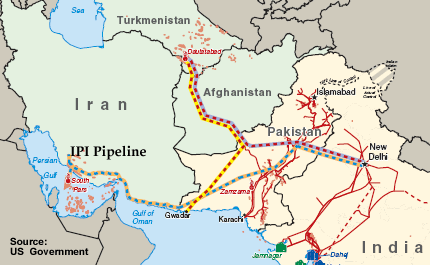
The implications are staggering – an alliance of Sunni and Shiites with potential future pipeline spurs to energy-starved India, and even China. And Russia strongly supports the deal – the alternative market for Iranian gas is Western Europe, which is currently supplied by the Russians. Iranian gas going to Asia is beneficial to the Russians in preserving their existing market.
Remember the acronym “TAPI”, or the Turkmenistan-Afghanistan-Pakistan-India pipeline, aka “TAP”, or Trans-Afghanistan Pipeline. This pipeline has been in the works, and was the reason why the U.S. military (allegedly) threatened the Taliban prior to 9/11 to bury them either under a “carpet of gold or a carpet of bombs”. TAPI is the red/yellow line on the map above.
Hindu India does not want to depend on Muslim Pakistan for energy, and so favors the TAPI line over the Iran-Pakistan line. And the U.S., of course, does not want Iran to have any options until it can install a puppet government there. (1979 was the year Iran gained its independence, and the U.S. has never forgiven them.)
So why are we in Afghanistan? There are many reasons – geopolitics, the Great Game, to clear the way for TAPI, to isolate Iran, to keep India from becoming dependent on Pakistan, to have a strong military presence in a critical area close to energy supplies critical to the region.
The reasons given for being there: To overthrow the Taliban, a security threat to us, “terrorists” in the hills of Pakistan, concern for human rights, nation building … these reasons are all smoke. All are false.
Obama has not changed one facet or detail in U.S. policy in that area of the world, and is forced to stand behind a podium and lie through his teeth now, just as Bush did before him.
It’s business as usual. Democrats are now carrying forward with the policy handed them by Bush, who inherited it from Clinton. For all I know, it could go back as far as 1979, when the U.S. first enticed the Russians to invade Afghanistan.
—–
Good reading on the subject here, from whence I stole the map above.
 Piece of Mindful
I should re-read. I was answering ‘what are we doing in Afghanistan’ not ‘why are we in Afghanistan.’
I don’t think the pipeline has much if anything to do with it. This one isn’t, imo, about natural resources at all. Not for us. It’s about the Pakistani nuclear arsenal, 9/11, and an inability to admit that we can’t remake the world in our image.*
I think you jump over a pretty crucial step in describing the relationship with Iraq as well.The invasion of Kuwait was a big deal, and I don’t care what kind of stupid shit April Glaspie said or was thought to have said.
* Not without total destruction, as in Germany and Japan, followed by fear of a common enemy. Mere shock and awe doesn’t work any better than sanctions. (Morons hoped we could get Iran built up as the common enemy, and replicate this for Iraq. Too bad the leaders of all the factions we like have strong ties to Iran.)
LikeLike
I put forth my views as settled facts, which I know they are not. The Gillaspie business was quite real, but beyond that, the US response to Kuwait was so brutal and disproportionate that it was obvious to me that they were achieving other objectives than merely removing Iraq from Kuwait, which could have been done without violence.
LikeLike
Maybe it could have. The idea though, and imo there are a bunch of people who believe in this, was that if we engage in huge overkill it’ll deter other people from messing with anyone within whatever perimeter we see fit to announce. Even retroactively.
Shock and awe.
The death penalty as practiced in Texas.
There’s also the Saudi relationship to the Bush family to think of. You know, bin Laden wanted to be allowed to drive Iraq out of Kuwait, and was honked off that the Saudis chose us instead. And I’m guessing that the Saudis were happy to make that choice, and that overwhelming force served both the needs of the princes, and the whole Weinberger/Powell doctrine faction in the US military.
LikeLike
Actually, the Iraq war was started in large part at the urging of an Iranian agent, and put pro-Iranian factions in charge. This resolved Iran’s central strategic challenge for decades at least. People, Amerivcans!, used to whine about post-war Iranian meddling in Iraq. While we’re backing one faction against others with more than 100k troops. Guess what, we can go home whenever we want. Iran has to care, and care deeply, about how Iraq is being run for the rest of all time. Doesn’t mean we have to like what Iran does, but it’s 4 year old tantrum material to complain that they are meddling as they mediate between different groups all of which are on their payroll in one way or another.
The point of this comment, then, is to suggest that maybe we’re not really the agents in Iraq. We got played by Iran, and, wow, Iran won the war.
LikeLike
I’m a little incredulous about that as I watch world oil companies troop into Iraq and walk off with its formerly-nationalized oil.
LikeLike
That hurting Iran? Nope. Iran wants a weak and dependent Iraq.
Pakistan wants a weak and dependent Afghanistan. Unfortunately, it’s neither playing us or the Afghan factions as skillfully as the Iranians.
Big dumb lummox getting played by people with more direct interests. More stupid than amazingly clever. That’s kind of where I am today.
LikeLike
Interesting points you raise … I view the key event as the fall of the Soviets, as Iraq had lived in its shadow and skillfully played one superpower against the other. It was not all that hard to get the Emir of Kuwait to antagonize Saddam by slant drilling the Ramallah Field thumbing his nose at him, and anyway, Saddam fully knew there would be no “Kuwait” except that the Brits wanted to cut Iraq’s access to ports off.
So enticing Saddam to invade was a nice trick, and when Saddam asked Gillaspie the US position, he got a green light.
The barbaric attack against Iraq’s infrastructure, and the subsequent sanctions, were directed against its civilian population. It might have been a warning, might have been long planned. I suspect the latter.
LikeLike
Good post, Mark.
Just a small point, there could also be concurrent motives as well – such as surrounding Iran and building an oil pipeline.
We have to consider that because if we see factors that seem to not apply to one motive – if we were thinking of only a single motive – we may come to believe that motive might not be true.
But it might be a factor to a second, concurrent motive – and as such doesn’t disprove our primary motive at all.
LikeLike
Fourth to last paragraph:
It’s very complicated, but my larger point is the huge web of lies that surround our presence there. Why? We can’t handle the truth.
LikeLike
If, as I suggest, the truth is that we can’t find our asses with both hands, then yes, there are a lot of people that have trouble handling that.
Remember when Chalabi floated the idea that if we invaded Iraq, the old Mosul to Haifa pipeline could be revived? What kind of idiot does it take to believe such a thing? First class.
LikeLike
I don’t know, Charlie – large organizations can be very inefficient, especially one like the Pentagon that has unlimited funds and is accountable to no one.
But I don’t draw from that that they merely bounce from one fuckup to another. There are motives, planning, smart people and very smart people, a propaganda branch, and a public that wants too see white horses and shining knights.
Remember that Cheney, in his enegry meeting in early 2001 had a map divvying up Iraq’s oil fields. That’s the only document made public, thanks to Freedom Watch.
Why wasn’t that treated as news?
LikeLike
We would be foolish to underestimate the Russian, Chinese and Indian influenced, all historical. What if the U.S. lost Texas to Mexico. Would we forget about it in years, decades, centuries?
The other thing to consider is the changing relationship between multi-national corporations and state governments. The prey has become the predator. The constructed “narrative” needed to keep (pick a country, any country) patriots from the truth becomes more and more Orwellian. Today’s uber-capitalists love money, not country. When they have sucked all the blood from our middle class, the U.S. will be left like roadkill on the highway to the next host. Vampires.
LikeLike
I operate on the assumption that multinational corporations dictate American foreign policy. I guess I should say that outright.
LikeLike
I agree, and has done so since mid-1800’s.
Selected incursions….
1864 – Japan. – September 4 to 14. Naval forces of the United States, Great Britain, France, and the Netherlands compelled Japan and the Prince of Nagato in particular to permit the Straits of Shimonoseki to be used by foreign shipping.
1893 – overthrow of the Hawaiian Kingdom, January 16 to April 1. Marines landed in Hawaii, ostensibly to protect American lives and property, but many believed actually to promote a provisional government under Sanford B. Dole.<-"Mr. Banana"
1894 – Brazil. – January. A display of naval force sought to protect American commerce and shipping at Rio de Janeiro
1899-1913 – Philippine Islands. Philippine-American War US forces protected American interests
1903-14 – Panama. US forces sought to protect American interests and lives during and following the revolution for independence from Colombia over construction of the Isthmian Canal. With brief intermissions, United States Marines were stationed on the Isthmus from November 4, 1903, to January 21, 1914 to guard American interests.
1912 – Honduras. A small force landed to prevent seizure by the government of an American-owned railroad at Puerto Cortes.
1917-22 – Cuba. US forces protected American interests
1920 – Guatemala. – April 9 to 27. US forces protected the American Legation and other American interests, such as the cable station
Gen. Butler, two time Medal of Honor winner in his book "War is a Racket"
It contains this key summary:
"War is a racket. It always has been. It is possibly the oldest, easily the most profitable, surely the most vicious. It is the only one international in scope. It is the only one in which the profits are reckoned in dollars and the losses in lives. A racket is best described, I believe, as something that is not what it seems to the majority of the people. Only a small 'inside' group knows what it is about. It is conducted for the benefit of the very few, at the expense of the very many. Out of war a few people make huge fortunes."
In another often cited quote from the book Butler says:
"I spent 33 years and four months in active military service and during that period I spent most of my time as a high class muscle man for Big Business, for Wall Street and the bankers. In short, I was a racketeer, a gangster for capitalism. I helped make Mexico and especially Tampico safe for American oil interests in 1914. I helped make Haiti and Cuba a decent place for the National City Bank boys to collect revenues in. I helped in the raping of half a dozen Central American republics for the benefit of Wall Street. I helped purify Nicaragua for the International Banking House of Brown Brothers in 1902-1912. I brought light to the Dominican Republic for the American sugar interests in 1916. I helped make Honduras right for the American fruit companies in 1903. In China in 1927 I helped see to it that Standard Oil went on its way unmolested. Looking back on it, I might have given Al Capone a few hints. The best he could do was to operate his racket in three districts. I operated on three continents."
LikeLike
I don’t think the corporations dictate the big questions, just enough of the smaller ones to be able to take advantage of opportunities that are presented.
LikeLike
C’mon Charley, I think BF offers up some pretty compelling facts. What’s with two-bit opinion and no buttressing evidence? Are you connected to that “small ‘inside’ group” who “knows?” Please,do share.
LikeLike
Well, sure, protecting lives and property is something government does, and it’s always going to be the case that people with property are going to want the government to do more for them. These early 20th century incursions are pretty different from what Mark is talking about though: Dole, Chiquita etc acquired their property independent of the US military action. When locals threatened, they got Uncle Sam to step in.
Newer and more obvious examples are overthrowing Allende at the behest of Anaconda and ITT, and overthrowing Mosadegh (sp?) for the benefit of the oil companies. These were small acts, not really of the same magnitude as invading Iraq or Afghanistan. To go get new property.
I just don’t think the wars in Iraq and Afghanistan were primarily driven by corporate motives; I don’t think the purpose of the Guantanamo prison was to enrich the Halliburton company, although I’m sure they were paid buckets of money for building camps V and VI (and probably others).
LikeLike
It’s all very hard to know, as we are outsiders and can merely speculate.
This I know: There is a formula at work, and it is this: There are developed and undeveloped countries, and not enough resources that everyone can live like Europeans, Japanese, or Americans. The role of “third world” countries was to supply cheap labor and resources to the “First World”, and those that tried to break that mold were severely punished. That’s why elite commentators history will sometimes refer to Vietnam as a “demonstration”, to demonstrate to the world what happens to those who try to break the mold. That’s also the origin of the “domino theory” – that if Vietnam broke away, others would follow its example.
Iraq fits under that model – it was a third world country that had achieved a very high standard of living, nationalized its oil, and was setting a bad example for others. So it had to be crushed.
Afghanistan is different – the US is building permanent bases, but Afghanistan appears merely to be the victim of location – it is at a crossroads, and Russian, China, India, Iran and Pakistan all have interests in moving goods through that region. The US is very concerned about those countries, doing what it can to maintain leverage. So a pipeline is not the only reason, but it is a big enough reason.
By the way, the model is breaking down, what with South American countries electing true democratic governments, like Venezuela and Ecuador, and even Brazil to a degree. The US doesn’t seem to have the power to control that right now.
LikeLike
Charlie,
Also consider it isn’t just “This exclusive to That”.
In other words, it just isn’t mercantilism; it is also Imperialism too…. a concurrency of goals, not just one exclusive one.
The Hawaiian Overthrow favored the banana cartel – as well as has create a strategic base in the Pacific.
The Philippine Invasion favored many business interests – as well as a base of operation within the Pacific.
Iraq Invasion favors oil interests – as well as a base of operation to counter Russian moves into the Middle and Near East…etc.
LikeLike
…and as Mark says – geopolitical operations are game plans extending for 25 to 50 years in the future as described in Zbigniew Brzezinski, Carter’s National Security Advisor, in his post–Cold War geostrategy book “The Grand Chessboard”
We plebes do not have enough information to understand the bizarre maneuvers of national power. The best we can is follow the “Who benefits?” line of reasoning and pick up a few bread-crumb clues.
LikeLike