
 I finally had an opportunity to talk to a neighbor yesterday – let’s call him Jack for short. We’ve been living next door to each other for a year now, and have met and said hi, but never talked turkey about anything. Yesterday he and his family were standing in their driveway eating ice cream cones as we arrived home, and so began to chat. Jack is a bit reticent and standoffish, and so his body was outside the circle of conversation among his wife and mine and his kids and me. So I decided to leave the circle myself and get into his sphere a bit.
It was interesting, but a bit uncomfortable at first, and he moved off the driveway and into the street. He is a nervous type, and his hands often say more than his others means of expression. I got him to talk a bit about what he does – it’s a mixture of things. He’s a bit of a weatherman and computer geek, but is primarily a mathematician, the field in which he has a PhD. I found it easy to get him to open up after learning about this, and marveled at the science of moving equations, weather prediction, Moore’s law, randomness, and the United States of America.
He’s from Canada. Much of his reticence comes from a learned reluctance to talk about this crazy, stupid country. Once he had finished his probe of me, and learned that he could speak freely, the conversation took off. Later his wife and kids were waiting for the two of us to shut up so they could get on with their evening activity, a walk in the park. I told him we must have a barbecue, but he suggested we take a walk together in the near future. Whatever – we are moving soon, but I want to maintain contact with this very interesting man (who does not waste his free time blogging, I’m sure).
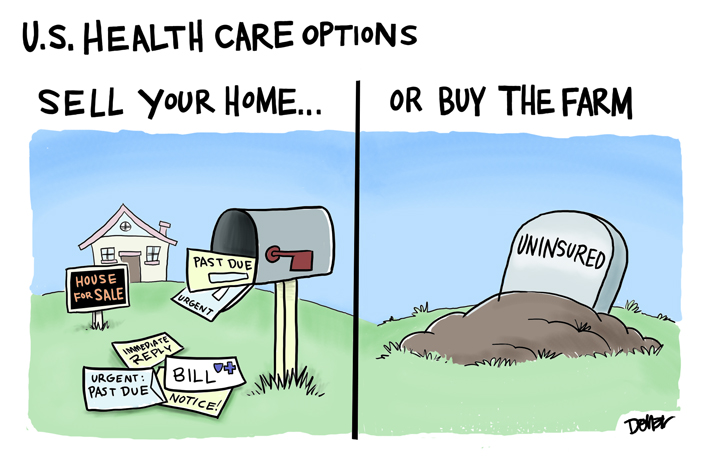 He asked me a very basic question: “Why can’t you reform the health care system?” (There were a few “Don’t get me going’s” littered about by both of us.) I told him that it was power – the health insurance companies have control of politicians and have constructed a wall around the system. They charge for entry, and rake off a large percentage of the health care dollar for their own consumption. Further, they only want to insure people who are in their prime – young and healthy. They are risk-averse. If an American is not young AND healthy, then health insurance companies don’t want to deal with him. They dump him – they don’t care what happens to him, whether he is uninsured or dies young or is so fortunate as to gain entry into a government program … they just want him to go away.
To a Canadian, this is insanity. To me, it is insanity. Canadians enjoy access to their system without having to pay a king or corporate executive a premium or royalty. Health care is a mere commodity – when we get sick, we take care of on another. In normal countries. Not in this crazy, stupid country.

I hope to take a walk with Jack very soon. He knows he can speak freely with me. I am so glad I took time to draw him out a bit. He is a brilliant man, academically speaking, but also a man living in a country whose people do not have basic intelligence or the ability to take care of their own needs. He feels a bit of an outsider. Imagine he has learned to shut up about what he sees, which is why he was reluctant to converse … until he knew that I was safe.
 Piece of Mindful
Both you and your Canadian are insane.
You say this:
Then you say this:
So, why don’t you and your Canadian apply this to every commodity?
Food is a mere commodity – everyone needs, so why should I have to pay a “royalty” for it?
Car is a mere commodity – everyone should have one, so why should I have to pay a “royalty” for it?
Every economic good is a commodity so why should I have to pay a “royalty” for it?
The fundamental problem is a failure of your understanding of economics.
You didn’t ask your Canadian how long he had to wait for his “brilliant” health system to offer services – some “services” are measured in years of wait time
And that’s your problem, Mark. You believe in free lunches.
You cannot have a commodity artificially priced below its value without that commodity consumed to exhaustion.
It will eventually show up as:
– a drop in quantity, like bread in Soviet Russia – it’s free, if you can find any.
and/or
– a drop in quality, everyone gets a free Ferrari, but it falls apart on the first pot hole.
AND
– the cost to the subsidizer will increase without any economic brakes as the pricing mechanism (and its associated, natural ability to allocate resources) has been destroyed.
Typically, the scenario you will get is both a drop in quality and quantity while the government goes bankrupt trying to pay for decreasing amounts of total junk.
You have merely replaced the voluntary trade of men with a gun as your method of distribution of economic goods. Using the gun as your tool of choice will guarantee an ever decreasing amount of economic goods until you suffer economic collapse.
LikeLike
They don’t have a gun problem up there. They are not living in a dictatorship – it’s a parliamentary democracy offering much more freedom than we have here.
We did talk about wait times – he volunteered that they do have a week or so for certain treatments … it is due to triage. When a country offers care to all its citizens, then there will be some waits for less serious conditions.
The alternative down here is based on insider-outsider status. If you are an outsider, you don’t have access to the system, and so have to wait for some emergent condition to exhibit before you can present yourself and an ER. That’s a true wait time.
And again, you are doing what all the Randians do – you take the market for other items, such as food or clothing, and say that health care should work in the same manner. Health care is a mere commodity, and having it run by government merely introduces equality and economies of scale…
Which of course, leads to the other thing about Randians … you are soooooooooooo out of touch! Health care works in Canada. It is doing just fine! They have lower costs, better outcomes. And no, they don’t rush here for care.
LikeLike
Mark,
They have the same gun problem you do – believe that the best way to allocate resources is steal them from “these” people and “give it” to those people.
Whether the bars on the cage are gold or tin, they are bars nonetheless.
You remove the choice of the individual and give it to a bureaucrat and you think this is an improvement.
There are more then the sick dichotomy of economic good allocation – either by a bureaucrat up there or a different one down here.
Again, I point to your lack of economic understanding.
Your food is allocated based on price and value. You do not demand government’s gun to allocate your food.
You cannot explain why the method of commodity allocation -when it is food- works great, yet you claim it will not work great when it is another commodity -like health.
Rand is not an economist.
All commodities, no matter what they are, obey exactly the same laws of economics.
You have not provided any reasoning to explain why your plan works for health care, but will not work for food, cars, TV sets, computers, stoves, washing machines, pencils, paper, etc.
Government does NOT introduce equality. It introduces a different system of allocation – it is still unequal. Equality does not exist in scarce resources
There is no economy of scale in government. There is no measure of economic value as the government destroys the pricing mechanism.
You have no measure to determine the economy, therefore you cannot determine whether it is better or worse, since you have destroyed economic calculation in favor of political calculation
No, they go to Mexico and buy it cheaper.
LikeLike
Nor do they go to Mexico. They do buy insurance policies before the come here, as getting sick or injured down here can be a disaster.
There is a universal need for health care, and so the private market, which can only thrive on the opportunity to exclude, has no place. I think I dealt with exclusion above. Health care is more like a utility.
The idea that markets should govern all, when only a small percentage of us are sociopaths who don’t thrive in communities, is a misfit. People care for one another in times of trouble without trying to make a buck.
That is, most of us. The U.S. is a country run by sociopaths – a future post coming up – how the definition of sociopath fits a publicly traded corporation to a tee.
And again, in 37 or 38 other countries, it works better and cheaper than us.
What the hell is wrong with you?”
LikeLike
Food, cars, and medical services all receive government subsidies. If you’re a family-run, small, or micro-business, forget it – you all that’s left of “free-markets.” If you’re rich, corporate, and you pay lobbyists directly, or through the Chamber of Commerce, you’re paying for protection from competition. Randians do not ever talk about the difference between big and small. Idealized markets do not exist outside the classroom.
Same goes for immigration policy. If you’re poor (small), you’re locked out. Rich Mexicans have no problem moving freely across our border.
That’s economics applied in the real world
LikeLike
Ladybug,
So your complaint is massive government interference, and therefore you blame those that advocate markets free from government interference.
I have found that economics, for many reasons, is the most bizarrely understood science of the masses.
LikeLike
Mark,
There is a universal need for food, yet you do not ascribe your economic theory here.
There is a universal need for houses, yet you do not ascribe your economic theory here.
There is a universal need for water, yet do do not ascribe your economic theory here.
There is a universal “need” for many things, yet your economic theory still has not provided a reason to why you think health care is a a different economic good.
I see where you economic ignorance lies. You do not understand scarcity at all.
The reason economics exists is because you need to exclude another person so that you can use the resource.
You cannot stand on the same ground as I stand.
You cannot eat the same apple as I eat.
There must be a method of allocating resources as their use is exclusive to the individual.
There are only two ways:
(1) Trade or Earn (economic way)
(2) Take or Steal (political way)
You wish to destroy (1) in favor of (2). I do not judge that choice.
However, if you destroy (1), do not insult the rest of us in claiming it is a better way, cheaper, or more economic – because it is not – it can never be a better economic outcome by destroying economics.
You want a better political outcome -fine- you got it, but at the cost of your economics.
In the end, because of your political choice, you will need to use your guns and kill people to enforce your economics or you will go bankrupt.
Prove it by describing the differences between economic good “A” and economic good “B” and the conditions that exist to make them “different”.
You argue society is sociopaths and your answer is to provide the centralized capability of massive firepower and legitimizing it for the sociopaths to use against you.
I do not fear the sociopaths. I fear those like you who give them power.
I do not accept irrational economic theories.
LikeLike
It is very easy to stratify food – some prefer and can afford caviar. But a basic healthy diet can be provided by beans and rice. So there is no need to interfere in the natural allocation of food beyond assuring that we all have access to enough calories to thrive.
The same can be said of all the other commodities you mention – stratification is healthy.
But with health care, what do you do? Allow some access to treatment for cancer, but not others? In the socialist countries, they do allow people to purchase private insurance to give them things like private rooms and fancy meals, but basic care is the same for everyone.
No one is robbed of anything except in your isolationist view. In fact, people are free to develop their talents in other ways, as basic needs are met.
Sociopaths thrive in market economies, as they live to game – nothing else-warmth, companionship or love matter to them. They usually wind up in high business circles, as one more thing is necessary to succeed in business: the kill instinct. Most of us don’t have what it takes.
LikeLike
The basis of your economic theory, as I see it, is that you wholly ignore the fundamental reason why economic exists – that is, scarcity.
Your theory requires the non-existence of the very thing your theory requires.
It is no wonder you are dazed.
You steal my money to pay for your care.
As the beneficiary to such theft, it is no surprise that you do not see this as robbery.
Such an ability to disassociate one’s benefit from someone’s loss is a sign of the very socio-pathology you claim exists.
LikeLike
BTW – economics is not a science – it is cloaked ideology.
LikeLike
Mark,
Economics is a science, based on Natural Law, which enables humans to derive consequences of human action.
Because you hate what Natural Law demands of you and you hate the consequences of your ill-conceived political dogma does not make Economics not a science.
LikeLike
Speak of the devils:
Canadians brace for higher health costs: poll
Canadians are concerned their quality of health care will decline from the strain posed by aging baby boomers, a new poll suggests.
[Damn that science of economic! Quality declines as product is exhaust! Hate Natural Law – therefore ignore it!!, right, Mark. Just too bad it doesn’t care if you ignore or not….BF]
The Canadian Medical Association carried out the poll as part of its annual report card focused on access to health-care services.
“This year our report card shows young adult Canadians are bracing for increased health-care costs in the future,” said CMA president Dr. Anne Doig.
P.O.V.
Are you concerned about increasing health-care costs? Take our poll.
“We know that as people age, they require more health-care services and right now, there is a very real worry that unless it is significantly transformed, our health-care system will not be able to meet the needs of future generations,” she said in a release.
About 80 per cent of those polled said they were concerned the quality of health care will decline from the strain on the system posed by the baby boomer generation.
A similar number, 79 per cent, were worried the health-care system will not be able to offer the same level of coverage as the baby boomers reach retirement age.
Financial burdens were also a worry:
* 76 per cent of those polled said they were concerned that they will have to pay more taxes so that the health-care system can provide services to the baby boom generation.
* 73 per cent feared they will not have enough money to maintain their health as they age, compared with 69 per cent who said their top concern was not being able to afford retirement.
* 85 per cent agreed that the rising challenges brought on by the aging baby boomer generation mean federal, provincial and territorial governments need to get on with negotiating a new health-care funding agreement.
Canadians under age 46 were more likely than baby boomers to say they were preparing for higher health-care costs, such as by buying long-term health insurance or dipping into planned retirement savings to help pay for their own future health-care costs.
In this year’s report card, 75 per cent of Canadians polled gave an A or B grade for quality of health-care services available compared to 74 per cent in 2009.
The release of the report card coincides with CMA’s annual meeting, which takes place in Niagara Falls, Ont., through Wednesday.
Earlier this month, the CMA released its report, “Health Care Transformation in Canada: Change that Works, Care that Lasts,” to spark discussion on funding, staffing and accountability among health-care professionals, politicians and the public.
The report called for the creation of a charter for patient-centred care.
[Wow! Government-run health care meets Adam Smith!! – BF]
At the CMA’s annual meeting in Niagara Falls, Ont., on Monday, patient advocate Durhane Wong-Reiger said patients want to work with doctors to improve the health-care system.
Canadians may feel their individual care is patient-centred, but the charter is a way to hold the health-care system accountable, said Wong-Reiger, who advocated on behalf of patients who were infected with HIV or hepatitis C during the tainted blood scandal in the late 1980s.
The report also sets out timelines for areas such as pharmacare, long-term care and accountability in time for the negotiation of the next federal, provincial and territorial health accord in March 2014.
[Accountable, how? Who pays? How is it measured? – BF]
Read more: http://www.cbc.ca/health/story/2010/08/23/cma-health-care-boomers-poll.html#socialcomments#ixzz0xSJhSK6G
LikeLike
Same straight as we feel down here. Why is Canada unique in your mind? They are still cheaper than us, and cover all their citizens. Why does that not sink in with you?
There is no such thing as natural law. That is totally an invention of people who don’t like living under human laws. We are here, we are all in it together, and we make rules as we need to exist in civilized society. That’s human law.
It would be nice to put a law of God above that, as it gives it the illusion that it comes from outer space, as does your “natural law”, but truth is, it is us. Period.
LikeLike
Mark,
Canada is not unique and that is my point.
Any commodity priced artificially lower than its value WILL be consumed to exhaustion NO MATTER WHERE in geographical space it exists.
You cannot use price properly to evaluate two different services, since they are completely different.
However, cheaper isn’t better.
Canada had 4.6 MRI scanners per million population while the U.S. had 19.5 per million.
Canada’s 10.3 CT scanners per million also ranked behind the U.S., which had 29.5 per million
Wait times of up to 22 months for an MRI were alleged in Saskatchewan
Again, that doesn’t prove worse either.
Ok, you win. I’ll let the Law of Gravity know the game is up and it can go home now.
Human law exists for civilization, true.
Does not disprove Natural law one little bit.
LikeLike
BF,
Free-market phoneys advocate for unfair competetive advantage, not free markets for all. There is no sense advocating for something that does not exist, and never will. In tribal governments, powerful families, clans, give friends and relatives advantage over those less connected. We call that corruption. In our country, the centralized government does essentially the same thing based on special-interest groups with money and power, excluding those without. The rich get richer, the poor poorer. Blame government, blame the Heritage Foundation, or Chamber of Commerce, it doesn’t matter, it’s corrupt top to bottom. Neoliberals (today’s rulers) are liars that want subsidies for their own benefit, not for the public good.
Yes, I’d like less reliance on government in many, many areas.
When it comes to health care, however, I think government regulated utility models work best. But then there’s always that corruption factor to worry about.
LikeLike
Yeah yeah yeah, Canada sucks got it got it got it. How do you know they under-price their service? Perhaps here, where it is cordoned off for the purpose of exclusion, it is overpriced? Ya think?
And again, 37 or 38 countries where it works, one country where it doesn’t work, and it doesn’t sink in. Unbelievable!
Gravity? You’re kidding, right?
No, I mean that this thing you call “natural law” – I know about it. It’s an artificial construct, a figment of the imagination. You’re saying that certain rules of existence, like gravity, cannot be overridden. And market is one.
You’re wrong. That’s all. You are wrong. Markets are not some function that was planted on the earth along with our DNA. They are a product of our interactions, and can easily be regulated. Left unregulated, they go crazy, and like fire, consume us.
Everyone fears the force of unregulated markets. Only people with power can exempt themselves. Want to know a group of people with no power to exempt themselves? Slaves, for one. Sweatshop workers? Non-unionized workers?
Who is exempt from markets? Wealthy people? Large corporations.
It’s a game! Markets are like Twain’s great books – everyone loves them to the exact degree they do not experience them.
Want to know a man who never had to experience a free market?
Milton Friedman.
LikeLike
Mark,
By the fact it is subsidized.
Overpriced? To determine that requires a free market in contrast.
The problem: Canada can only be “Planned” or “Free” – but not both at the same time. Comparison is thus impossible.
It does not work anywhere. You are fooled by your illusions. See my new post.
No, I’m not kidding. It’s a Natural Law.
Humans are as “natural” as any other part of nature.
Gravity can be “overridden” – you have flown, right?
By understanding the fundamentals explains why you fall and fly.
True:
True.
False
Natural law determines the consequences of your “regulation” – it is not saying you “can’t regulate” – it says if you do, “this” will happen.
You hate that. You know that “this” is bad for “us”…but good for you. But you are not an evil man, so you do not like “bad” for us… but you really like the “good for you.”
You are conflicted and thus apply deep illusions and fantasy to solve it.
Many men fear the freedom of others but not the freedom for themselves.
“Freedom for me but not for you” dominates many men’s ideas.
With fear, men replace voluntary action with violence and think they are solving violence.
LikeLike
(Cross posted)
I would like bring forth some clarity regarding the basic fundamentals of often-posted concepts.
Note: — My use of Left/Right is NOT describing political spectrum, but sides of an equation; Left side of the Equation/Right side of the Equation)
These fundamentals will face the application of human action to determine consequences.
One such human action, which will be referred to many times, is:
“What is good for a person will be repeated, what is bad for a person will be avoided”
There are two, fundamental methods of exchange.
(1) Win/Lose
(2) Win/Win
These fundamentals created a sub-strata of consequences.
First, Win/Lose.
The Left side gains at the loss of the Right side.
This is commonly also referred to as a “Zero sum game”, but that term is an improper understanding and mis-applied here.
Applying human action, the Right side will avoid this transaction and refuse it.
Thus, to achieve their gain, the Left must use force/violence on the Right to compel the surrender of their goods and enforce their loss.
Fundamental consequences:
– the Right produces less goods for the Left to seize. (Human action of avoidance)
– The Left will use more force/violence to seize an ever-increasing amount of goods. (Human action of success)
Eventually, the Right will resist the Left’s use of force/violence with a response of force/violence of their own.
This will cause either:
(1) A reversal of Left/Right;
– those on the Right of the equation win, and become the Left side, and the Left are caused to submit and become the Right side.
The Win/Lose scenario, however, has not changed fundamentally – only those on whatever side have changed.
Thus, the Win/Lose scenario re-cycles except at a fundamentally degraded state as the economy/society has been damaged by the previous runs of the cycle.
This cyclical flip-flop of sides continues until:
(2) Lose/Lose;
– There are no more goods available to seize (destroyed or lack of production due to avoidance) and the economy/society totally collapses.
Both sides die badly.
Important: Win/Lose always ends badly. Such a bad ending is unavoidable if Win/Lose scenarios are enforced and continued.
Next, Win/Win;
Both sides of the transaction receive a benefit from the exchange.
If one side does not receive a benefit, there is no transactions, a No-Win/No-Win.
This is fallaciously confused (purposely?) by some political advocates as a loss – but it not.
Neither side has lost their goods – they still have exactly what they had before the attempt at exchange. Thus, the concept of “loss” cannot be applied.
This is important because many political advocates will use their fallacy to justify moving the Win/Win scenario consequence of No-Win/No-Win to a Win/Lose circumstance by claiming that the No-win/No-win is a “Lose/Lose”!.
This nefarious intellectual foolery is incredibly dangerous.
Using human action, what is successful will be repeated, thus:
Win/Win scenarios will be repeated by both sides and in great velocity and quantity.
This creates an exponential increase in the prosperity and life style of all sides and hence of the economy and society in general.
Exponential growth here is important, and I will be referring to this.
This is not a factor in the Win/Lose – only one side wants to increase the speed, the other side is applying the brakes. This circumstance creates a linear regression, as already described above.
But when both sides engage in repetition, it is a doubling factor ie: exponential.
A quick understanding of the power of exponential:
-Michigan Stadium is the largest football stadium in the USA.
-I am standing in mid-field with an eye-dropper and you are sitting in the upper most seat of the stadium.
-I squeeze out one drop of water in the first second, two in the second, four in the third, eight in the fifth, and so on … doubling the drops every second.
How long will it take to drown you? (That is, fill the stadium to the top with water?)
Answer: 45 minutes.
Now, you may think that is fast, but the astounding thing about this example is:
At the 40 minute mark, you do not perceive any water in the stadium, it is less than an inch deep at that time. In 5 minutes after that, you’ve drowned.
The point of this lesson is that exponential growth curves have a very long “tail” and then have a sudden, nearly straight up neck. All the “mass” of the growth is back-ended at the neck.
Another quick story helps understand this concept:
Lilies on a lake double their growth every day.
On day 10, the lake is completely covered.
What day was the lake only half covered?
Answer: day 9
Western society has benefited from the exponential growth of Win/Win economics.
The long tail of the exponential nature that started in the mid-18th century has morphed into the “turn of the neck” in the 20th century.
It is this long tail that many political advocates claim offers an example of the “problems of Win/Win economics”, but as exampled, it is their misunderstanding of exponential growth and where the “mass” of that growth accumulates on a curve.
However, they dangerously insist that their misunderstanding is enough justification to introduce Win/Lose economics to “correct” the “mistakes” of Win/Win economics.
Win/Win economics is sustainable indefinitely and exponentially accelerates, creating exponential growth and prosperity for all society.
More fundamental causation:
There exists a number of co-mixing of these two fundamental systems (Win/Win and Win/Lose) – called “mixed” economies. A bit of a discussion here:
All “mixed” economies exist after the long tail of success of a Win/Win economy has achieved the “turn at the neck”.
Any attempt at a mixed economy before the neck undermines the Win/Win exponential growth, and forces the economy into the Win/Lose stagnation and collapse. (Example, Russia)
Thus, the only examples that can exist is one where the Win/Lose economy is substantially introduced after a long success of a Win/Win economy.
Thus, we see in modern economies that started substantially as “Free” market, and after a few centuries became infiltrated with “Planned” market philosophies.
Win/Lose political advocates claim that a Mixed Economy is sustainable, and they are partly right – however, they claim the wrong reason.
They claim the Mixed economy is “successful” on the merits of their political Win/Lose action – that is, on the “success” of violent redistribution of wealth. But on simple fundamental review as provided above, we can see that this is completely untrue.
A Win/Lose policy is linear regressed – straight line regression into stagnation, where Win/Win policy is exponentially positive.
Thus, applying a linear regression to an exponentially positive curve causes the curve to flatten away from the optimum – that is the curve of the neck is less straight up and more flat.
As long as the resulting curve is still positive, the “mixing” is sustainable – albeit at a far lower prosperity to society than if no Win/Lose was introduced.
But applying human action, again, to the “Mixed” scenario.
The advocates of Win/Lose policies continue to see these as successful as society continues to prosper.
As these advocates believe it is their policy which is creating the success (instead of understanding it is degrading it), they demand more of their policies as time goes by.
But here is the fundamental point and problem:
Where Win/Win policy advocates have refused the use of force/violence as part of their policy regime, the Win/Lose advocates demand more force/violence as part of theirs.
Where one policy group refuses violence while another policy group demands the increases of its use will accelerate the application of Win/Lose scenarios in replacing Win/Win scenarios until the exponential growth of Win/Win scenarios is completely undermined.
The system then degrades completely to a Win/Lose scenario.
This outcome was highlighted in the Noble prize winning concepts of Hayek, what he called fatal conceit – that those that advocate for the use of force to “correct” what they see as market failures undermines society because of their conceit and ignorance.
It was my goal to present some basic fundamentals of human systems.
All complex societies are derived from these fundamentals.
When advocates of certain actions within society present their arguments, flush with rhetoric, it is core to address their claims against these fundamentals to make your rational decisions on the merits of their arguments
LikeLike
Mother-of-two Elin Andersson has highlighted staffing shortage problems at a maternity ward in Sundsvall in northern Sweden after she was asked to clean out her own hospital room just two days after giving birth by caesarean section
LikeLike
You want scary anecdotes, you should visit this place they call US of A. It’s only a seven or eight week journey from your abode on Mars.
LikeLike