
The twentieth century has been characterized by three developments of great political importance: the growth of democracy, the growth of corporate power, and the growth of corporate propaganda as a means of protecting corporate power against democracy. (Alex Carey, Taking the Risk out of Democracy: Propaganda in the U.S. and Australia, 1995) [This is the opening citation in Potter’s book.]
 One of the nagging questions about health care “reform” is “Why now?” Health care reform has been one our primary concerns for decades. The problems we face now were minor when Clinton proposed his plan in the early 1990’s. It was a festering problem in 2004 when John Kerry avoided it. Why now?
 We drove into Denver last night to hear Wendell Potter discuss the issues. Potter was a PR executive for CIGNA, but also a man with a conscience who, in the end, did the right thing, the costly thing. He walked away from CIGNA and turned against his former employers. He became an advocate for true reform.
He answered the question, though I did not like the answer. I paraphrase: Wall Street is making severe demands of health insurance companies. They have to deliver excellent returns to investors, or the investors flee. In 1993, when Clinton proposed his plan, the “medical loss ratio” (“MLR” – the amount that insurance companies pay out in actual medical expenses for clients) was around 95%. Most companies were not-for-profit.
Then the for-profits moved in.
Most of the not-for-profits are gone now, and the industry is driven by Wall Street. MLR now hovers around 80%. Insurers are looking for new and better ways to squeeze more profit out of this system. Their long-term plan is to force us all into crappy high-cost high-deductible policies, and sell junk insurance for the more destitute (these are plans that cover some in-system doctor bills, but not hospitalization). But they know that the fallout for this will be more pressure for true reform, even single payer (or at least a public option).
So they went to Obama and the Democrats for “reform.” That’s why it finally became a campaign issue. The lobby called “AHIP” (America’s Health Insurance Plans) wanted it.
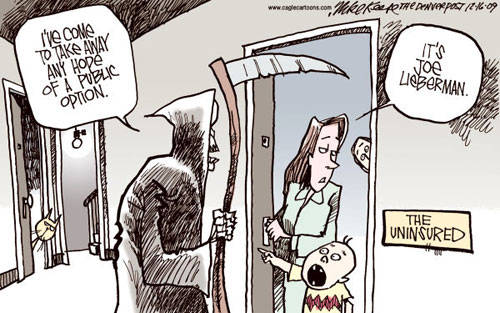 AHIP went into the game knowing exactly what they needed, and got it. One, they want a private mandate – the ability for force us to buy their products. Second, they wanted no government competition, no public option. In the reform charade, the Kabuki theater that Obama, Baucus, Lieberman, Nelson and the other Democrats put us through in 2009, it had already been decided that there would be no public option and a private mandate. The insurers bought Obama, and Obama delivered.
That’s why we finally got reform. Wall Street decided it was time.
____________________
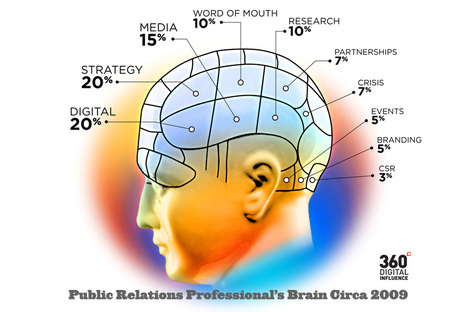 Potter is at heart a journalist who lost his way, finding his way back after decades of public relations. He watched the health care debate unfold, and understood the forces at work. Phrases like “death panels,” “government takeover,” and “job killing” are professionally crafted, the specialty of the PR industry. They are planted in the dialogue, and then spread like viruses. They are short and memorable, and pack emotional punch. That is usually all that is needed to win a debate in our shill-infested environment. (Isn’t it interesting that the Democrats can never manage to come up with a good hard-hitting name for the things they supposedly favor? S-CHIP anyone?)
Potter is on a book tour now, which is why he was in Denver. Most of his talk was Q&A, and there were very good questions.
Here’s his take on what is unfolding right now: While the health insurers got most of what they wanted out of Obama’s bill, there were some unpleasant features that they want eliminated. One, they want the 80% cap on medical losses eliminated. (As outrageous as that number is, it merely froze them in time – that’s where they were already at.) There’s also a provision in the law that mandates basic benefits that must be covered, basically outlawing junk insurance. They have bought the companies that sell the junk, and so want that provision gone.
There is also a provision in the bill (coupled with the private mandate) that prohibits insurers from denying coverage for “preexisting conditions” starting in 2014. Right now these poor schmucks are being sent to state exchanges that are adversely selected and prohibitively expensive. (Potter did not talk about this, but surely the “reform” that now exists is useless – about 8,000 people nationwide have taken advantage of the exchanges.)
“This legislation will set into motion several key reforms. First, it will eliminate the possibility that individuals can be denied coverage because they have a preexisting medical condition. Second, it will require insurance companies to sell coverage to small employer groups and to individuals who lose group coverage without regard to their health risk status. Finally, it will require insurers to renew the policies they sell to groups and individuals.”
Those words are from Bill Clinton’s signing statement for HIPAA, the portability act passed in 1996. The insurers merely countered by making portable insurance unaffordable. I do not believe that there is a real fix in Obamacare for preexisting conditions because there were no cost controls. Nonetheless, expect that the preexisting condition mandate scheduled to take force in 2014 will disappear. Already the PR industry is hard at work – they are saying that we who have preexisting conditions are actually people who wait to buy insurance until we get sick. That’s how they are selling the repeal. It invokes the notion of freeloading, and so has emotional punch.
Anyway, Potter’s message was that current bill that passed the House, the title of which actually contains the PR-written catchphrase “jobs-killing”, is a smokescreen. Of course it won’t pass, but the real negotiating is going on elsewhere. AHIP is under incredible pressure to produce more profit for the investors. Expect that the few actual reforms that were included in reform will disappear.
And Obama will not stop them. He’s no friend of Jack.
__________________
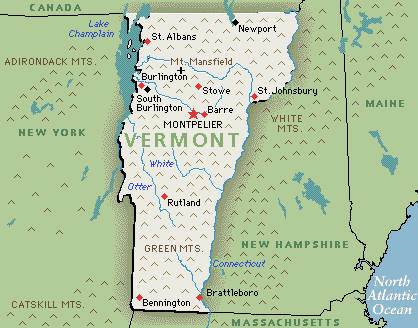
In the board game Monopoly, there comes a point late in the game when so much power has acceded to one player that he can easily overwhelm all the others. We are probably at that point in the health care game, when our best hope is that a tiny state might boot the for-profits. But it might be our green sprout, our lifeline, a sliver of light in our darkest hour before dawn.
Let’s hope so, as it is all we have right now.
 Piece of Mindful
Wall Street is making severe demands of health insurance companies. They have to deliver excellent returns to investors, or the investors flee.
I don’t see why this is such a controlling factor. Multitudes of businesses operate in this country without paying one whit of attention to Wall Street. Customers are the controlling factor here, customers go to the best companies. Does Wall Street tell customers where to go?
Even if we give you the power to slap around insurance companies, how does this ameliorate the cost problem? You could cut insurance overhead to 1/10 of 1 percent, and every other complaint remains.
single payer is on the table in Vermont and California.
I’ll hold out hope that I will be pleasantly surprised, but I’ve seen our government in action. I have great confidence they will find a way to make the situation worse. I expect this headline:
(AP) California today announced a large side payment to doctors for every white patient that dies. A Green party spokesman expressed their pleasure with this law, noting the extreme cost to the environment of white people, and how they need to get on with the business of dying and thus releasing more resources for the proper people of the planet.
(Above idea from here.
LikeLike
Customers are not the controlling factor. This gets down the the basics of health insurance: Companies make money by not paying claims. Their objectives and good service to clients are at odds with each other. It’s a bad business model.
Go down below and read the Lindsey Jackson piece to understand more – why for-profit health insurance is the cause of most of our problems. Report back.
This is one of those right wing truisms that gets repeated ad nauseum, and is never challenged when you are among your own. Problem is, however, that it’s not true. Government does many things well, as seen in 33 other countries with better health care than us.
LikeLike
This gets down the the basics of health insurance: Companies make money by not paying claims.
Every person and institution is out to “make money”, yet somehow the world moves on.
Insurance companies seem to pay out plenty. I’ve heard that some even pay out 80% of revenue in claims!
I query again: if you stuff this 20% back into the pockets of customers, how does this help all the other complaints about health care?
You make some facile arguments below, such as, “the lack of payment by companies causes doctors and hospitals to over bill their paying customers, thus driving up costs.” Well, the over-payers pick up for the slackers, so the real solution is to get the slackers to pay their share. We’ll still have our high cost system. I don’t see where pulpating the middle man helps.
Every enterprise is under pressure to generate returns, i.e. money for nothing. You yourself are on a jag to get free health care. Every bureaucracy is subject to a “profit motive”: get the biggest budget they can, hire all the people they can, expand their turf, make the jobs easy, screw the customer just to the point before open revolt. Angels don’t appear just because something has been put under government control. Look at the VA and the Indian Health Service.
LikeLike
Man, it is so ’round and round we go’ with you. First, your claim above that all we need do is move from one insurer to another when we don’t like the service. One, they don’t compete on prices – that is the whole point of monopoly and having antitrust exemptions. Yeah, it’s not “monopoly” per se, but when one company controls as little as 20% of a market, the monopoly mentality sets in. These guys control far more than that. Two: Suppose you have a health problem and don’t like the way the insurer handled it – if you are insured through your employer, your only recourse is to go the the state insurance commissioner for redress. Sometimes that works. If a whole bunch of people are dissatisfied with service, the employer might seek out a new carrier, but there are no cost savings in doing this due to lack of competition, so it usually does not happen.
If you are in the private insurance market, and are dissatisfied with your carrier, you can indeed shop around. Montana has two carriers that control just about everything – BCBS and New West. There’s no price competition between them, and if your medical condition was serious, you’ve now got a preexisting condition, and the other carrier won’t touch you.
Your blase’ attitude about this tremendous overhead factor (added to that of doctors and hospitals, that too a product of the demands of private insurance, it’s about 1/3) is stunning. Right now health care is pushing towards 18% of GDP, op which 6% is medical overhead. What would that do back in the pockets of consumers? It would increase demand for other goods and services.
Add to this the fact that insurers avoid paying claims wherever possible, so that doctors and hospitals pad their claims, incessantly driving costs upwards, and you can see why our costs are irrationally off the charts. Other countries merely pay and audit expenses. Consequently, and I wish this would sink in, they generally cost about half of what we do, and so have all of that money left over for other things.
Take American taxes, out-of-pocket health care and out-of-pocket education and compare it to the tax burden of countries that socialize health care and education, and we are paying far more than them and getting far less bang for the buck. Market driven health care is extremely inefficient and corrupt.
VA, by the way, is the most efficient health care delivery system in the coutnry, with the highest satisfaction rate of all, even better than that of Medicare. Indian Health Care is a problem, and I don’t see where privatizing it would help, given the incredible inefficiency of our private system.
LikeLike
I’ll post twice. Once with some general remarks, and one with a point by point response to above.
I agree our health care delivery could be better, but I don’t find the route or destination an obvious thing. There is a “conservation of social momentum” to these things. “Meet the new boss, same as the old boss.”
We are not as bad as you like to portray us: I was reading a poll today that put Americans as the most satisfied with their health system. here. As I keep reading somewhere, “The whole aim of practical politics is to keep the populace alarmed (and hence clamorous to be led to safety) by menacing it with an endless series of hobgoblins…”
(A little stream of consciousness here:) When I read about health care reform, I ask myself, “from where are the cost savings going to come? Who’s going to take less money? Comes now Tokarski. What’s his schtick? He wants to tie up the insurance companies and kick ’em in the balls for eternity. Yes, yes, that is probably a good idea, but how will that cut costs? Seems to me they just pay the bills and add 20% to cover their gambling habit. I suppose we can cut the 20% overhead…or is it 33%? But I’ve never seen much overhead cut in these situations: everyone is shocked, shocked! to find the new entity snorting as much white powder off a naked body as the person before. Hmm…he says they deny coverage in some cases…yes, but that just cuts their overall payout, and otherwise they would have to raise their rates to cover that payout. It’s a fungible thing. He says they push doctors and hospitals to pad bills of payers to cover non-payers. Again, this is a fungible thing. Doctors want their $150,000 a year, they don’t care if half their patients pay double and half pay nothing. They’ll take the same cut if the insurance companies pay the full rate for everyone. He wants the middle man to handle more money. This doesn’t save anything. What else here…he gripes about pre-existing conditions. Yes, bad deal. But how does getting a middleman to cover them save any money? He again wants the middle man to find and handle more money…He gripes about insurance companies lobbying for bills that screw the public. Okay, something here. But it is a middle man protecting their vigorish. There are still some fundamentals underlying rising health care costs: expensive tests and procedures, liability concerns on equipment and people, high wage structure in the industry, the American penchant for heroic measures in accidents and end of life situations. Whacking the insurance companies doesn’t help any of this. Mark stresses that other countries do it as well and cheaper than us. Hmm. I’m prone to make cross cultural comparisons as well, though we need to realize we don’t get a direct transfer. I’m sure there are things to learn, but we should also keep in mind other countries have different expectations, including less reliance on heroic measures: fewer premature babies and accident victims get the level of US investment. End of life procedures are less extensive over there.
LikeLike
It is so rare to get a stream of consciousness from you. Usually you jump ahead to your ill-thought-out conclusion, no offense intended. You start with a faulty premise, that health insurance is insurance, and then mix it with your preexisting premise, that markets untangle everything, as if by magic. You are unwilling to even for a moment consider the unthinkable – that marketing this commodity called health care has made a mess of it for everyone. So now you’re looking for other reasons why other countries are successful and we are not. It cannot be markets, of course, as that is your inbred ideology. So surely it must be … what?Premature babies here? We have more accidents?
When you come around to facing reality, we’ll talk again. I think you’re beginning to come to grips with it in the comment you make below this, but we’ll see.
LikeLike
One, they [insurance companies] don’t compete on prices
Yes they do. I realize there are barriers to entry and all that, but I suspect there is not really a whole bunch of money to be made in the enterprise. The insurance industry as a whole is pretty competitive (Geico etc). Health insurance is not really insurance anyway, more like a funding mechanism for known costs.
Suppose you have a health problem and don’t like the way the insurer handled it…
These problems exist under any regime. It may be better under your regime, but maybe not. Lots of isomorphism here.
this tremendous overhead factor
Okay, maybe some savings here, but I’ve seen these cries of SAVINGS FROM OVERHEAD reduction before. One man’s overhead reduction is another man’s mistaken cut to important support.
Right now health care is pushing towards 18% of GDP, of which 6% is medical overhead.
I’d like to see that number lower, also, but we need to lower people’s expectations of the health care system, if only of employment opportunities.
Add to this the fact that insurers avoid paying claims wherever possible, so that doctors and hospitals pad their claims, incessantly driving costs upwards, and you can see why our costs are irrationally off the charts. Other countries merely pay and audit expenses. Consequently, and I wish this would sink in, they generally cost about half of what we do, and so have all of that money left over for other things.
Bills avoided one place are paid in another. Are billings greater than costs? Is there really extra money floating around the system from this?
we are paying far more than them (socialized countries) and getting far less bang for the buck. Market driven health care is extremely inefficient and corrupt.
Markets seem to work in plastic surgery. The larger system in the US is mainly socialized and non-market. I realize grandma in a traffic accident doesn’t lend itself to market economics, but I don’t see where the call for more socialism helps the cause.
VA, by the way, is the most efficient health care delivery system in the country
Good. But is wasn’t always so, and was brought up by comparing it to other parts of the system.
LikeLike
Property and casualty insurance is a competitive market. The reason is that it is true insurance, where there is high unlikelihood of a claim. And even here, as with all marketing, there is deception going on. We enjoy Geico commercials immensely, but I would not touch their insurance with a ten foot pole. Years ago I gave them a try, and found that the savings they offered were to be had in reducing liability coverage to an unethical level. When I priced them at 100,000, the level I carried back then, they were the same price.
I digress.
You obviously have not experienced the health insurance “market.” One big player sets the stage, and all others are forced to act on it. If they don’t, then they end up with the rejects. So suppose that United Health Care comes into Colorado and begins to market, and their strategy is to only seek out profitable clients, people who have never been sick before. Now suppose Kaiser Permanente, a not-for-profit company that already serves this market, has been ethical and offered insurance to a broad band of people, spreading the risk and keeping costs down. KP quickly discovers that United is taking away their healthy base, and leaving them with the more sickly one. So KP is forced to stop offering insurance to the less healthy ones. United has changed the game.
In fact, this is what happened in health insurance starting in the 1990’s with the great push of private companies into the not-for-profit health insurance business. The NFP’s could not compete on their old models, and soon, one by one, either went for-profit or were taken over by Wellpoint. And the entire business model was taken over by Wall Street, which demanded that insurance companies stratify. Humana got out of hospitals, CIGNA and Aetna got out of property and casualty, and each company was reduced to one line of business.
They then began, as all companies do, to bleed the model for the sake of stockholders, most of whom are large institutions (hence called “Wall Street.”) “Overhead” is the cost of sifting through the population looking for healthy clients (the sole job of insurance salespeople is is to find healthy people and avoid sick ones); advertising, executive salaries and bonuses, dividends, a huge staff of green-eyeshaders whose only job is to devise legal means of avoiding payment of claims (“rescission” came about this way); and, of course, lobbying politicians for favorable treatment (the anti-trust exemption and “Obamacare” are insurance company giveaways) and funding astroturf groups to protect them from regulation (The “Tea Parties” initially served this function).
That’s all market magic. And it is all avoidable. Health care is a commodity – we all need it, so the best thing to do is to buy wholesale (government-run programs) and avoid the for-profit market and all of the inefficiency and greed and crime that goes with it.
By “overhead” I mean unnecessary expense. Assume, for example, that I have a kidney stone. In Great Britain or France, I go to the hospital and it gets treated and the bill is paid via the tax-funded system. End of story.
In the U.S., my hospital visit sets off a whole chain of paperwork, with co-pays, deductibles, and insurance bureaucrats breathing down the doctors’ necks making sure they don’t do anything that might cost them an extra buck. Everyone is seeking a way to dump the cost on someone else. Insurance companies review the procedure, and the hospitals have special staff and a whole set of computers and software to deal with each insurance company. That’s if I have insurance. If I don’t, then I am outside the system, and serve as a pressure relief valve. The hospitals and doctors dump everything on me -I’ll pay thousands and thousands of dollars more than in any other country because of that. And then comes the haunting … there’s a myth out there that if we can’t pay our bills, the hospitals just forgive them. That is not true – if I am indigent, then perhaps government will pick up the tab, but if I have any resources at all, the hospitals will come after me. I’ll either enter a long-term payment arrangement, or declare bankruptcy.
That’s why the knee surgery that I had last year, which “cost” overall about $15,000 (of which I paid $2,200 and the insurance company about $3,000) was so crazy expensive. It did not really cost $15,000, but the doctors and hospitals had to show that much expense to justify the amount that they finally collected. And if I didn’t have insurance, I would have been forced to pay the entire $15,000. For the non-insured, it is not funny-money. (Or, most likely, I simply would not have had the procedure and lived with the pain.)
In Norway, the cost would have been $1,600, paid by the tax-based system, and forgotten. Same in the UK – in Spain, for reasons unknown, the procedure would have cost $6,600.
It is the job of Democrats to lower our expectations. Some of us want more and better than your market can deliver.
You’ve said something true here, at last. I leave it to you to figure out why the cost of plastic surgery is subject to market forces, while that of chemotherapy is not.
We cannot avoid these costs. All of us, before we die, will need lots of health care. It is best to buy wholesale, which you call “socialism,” a bugaboo word for a more efficient way of doing things. It works very well is some areas, usually in the area of public utilities. While I don’t want government making my shirts and cars, I do want them running my health care system and building my roads.
That ass-pull just cost you the argument. VA is modeled on the British system. It is government-owned, and all who work there are government employees.
LikeLike
I was going to chide you above for an uninspired reply, but I see you have come through here in fine fashion.
VA is modeled on…
I’m glad you like it, but if I recall correctly it had some big problems back in the 70s, and was fixed by inspired military people who expected some service on par with civilian hospitals.
It is the job of Democrats to lower our expectations
Funny.
Some of us want more and better than your market can deliver.
Good luck with that.
overhead…knee surgery
Yes, I’m a big fan of cutting costs, but I’m a little skeptical that we can find the savings here you imply.
Billing can be streamlined, yes, but the savings would be marginal.
You get billed $15,000 for a $5000 knee surgery because you are paying for two people who paid nothing for their knee surgery. I realize this is a simplification, but at the end of the day we are paying for lots of medical procedures in this country. Changing the accounting procedures doesn’t change the costs.
One big player sets the stage, and all others are forced to act on it. If they don’t, then they end up with the rejects.
Nice exposition in this part. You are still complaining about the middle man mis-arranging the chairs. The healthy banding together for a lower insurance rate carries the implication from you that they are not paying their fair share. It is time now for another debate about what is fair and how much is fair. Insert here:_________. But again, still, at the end of the day, the insured and the uninsured are paying 18% of GDP for health care. Switching to a European system will not change this, I predict. Americans have always overpaid for stuff. We shocked the Europeans when they saw the profligacy of our army in WWII. They called them comfort brigades. Give us the British, Swiss, whatever medical system, and we will find a way to spend 18% of GDP on that. Take it to the bank.
LikeLike
I think a state-by-state approach to government-controlled healthcare would be great. Then all the freeloaders can move to those socialist states while all the productive people move out.
Or is that what you are afraid of?
LikeLike
In fact, this is what Canada did, and the for-profit boys ended up taking a hike. Be careful what you wish for.
LikeLike
I hate to keep reminding you of this—over and over and over—but America is not Canada. Do you own an atlas or what?
Nevertheless, in a society unfettered by government intervention, good things tend to increase and bad things tend to decrease. People generally want more of what they like and less of what they dislike.
Therefore, I am in favor of a state-by-state test. I would like to suggest a test in California first, since it is the most populous state and strongly inclined toward socialism. Unfortunately, it seems California’s previous welfare programs have bankrupted the state. So I guess we will have to look elsewhere for a guinea pig.
What about Massachusetts? They are pretty goofy left. Oh, that’s right. They already imploded fooling around with healthcare, didn’t they?
Any other ideas?
LikeLike
Yes, this is the United States, and our public relations industry runs the show. But nothing is written in stone – Taiwan suffered the same health care problems we do under a private system, and the transition was hard and unpopular, but it worked. About the only thing unique or different about us is the degree to which we think we are unique and different. Our socialism is the denial variety, as were awash in it – our capitalism survives because our socialism regularly bails it out.
Obamacare is basically Romneycare – the mandated private solution. It Si workign in MA, but has not brought costs down due to the reliance on private insurance.
California is a unique case, with a tax cap and incessant demand for government services. That’s not socialism, but rather American stupidity.
If you want to see a test case for what works, follow Illinois.
LikeLike
Bad choice there, Trotsky. Illinois is bankrupt, also. Too much socialism and too little capitalism!
Say, do you read the financial news at all? You seem to be oblivious to what is going on. California is bankrupt, Illinois is bankrupt, Michigan is bankrupt, etc., etc. I hope you unloaded all those municipal bonds you were sitting on!
Read this: “State bankruptcy bill imminent” (Reuters). Or try Googling “state bankruptcy.” Get up to speed for heaven’s sake. The states that dabbled in socialism the most are toast. (Internal rhyme. Cool, eh?)
What I am trying to tell you is that the happy days of out-of-control spending are gone. No state is going to enact any healthcare reform if it costs a penny. You are wasting your time lecturing on the merits of this healthcare system verses that healthcare system. We are out of money. Period.
PS: This was a side splitter: “[O]ur capitalism survives because our socialism regularly bails it out.” Apparently, no one ever told you that socialism is the spoiled stepchild of capitalism. You have to have an economic system that produces wealth before you can have a welfare system that redistributes it.
LikeLike
No no no, bucks – Illinois is going to put your economics to the wastebasket – they raised their state income tax from 3% to 5% to rescue the budget. You’ll see, most
linoleumlikely (where do th4ese Jobsian words come form – “linoleum”??], that the higher tax rates are stimulative, and that their economy, far from being hurt, is helped by the infusion of money from non-productive low quality investments into state programs and infrastructure.I don’t know if anyone ever told you, but your theories are bankrupt. When put into practice, things quickly go to hell.
LikeLike
they raised their state income tax from 3% to 5% to rescue the budget.
How long is that going to last? Historically, needs always out pace taxes until the host dies, and then you complain that the host was too weak.
LikeLike
Trotsky is just joking about Illinois and raising taxes. He knows that will tank their economy further by driving individuals and businesses out of the state. (Read about people fleeing states with high taxes: “Low-tax states attract budget-conscious Americans” (Reuters)).
Illinois, like California and other insolvent states, is caught in a debt death spiral. It will become the next Greece or Ireland. Once the suction starts, it is all over. It is the power of compound interest in reverse.
The new Republican-controlled House will not bail out these bankrupt states as the former House had done under the Porkulous Program. There are only two ways out for these states: (1) spiral into the black hole of debt oblivion and live like the Third World country they really are; or (2) declare bankruptcy and shed all their public employee unions and public pension plans and stiff their bondholders. (This is why there is a panic currently underway in the municipal bond market.)
One problem: A state cannot declare bankruptcy. States are sovereign under the US Constitution; therefore, they cannot fall under the control of a bankruptcy court, which is an instrument of the federal government.
So a new law is needed allowing states to voluntarily enter bankruptcy but not be subject to federal control.
Not being a lawyer, I have no idea how that would work. But I do know that the idea has been kicked around for six months or more and is now being taken very seriously.
Anyway, no need to worry about any new socialist programs. There is simply no money for them. If anything, socialist programs will begin dying like flies after the first frost. The welfare crowd, the public employee unions, and all the other bloodsuckers living off productive America will be lucky to hang onto half of what they have stolen when this is all over.
LikeLike
Illinois is simply seeking the proper level of taxation to support the level of service that the public demands. Too many other states avoid this hard decision, and instead lower taxes, try (and fail) to cut services, and go in the red.
Of course there is a level of taxation that is excessive, but I doubt that a modest 5% is it, and to further disabuse you of your economic fantasies, it makes no difference, from a macro standpoint, whether money is spent in the private or public sector.
LikeLike
“[I]t makes no difference, from a macro standpoint, whether money is spent in the private or public sector.”
Hahaha. Tell us all about that the next time you start crying over “unjust wars.”
LikeLike
War spending is a matter of producing things and then blowing them up, and offering make-work employment to unemployed youth. Sounds like a stimulus program to me.
Perhaps one difference between public/private spending is the incredible return we get on public projects like infrastructure and education.
LikeLike
You have a problem with war spending? Hey, you just said it makes no difference how the government spends money. Now it does?
Incredible return on public projects? Like what? All the Great Society public housing projects that had to be torn down?
Incredible return on education? I am sure that was a misprint, so I will not bother with it.
LikeLike
the proper level of taxation to support the level of service that the public demands.
The public pretty much demands infinity, so I guess the proper level of taxation is infinity.
Of course there is a level of taxation that is excessive, but I doubt that a modest 5% is it
Five percent here, five percent there, pretty soon we’re at the bare minimum needed to run a society.
Whenever I’ve spent time at the legislature, I’m struck by how many needs are out there. People testify at great length about the need for more money here and there. So much of governing involves saying “no” to people. Undertaking care of the public can be overwhelming. I can see now why, in one of the few extant writings of Barack Obaman Sr., he advocated a 100% tax rate. We’ve just got to give it up. And work harder to earn even more. From each according to their ability when on steroids and methamphetamines.
LikeLike
It’s not 5% here,m 5% there. It’s 5%.
And the restraints on public spending are intense – they have to fight for every dollar.
LikeLike
It is a 67-percent income tax hike and a 46-percent corporate income tax hike, or what the Federal Reserve likes to call an exogenous shock when explaining for the sudden collapse of an economy.
LikeLike
The Illinois situation will play out, and I’m confident their economy and budget will improve. But we don’t know, can’t know right now.
Imagine the investment return on a road between two cities. It allows them to trade. Same with the Internet. Infrastructure, blue sky research are the kinds of things that the private sector doesn’t do well. You don’t look around you and see a return on education? Good for you.
LikeLike
I’m confident their economy and budget will improve. But we don’t know, can’t know right now.
We know the feedback mechanisms in public sector spending tend toward over-spending and over-promising.
Imagine the investment return on a road between two cities.
We need to be careful here. Road and rail into the Central Valley of California was an excellent investment because it opened up a highly productive area. Ditto the barge infrastructure on the Mississippi. But not every road opens into a productive area, and resurfacing any road is a cost. Building unproductive roads is a net loss, sometimes in ways beyond the initial cost, i.e. a better road into the ghetto allows criminals easier access to victims.
You don’t look around you and see a return on education?
On some spending I do. But a lot of education spending is wasted, akin to training everyone to be a concert pianist while those who actually benefit from such training are few in number.
LikeLike
Or how about that incredible return on the US Post Office?
Read and weep:
“Postal Service Eyes Closing Thousands of Post Offices”
(The Wall Street Journal, 01/24/11)
LikeLike
You’ve heard, then, of the Internet?
By the way, the Post Office was never meant to be a profitable enterprise. It was a public service put in place to advance commerce. In that sense, it has always been profitable, as it has given us so many positive externalities.
LikeLike
“Positive Externalities” = “Junk Mail”
You are talking about an army of over a half-million government bloodsuckers. You are talking about a government-run business that lost $9 billion last year and is in hock to American taxpayers for $12 billion. You are talking about a government-run business with 32,000 post offices of which 16,000 are losing money.
And you want us to believe in your “incredible return” on government investments?
Be serious, Trotsky.
LikeLike
You’ve got nothing. You’ve got no known cause and effect here, no rigor, just Friedman et al. You lack rigor. You’re all ideology, no substance.
LikeLike
I’m totally serious. This is one of the larger failings of our system – that we do not know how to measure externalities, and narrowly measure profit by what happens inside an enterprise.
That, and your contempt for ordinary working people of average intelligence is showing. This idea that they are not entitled to a good life along with the rest of us is a little off-putting.
LikeLike
“You’ve heard, then, of the Internet?”
Have you heard of FedEx and UPS?
LikeLike
I have no contempt for ordinary working people. I am one. My wife is one. We have worked for wages all our lives, as did our parents before us.*
Mark, your distorted vision of how the world works, your simplistic calculus of good guys and bad guys, this infantile us-versus-them stuff, makes a fool out of you every time.
___________________________
* The reason for our material success is we learned early that the only reason to work for wages is to earn enough to invest. Maybe someday you will understand that.
LikeLike
I do hold some people in contempt – those who openly seek to profit off of the labor of others and claim it as their own.
FedEx and UPS are niche services. I would trust neither of them to deliver a letter for 44 cents and treat their employees fairly. UPS is unionized, and its employees are in a better position than most. FedEx I don’t know about.
Over the last forty years, wages in this country have been basically stagnant. Productivity has doubled. When did labor get dealt out of the hand? (1980).
And where has that wealth gone? 1/3 to the upper 1%, 20% to the upper 1/10th of 1%.
So tell me, Bucks – I don’t hold out that people individually are responsible for this, but the anti-union fervor of the right, and the incessant propaganda of NAM against unions has hurt people. Is ti good-guy bad-guy? No. It’s power. Unions represent worker power. I favor unions. Period.
LikeLike
Over the last forty years, wages in this country have been basically stagnant. Productivity has doubled. When did labor get dealt out of the hand? (1980).
And where has that wealth gone? 1/3 to the upper 1%, 20% to the upper 1/10th of 1%.
Many of these one percenters are of the liberal persuasion, so its not just a right wing thing.
This is a multi-faceted thing, you can’t just pin it on anti-union right wingers. There is immigration, both legal and illegal, the globalization of labor, the rise of finance, the shift in industries.
LikeLike
Also, Trotsky, will you stop this “your economics” and “your theories” stuff? You sound like you think I am the spokesman for some school or something.
I just do whatever works for me.
LikeLike
I am fully aware that you lack a (social) conscience. But don’t project that attitude on all of us.
LikeLike
I am not projecting my attitude on you.
Do you have some kind of reading disability or what?
LikeLike