
 I’ve been reading a paper presented in 1999 by Peter Orszag and Joseph Stiglitz called “Rethinking Pension Reform: Ten Myths About Social Security Systems.” It’s over my head, of course. It deals with five “macroeconomic” and five “microeconomic” myths, and treats the matter of pensions from very high above in addition to ground level.
If I may, I’ll assemble my strawmen right off: The thrust of the far right is the idea that without the link between contributions and individual pension payments, retirement benefits amount to nothing more than welfare. And anytime we give money to non-bankers and non-corporatists (who are immune to corruption), we destroy individual character.
Orszag and Stiglitz deal with the matter with much more subtlety, comparing and contrasting defined benefit versus defined contribution, and equating savings rates under both – that is, defined contribution plans displace savings in one area and replace them in another, but so do defined contribution plans.
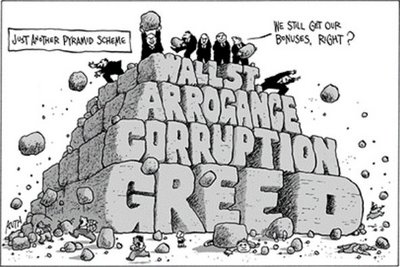
The other strawman is the idea that government is too inefficient and corrupt to run a pension plan. Set aside the fact that the American Social Security system negates that contention, and remember the lesson of the recent crash: Government failed to regulate Wall Street, and Wall Street went crazy. If we turn our pension system over the Wall Street, someone is going to have to regulate them. If government is corrupt and inefficient, then we need another mechanism.
Good luck on that.
… even in industrialized economies with relatively efficient governments and well-developed financial markets, the scale of the regulatory challenge should not be underestimated. For example, according to Arthur Levitt, Chairman of the Securities and Exchange Commission in the United States, more than half of all Americans do not know the difference between a stock and a bond; only 12 percent know the difference between a load and no-load mutual fund; only 16 percent say they have a clear understanding of what the Individual Retirement Account is; and only 8 percent say they completely understand the expenses that their mutual funds charge. The investor education and investor protection measures required to ensure that an individual account system operates well despite these knowledge gaps seem substantial.
Take a sophisticated fund salesperson, give him an easy mark, and expect that he will behave. What could possibly go wrong?
Take two examples of countries that experimented with privatizing their public pensions: Chile and the United Kingdom.
An alternative approach would be a decentralized system of individual accounts, in which workers held their accounts with various financial firms and were allowed a broad array of investment options. Under such an approach, costs tend to be significantly higher because of advertising expenses, the loss of economies-of-scale, competitive returns on financial company capital, and various other additional costs. The Advisory Council estimated that administrative costs under such a system would amount to roughly 100 basis points per year. Such costs would, over a 40-year work career, consume about 20 percent of the value of the account accumulated over the career.
Experience from both Chile and the United Kingdom is consistent with these predictions and indicates that a decentralized system of individual accounts involves significant administrative expenses. Both Chile and the United Kingdom have decentralized, privately managed accounts, and administrative costs in both countries have also proven to be surprisingly high. … Taking into account interaction effects, Murthi, Orszag, and Orszag estimate that, on average, between 40 and 45 percent of the value of individual accounts in the U.K. is consumed by various fees and costs. Given the fixed costs associated with individual accounts, furthermore, costs for smaller accounts (e.g., in developing economies with lower levels of GDP per capita) would be even higher relative to the account size if the U.K. experience were replicated in such countries.
There is a drive to privatize Social Security in this country that goes back to 1980, when Reagan took office. When Republicans have tried (Reagan in 1983, Bush in 2005), they have failed miserably. (Reagan parlayed the failure into an opportunity to raise middle and working class taxes, giving us the largest tax increase in history in exchange for that failure. Which of his faces does the right wing want to put on Mount Rushmore?)
Because we live in what is essentially a one-party state, with private corporate wealth financing the “two” parties, the thrust for privatization is two-pronged. On one side, the Republicans brazenly confront the system, and unify support for that system. As seen, that approach is not effective.
On the other side, the “enemy in our camp” approach, Democrats appear to support the current system but are its deadly enemies. By luring supporters to comfort, they can launch a surprise attack from within, and gut the system before opposition crystalizes.
This indeed was the approach that was taken by Bill Clinton, who before leaving in office in 2001 had in place an elaborate plan to privatize Social Security. He was only derailed by the Monica scandal, after which he became the program’s biggest supporter in order to rally support and save his sorry-ass presidency.
Such plans must surely be in the works now with DLC Democrat Obama as under Clinton. Without eternal vigilance (and Democrats are not vigilant when Democrats are in office), the program will not survive, and we will join the Chileans and Brits in seeing our pockets picked while Wall Street lines its own off of our private retirements.
 Piece of Mindful
What’s left to steal? SS IOUs are as good as future tax revenue from our grandchildren. Until the big banks and other monopolies (duopolies etc.) are broken up, this goes on endlessly.
LikeLike
The IOU’s are as good as the people behind them. Our generation was asked by Reagan to pre-fund our Social Security, and we did that, accumulating about $3 trillion in legal claims on taxpayers over the coming thirty years. It will be $4 trillion before they are done.
Now that we have pre-funded our retirements, they are telling us they are fresh out of money. Not so – a $4 trillion claim on a $14 trillion economy over thirty years is affordable. Trouble is, we are not dealing with people of integrity.
LikeLike
The Social Security Trust was just a front organization for government borrowing, or just another place to offload government debt issues, however you want to see it. Now the game is up. The government suction on the Fund must reverse if the Fund is to meet its obligations.
The only con left in town is called quantitative easing. It will be interesting to see how much government debt Bernanke can eat before he pukes his guts out.
LikeLike
What I like about Max is he never pulls punches and really expresses himself 🙂
It also helps that I agree with him most of the time!
LikeLike
You two should get a room.
LikeLike
Mark,
We’ll send the bill to you, right?
LikeLike
“You two should get a room.”
We have. It’s called Piece of Mind. And it’s free!
LikeLike
It’s easy to assail the moneychangers when ignoring the overall benefit of a privatized system.
Instead of looking at foreign countries why don’t you concentrate on the 15M US workers who have hit the lottery and opted out of Uncle Sam’s plantation retirement system.
Can’t cut and paste a pdf- so I’ll link this.
Click to access ssp16.pdf
LikeLike
I printed it, I’ll read it tomorrow morning. I remember high praise coming form CATO on the Chilean system from some dude there – he had a Spanish surname, and he somehow neglected to account for transaction costs, which is why Chile’s administrative drain on retirement payments if 40%.
LikeLike
Mark,
This is true.
Who is this “we” you continue to refer to??
If you give your money away to whomever you choose, I cannot say whether it destroys individual character or not.
For me, I have found that when I give MY money away to someone, I have done research in understanding that person, and have satisfied myself that it would be a “good thing”. I am confident you have done the same.
But if you are giving my money away without my agreement, indeed you are very destructive to everyone
You harm me.
You take what is mine without my permission and deprive me of it.
You harm yourself.
You have justified others to take from you without your permission.
You harm the recipient.
He will have learned that he need not earn, for someone else will steal whatever he needs for him as long as cries hard enough.
That is no strawman. It is a fact.
The government has no economic measure of success or failure – by force, it is immune to profit and loss calculation = that is, it cannot enjoy the rewards of profit and it will not suffer the punishment of bankruptcy.
It only measure political success which is gained by accolades and votes of those that gain from government largess. The means of that gain even if it leads to massive economic destruction is irrelevant – because the measure is not economic but political.
Government regulated Wall Street and that is why it went crazy.
The pure Statist Mark: the concept that “we” manage our own pensions is absolutely foreign to his mind.
Yep, called the Free Market.
Yep, because people like you are fearful of the freedom of other people.
LikeLike
I see you are doing your people-are-stupid routine again. OK. I’ll go with that.
Take all the stupid people you are trying to protect from Wall Street and force them to participate in your public pension scheme. Everyone else can provide for his own retirement.
How’s that work for you, Trotsky?
LikeLike
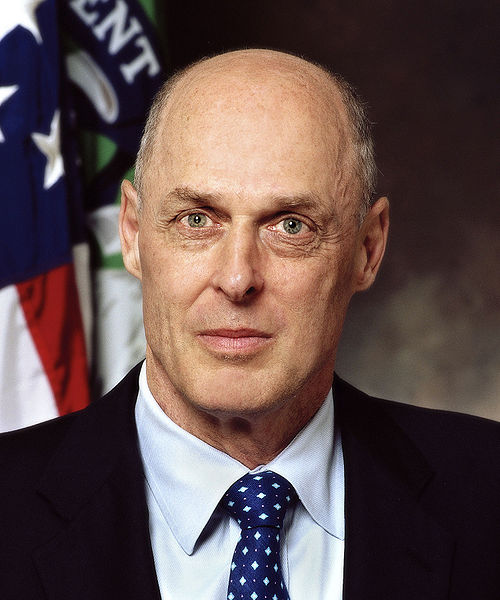
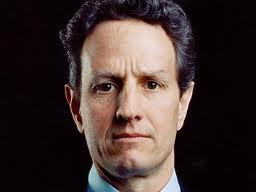
By the way, based on the photographs you furnished, my main takeaways from this post are:
1. The Treasury Department is run by Jews; and (2) that Democrats have more hair than Republicans.*
_______________________________
* It has already been established in prior posts that women prefer bald men, especially during foreplay. Thus, we may infer that Paulson’s performance was of a higher caliber than Geithner’s current performance.
LikeLike
Government deregulated Wall Street. Then it went crazy. Dispute this all you want, but Wall Street does not exist without huge subsidies. Taxdollars pay for corporate welfare. Who is exempt from taxes? Oh, that would be hundreds of multi-national corporations. Why do so-called free-marketeers love corporate welfare so? There is no free market on Wall Street.
LikeLike
Ladybug,
There are 70,000+ regulations that surround “Wall Street”.
Between 1990 and 2010, another 4,000 laws were added.
Please provide evidence that the amount of laws were reduced while 4,000 more were added.
No free marketer loves corporate welfare, so your descriptive adjective, so-called, is very appropriate.
They are not free marketers. They are mercantilists.
LikeLike
Unfathomable comment. The repeal of Glass Steagall was enough to cause the crisis. And btw, most of what went on there that brought about the crisis was perfectly legal.
LikeLike
Mark,
What is unfathomable?
You argue lack of regulation is a problem.
70,000 regulations are in place. It becomes a bizarre argument that there is a “lack” of regulation.
It was absolutely NOT the cause.
The cause was PRECISELY the artificially low interest rate by the FED.
It artificially created a flush of “virtual” capital and capital does not rest. It flows to the lowest common denominator. Thus, massive investment in massively increasing risk is your cause.
LikeLike
Your 70,000 number is unfathomable – it’s meaningless. It’s just a number, and could mean anything.
Repeal of Glass Steagall, on the other had, is real and identifiable as a cause of the crash.
And artificially low interest rates too.
LikeLike
Mark,
It is not meaningless.
It means your comment of “lack of regulation” is completely bizarre.
Further, the repeal, though real, cannot be claimed to be the cause. Removing a set of laws out of 70,000 cannot be called the cause of any “crash”.
The fundamental economics of all bubble/busts is the expansion and contraction of credit. This has been fundamental all the way back to 1913.
LikeLike
The expansion and contraction of credit was fundamental before 1913, except private banks expanded and contracted the credit, rather than the central bank.
Anyway, you are 100-percent correct. Booms and busts have nothing to do with regulations or laws—even the law of gravity.
LikeLike
You speak to rigidly. Of course credit was in large part responsible. So too was the act that prevented regulation of derivatives. So too was Glass Steagall, which exposed ordinary folks to Wall Street high risk gambling. So too were low marginal tax rates, which allowed for large amounts of free-floating capital chasing too few investments. So too were banking practices which allowed for payments of bonuses on current operating results without knowing the long-term profitability of the instruments. So too was the absence of mark-to-market. So too were the store fronts that enticed so many people into loans who did not deserve them, and the people who took advantage of easy credit without understanding the risks. So too were Fannie and Freddie, who went after derivatives for investment return. And so too were Bush and Obama, who failed to get rid of the people who caused the mess, and instead rewarded them.
There were a lot of things, but for you two to say that regulation had no effect on the confluence of events is, once again, ideology trumping reason.
LikeLike
You are merely looking at the surface. (Dare I say you are being superficial?) Underneath everything is the availability of credit. It makes no difference what laws or regulations are in effect.
You are the one who is stumbling around with ideology. I have none.
LikeLike
Mark,
Read Max’s response again and again until it replaces the dogmatic belief you hold about the crisis.
You watch too much of the talking heads on TV.
LikeLike
Even with the availability of credit this could not happen with proper regulation. There was no transparency.
Don’t watch talking heads. I read books. I don’t trust economics, as I don’t think that we really know how things work and that most economists provide advice that pleases their financial backers. I cannot begin to know enough to say what causes such a massive crisis other than to point out a few things than any observant amateur can spot.
LikeLike
Mark,
That’s your problem.
You believe that given enough clubbing on the head, you will be able to cause people to act in a manner you think is right.
The problem is (1) it never does and (2) your way is not right.
The problem was government-created, essentially free, credit.
The government – as always – created the problem which means that -as always- a government created solution to repair the government created problem that create worse government created problems.
And that would devastate you who argues that government is necessary.
LikeLike
“Even with the availability of credit this could not happen with proper regulation. There was no transparency.”
You still don’t get it. First, there is an entire universe of unexplored financial products waiting to be discovered. That is what the wonks on Wall Street get paid the big bucks for: to explore and discover. These are some of the most intelligent and creative people in the world.
Do you think Johnny Three Fingers Tester from Podunk Montana is going to outsmart them with some new regulations, or for that matter, anyone else in government? Do you think regulations based on experience from the last boom and bust cycle will be any help coping with the next boom and bust cycle, which is at this very moment forming out there somewhere?
Second, money (credit) is like hydrogen gas; it is elemental; it is universal; and it is volatile. Too much of it, and everything explodes (boom). Too little of it, and everything stops (bust). Whoever controls the supply of money (credit), no matter if it is one bank or many, controls economic events.
You can regulate financial markets until you are blue in the face. But you might as well try to regulate the wind; for money is the wind that blows through the financial markets. And, like the wind, all you know is where it came from the last time, but you cannot know where it will come from the next time.
LikeLike
Mark: It’s about time somebody thanked you for the enormous public service you perform here day after day after day. This has become almost a sanctuary or zoo for endangered species — throwback crackers, dime-store Brown Shirts, race-obsessed hooligans, free-market fetishists and plain assholes (though of course the last-named creatures are not endangered).
If you didn’t keep them so busy entertaining each other with their sallies of lernin’ and wit, they’d be out in the world at large, even breeding, God forbid, with normal human beings! So again, thank you.
LikeLike
Could be worse – at least they keep the Democrats away.
LikeLike
Ozzie:
I realize it is hard to reproduce slurred speech accurately in print, but your excessive use of hyphens only makes things worse, especially when combined with dashes.
LikeLike
Max, I’m taking the “throwback cracker” label.
Which one do you want?
LikeLike
I would rather wait to see if Ozzie can come up with some really creative labels and then make my choice.
Maybe if we rib him a little more, he will get to work on it.
LikeLike
[On a vaguely related topic.]
“Postal Service warns of default as losses mount”
http://money.cnn.com/2011/02/09/news/economy/postal_service/index.htm
No doubt, all the US Postal Service needs is more regulation!
LikeLike
Somewhat … Postal Service is reeling from the Internet and loss of first class mail. 1st class is used to subsidize 3rd and 4th – – got to keep them mattress sale flyers coming.
They are going to have to downscale. Just like with newspapers, the Internet is changing our world.
I notice that FedEx won a big case last week – it’s drivers (at least in some midwest states) are not employees anymore, meaning that FedEx doesn’t have to abide by wage and hour laws or pay unemployment or workers comp or FICA. And of course forget about health care – even though we use the business model in this country for health insurance, business doesn’t do it if it don’t have to.
There’s your model of efficiency – workers getting screwed. Does it give you a warm feeling?
LikeLike
Mark,
They can choose to work somewhere else if they feel their “deal” is unsatisfactory.
The only “screwing” is if the government forces them to work or forces FedEx to hire those they do not want to work for them.
LikeLike
Too bad you failed to read the article. Because if you did, you would know that the US Postal Service was ordered by Congress to start funding its ridiculous benefits system. That is its biggest problem at the moment, besides all the bloodsuckers it is trying to support.
///
The agency said it will be forced to default on some of its financial obligations this year unless Congress changes a 2006 law requiring it to pay between $5.4 and $5.8 billion into its prepaid retiree health benefits each year.
“The Postal Service continues to seek changes in the law to enable a more flexible and sustainable business model,” Patrick Donahoe, the Postmaster General, said in a statement. “We are eager to work with Congress and the administration to resolve these issues prior to the end of the fiscal year.”
///
See? It all comes down to regulation!
LikeLike
You idiot. That was done to put the squeeze on them. No one else has to fully fund pensions. Your rg is at it again. You don’t understand enough, jump to too many self-serving conclusions.
Thread closed.
LikeLike
No one else has to fully fund pensions.
The sound of impending doom.
LikeLike
Wha? Did I sneak a comment in after comments were closed? I must be a favorite son.
LikeLike