
That did not sit right with me … there is in there a logical fallacy. I’m no expert in such matters, but the one I use is called “the gambler’s fallacy.” It goes like this: Suppose I flip a coin ten times, and it comes up heads eight times. A gambler might intuit that the odds of the next toss coming up tails are greater than 50-50, as heads-tails has to even out eventually.
The chance of the next toss coming up tails is 50-50. The past says nothing about the future. Past coin tosses are completely independent of future ones.
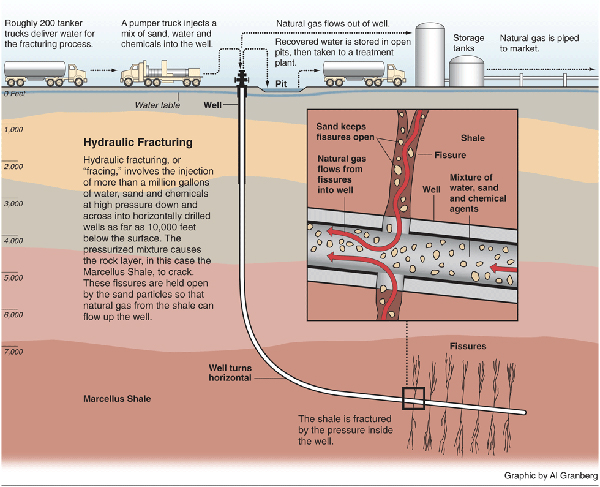
Fracking is a little more complicated than a coin toss, of course. It’s a process by which millions of gallons of chemicals are injected by high pressure into gas-bearing formations underground to free up trapped gas. The danger is migration of those chemical into water-bearing formations, and localized earthquakes. Assuming we’ve never had an accident, what are the odds that we will have one in the future?
We don’t really know. The past says nothing about the future. If accidents are small and if they can be remedied, this is not a big deal. If accidents are large and cannot be remedied, we have a problem. Put another way, certain nuclear reactors in Japan were deemed safe, and had three back-up systems built into them. They were built to withstand an earthquake as large as the one that happened on March 13th. They were not built to withstand both an earthquake and a tsunami, but what the hell – up through March 12, nothing bad had happened!
It’s worse than that with fracking in that we do not know the risks and are not getting good information. The chemicals that gas companies inject into the ground are a trade secret. We must rely on them for our information. They have a conflict of interest, the profit motive, and a great incentive to lie not only to us, but to themselves, about the safety of what they are doing.
Consequently, the government needs to step into the process, find out what is in the fracking fluids, do detailed studies and simulations, and decide if the process is safe. If not, it needs to be outlawed. If risky but if the risk is deemed acceptable, then the process can go forward, but only under heavy regulation.
It’s only sensible, but next I intend to write about the phenomenon known as “regulatory capture,” which explains why fracking is not transparent, outlawed, or even regulated, and why the prospects of this happening are dim.
_______________
***Buried Secrets: Gas Drilling’s Environmental Threat, ProPublica, by Abrahm Lustgarten, February 25, 2011
 Piece of Mindful
Mark, you are obviously confused about the topic. See: http://marcellusdrilling.com/2010/06/list-of-78-chemicals-used-in-hydraulic-fracturing-fluid-in-pennsylvania/
In the link you will find a MSDS on fracking fluids and this:
There is no one size fits all fracking process. However, the 99% being water and sand seems to be the norm. What’s never mentioned is the all the old unlined open pit dumps and such used by farmers and ranchers and small towns across the West for over a 100 years. The closest contact with potable well water comes from the surface, not 1000’s of feet below.
LikeLike
I beg you turn a critical eye on your own comment. It is full of holes. I’ve no time at this moment, as I am doing housecleaning, and the Mrs. is in charge today.
LikeLike
Hey Craig, you know the good thing about Fukushima? It wasn’t as bad as Chernobyl (yet).
I love this style of, if I can something that is worse than the topic at hand, then what we’re discussing really isn’t all that important.
Oh, and Craig, what’s your take on the fracking blowout in Pennsylvania? Fracking fluid headed into the Susquehanna river.
Gee, I wonder what chemicals are headed downstream???
LikeLike
Lost a few words there:
“I love this style of debate, if I can point to something that is worse than the topic at hand, then what we’re discussing really isn’t all that important.”
LikeLike
Now that I have a minute, Craig: The points you raise are either wrong or irrelevant.
The percentage of chemicals in a compound has no bearing on their potentate threat. Most products sold even for medicinal purposes are a tiny amount of a chemical compound contained in a delivery agent.
The depth of gas bearing formations is of some importance, but not definitive. The fracking chemicals have to be delivered via a string of tubing, and if that tubing fails, the casing in which it exists will be inundated. It then depends on the integrity of the cementing job, and depth can help alleviate risk, but does not eliminate it. Remember that fracking itself contributes to instability of geological formations.
In northern Montana, gas-bearing formations are often less than a thousand feet underground. Make a difference to you?
Voluntary disclose is meaningless.
The state of Wyoming has forced producers to disclose the chemical in the solution. This is mere common sense, but only the beginning of the problem. Ever hear the expression “unknown unknowns?”
LikeLike
“There’s no way….” Fameous last words of every industrial polluter and their K Street lobbyists. The list of lies is so long, how about the highlights reel.
Exxon Valdez, BP Gulf, Amazon rainforest, and every pipeline ever built. There are spills, always. Nuclear industry lies are legendary. Mining, whether it’s coal blowing tops of mountains into streams and rivers, or cyanide pulluting the groundwater, it’s always the same story. Ask Libby. Plastics in the ocean, or acid rain, or overfishing, or “research” whaling, it’s lies.
Why aren’t fracking industry flacks lying too? The burden should be on them, not us to prove them liars AFTER they’ve polluted the groundwater for generations, or millenia. Cancer anyone? Oh, just one more chemical won’t hurt anyone.
As Reagan was so fond of saying: “Verify.”
LikeLike
What the Frak.
LikeLike
Wow, I know that focus is on all the chemicals that are used, on average over 15,000 gallons of potentially dangerous, toxic, health destroying chemicals. But what about the millions of gallons of water that is gone…poof… One frack uses millions of gallons of water that is then no longer in the water system. We are using one no renewable resource to extract another non renewable resource. Shale gas I can live without, water I can’t. My wife and I have become sort of experts on this topic ever since there was an exploratory oil/gas permit given less than 600 meters from our front door.Less than 600 meters from the shore line of Nova Scotia largest fresh water lake.
Cape Breton, Canada.
LikeLike