
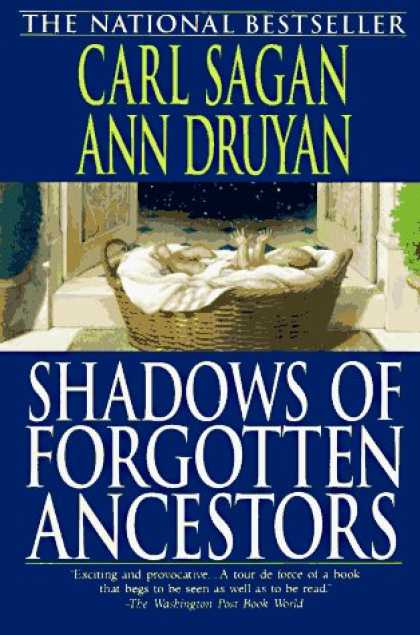
 Carl Sagan made science accessible to me and so many others. Much of his appeal for me was his humility. He did not denigrate ignorance, only willful ignorance. He did not look down on religion. In his Shadows of Forgotten Ancestors, he expressed admiration for the people of past ages whose only tool for understanding the world was religious mythology. Since no other tool existed, what they were doing was reasonable. Their minds were no less capable than our own. Our modern science is just a tool for understanding reality, as was the religious outlook. But science is not “truth.”
Sagan had “respect for wisdom of the past,” said to be a tenet of conservatism. Those in this country who call themselves “conservatives” are really something else. (“Radical reactionaries” works for me.) But as we look at the past, there are some really ugly things that went on that we don’t do as much anymore. Things have gotten better.
Slavery, though still practiced, is no longer defended. Racial prejudice, still rife among us, is submerged into the subconscious. 
And, “democracy” is the guiding principle of our age. But like a beautiful loaf of bread that has no salt or sugar, it should sit in the bakery window and not be eaten.
Technology is real, and our knowledge continually expands due to better tools and the scientific method. But people have not changed. Not an iota. True, we no longer jeer at and lynch Negroes, and Jews are now employed in daily life and in our universities. But all that hatred we used to unload on them has merely moved over to Muslims. It has to come out somewhere, and Abdul has replaced Hymie and Jimarcus as the whipping boy of the age. Progress is an illusion.
I wish to express something that many of us feel but are not free to say openly: Voting is not democracy, and not everyone is qualified to vote. Our ruling class knows this. Elections merely reinforce our belief in voting while at the same time rendering it pointless.  People need to feel that they have a voice, but that voice cannot be heeded. Have you looked around you? Have you listened to talk radio? Have you heard the conversations on the bus? People are not born stupid – far from it. But the absence of meaningful dialogue does foster the growth of an idiot culture. Is that what we want running this country?
Around the time of the founding of this country, people were less circumscribed about their attitudes toward the “common man.” Voting in most states was reserved for men, and only to men of property. Attitudes about women are hard to fathom, of course, but the ownership of property implied an education. It did not rule out thoughtless people, but it did minimize their impact.
These were not stupid people who set up those rules. They expressed Enlightenment ideals, and believed deeply in them. “The Rights of Man” was not an inauguration speech, but rather a real outline of concrete goals. And yet voting, which we now believe to be our most profound expression of the democratic ideal, was reserved to just a few people.
Bertrand Russell did not try to undo the modern impulse to let every fool have a vote. He merely reduced it to its essence. He said that the only real importance of voting is the prevention of aristocratic rule. Office holders are forced to step down on a regular basis. But it hasn’t really worked out that way here in the United States. Because we allow money to rule politics, we’ve been reduced two parties that are really one. The people who step down after each election are replaced with mere clones, either themselves aristocrats, or tools of that class. Democracy in this country is an illusion, even in Russell’s sense.
When I was forty years old, I felt that my most useful purpose was to join the struggle to preserve a few wild lands in their natural state, and so devoted my spare energy to wilderness causes. That is a worthy cause with many serious and dedicated people hard at work on it, but I moved away. It’s been hard to replace that ’cause’ with anything more substantive, but I realize now that something else had taken its place when I worked for Ralph Nader: meaningful democratic governance. It goes back to Russell again – we should have democratic rule, and voting should matter, even if only to force people to move on. With the two-party system, the ruling class never has to move on or move over. That needs to change.
Here is another tenet of conservatism: change should be gradual and done through laboratory experiments. States and cities need to run experiments in things like fusion voting, charter schools or single payer health care. The results of successful experiments will spread, just as Tommy Douglas’s Saskatchewan health care system took over Canada.
Meaningful democratic governance is a good cause. It’s a good way to spend my remaining days (not to sound morbid – I hope I have a lot of days left).
So I’m really deep-down a conservative! Who knew? It was hard to see, as there are so goddamned few of us, and we often go by other names.
 Piece of Mindful
Could it be possible that the unlimited notion of owning property and the ideals of democracy are not compatible? Concentration of weallty seems inevitable without effective democratic rules. The state too has proven incapable in matters of commonwealth — always thinking it “owns” the people’s property. Heresy in today’s post-Reagan fantasy, perhaps.
LikeLike
I am struggling with an even deep[er] anti-Reaganian ideal – that beyond a certain natural limit, it is impossible to “earn” money. It’s an invitation to totalitarianism, I know. But the primary means of earning large sums of money are due to inheritance, scaling, and mere proximity.
Scaling is the ability to take a product sold one-on-one, and repeat the act of selling that product without additional effort. Effort is involved in writing a computer program, scaling comes about when you have the ability to market it by merely putting up a web site . If you are a writer you can read your writing to someone and charge a fee, read it to a large group and collect a number of fees at once, or get it published, like Dan Brown, and watch the public engage in a crap-feast.
Hard to quantify, but pure luck has a lot to do with rewards in that type of activity. How many authors better than Dan Brown never get published?
And then there is proximity – this includes inheritance, but also banking, real estate – any type of transaction where you can place yourself at a bottleneck and charge for passage of that money from one set of hands to another. There’s a lot of calculating in that, but not what I would call socially useful skill. As a banker you are managing other people’s money, and charging a fee for taking from one group and lending to another. Whoopti-doo. That ‘skill’ would not amount to a dime’s worth of income were it not for the fact that the banker is close to the money.
There’s a whole class of people who are merely in the hunt for bottlenecks. We call them “entrepreneurs”, but that is something else entirely. These people don’t invent, they merely fence off goods or services and charge for use – wireless Internet or cell phones are a good example – the “skill” involved in those activities comes from lawyers who rope us into complex contracts of little benefit to us, but huge benefit to the people who stand at the bottleneck.
It’s a part of my justification for high tax rates on high incomes – the idea that for the most part, high income is due to clever calculating without much societal benefit in the outcome, or mere luck. From a moral standpoint, I can justify high taxes on high incomes if we allow people to avoid those taxes by doing socially useful things with their money, like investing in plants and equipment and people, or giving it to charity. You [know], like in the 1950’s, when we had a better system of shared prosperity than now.
Enuf. What brought that on?
LikeLike