
 There is so much of history that is hidden – it’s more a filtering process than actual censorship. Chomsky and Herman did a nice job of describing media filters in 1989 – there were five: 1)The size, ownership and profit orientation of media outlets, meaning that only big enterprises gain credibility; 2) advertising as a license to do business, giving advertisers de facto control of news; 3) sourcing, meaning that special access is granted to those news outlets that report in an acceptable manner (Tim Russert, for instance); 4) flak and the enforcers – negative fallout to unacceptable content (which is why Dan Rather lost his job); and 5) anti-communism as the dominant social control mechanism (since replaced by anti-terrorism).
With those filters in place, it is not even necessary to censor news (even though heavy censorship is accepted as normal in the name of vaguely defined “national security”). People who live within the upper echelons of our news delivery system internalize all the concepts and even think of them as normal. And, of course, the people down below who report to us haven’t a clue what goes on in the suites above.
That in mind, here’s a passage from David Harvey, author of A Brief History of Neoliberalism*:
There’s a very interesting story to be told … and I’m not sure it has been fully elaborated upon yet. With the OPEC oil price hike in 1973, a vast amount of money was being accumulated by the Saudis and other Gulf states. And then the big question was: well, what’s going to happen to that money? Now, we do know that the US government was very anxious that that money be brought back to New York, to be circulated back into the global economy via the New York investment banks, and persuaded the Saudis to do that. Why the Saudis were persuaded to do it remains a bit of a mystery. We know from British intelligence sources that the US was actually prepared to invade Saudi Arabia in 1973, but whether the Saudis were told: recycle the money through New York or you get invaded … who knows?
Now, the New York investment banks then had vast amounts of money. Where were they going to invest it? The economy wasn’t doing very well at all in 1974-75, as, all over, it was in depression. Citibank and Walter Wriston came up with the comment that the safest place to invest the money is in countries, because countries can’t disappear – you always know where they are. And so they started to make the money available to many countries like Argentina, Mexico – Latin America was very popular – but also places like Poland** even. They lent a lot of money to those countries.
[These words are taken from an interview of Harvey by Sasha Lilley.]
What follows is somewhat well-known – Mexico goes bankrupt, and is bailed out by Washington, in effect circulating taxpayer money back to Wall Street. Sound familiar? Mexico is not a richer country today as a result, but wealth is distributed differently. Mexican billionaires pop up on the Forbes list, peasants are dispossessed (further aggravated by NAFTA), and migrate north looking for sustenance.
In Argentina, military personnel work in league with Chile’s Pinochet to conduct terror operations, and take the country deep into fascism and later bankruptcy. The country is still recovering.
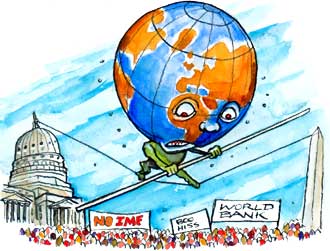
It’s complicated, of course. There is no one narrative that lays out history for us, that is, unless you follow American news. But there is always hope for gradual progress. The first filter, the size of media outlets as a prerequisite for entry into the business, is evaporating before our eyes. Newspapers are collapsing, media is heavily fragmented (though still centrally owned), and it is not difficult at all for a naturally curious person to research unreported events in foreign media and alternative histories. And if we lose the big newspapers – if the New York Times goes down, for instance – what replaces them? I do not know. It might be better, it certainly cannot be much worse than that state-subservient rag.
__________
*Neoliberalism and neoconservatism to me appear to be the same animal, but according to Harvey differ in that the Neolibs tend to want to leave markets alone to perform their magic (amassing of resources in a few hands). Neocons are less tolerant of markets, which can indeed be volatile and dangerous, and want to impose order from above. In this case there might indeed be differences between Neoliberal Democrats and Neoconservative Republicans, but neither has any good outcomes for ordinary people.
**It was around this time that Gerald Ford was pilloried for commenting in televised debates with Jimmy Carter that Poland was not part of the Soviet bloc. Gerald Ford was not a stupid man, and his statement that evening probably reflected a better understanding of world affairs than Carter possessed, and certainly more than the media that covered the event.
 Piece of Mindful
Democracy Now! has a nice piece up about some of this in its current form. Amy Goodman interviews Slavoj Zizek and Julian Assange. The discussion of extradition, grand juries and judicial independence is particularly interesting. Wikileaks has indeed revolutionized how information is (un)managed, and its implications for elites, accustomed as they are to possessing the power to manipulate our understanding of events, and our social, cultural and natural environment. The age of sleepwalking may be coming to an end.
LikeLike
Don’t expect any general strikes, intellectual or otherwise, any time in the near future, Ms. Zinov’yevna Rosenbaum. The corporatoblicans will see to it that FOX survives right along with the US Constitution when the Yellowstone supervolcano goes off.
We can sit around grousing, we can organize, or we can slip into something really uncomfortable and walk into the throng of our choice then detonate.
Mark, put your your outstanding talent to good use. Help me draft an invitation to the people of Mexico to dissolve their constitution and petition for Statehood.
LikeLike
There is organization going on all over the globe, including in Mexico, but in the United States we seem to have been lulled to sleep by cheap Chinese goods and entertainment. What is needed is cross-contact between groups around the globe. The US is pretty much hopeless.
LikeLike
Like hairdryers and blogging?
LikeLike
The Saudis got a good deal they get the American taxpayer to ‘guarantee’ the security of their profits…an offer they couldnt and had no reason to refuse. They arent even really a nation state as much as they are a loose knit crime family that just happened to wake up one morning and find out they live on top of a giant pile of gold.
LikeLike
Mark – your posts are too long. I can’t get all the way through them before I get hung up on the little inaccuracies. You see, when I read “Mexico is not a richer country today”, I actually go look at vital stats. And not GDP per capita. I look at things like life expectancy (up ten years since ’75), percentage of infants with a low birth weight (declining since around 1990), literacy rate (climbing slowly but steadily, approaching 100 now), the malnutrition rate for children under five (down from 14 percent in 1992 to less than four percent now), etc. And then I just can’t read the rest of the post, because I get distracted by the inaccuracies!
You mention the massive loans made to Poland. Talk to someone who actually lived in Poland in the 70’s, and you’ll get an interesting story. Grinding poverty was erased by the sudden appearance of low quality, but existent consumer goods. And talk to an educated Pole, and they’ll tell you that while that had the effect of mitigating the misery caused by the communist government’s inefficiency, the need to pay back those loans increased the importance of the coal mines of Silesia and the shipyards of Gdansk, as they produced products for export. Thus, workers’ movements in those places had a great deal more leverage. You may have heard of them. So, I’m going to say those loans to Poland were all around a good call.
LikeLike
I don’t see where we disagree. I said that Mexico was not wealthier today, and you deflected to non-economic stats. If The country is statistically healthier, how on earth do neoliberalism and NAFTA factor into that? And if it’s so damned good and getting better, do they come here en masse looking for peon wages? Inequality naturally follows neoliberalism. Wealth is redistributed upward.
They do have a national health care system, which has some impact on your point. Regular people do uhave access to the health care system. Quite a few Americans use it.
And where did I say what was done with the money in Poland? I know you want to go all raggy on the Soviets, and wasn’t the whole point of fifty years of post-war propaganda to convince us that there were only two ways? But this again is off-point. You’re better than Swede by a long shot, but are doing non-sequiturs nonetheless.
LikeLike
Mexico is wealthier today. Per capita GDP, PPP, is up as well, over 50%. I cited non-economic statistics for this reason – Mexico is both getting wealthier, and its people are living better. There may be more inequality, but considering the overall higher standard of living for everyone, that inequality is more than compensated for. Neo-Lib and NAFTA factor into that because a great deal of the growth and increased investment have come from overseas sources of capital. Now, NAFTA is still seriously flawed – it allows goods to move, capital to move, but still restricts labor, thus hurting its capacity to help people.
Moreover, I’d like to point out that immigration doesn’t mean that a country is doing worse. Poland and Portugal now have more immigrants abroad than in the 1960s. Does that mean that they are worse off than they were under Communism or Fascism? Hardly. However, the increased openness of Mexico’s economy means that Mexicans are more exposed to and more aware of the opportunities in the United States. The US economy in the 1990’s was booming and needed workers, so there was also a significant pull factor. Lastly, it’s true that neo-liberalism has not affected urban and rural populations evenly, and so rural workers unable to support themselves on their land (which, mind you, is often the same amount of land for an increasing population) move either to Mexican cities, or to the US.
Ultimately, I think one issue here is something Said described – when observing a society radically different from your own, your impression is likely to be that it will be static, unchanging, compared to your own society. Thus, Mexico, being very different from the US, seems to have not gotten any wealthier since the 1970’s. But I bet the Mexicans notice when only half as many babies are dying, when grandmothers are living longer than expected, and many of them are experiencing increased cash flow as well.
As to Poland, I was merely pointing out that, intentional or not, those loans were a more effective foreign policy tool than missile defense or the military build-up that characterized the decade that followed. And so Poland, as well as Mexico, is also much richer today, partially as a result of those loans in the 70’s.
LikeLike
You are, in essence, a trickle down guy. You are also a neoliberal, it appears. Well enough. .
You are coming at me from so many angles that it will take a long time to parse it all out, and then you will tell me that my posts are too long. Yours at ID are quite long. I don’t care. I like them. Is this an attention span thing? Anyway, I’m going to separate your post into segments that seem to address one topic, and limit myself to 10 word responses. We’ll see how it goes.
From when to when? In real terms? Which sectors?
Neoliberals demand austerity in public programs. Mexico has universal care. Contradiction?
Isn’t inequality the most important factor? Are billionaire’s useful?
“Free trade” destroys nascent industry. It depresses wages.
Shinola. Mexican immigrants work for less than Americans. That’s all.
You’re dissipating. Please describe neoliberalism’s role in this.
Aside, devastating Afghanistan in the 1980’s was also a good FP tool.
LikeLike
Your first mistake – that I am defending neo-liberalism. I never said that. I believe that connectivity can increase production and standards of living for everyone. Thus, policies that allow for greater movement of goods and labor are beneficial. However, neo-liberalism also makes demands within countries. These demands are often foolhardy. Countries that have not followed them have often prospered, while those who have have suffered repeatedly. So while a country like China inevitably benefits from outside trade, they managed to direct it very effectively, despite following policies that the IMF would probably condemn. So, now that we’ve cleared that up:
Since 1992 GDP per capita, PPP, has roughly doubled in Mexico. I don’t know what sectors, as I’m not an economist and I really can’t be asked to find out. I do realize that much of that has gone to the very wealthy. Much more important are the material gains in the everyday life of the average Mexico. The new Slim Helu’s may distort GDP numbers, but they have little effect on numbers like infant mortality or life expectancy. Those numbers show that, while still not living like Americans, Mexicans have seen their lives get much better as a result of greater trade and investment from the outside. That’s not a win for neo-liberalism specifically, but rather a good indication of the possibilities provided my modern connectivity. And so, decisions like investing in Latin America have true effects on people’s lives, and often benefit them.
LikeLike
That’s really, really messy. You’re not a neoliberal but say that neoliberalism works. Even though neoliberals are specifically opposed to programs like public health care, which Mexico has invested heavily in, you credit i neoliberal policies for Mexico’s economic health. And even though you don’t know the numbers, you say that despite extreme inequality, which neoliberalism promotes, that ordinary Mexicans just must have benefited from neoliberalism.
And you have no answer for the massive migration that has taken place since neoliberalism took hold in Mexico. Your last shot at it was that the migration was a sign of health. Somehow.
One of the semantic tricks neoliberals use is to conflate free trade with trade, as if it were a dichotomy, and you’ve done this as well. But I’ll take it a step further – we don’t know much about how it all works. Countries that have highly restricted trade often end up engaging in more trade as a result, as they create more wealth internally and have more to offer. But we don’t teach that, as it does not favor the acquisition class, who are the ones who promote neoliberalism and control the economic classes.
Anyway, like I said, your notions here are quite a mess.
LikeLike
Find out where I said Neo-Liberalism works. I said, Mexico is better off now than it was before NAFTA. And I have the numbers – the average Mexican has more money now than they used to. They are more likely to have a long life, more likely to be literate, less likely to lose infants.
They are much more likely to be in the middle class now than they were in the 80’s – the middle class is now 40% of the country. They are more likely to own homes and to have disposable income. In short, the country is better off. I’ve offered dozens of numbers now, all pointing to a higher standard of living for the Mexican people than they previously enjoyed. You’ve offered no evidence to the contrary except that many Mexicans are coming to the United States. How much has the rate increased since NAFTA? Care to offer actual evidence?
I’m sure it has increased, and here’s why – the US economy was growing post-NAFTA, meaning the demand for Mexican labor was also high. Mexican immigration has dropped off significantly with the slackening US economy. Moreover, a dirt-poor peon is going to have trouble getting to the Untied States – most Mexican immigrants come from Zacatecas or further south. That means they have to pay for travel through an entire state, as well as paying to cross the border, which is often hundreds of dollars. This is a huge sum, and the fact that thousands of Mexicans pay it indicates that while Mexico is far from being the US, they have some money to ‘invest’ in this opportunity.
But don’t worry, Mark. Admitting that Mexico is richer now than it was in the 70’s or 80’s doesn’t involve admitting that Neo-Liberalism is right. Mexico has free trade agreements with the US, but it has also been able to keep some very un-liberal (in the neo or classical sense) policies domestically. Nationalized petroleum and universal health care are both completely opposed to neo-liberal thinking, but at the same time highly effective. Combined with free trade agreements with the world’s largest economy, they open up a lot of possibilities.
LikeLike
Mark, when I criticized you last week for always sniffing out nefarious American influence on world events, I didn’t respond to your follow-up comment for various reasons.
But here’s a perfect example of where I think you go wrong. You see the world, or at least write about the world, exclusively through an American lens. It’s like the old idea of “American exceptionalism,” but turned on its head. You don’t seem to have ever read a book about another place in the world, or a good history book, unless it somehow dealt with how the United States fouled up that place, or that era of history.
Give these other countries a little credit, or a little blame, for God’s sake. The Polish Wolf, for instance, now there’s someone who knows something real about a couple of other countries. Your exclusive focus is hugely distorting.
LikeLike
Can we deal with specifics? Did the US threaten to invade Saudi Arabia in 1973? Was the purpose of sending money to Poland to make life better for the Polish people? These are areas where your profession should offer some good insight. But it doesn’t. I don’t get insight on America from American journalism due to the filtering mentioned above.
I do think that anything that doesn’t smack of American exceptionalism strikes a discordant note and is automatically held to high scrutiny, and anything that follows the formula passes unnoticed, and that is all you are reflecting here. You notice the things I write about because they don’t ‘fit’.
Here are some additional insights: the world changes, and American gold reserves were being drained under Bretton Woods, so Nixon closed the gold window. Most world currencies were tied to the dollar, and were effectively allowed to float. With that, there was no real reason over time for the dollar to be the the world’s reserve currency. But if the US could force the middle eastern oil states to deal only in dollars, there dollar would still rule. Every country that needed to import oil would have to have dollars on hand. That would offer a reasonable explanation for not only threatening Saudi Arabia in 1973, but also Iraq in 2003, and Iran down the road. (Iraq was trading in Euros in 2003.)
Regarding Poland, it’s a bit more complicated, but money has no ideology. PW, not knowing of Wall Street investments in that country, merely presumed to know that good things followed. That is how American exceptionalism works – anything said in favor of the empire stands unchallenged, anything said against is held to high scrutiny. That’s how it works. It’s a state of mind, and has to be severely shaken to be dislodged.
Harvey’s mission, should you ever want to follow up on something like this, is to introduce the left to the reality of the neoliberal world, and to get them off of returning to the fifties and Keynesianism and all of that. He’s not a good/evil guy. He’s ideological but deals on a macro scale without presuming that everyone in the system is a crook.
BTW, I was sitting in a man-chair in a shoe store in Bozeman last week and came across your article in the Quarterly on looking for books in a dusty Butte storefront. I could not finish it but it held me until I was forced to leave
LikeLike
Mark,
If you’d only swear allegiance to neocon/neoliberal ideology I’m sure all would be forgiven. Alas, your loyalties lie elsewhere.
“An error does not become truth by reason of multiplied propagation, nor does truth become error because nobody sees it.”
– Mohandas Gandhi
LikeLike
Thanks for the support. The psychology is very interesting. Nothing I write here would raise an eyebrow if it just fit the formula.
LikeLike
After all, the ultimate question remains: Eyebrows or highbrows?
LikeLike