
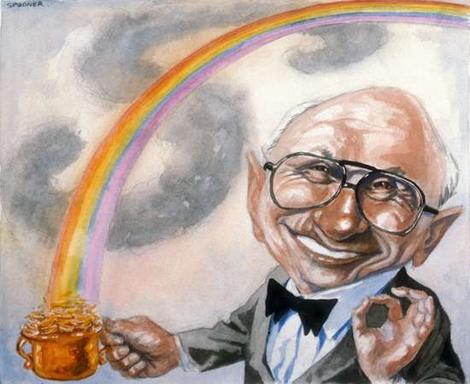
 It’s a wonderful system, this free market capitalism. So I take this opportunity to celebrate and offer examples of how it works and makes life better for all of us. Since we recently traveled from Denver to the east coast, I’ll start with the airlines in the wake of Jimmy Carter’s deregulation:
Baggage: Once airlines charged to carry customer luggage in addition to the ticket price. But one airline saw a market opportunity, and offered to carry bags as part of the ticket price. Soon all the other airlines were forced to go along. Bags now fly free. Markets work.
Legroom: Airlines once squeezed as many people on to an airliner as possible. This allowed them to run fewer flights. Then one of them saw an opportunity to increase its market share, and increased passenger comfort by increasing legroom. All the other airliners, for fear of losing market share, went along. Markets work.
Meals: Airlines used to offer only coffee and soda service and a bag of peanuts during flights. Then one enterprising airline started to offer hot sandwiches. The others had to go along or lose customers. Soon the airlines were tripping over one another to offer more and better meals with each ticket. Markets work.
For all of the above prices did not increase, as competition means that prices must clear the market. This means that they cannot just willy-nilly pass their costs along. Investor return decreased, but investors believe in the market system and competition, and so take whatever return the market offers. They try to be better than their competition and offer more to customers.
Corporate boards, realizing that stock incentives for executives create perverse incentives, pay them a flat salary and pressure them to make better companies and beat the competition based on service and quality. Markets work.
There are other areas where markets have also performed well:
Ratings agencies: There once were three companies that rated the quality of financial products for private corporations. But they realized that this created competition among them to provide better ratings to customers, and was a perverse incentive. Each company retired from the business, and formed a not-for-profit corporation whose sole task was to offer ratings. With this system in place, these days there is never any question that when the agency rates a financial product, it is backed by due diligence. When competition doesn’t work, private companies fix the problem. Self regulation works.
Mobile phones: Once there were only a few companies that provided mobile phone service. They all offered the same product at the same price. Then an innovative start-up company entered the market and offered to sell use of its signal to anyone who agreed to pay for monthly service. It allowed its customers to purchase their own phones. Prices of phones sank like stones as the easily manufactured products became available in stores. Banks offered free phones along with toasters for new accounts. This shook up the mobile phone market, and soon the other companies abandoned the old business model. Consumers benefited, and the companies realized smaller returns, but understood that competition does that. Markets work.
Health insurance: Once there were only a few companies selling health insurance, and they divvied up markets among themselves. They refused to undercut prices. They agreed not to offer insurance to a group of people they said had “preexisting conditions.” One company board realized this was not good public policy, and so offered to insure people previously excluded from access to health care. But soon it found itself with only rejects from the other companies, and was threatened with bankruptcy. It appealed to the other companies to better serve the public and accept all who applied for coverage. Seeing it as a public duty, as health care is something everyone needs, they all agreed. Soon there were no uninsured people. Since all were competing for customers, market pressures lowered deductibles and co-pays. Doctors and hospitals, no longer threatened by insurance cartels, stopped padding bills. Premiums leveled. Markets work.
These are just a few examples. There are so many others. For instance, our constitution guarantees free association. This allows workers to ally with one another, and labor unions are easily formed. Companies negotiate with unions in good faith, and where companies behave themselves, unions are not strong. This keeps wages at levels that compete even with first world countries.
This same free association allows for formation of corporations and many other business forms, so investors can form their own unions too. But only market success brings profitability, and so there is constant pressure to offer better services and products. Because the public has a strong wage structure, there is plenty of demand for good products. Labor and investor unions, realizing that influence peddling is highly unethical, refrain from trying to influence public policy or buy politicians. They love markets, and that’s why markets work.


Will your next post be on how great government works?
LikeLike
Balance is the key. Markets are great generators of wealth, government is as well. Too much of either leads to destructive behavior. We are currently in a markets-are-magic phase, as the generation that experienced that madness last time around has died off. So we have to learn it all over again.
LikeLike
Markets are great generators of wealth, government is as well
Both are also great destroyers of wealth, government more so, in my opinion.
We are currently in a markets-are-magic phase
??? Exactly what market is on the increase? Seems to me we are in the era of big and bigger government.
LikeLike