
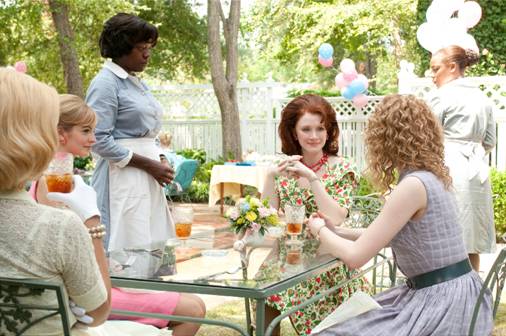
 We went to see the movie “The Help” last night. It’s a good movie – the characters are caricatures and the plot is held together by a thin piece of thread (having to do with a pie), but afterwards over pizza it led to some really good conversation that would not otherwise have come about.
The movie is about black maids in the south in the early 1960’s. These women raise white children during the day and their own at night. They must endure white attitudes about black people without the ability to speak up or out, a most undignified situation. Because it is a movie, bad people get what’s coming to them, good people prevail, and the people in the middle are changed for the good.
We discussed afterwards southern attitudes about black people. I said that they were no better or worse than anywhere else – that southerners could merely be open about what lay underneath. I said that it was wrong to portray them as bad people and claim moral superiority. Each of our individual minds is an castle, and our mind’s view of reality is through the fog of our own goodness. Even the worst character in the movie, Hilly Holbrook (Bryce Dallas Howard) sees herself as a good person, but plots require antgonists, and she fills that function.
My wife taught in Louisiana, and said that the caricatures were not that far off and the attitudes were dead-on. So perhaps we are entitled to claim some moral high ground. But, I added, Martin Luther King said that (and now I have the exact quote) “…the tragedy of this period of social transition was not the strident clamor of the bad people, but the appalling silence of the good people.”
It might have been easier to be black in the face of open racism than to deal with the quiet racism of good people. I doubt it was easier in that period (or now) to be a black northerner than a black southerner. So much of it is submerged deeply inside us, and comes out in other forms, like presidential birth certificates. In my own case, when I think of black people, I want two things – for them to succeed on their own wits and intelligence, and to help them. I want to foster independence and be paternalistic at once. That attitude might cause some resentment.
In the movie one character comes off very well – Celia Foote (Jessica Chastain). She’s kind and vulnerable and is badly abused by the white women of the community, but those are all plot devices. I liked her character because she was at ease in her own skin, not condescending, and genuinely caring for other people. She came off well even though, as Hollywood requires, she goes smarmy on us at the end.
Good things happen in the movie – “good” in the sense that they transcend Hollywood a bit. People get hurt and there is no plot device to heal them. The lead character, a writer named “Skeeter” (Emma Stone) is told just to leave the community, as she’ll never have a good life there. Her boyfriend leaves her for the wrong reasons, and they do not reconcile. The maid Yule Mae (Aunjanue Ellis) is unjustly imprisoned, and is in jail in the end. So the movie is not all about closure, and that is true of life too.
It will be nominated for an award or two, I’m sure, for good acting and strong characters. Since there are no Americans doing Beitish accents, no “best” will come out of it. As long as Hollywood insists on putting up ten movies so that one can be The “best,” it can fawn over itself a bit about its social conscience, and The Help might serve that purpose.


It might have been easier to be black…
Interesting how easily you toss off that phrase, that people can get up each day and go about the business of being Black.
LikeLike