
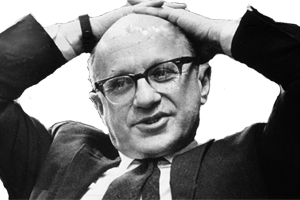
 This from John T. Harvey, economist, at Forbes Blogs:
…I wonder how many people know the formal Monetarist (Milton Friedman’s school of thought) explanation of how the Great Depression occurred? Their analysis depends on the existence of something called money illusion on the part of workers. The idea is that laborers are never quite certain what the current cost of living is since they do not keep a careful accounting of their expenditures. Meanwhile, firms are pretty darn sure what prices are because it is so important to their livelihood to pay close attention. Now imagine the following. Let’s say there is a massive collapse in the supply of money, leading to a fall in prices … The fall in prices, because it means they are earning lower profits, leads firms offer lower wages to their employees. But–and here’s what they say happened in the Great Depression–workers, not realizing because of money illusion that the cost of living has declined (and that firms’ offer is therefore not unreasonable), quit their jobs. And that, apparently, is how unemployment rose to 25% in the 1930s: the money supply fell, lowering prices, leading firms to offer lower wages, and causing workers to VOLUNTARILY QUIT THEIR JOBS!
I’ve heard this before – the monetarist explanation for the Great Depression, but had no idea it was mainstream neoclassical thought.
Read the whole article here.
 Piece of Mindful
True story!
LikeLike
I think it’s called reverse engineering, or forcing reality to conform to formulas.
LikeLike
Friedman actually blamed the depression on missteps of the Federal Reserve that caused price deflation. He, only speculated (as opposed to believed) that some workers left the work force voluntarily due to the “money illusion.” . There’s a very large body of evidence, however, that a good deal of unemployment was voluntary – initially because of the “money illusion.” That, however, fed on itself to the point where many who left voluntarily could not find work since GDP had dropped so far.
I don’t know anything about John Harvey but I would suggest that this is an oversimplification at best. It’s also important to understand that monetarists are born from Keynes and the idea that “wages are sticky” is first and foremost a Keynesian notion. Keynes understood it this way: a drop in nominal prices equaled an increase in real wages. That “wage increase” caused the labor market to fall out of equilibrium hence a rise in unemployment.
I don’t know whose right but the idea that some left the workforce because they saw a cut in pay as “unfair” is worth considering as part of the conditions that brought the economy to its depth in the ’30s. In other words, its not really a crazy notion except to think that it was THE cause as opposed to a contributing factor.
LikeLike
Probably abandoning notions of equilibrium would be a good start. That’s a made-up idea anyway. Economies are not simple things and do not self-regulate, and spin wildly out of control without some sort of guiding hand.
My evidence? the Great Depression and the current one. Friedman set out to prove that there was a magic element in our interactions that made government unnecessary and so got the attention of people who found government a pain – wealth accumulating capitalists. The absence of evidence to bolster him, the crazy search for evidence that is pointed out here, all point to bankrupt pseudoscience. That he could not explain the past or present nor predict the future ought to speak, but oddly doesn’t.
LikeLike
Friedman was fundamentally an interventionist with his work on monetary policy. I think you stereotype him at your own peril. He may have been wrong on many things – as are most economists – but he had many fascinating ideas.
I find it interesting that you at one time wrote that Keynes was on the right track and now you say that notions of equilibrium should be abandoned. Everything Keynes ever wrote was about various equalibria and how to correct imbalances.
I’ll submit that economists have far too much influence in public policy. Does it male any sense, however, for mankind to stop looking for answers?
LikeLike
There is a school of neo-Keynesians who respect his work. There are others doing what you say should be done, and they are mentioned in the article I linked. But the thrust of neoclassical economics is to build a society where wealth is allowed to concentrate in a few pockets, and so that’s where the think tanks, the universities center their studies, as that is where the money takes them. The whole of the profession is, in my opinion, a political undertaking.
Just like politics, opinions are like fragments of metal drawn to a central power, a magnet at the center of it all, and that magnet is concentrated wealth. That is why it does not matter that neoclassical economics doesn’t describe the real world. Money does not drive the other avenues of thought. Friedman taught a a university financed by concentrated wealth. Had he gone down other roads of thought, he would have ended his career in obscurity and in another school.
For me, I was one of those who asked the professors in my economics classes why, if the theories and graphs did not describe the real world, we’re they even useful, and here Friedman had given the whole profession an escape clause. – some nonsense about how even though not real, the graphs and theories were useful – as the blind leading the blind – the end result would be truth.*
____
*I should add the I was not smart enough to understand that then. I bought in. This is wisdom long after the fact.
LikeLike
I find your opinions self-restricting and unfortunate for you. You seem to have stopped looking for answers in ascribing that economic opinions are made to support a political outlook as opposed to the other way around. That may be true on occasion but it certainly is no less speculative to think so than the ideas of any economist who makes an abstract argument.
LikeLike
Deal with specifics please – if you cannot explain the past or present or predict the future, if you proscribe the same remedies over and over again even though they do not work, then what is going on?
I suggest it is quite easy to understand – money and power. People don’t consciously go to the magnet, but end up there nonetheless.
LikeLike