
Oh, I know – we’re in laugh-about-it-shout-about-it election time, and people are going to select from limited pre approved choices. That is the extent of representative rule, but man it does suck up the oxygen! I think that is the only real purpose of national elections – to give us the illusion of self-rule.
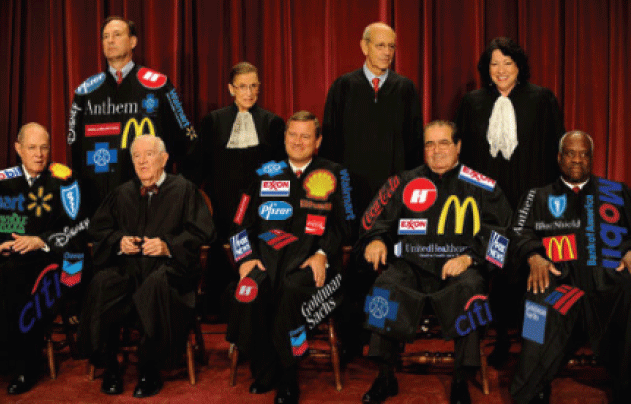
Supposedly the Final Nine are limited in that they can only rule on laws passed by the legislature, but that’s as illusory as democracy itself – with Citizens United, they went looking for a platform on which to write new law.
SCOTUS power is not in the constitution. It was grabbed in the 1801 Marbury v Madison case. Thomas Jefferson, president at the time, was appalled.
You seem to consider the judges as the ultimate arbiters of all constitutional questions; a very dangerous doctrine indeed, and one which would place us under the despotism of an oligarchy. Our judges are as honest as other men, and not more so. They have, with others, the same passions for party, for power, and the privilege of their corps….
Judges are in office for life, an absurd proposition. The current far-right majority of the court was installed by George W. Bush with the assent of the other party. Democrats could have stopped both Roberts and Alito, but chose not to because … they are Democrats, and are only there to prevent real alternatives.
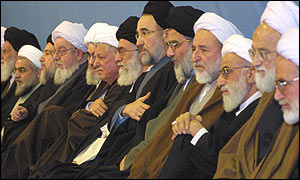
 Nonetheless, as the mullahs today decide on the Affordable Care Act, it does not hurt to reflect that the law was passed and the subject only came up for debate because the health insurance cartels and PhRMA wanted to permanently forestall reform. We’ve had every opportunity since Truman to fix this awful system, but the subject never came up, was not deemed politically feasible until 2008. Why then? 2004 was a good chance, but John Kerry avoided the issue.
I know exactly why. Do you?
In 2008 the issue was politically feasible, and debate was allowed within prescribed parameters, set early by Max Baucus when he declared that single payer was “off the table.” Time was at hand, all the players were on the same page. Baucus had non-players arrested.
As author Paul Street wrote recently at Counterpunch,
The key point for the corporate insurance bosses was to block any public insurance competition or alternative. They were ready to give on “pre-existing conditions,” lifetime benefit caps and the like in order to do that. They knew that “reform” was in the air and had support from many large business, political, and professional interests, not just the nation’s quaintly excited citizenry. A popular new president had staked his reputation and perhaps his re-election chances on some (almost any) version of “health care reform” being passed in his name. Something was going to happen, the big private insurance and drug protection outfits knew. Their goal was to “redefine” and set the terms in a way that left core corporate prerogatives unchallenged by popular public alternatives.
I doubt that SCOTUS, employed by the same masters, will undo that. But with Citizens United in mind, they might well reach out and impose an even worse system.
Such is life in the United States of Iran.
 Piece of Mindful
Insurance-based health care systems disadvantage individuals who take preventative measures more seriously, and save for when treatment is needed. This is somewhat true for all insurance schemes.
The insurance-doctor/nurse-hospital-equipment-prescription drug-transport-record/billing-assisted living-physical therapy- etc. cartel is vast and interconnected. The false, pre-limited battle over for-profit or non-profit insurance mirrors our false political choices. Single-payer is arguably the ultimate “public option,” but is it much more than a lesser evil? Save 30%, but still can’t afford it. The cartel remains intact.
It is time to consider real alternatives to the underlying health care affordability problem.
LikeLike