
 I have been struggling to come up with a way to incorporate the suffix “itute” onto the word “dietitian” as a means of conveying the essential bankruptcy of that profession. Another profession equally bankrupt, economics, lends itself quite easily – “econitutes.” They are, as Keynes reminded us, usually slaves of some dead and “defunct economist.”
It would be interesting to study the intellectual depth of every profession, including my own. Most of us are just going through the motions, repeating received wisdom. True depth and understanding is rare, and those who have it rise to the top. But in the dietary fields, along with economics, quite the opposite is true. With economics the driving force is easily understood. Powerful people who benefit from low taxes and little regulation want it kept that way, and so finance the schools that teach the horse shit that dominates the field.
Dietitians are different – I don’t know of any who are wealthy. Like chiropractors, they have to sell a low-value product and so dress it up as science. A few of them are lucky enough to latch on to some moneyed interest – Bronson Arroyo, a pitcher for the Cincinnati Reds, hired one during the offseason last year. And she, of course, preached to him the standard wisdom of the profession – eat carbs in large quantities, minimize fat. Watch out for them trans-fats! (As if such a thing even existed.)
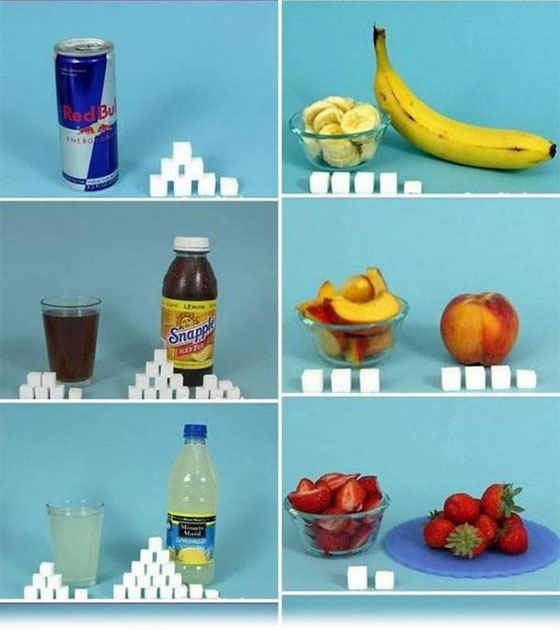
 The essential source of our country’s obesity problem is carbs, both simple and complex. They are most abundant in soft drinks, french fries and pizza, cookies and donuts and chips – our staples. It is well understood, and the science is solid, going back even to the early twentieth century, that high-sugar diets lead to obesity and diabetes, and heart disease as well.
Back during the days of the military draft, the army knew how to deal with the occasional obese inductee – take him off carbs, feed him a restricted diet of fat and protein. The results were immediate.
But the science these days says the opposite – reduce fat intake, and exercise. The latter is indeed somewhat healthy – going from a no-exercise lifestyle to some exercise is beneficial. Beyond that, there are no known benefits. Running, high levels of intense exercise, pounding out the miles on treadmills and ellipticals might produce some endorphins, but does not lead to weight loss or better health. (One Snickers bar is enough fuel to push the typical human three miles.)
This is known, understood! It is science. I paid heed to science myself two years ago, and within three months lost 21 pounds and kept it off. I cut back on exercise. My March physical put me in excellent health, just a little high on the cholesterol, not something I worry about.
What is up? I do not know. I can only speculate. There are two factors that might be at work: One, diets of fat and protein are more expensive, and may not be good for the larger population in terms of cost and ecological impacts. It takes more calories and water to produce meat than to grow garbanzos. Consequently, leading manufacturers and the Department of Agriculture, long since captured by the private sector, push carbs for reasons of consumer cost. That approach goes all the way back to a brilliant man with an unfortunate and prescient name who served at Agriculture under President Nixon: Earl Butz.
But then there is the econitute angle – the companies that finance much of our “science” behind diets are those who make their money by processing corn-based food. Each level of processing adds a new level of profit, so that by the time corn is presented to us as pizza dough and soda pop, a few pennies costs a few dollars. Even though profit margins are high, consumer cost for basic sugar is low by comparison to most meat-based products. So the “science” is driven by the money, just as in economics.
And of course, in our “free” market, things are driven to extremes. MacDonald’s offers enormous quantities of fries. Soda pop is its primary profit center. It is so cheap that they don’t even monitor it. There is no incentive beyond window dressing to offer healthy food. Market magic, that is.
Let’s take it to extremes – what if the American public could be persuaded that a milk shake for breakfast would be healthy. That’s beyond the pale – advertising, as powerful as it is, has limits. That won’t sell. Right?
But consider the following: Yoplait yogurt chocolate flavors contain 25 grams of carbs per serving, while its fruit flavors offer up only 23 grams. A Starbucks Frappucino gives 38 grams. That 16 ounce Coca Cola in our fridge (soft drinks are common now as a breakfast drink) has an amazing 55 grams of carbs, pure sugar. On the other hand, a one-half cup dish of ice cream yields 20 grams.
Indeed we do have the carb-equivalent of milk shakes for breakfast. Advertisers are clever. They merely changed the name.
What to call dietitians? Dietutes? Dieticitutes? Food whores? Nothing really catches … suggestions are welcome.


Most curious is why individuals with functioning brains need others to help them decide what to eat. Nutritional info is readily available and ignored. Remember “You Are What You Eat?” Dietition or nutritionalist? What most Americans on a typical American diet need more is a better understanding of neurology, tax code/business-expense deductions and how giant food cartels operate and dominate. Another handful of hand-picked corporations control almost everything we consume. And don’t think for a second that the “health-care” industry isn’t “Lovin’ it.”
LikeLike