
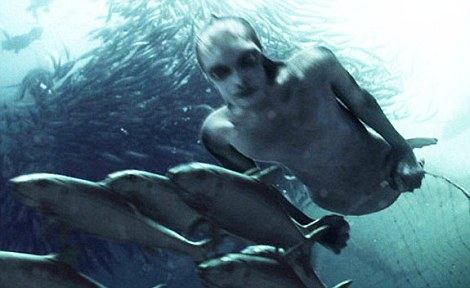
 Recently I came across a TED talk* by Elaine Morgan, an old gal and a counter-cultural writer who has challenged the academic world with her advocacy of the water-born theory of human evolution. It’s been around for a while. She did not originate the theory, as her degree is in English, which should rule her out without argument. Yet the idea has explanatory power that others lack. We have little body hair, we are amazing swimmers, and we know that other species have evolved from water, gone back to water – it’s not unusual. None of that is definitive, of course.
Today I learned of a new theory to challenge the Big Bang – the Big Chill. Advocates, based in Australia, claim that this theory has more explanatory power than the BB, perhaps even approaching a “unified theory” that relativity theorists have so long sought in futility.
I have no clue, of course. But I like this sort of debate where an entire framework is challenged. Of course the old guard dismisses these ideas! That’s how science works. It takes new people to bring in new ideas. (Unfortunately, Elaine Morgan is an octogenarian.)
Are there unknown unknowns? Most assuredly. Every age has prided itself on advancements over the preceding ages. Mark Twain, in his book Connecticut Yankee, wowed (and murdered) knights and kings with electricity. He was on the cutting edge, as we are now.
But scientific hubris is unwarranted. We are self-engrossed and wholly attentive to further exploring those things we know. There is little money available for unknowns – DARPA exists for that reason. (Like most of our R&D, it is a disguised subsidy to industry parading as a national defense program.) We are unable to fathom discoveries and ideas that upset the broad existing structure of science. Galileo and Copernicus did this, as did Newton and later, Einstein.
To imagine that it won’t happen again? Please.
______________
*Not available on line


Eve Swam to Sapience.
What characteristics assured the success of one sapient hominid to survive and reproduce amidst a savage, predator-infested environment? Researchers are focused on ancient African river deltas searching for evidence that the earliest humans foraged for mollusks and the eggs of seabirds.
These aquatic hominids were no longer reliant on knuckle-walking as the buoyancy of water enables upright wading. Usually, she waded just deep enough to hide from or repel marauding hyenas and just shallow enough to leap away from crocodilians while an infant clung to her, fingers entwined in ample head and body hair.
Shellfish-crushing molars had evolved to replace the canine teeth more prevalent in other primates (now sometimes disappearing in modern humans), because she learned to soften food, especially meat, with fire. Wading and diving into deeper water lead to the development of her voluntary breath control, a trait absent in other primates and a core requirement for the evolution of language.
Some have dubbed her Mitochondrial Eve.
Having adapted logs to aid her migration from deltas to islands to continents beyond her native Africa, Richard Dawkins says her 2.5 million year swim continues to this day.
Humans’ genetic relationship to a history of riparian life runs deep.
LikeLike
I should add that I have deep respect for science, scientists, and the method. I just love a little food fight among them.
LikeLike
We were brought here and engineered by aliens.
LikeLike
Any alien that would engineer us is ipso facto incompetent and therefor unable to engineer us.
LikeLike
We make fantastic proles.
LikeLike