
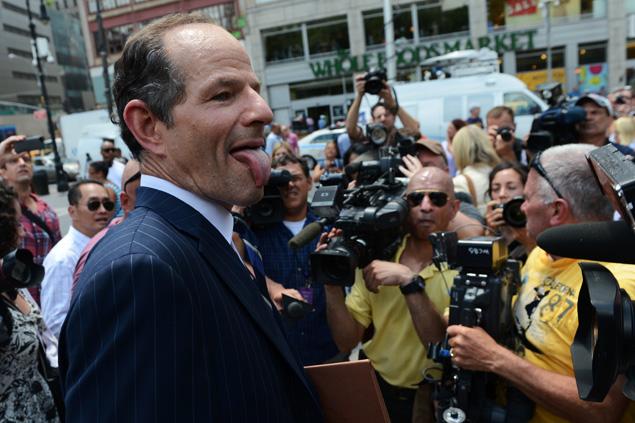

Here’s a metaphor for politics as it really works: All of the candidates have asked to appear on a quiz show where they are asked questions and must think of their feet and supply answers to win. But the people who put the show on the air are only concerned about ratings. So the show is rigged, and those who are allowed on as contestants are told the answers beforehand. And each of them has been vetted. The show’s producers have looked into their backgrounds, and for each of them there is some small scandal that can be exposed if that person were to talk in public about the show being rigged. So once on the air, they are under complete control of the show. They can be taken down at any time, or allowed to win. If they are allowed to win, they can pretend to be smart and the public will have no reason to doubt it.
But suppose someone has such natural talent and appeal that he makes it to the show despite having a clean background. Suppose he really knows the answers, and is attractive to boot. How to control that person? The show’s producers are wise to the fact that there is real talent out there, so absent a real scandal, they supply one. They hire a beautiful young woman, someone like, say, Donna Rice* or Ashley Dupré to flirt with him in a bar, and seduce him. It’s over then. The fresh face is allowed into the game, but he’s already lost a bigger game, as he can be taken down at will.
I doubt very much that people naturally enter into politics and gain support and traction as the public imagines. The news media, always worthless, decides who is “viable” and promotes name recognition. It’s going on right now in the state of Montana, my former home, with Brian Schweitzer. He’s been vetted, likely has plenty of skeletons in his closet. He’s a natural showman. He’s being promoted for the senate seat held by the schmuck and lousy person Max Baucus. As a result, there are no new fresh faces – no one is talked about except Schweitzer. He’s taking up all of the bandwidth. The next junior senator from Montana will be him, or some yet-to-be-designated Republican.
People think that politics is a bottom-up business, and that candidates like Schweitzer (or Obama) appear out of thin air. The truth is less pretty – they are selected for us in advance, and then promoted as the real thing. No one would have remembered Obama’s ‘inspiring’ speech at the Democratic Convention in 2004 had it not been suggested to us time and again that it was inspiring. Suggestion precedes selection precedes election.
In New York City, it appears that neither Spitzer or Weiner has much of a chance, but even if elected, I don’t take too much encouragement out of it. They each know the game now. They are housebroken. They have either been selected, or new scandals are in their immediate future.
_______________
 *Donna Rice, pictured here, gave presidential candidate Gary Hart a wild time on a boat back in 1988, and then, believe it or not, publicized photos of the weekend! Hart had to quit, and instead we got the riveting and inspiring Michael Dukakis to challenge George H.W. Bush. It takes a really lousy candidate to lose to a Bush – apparently his people knew that.
 Piece of Mindful
…for the office of controller of NYC
Typo, or Freudian slip?
What we need to do is find a scandal on the Power that is placing these pretty women in the paths of our honest politicians. Expose the Power. Then all will be better.
LikeLike
I was going to write “comptroller” but the New York Daily called it “controller.” The office theoretically presides over a $70 billion budget.
Our political system as it has evolved has developed an intricate system of public office holders acting as shields for private power. If you take time to notice sometime, you’ll see that news reports always devote full attention to the activities of politicians as if they were the only power in the land. It’s pretty ingenious as it keeps us from poking our noses into the affairs of real power.
LikeLike
Does ultimate power lie in the private sector, or the public sector? There is a synergy between the two, but it is usually taken to be the public sector as the place to go to make a difference. Even your writings: you want a better public sector.
LikeLike
I think real power lies in private fortunes. I do want a better public sector.
LikeLike
The “real power” lies in the ability to create or destroy private sector jobs.
Any third grader knows that.
http://www.zerohedge.com/news/2013-07-12/are-you-smarter-3rd-grade-economist
LikeLike
Utterly, stupendously false! Even Randian. But wait, you are a Randian.
You gotta move on from third-grade economics sometime, Swede.
LikeLike
and Obama so loved the poor
that he created millions more
LikeLike
And he reflexively reverts to partisan politics.
LikeLike
and he reflexively assumes that I wouldn’t criticize an “R” for his piss poor record on creating jobs.
LikeLike
No – “partisan” means arguing differences between D and R, and while it oversimplifies to a degree, most partisan issues are mere distraction devices. It is much more informative to dwell on the vast majority of issues on which the parties are in agreement. On those issues, there is no discussion. That’s where we should focus. The ongoing wars is an example – we should be talking aout ending them, but we don’t because the parties agree.
“Job creation” is a phrase that has exactly no meaning, like “hope and change.”
LikeLike
Job creation/economy is issue numero uno Mark. Sorry bout the war, its slipped into oblivion.
Somehow I don’t see the “D’s”
1. Cutting the corp tax rate to be more competitive with other nations
2. Approving XL
3. Building more refineries
4. Leaving coal generation plants open
5. Allowing off shore drilling
6. ” public land drilling
7. ” Alaskan drilling
8. ” the overseas shipping of natural gas
9. ” the overseas shipping of coal
10. ” fracking
11. ” right to work
12. ” the simplification of the tax code
I do find them allowing 10 to 20 million untrained uneducated into the US with full rights. And I do see them turning our country in Detroit.
Versus Texas which has been responsible for the creation of one half the new jobs in the US which is run by a majority of “R’s”.
LikeLike
All of that stuff goes on , will go on unaffected – electoral politics doesn’t affect anything but your perceptions. Democrats merely play the to a different audience and so make different sounds, but they are the same people. God it’s so easy to see outside,looking in! You’re being played, but Democrats more so. You’re allowed to believe your third grade economics, while Democrats have to be reeled in with different bait.
That’s kind of a crucial point – if you could see through politics, a whole lotta things would clear up for you.
_______
PS:
“Fracking” for example, going on everywhere. No one has stepped up to fight it. In CO, Gov Hickenlooper is a big frack guy (and craft brewer) and wants to prohibit towns and cities from stopping fracking inside their own city limits. He’s a Democrat? What the hell is wrong with you?
LikeLike
NY has given the ok to munis to ban it, Illegal in the whole state of Vermont, Mora NM also voted for a ban.
The people’s republic of Boulder wants it banned.
http://watchdog.org/90462/activists-push-fracking-ban-in-lafayette-co/
Your Gov. did drink the water(last paragraph).
LikeLike
You are not focusing. I didn’t say anything about voting for or against a particular issue. If you’ve been reading the first sentence of blog entries here for the last seven years, you’d get my drift, that both parties are financed by essentially the same money and so must achieve the same ends. Republicans, an open business party, have it easy. Democrats have it tough – they must appear to support public opinion on these issues while screwing us. That’s why I regard it as difficult to be a Democrat, as they have to be stealth Republicans, much harder. Fortunately there are a lot of stupid Democrats, in case you’ve never read Cowgirl or Pogie or Kailey. They eat that shit up, believe every word their great leaders say.
If I had a chance to vote against fracking in my community, I would do so. If I were to instead vote for a Democrat who said he would support me on the issue, I would likely (not always) be screwed.
Do you get the point? I do not say that the parties don’t appear different or that there are not good people in either who want different objectives. I merely say that they must both abide by their financiers, and those financiers are essentially the same people for both. Ours is fake representative government.
LikeLike
And you’re ignoring my point.
Republican strongholds/states, while not prefect, put people to work.
Democratic strongholds purposely dumb down its constituents creating more dependency and less incentives to work.
LikeLike
Case in point. Gov. Walker.
http://www.weeklystandard.com/articles/great-scott_626645.html
LikeLike
I am not ignoring your point. Your point is indefensible, not even fathomable. There is no discernible difference among states that can be attributed to party differences. There is no great upsurge of wealth in “red” states, for instance. The coastal areas of the country are by far the wealthiest, owing solely to location as ports of trade. The taxes collected from places like California and New York are redistributed to places like Montana and Kansas. Most “red” states are either former strongholds of slavery or farm belts utterly dependent on subsidy for survival.
But party representation has nothing to do with any of it.
LikeLike
Gov Walker, by the way, is the perfect poster child for the bankruptcy of the Democratic Party. The guy is an open fascist who deliberately stirred up a rebellion to enable him to crush unions. So unpopular was he that a recall election came about. Here is where the Democrats do their best work – they put up one of their uninspiring hacks, the former mayor of Milwaukee, who created voter fatigue. Walker most likely stole the election, as in the Supreme Court election there we saw that vote counting was crooked. But the Democrats put up a loser.
But it didn’t matter. The Democrats took all of the raw energy that Walker created in opposition to autocratic rule, and crushed it. That is their role in a fake democracy.
LikeLike
BS Mark. Walker came into power because his predecessor was playing fast and lose with the money.
4th paragraph of my link.
“Walker came to office in the Republican wave of 2010. He inherited a mess. Under his profligate predecessor, Jim Doyle, state government had operated almost as a slush fund for public employee unions. Giveaways to teachers and others put the state on an unsustainable fiscal path, so Doyle raised some taxes and threatened to raise others. He raided a state fund set up to cover medical liability, essentially stealing contributions doctors had made to the pooled account. The Wisconsin Supreme Court ruled against that pilfering, but the money had already been spent. Even after budget gimmickry that would make Fannie and Freddie blush, the official deficit was $3.6 billion.”
LikeLike
That is nothing but a big reveal – contempt for working people. It’s all over Forbes, all over you. “slush fund” = good pay and benefits, something that drives fascists batty. Mussulini went after unions first and foremost. Utter contempt.
Question: do you hate all people, or just the ones who work and demand to be paid well?
LikeLike
Then why are “Death Spiral States” blue?
http://www.forbes.com/sites/baldwin/2012/11/25/do-you-live-in-a-death-spiral-state/
LikeLike
I’m calling Budgism! You’re saying the following:
You thereby put yourself in a position that cannot be debated, as all the good to come from you is set In the future.
There are no “red” or “blue” states, no “death spiral.” That’s all perception management.
LikeLike
If you were sending a young man out into the world, and he was interested in garnering political power, would you tell him to try and amass a private fortune, or would you tell him to get into the civil service?
Occasionally I sit across from a GS 15; nice but thoroughly ordinary people who increase their fiefdom with every budget cycle; and increase their power by publishing rule changes and fee increases in the Federal Register that then go into effect after a public comment period, where from what I can tell all written comments are shredded upon receipt.
The private sector counterpart works harder and faster than the competition in the hope that when the competitor goes broke, he can take over that trade and go into competition with the next larger entity until only one is standing.
LikeLike
Imagine this: you live in a formerly primitive society that has converted to agriculture. Your population grows with the food supply, and you find yourself with surplus labor. What to do? You take them and start building pyramids, utterly useless artifacts. workers get paid, buy goods and services, the economy flourishes.
I know it’s heresy, but productivity and efficiency don’t matter much. All that matters is that we have incentive to work so that we can buy goods and services. It doesn’t matter whether jobs are government or private. They are all of the same value to the economy, even as government jobs are better for workers.
We produce far more than we need. Where we go haywire is when money accumulates in pockets and goes looking for places to make money on money. Then the economy is fiancialized, and the paper chase begins. Inevitably we have a bubble then a bust, or depression, as the markets collapse. Everyone suffers. People are impoverished. Money chasing money creates bubbles. The remedy (nothing is perfect) is very high taxes on passive, or legacy income to prevent the money chase.
Everything you know is wrong, I say!
LikeLike
productivity and efficiency don’t matter much. All that matters is that we have incentive to work so that we can buy goods and services.
??? Then why even work? Why not just mail people a check? Worked in Zimbabwe, where highly productive farms were given to political cronies, ’cause “productivity and efficiency don’t matter much”.
It doesn’t matter whether jobs are government or private. They are all of the same value to the economy
The value is inherent in the job itself. You yourself tell us that teachers are more productive than bankers.
Nationalized econcomies, pretty much across the board, don’t deliver as many goods and services as market economies for reasons that seem to elude you.
Most of the time we are better off after a bubble than before. Uptrends can go too long or too high, but at least there is an uptrend, instead of the dreary Cuban existence you want to wish on the world.
LikeLike
We are traveling today. I want to have this debate … Later today or this evening.
LikeLike
Economies, like money, depend a lot on illusions. We over produce, create surpluses, have to do something with them. One solution was to build pyramids, another weaponry. We could easily sink our surplus back not ourselves for retirement, health care, education and infrastructure. But that has untoward results, a healthy egalitarian society. Aristocrats don’t like that, prefer exclusivity and privilege.
We must work and make things. But we soon have made enough. We should have more leisure time.
LikeLike
PS – you don’t seem to understand that it is the money chase economies that collapse, and no, people are not better off after.
LikeLike
One solution was to build pyramids, another weaponry. We could easily sink our surplus back not ourselves for retirement, health care, education and infrastructure.
Weaponry and pyramids have a value on par or greater than retirement and health care. We spend a lot on the latter, to the point of diminishing returns. After a certain point, how does funding more leisure make me better off?
The demand for culture is huge. Congress and legislatures are inundated with requests for more spending. I want a super conducting supercollider and a larger manned space program, but apparently the money needs to go elsewhere.
Surplus is a relative term.
I’m not sure why you are so down on the “money chase”. It is fun to bash bankers, but they offer a service that is in demand, they add value. What is your alternative here? Let everyone print their own money?
The “money chase” you deride is our way of getting people to produce more than they consume.
LikeLike
People assume the purpose of the 70-90% tax brackets on passive income is to punish success and raise and redistribute revenue. As with everything, true to a degree, but also false. High tax brackets prevent disinvestment and, when investors choose to disinvest, force other choices on the, such as reinvestment or charitable contributions. They don’t like it. Don’t blame them.
However, if money is allowed to accumulate in pockets, several things happen: One, democratic government disappears, wealth naturally captures the political process. This has taken place. Two, wealth seeks to build on itself without productive investment – that is, mney chasing money, financial products go haywire, boom/bust, derivatives, all that stuff. I call it the money chase – it is not a natural or healthy phenomenon.
Gotta go. Later as time allows.
LikeLike
Yeah, I’m up against a massive deadline. So of course, procrastinate.
The money chase, wealth building on wealth, rent seeking: is this all necessarily bad? This is a service and can provide value. It depends on how it is used.
Your alternative? Let the public sector plow it into current consumption. How is this necessarily better? Both sides can go off the rails. It is kind of like arguing about what mode of transportation is better: trains or highways.
LikeLike
No deadlines. We’re traveling,driving, meeting people, all that fun stuff. I’m not putting off anything.
Money accumulating in pockets is the nature of things – if we take everything and divide it up evenly, within six months we’ll have the same thing again. It just happens naturally – a few people are very good at harvesting wealth produced by others. They don’t create wealth, but merely accumulate it by various schemes, usually centered around monopoly and banking.
The remedy, which does produce stability and a relatively healthy distribution of wealth, is high taxation of wealth. It keeps it churning – wide demand for basic goods and services is the key. There is wisdom in that 90% Bracket. These people were not fools.
LikeLike
Among other things, you need a population willing to make it work, including a public sector that is not on the take.
The Scandinavian countries often touted here have a population with a high degree of out-group altruism. Lots of cooperation, sacrificing for the other, etc. Not so much in Nigeria. When Nigeria flexes their 90% tax rate, everyone knows the gov’t people and their cronies just pocket it, and they avoid taxes in the usual way. The Scandinavians have more certainty that the 90% will be returned to them in some public good fashion.
LikeLike
Public/private sector makes no difference. All we need is a viable economy producing enough goods and services, and a wide enough distribution of cash to buy those goods. Then it self-sustains for so long as the tax structure keeps rechurning it – otherwise money begins to pile up in investor pockets … Blah blah blah.
Economics – Randianism, Austrian school, neoclassical, are all “approved” schools because they serve the needs of the wealthy classes. It does not matter that those economists are always wrong about everything. They are being wrong for the right group of listeners.
LikeLike
Compared to a 30% tax rate, how much more revenue does a 90% rate bring in? And is the difference lost, or just shifted? If lost, do you shed any tears?
Your complaint here seems to be that there is too much capital accumulation (people hoarding their income) and not enough spending by those with a lower income. I don’t see much evidence of this. Government taxing and spending is about the same mix of capital investment and consumption as would have gone on otherwise.
Keynes advocated gov’t taxing and spending because people literally had money stuffed under their mattresses, and gov’t taxation was one way to get this money out and in circulation. But today most all money is banked, spent, or invested, so you money velocity argument has almost no force. So you are down to arguing that gov’t makes better spending decisions than individuals. Good luck with that. The gov’t financial p. r. division needs all the help they can get.
LikeLike
The amount of money raised by a 70-90% tax bracket – don’t care. The idea that you raise revenue by lowering rates is thoroughly discredited by evidence, but I specifically said that the rate exists to ‘encourage’ investors not to disinvest, to reinvest, or make charitable contributions.
I said nothing about “velocity” as I don’t use such terms. Demand runs an economy, and people who have money create demand.
And I said that when mney accumulates in pockets, as it has, it takes on an life of its own, begins to chase other money and seek havens, as it has, create bubbles, as it has, followed by busts, as it has. My evidence? 1982 forward. That has nothi g to do with tax revenue or velocity, and is a phenomenon unto itself, highly destructive.
LikeLike
Not the term but the concept: you are very much talking about the “velocity” of money. You are complaining that the rich hoard their money, not use it to demand more goods and services.
You seem to be arguing against capital formation, or that only the central government should control the capital for investing. I don’t quite get your deal: do you want a simpler life, where the largest capital investment is a shovel? Or do you think individuals make bad investment decisions, and only a committee of “cronies” can make investment decisions?
For that matter, it would appear that you like bubbles: a bunch of people borrow money from rich people; blow it on their internet start ups; declare bankruptcy; rich people lose their money; money is back in the economy in somebody else’s hands.
LikeLike
…those economists are always wrong about everything.
They were debatably more correct than the alternatives. They alternatives you suggest aren’t any better at prediction or delivering the goods.
LikeLike
False and false.
LikeLike
Entering northern Yellowstone National Park, Internet darkness except for Slough Creek Campground if we happen to end up there.
LikeLike
So your five year plan is working out?
LikeLike
Millions work for minimum wage. No state pays a minimum that exceeds poverty. http://www.ncsl.org/issues-research/labor/state-minimum-wage-chart.aspx Cuba, Mexico, U.S., for too many workers and their families there’s not that much difference at the end of each month.
LikeLike
Low wages is a primary cause of poverty. http://www.washingtonpost.com/blogs/wonkblog/wp/2013/04/12/heres-why-10-4-million-american-workers-are-still-in-poverty/ Democrats and Republicans share responsibility, yet neither gives poverty the time of day. Too busy raising money from Wall Street and K Street I guess.
LikeLike
Cronies.
LikeLike
I punched the “like” button on that one.
LikeLike