
I had a vague memory of an exciting idea some years ago. I watched a report where a Treasury official held up what he called a “Trillion dollar coin*.” He claimed he could use it to march across the street to the Federal Reserve, and pay down the national debt.
I ran with that thought, but did not understand what was going on well enough. I thought the Treasury official was merely making light of our monetary system. At that time I had not theorized deeply on things, but all by myself in subsequent years came to believe
- We could eliminate the national debt tomorrow, and nothing would change. Just eliminate it, draw a line through it with a #2 pencil, not pay it off. It’s all funny money.
- Budget deficits are political tools used to deny funding to some things while funding others. For instance, what I consider a noble cause, funding college education for well-performing students, would be denied due to “deficit constraints.” But a new war? We have tons of money, no restraints!
- Social Security and Medicare could be perpetually funded.
- The Social Security Trust Fund, an illusory “fund” at best, could be eliminated.
- Medicaid, which is in part funded by individual states, could be funded in full by the federal government. States are truly constrained by real budgets and would be relieved to be free of paying for Medicaid.
- Taxes on the public, merely a means of controlling spending and inflation, would continue. But the idea that the federal government is using that money to pay its bills is nonsense. The money just evaporates.
I was a little ahead of the game. The 2011 introduction of the trillion dollar coin was far more limited in purpose. It was only intended to pay down the national debt enough to eliminate the need for the ongoing debate over what is called the “debt ceiling.” That too is a pointless concept, but it is used as a means of threatening government shutdowns and again, as with deficits, a means of approving some programs, doing away with others. As always, new wars would have perpetual funding.
*As I just learned within the last two days, the $trillion dollar coin is made of platinum. It is based on a 1997 law that, in response to requests from coin collectors, gave the Treasury the power to mint platinum coins of any denomination. (See: The Money Game.) It seemed like an unintended consequence, as surely no one intended the the US Mint could print a $1 trillion dollar platinum coin. But not so fast. This quote is from that link:
“As the head of the U.S. Mint, he said, ‘I had very specific objectives in mind. I was appointed by a Democratic president, Bill Clinton, and I worked with bipartisan committee chairs. This was a bipartisan effort, and together we passed that bill. And the fact that it can have a trillion-dollar denomination on it was absolutely part of the intent.’”
I take that to mean that MMT, Modern Monetary Theory, is taking hold though few speak openly about it. It appears that it has arrived.
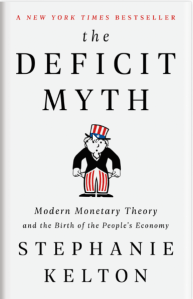 In 2022 I came across a book, The Deficit Myth, written by Stephanie Kelton, a professor of economics and public policy at Stony Brook University. So excited was I by this book that I took down 3,800 words of notes. She is an advocate of MMT, or Modern Monetary Theory. Here are some significant passages:
The taxpayer, according to the conventional view, is at the center of the monetary universe because of the belief that the government has no money of its own. Therefore, the only money available to fund the government must ultimately come from people like us. MMT radically changes our understanding by recognizing that it is the currency issuer – the federal government itself – not the taxpayer, that finances all government expenditures. Taxes are important for other reasons that I will explain in this book. But the idea that taxes pay for what the government spends is pure fantasy. (Page 2)
In a now-famous speech from 1983, British Prime Minister Margaret Thatcher declared that “the state has no source of money, other than the money people earn themselves. The state wishes to spend more it can only do so by borrowing your savings or by taxing you more.” This was Thatcher’s way of saying that the government’s finances were constrained in the same way our personal finances are constrained. In order to spend more, the government would need to raise the money, “We know that there is no such thing as public money,” she added. “There is only taxpayer money.” If the British people wanted more from the government, they would have to foot the bill. (Page 20)
The question is, about Thatcher, was she deliberately misleading, or economically ignorant? It’s not an important point, but what she did there, probably following Milton Friedman, was to misstate the nature of spending and taxation in Great Britain, a country that issues its own currency. One of the great outcomes of MMT is the ability to ditch John Maynard Keynes and Milton Friedman (and the Austrian School).
I spent months researching the intricacies of government finance. I poured the documents from the Federal Reserve and the US treasury, and countless books and articles about monetary operations, and talked with numerous government insiders. Then I began writing. Organize my thoughts around a single question: do taxes and bonds finance government spending? Everything that I had been taught suggested this was a pointless exercise. Everyone “knew” the purpose of taxing them and borrowing was to finance government spending. I thought of that Mark Twain quote – “It ain’t what you don’t know that gets you in trouble. It’s what you know for sure that just ain’t so” – and decided to keep an open mind. As I began to write, I honestly had no idea where I would arrive. I was committed to letting the research be my guide. In 1998, I publish an early draft of the paper, and two years later a more polished version became my first peer-reviewed, high academic publication. The answer to the question I had posed was … no.
This is at first a hard concept to grasp, but along with eliminating deficits and national debt, government issuance of bonds and taxation of the public are not done for their stated purpose – to raise money to pay bills. Ask yourself why government would tax us in dollars when it is the issuer of dollars, as many as it needs. Why then tax us? It is a tightrope technocrats walk, to keep the economy humming while at the same time controlling inflation. Money raised in taxes … evaporates.
Then why does the government need to borrow? The answer is, it doesn’t. It chooses to offer people a different kind of government money, one that pays a bit of interest. In other words, US Treasuries are just interest-bearing dollars. To buy some of those interest-bearing dollars from the government, you first need the government’s currency. We might call the former “yellow dollars” in the latter “green dollars.” When the government spends more than it taxes away from us, we say that the government has run a fiscal deficit. That deficit increases the supply of green dollars. For more than 100 years, the government has chosen to sell US Treasuries in an amount equal to its deficit spending. So, if the government spends $5 trillion but only taxes $4 trillion away, it will sell $1 trillion worth of US Treasuries. What we call government borrowing is nothing more than Uncle Sam allowing people to transform green dollars into interest-bearing yellow dollars. (Page 36)
Functional finance turned the conventional wisdom on its head. Instead of trying to force the economy to generate enough taxes to match federal spending, [Abba P.] Lerner urged policymakers to think in reverse. Taxes and spending should be manipulated to bring the overall economy into balance. It might require the government to add in (spend) more dollars than it subtracts (taxes) away. It might even need to do this on an ongoing basis, meaning sustained fiscal deficits over many years or even decades. Lerner saw this as a perfectly responsible way to manage the government budget. As long as any resulting deficits didn’t push inflation higher, the deficit should not be labeled overspending. (Page 61)
Over many years, deficits have accumulated and been labeled the “national debt”. If it were a real debt that had to be paid, it would be worrisome. Right now it stands at $35 trillion (actually, as of July 25th, $34,969,578,299,467.18). Honestly, if it were real, would we not be broke? But we are not broke. Will bankers knock on our door demanding payment? No. It’s not real, and they know it is not real.
I am a little full of myself as I write this, as my list at the opening above was completely dead-on without having read Kelton. I’ll come back to earth here. The mythology of how we run our country, financially, as with a few other countries (United Kingdom, Australia, Canada, Japan) is so powerful that even those in power must bow before it, running annual debt ceiling debates and bemoaning deficits. How many of them really get it? I suppose less than half. But I do not know.
Do you remember the Greek financial crisis that started in 2009? It was real. Why so? Greece had converted from the drachma to to euro, in effect giving up its sovereignty. It became a ward of the European Union. (Do you imagine it a coincidence that Great Britain never converted to the euro?) If you want to understand how central bankers can bring a country down without firing a shot, Greece showed us.
Even though it can’t happen to the United States, it is possible for a country to lose access to affordable financing. That’s what happened to Greece in 2010. But that’s because Greece undermined its monetary sovereignty by abandoning the drachma in favor of the euro in 2001. Adopting the euro changed everything. All of the Greek government’s existing debt was re-denominated into euro, a currency that the Greek government could not issue. From that point on, anyone who bought bonds from the Greek government was taking on a new kind of risk – default risk. Lending to Greece was now a lot like lending to an individual US state, say Georgia or Illinois. As we learned in chapter 1, individual states are currency users, not currency issuers. They really are dependent on tax revenue and borrowing to pay the bills. Sure, they can sell bonds to raise money, but financial markets normally demand a premium for the added risk of lending to someone who might not be able to repay. It’s a lesson Greece learned the hard way (along with Ireland, Portugal, Italy, and Spain). (Page 84)
So while some may lament our abandonment of the gold standard and react in panic and fear at our deficits and national debt, MMT can put our mind at ease. Greece voluntarily abandoned its independent status when it converted to the euro. While it seems to me at times that our spending is profligate, underneath it all, our house is in order. That of Greece is not.
Except … remember Covid? Of course. My wife and I, a retired couple, received in the mail (or by direct deposit) $3,600 in relief … all part of the financial stimulus needed because so many people had left the workforce. We put our stimulus in savings. Most could not do that, we know. But here is the point: This exemplifies what happens when the monetary restraint at the government level is not done. All of that free money, important as it was to those who needed it, created demand where there was not enough production to answer it. The result: Inflation. By 2022 it had escalated to 8% from 1.8% in 2020. It is now settled down to 3%, but generally the financial whiz kids want it at around 2%.
That’s how we roll, however. I remember when a stamp cost a dime, now it is 73 cents. Mild inflation is built in to our system on the theory that deflation would be disastrous. I can still pay my bills, we still have savings, so something, at least for us, must be working.
 Piece of Mindful
Block-chain, crypto-currency, and Web 3 will replace Britton Woods global currency/finance structure. We’re waiting for the next 9/11 or Covid psyop, or an expanded “forever war” (WWIII?) to burn down the old, and in with the new “track and trace” system. The way “sanctions” are being used for nation states, will be our future at the community and individual level. Conform, comply, or “poof” your account is frozen, or stolen. Slaver-pirates never change until their heart rate is reduced to 0 beats per minute.
“Freedom tech” is as bullshit as “democracy.” Oligarchy has many faces.
I can’t load the videos, but check out (any search engine will do) RFK Jr. acting — with rose colored glassed — as the Pied Piper of block-chain.
LikeLike
That is all technology run amok. We can’t stop that train, and yes, our precious freedoms are under threat from the people, the monsters, who brought us Covid and Climate Change. But none of that is brought about by MMT, which I regard as benign. It’s been with us, hidden in the tapestry, for decades.
LikeLike
I agree, MMT is benign. All is going according to plan. My question to MMT advocates who write the books and articles is this:
Who do you think ‘the government’ is? And why would anyone think these self-appointed rulers of our government, within the global governance framework/structure, want things any other way? The obsession over the “national debt” helps to perpetuate our belief in the abstract virtual model we call the United States of America.
Obviously, we (the commoners/goyim) are not on their minds when they structure, and ultimately restructure, the global financial/currency system. Last time, United Nations Monetary and Financial Conference consisted of 730 delegates from all 44 allied nations
All I’m trying to say is that there are a lot of indications that the (global) structure of the system is nearing a point when it will change, and change radically.
LikeLike
Interesting line of thought. But I don’t agree with the notion of MMT being benign – the purpose of MMT is as crooked as the monetary system itself.
MMT is political correctness on perpetual public display – what is actually going on in reality is manipulation of volume of money in circulation and its value. In other words, the system is rigged in their favour and MMT is the tool enabling it, rendering MMT exactly the opposite of benign.
The government, state, congress, parliament,… are just words. Real actions are executed by real people – there’s no State that takes care of anything, it is people that get anything done in the context. The same applies to ruling and governing – it is just certain people making decisions and delegating execution of the tasks to other people, nothing is done by the government or State.
That’s why the important people, the decision makers in monetary subsystem, are their peons under 100% control. This is also true in all other subsystems that are included in the government – all the important decision makers and executors of any planning are trusted peons.
While debating, I also think that we, the commoners, are definitely on their mind. Big time. They fear us more than anything and by working against us they’re showing it transparently. They fear we might collectively remember heaven on Earth (as an euphemism) is actually possible, given the abundancy of resources.
LikeLike
As I see it, MMT in itself isn’t inherently bad. The issue lies with how its principles are utilized, and as far as The-Powers-That-Be are concerned, they haven’t done a good job in creating a better economy for everyone with the tools they possess. In an ideal world, its tenets would be better executed to create a more palatable economic climate for the masses instead of stacking the decks in favor of the privileged few to the detriment of everyone else.
LikeLike
https://www.usdebtclock.org/
The total US debt is much higher than the 35. But who is this debt owed to? It doesn’t list the organizations or other countries that are waiting for a check….The State debt clocks are even more confusing.
LikeLike
And than just think about the value of all nations’ debts globally – to whom do all these “nations” owe their debt? There’s trillions owed by Americans and trillions more owed by every other living man and woman of all possible nationalities from all over the world. So I’d really like to know: a) who’s the owner of the debt and b) how does that work, allegedly collecting debt that is always increasing without the debt issuer being insolvent as a consequence?
They will claim that each nation has its own debtor (central bank), but that explanation also fails to explain where the extra money comes from and why is there no surplus in volume of money circulating over time, as the alleged debt gets repaid.
So here they will say that’s why there are instruments of monetary politics / tactics / strategy, which allow them to manipulate (enlarge / diminish) the quantity of money circulating in the system. They confess and admit to this part of the story being true – they do manipulate both volume of money’s circulation and its perceived value. They say it’s absolute necessity to control the volume of money supply – if they don’t, the volume of money in circulation growing faster than goods produced in the economy, leads to inflation and eventually system’s collapse. I say bollocks.
But then why are they doing it, you may be asking, if they have all the money printing capabilities in the world?
From my own perspective and understanding, the real reason for all these financial machinations is to take away money from me and you as the commoners – all that people can share in common is indebtedness. And we have to admit it – they’ve done superb job at owning the world by debt. But still, why? I believe it is because of their own and worst fear – control over money allows for weapons and armies to be built, and armies theoretically represent possibility for them to lose their ruling position and hegemony. It is exactly how they managed to conquer the world some time ago and they’ll do anything and everything in their power so nobody else can repeat it.
LikeLike
I don’t take issue with a word of that. There are powerful forces that run this world by mechanizations put in place long ago, using debt and war to take control of kings and queens and princes, and then nesting behind them running everything.
I can’t do a thing to end their rule, cannot even convince people that their votes are not counted and that visible leaders are actors and fakes.
But I take solace in MMT. We don’t have great burdens. We don’t have national debt or deficits, Social Security and Medicare will go on indefinitely. Taxes reduce our spending and saving ability, but if you live a simple life and set aside enough, you can be comfortable and secure. You are allowed inheritance without tax.
My dad was a simple man of no notable ability. His only asset was some land he and his siblings inherited in Great Falls. Because he had no financial sense he set up his business as a partnership with my brother rather than a corporation. IRS ate him alive. He had to sell the land to pay the tax. I remember him saying to me over the phone one day, a clean man who did not swear, “Fucking IRS!” But it was his own shortcomings that did him in. He could have avoided that nightmare.
LikeLike
I forgot, one aspect of our tax system is a 500K exemption from capital gains tax on sale of home for married couples (250K for singles), making homes the primary savings vehicle for most of us.
Also, conservatives love to mock the Canadian health care system and income tax, which is indeed higher than our own. But the average Canadian household is wealthier than the average American one. The primary reason is that they are not burdened by medical expenses, a secondary one that they are not burdened by the cost of higher education.
LikeLike
I think it’s important to point out that MMT proponents claim (justly imo) that MMT is descriptive, not prescriptive. They are “proponents” of having an accurate understanding of the existing economic system – NOT proponents of that system as such. Or, at least, if they are (or believe it could be used “for good”) that’s separate from MMT as such, as an analysis.
They appear to be “proponents” of some strange bizarre form of financial legerdemain because the entire economics discipline has since the 19th century placed a veil over its actual workings. And so all understanding of it, all talk by politicos or government officials, media and financial pundits, etc, reinforces the folk conception that government spending is like household spending, and ought to be managed in the same way. Now these loons come along and try to lift the veil, and people get mad at them. As if they’re trying to institute the system seen beneath the veil.
Or, if there seems to be some truth in the analysis, it nevertheless seems a bit shady and suspicious. Never mind it’s been running for generations, it ought not to work. People don’t object to the veil as the scam – no, now they demand that the system be changed to match the veil, to match what they had thought it was – a household type budget. Whether that’s ever actually been the case anywhere in history or not.
In the story of the emperor who had no clothes – suppose it had taken a hundred years before anyone noticed. And then some academics came along with MET – modern emperor theory. The public would feel a bit queasy – “I had a sense something twern’t right” – but they might want to burn these heretics, as though they were advocating for nude kings. Well no, they’re just saying, hey let’s make the best of the situation…
LikeLike
I sat at lunch next to a president of a small bank sometime in the 1980s, and in the course of conversation he told me that the issuance of war bonds during World War II was not done to pay for the war, but rather to remove money from circulation, as there were only limited goods to buy. This tells me now that MMT was in effect even then.
LikeLike
Mmt has been in effect to an extent since before true paper money. Banks counted the same gold multiple times giving out paper coupons over and over. Even before the paper credits for gold, the gold supply kept growing due to mining or tripping over more gold. Goats kept breeding and more fields were tilled back when these commodities were used for trading etc etc. Money just makes it possible to do the same thing from absolutely nothing.
it is a brilliant idea and the world would not be the same without it.
LikeLike
Mark and Alex –
“MMT was in effect, has been in effect..”
I know what you mean and agree in the sense you mean it, but to repeat my point above, MMT is an analysis of a fiat currency system, not the system itself. I don’t think it’s entirely pedantic because imo MMT is a very useful analysis and it creates a lot of semantic confusion to use the term for the theory of the thing interchangeably with the thing itself. Map and territory issues lol.
MMT as such has not been “in effect” since whenever, it doesn’t have effects. It’s an economic school of thought that may be more or less accurate. It has existed since maybe the Seventies or Eighties, I’m not sure when it was branded – it grew directly out of the work of Marvin Minsky IIRC. Of course before that the ideas, at least in part, were present to an extent in the work of Keynes and others.
LikeLike
It more or less grew out of abandonment of the gold standard and Bretton Woods, maybe not formally, but look at the facts: The gold standard had to go because of inflation eating away around the edges. After that we had wild inflation that had to be checked, and we recently, since the “housing crisis” and until 2022 and Covid had maybe 12 years of low inflation and market expansion.This all done by expert management of currency.
LikeLike
Off topic.. question for any Freemasonry etc experts –
I know masons have their “grips” they do when shaking hands.. are there other signs and signals they use, and do they ever mistake someone based on other cues?
I ask because I had an encounter I wondered about. I was on a state highway cutting across a rural part of the state, and stopped at a Texaco (it was on a lightly developed road, a little strip of franchise type businesses.) After paying for gas and coming back out to my car, an ordinary looking guy, friendly, came walking across the Islands toward me.
“Hey, don’t I know you?” He seems genuine enough, not obviously a con man or anything. I try to place him and tell him sorry, I don’t recognize him.
He seems genuinely surprised. “You’re a J, right? Your last name starts with J?”
I pause for a second thinking about the odd formulation “a J” and tell him no, sorry.
He seems skeptical, and disappointed, but accepts this and walks off.
So, am I crazy.. just a guy mistaking me for someone? I know “G” has significance in masonry, is “J” anything? I see “J” used a lot in various forms with public figures or news figures I would consider probable spooks of one sort or another. FWIW. Also, incidentally.. continuing down this little highway, I was seeing “J&J’s Peach Stand,” “Jupiter Inn,” other J related names.. pattern recognition run amok? You tell me..
LikeLike
That’s really interesting! Did the guy ask you if you had a copy of Catcher in the Rye in your back pocket?
LikeLike
Ha! So you think it was nothing? Probably so..
Re MMT – my last attempt at this and then I won’t bother anyone with it..
The way everyone here is using the term, would be like saying “Newtonian physics has been in effect since 1665 at least..”
Or whenever Newton was working, I forget. Or, “I for one find Newtonian physics completely benign..” and “Oho! You do eh? Newtonian physics is anything but benign..”
This probably won’t dent the consensus either, but I can hope..!
Incidentally NakedCapitalism has a new article up that’s probably based in MMT principles. I haven’t read it yet but the headline looks like it. About how repaying bank loans “destroys” money.
LikeLike
MMT aka Modern Monetary Theory….which describes the underlying system. If the theory was correct, one could use its postulates as the tool to achieve a certain monetary goal.
As in math, if you know for instance the length of two sides of a triangle, you can calculate the third one based on theoretical principles. In which case you’re using the theory as a tool, right?
I believe I have no issues with understanding which is which. My small point was that if the underlying system is rigged and therefore defunct, then the theory describing it cannot be benign. The reasoning behind this is simple – any application of theoretical principles (MMT) leads to results, that have little to no correlation with reality. Since nobody knows what exactly is going on at the top levels of control, not a single theory was ever written about this topic that would resemble reality.
Also, these theoreticians even dare to equate the term “theory” with “school of thought”. Which for me clearly shows what all these attempts to describe the monetary reality really are – mental exercise programmes for the gullible.
LikeLike
No, I meant that your comment was really interesting, and then made light humor, but not to belittle you. Your comment was really interesting.
LikeLike
Thanks for clarifying. Now if he had mentioned Catcher in the Rye, at least I wouldn’t be left puzzling over whether it meant anything or not. Darn it 🤣
LikeLike
Minime –
I can’t quite follow your reasoning there.. maybe it’s just me but every time I reread it, it seems to get tangled up semantically and would be difficult to untangle. It appears you see the basic map/ territory issue I was raising though, that’s all I wanted to point out.
Personally I appreciate the work of the MMT “school” giving us interested laypeople a clearer understanding of the workings of the financial system, vs the mythologizing and veil laid over it by neoclassical or neoliberal economics (or whatever the orthodox school calls itself.)
Not quite sure of the sense in which you object to that, or even if you do? Of course the system itself is another matter.. and easy to object to, as thousands have. Perhaps it could be relatively “benign” if genuinely used to serve the “public purpose,” as Mark suggests in his bullet points above, and the leading figures of MMT advocate when they go into prescriptive mode.. how the system could be used “for good,” if the public understood it properly. Or maybe that’s utopian scheming, and would backfire in practice.
LikeLike
Imo, I couldn’t be clearer with my comment above.
Maybe it’s just me, but I believe nobody on this comment thread shares the same viewpoints as I do.
All these “schools” are bogus due to the fact that the underlaying system isn’t transparent. So all these theories about certain economical principles can’t be ever proven and are therefore useless, unless you want to believe the MSmedia telling you otherwise. That’s partially one of my points.
The second point being that since the monetary system is apparently working against the people and is inherently malign, the theory describing it cannot possibly be benign.
An analogy would be to a magician, who pulls a few rabbits and pigeons out of a seemingly empty hat and then a few theoreticians come along and start developing endless ideas how those rabbits actually materialised into reality out of thin air, while nobody wants to discuss or notice the trickery.
Mark made a quote in his article coming from the author Kelton, saying something along spending months into research by sifting through public documents, which made me write my initial comment. Does anybody here really believe that the secrets of monetary reality are hidden in FED’s documents? Or that any public person/author knows what exactly happens to collected taxes? Do you believe government financial records and accounting info about them are true?
In short words, there’s nothing benign about the monetary system nor its “schools of thought”. People having map/territory issue is the least that worries my mind.
LikeLike
Minime – I’m sure there must be black budgets and hidden financial dealings, but imo the vast amount of it IS quite open and public – hidden in plain sight – probably. It’s hidden by being misrepresented to the public for the past century, and by the public’s own incredulity at the reality vs the myth they’ve been told. Try to convince someone that federal spending isn’t like a household budget! You won’t get far, I assure you. So, politicians and media can fret about running out of money for social security, about the national debt, etc. All in plain sight.
It’s also hidden in the same way science or the law or medicine is – it’s too technical, or wonkish, or time-consuming, for most people to bother looking into. And most the initiates – the orthodox economists – are indoctrinated to view it and talk about it in ways that maintain the veil. Just a few “renegades”, in heterodox schools, are interested in really understanding and writing about how it actually works. The public never listens to such cranks, lol. And perhaps the system even has a use for some limited opposition of that sort..
LikeLike
“Try to convince someone that federal spending isn’t like a household budget! You won’t get far, I assure you. So, politicians and media can fret about running out of money for social security, about the national debt, etc. All in plain sight.”
This is the key point here.
But with huge difference to any other sciences you’ve mentioned – economics is an absolutely empirical science, which in simplest terms means that people acquired theoretical knowledge by observing real events and trying to scientifically describe them, searching for principles and patterns, etc, making experiments and confirming them independently… But how can you make any true theoretical assumptions about the system which is controlled and manipulated by a few corrupt individuals? How can you test any theoretical principle within macro-economy? And most importantly, would you trust the data if it is coming only from them? Since nobody can actually measure anything within macro-economy by himself and therefore guarantee the reliability of data, any such experiment probing the theory is absolutely useless.
It’s all akin to analysing a mirage instead of the real visual object – without knowing anything about the optical phenomena that distorts its visual appearance. Your eyes would be fooling you into believing that i.e. ships can float in the air. Which is exactly what majority of people believe in about the monetary system – the description of a mirage, a distorted reality presented as the real deal.
LikeLike
Hi, nice to be back
I am not an expert on economics so I was hanging back from taking part in the discussion. I am a natural scientist by training and natural way of looking at the world.
I am generally in agreement with Minime. Economics a false science invented by man to legitimize the theory of money, loans, economies, etc. Econonics is treated as a force of nature by academicians, similar to Marx and Marxism. Because half my comments disappear I will end bluntly into saying it’s all a magicians trick, economics is not a force of nature controlled by “God”, it is controlled by their God at his whim.
LikeLike
Contact me when your comment disappears. If I’m around, I will retrieve it. mpthct at proton dot me.
LikeLike
Thanks Mark much appreciated!
I will give some practical advice to how to best deal with the “beast” economic system we live in. It is not easily achieved, but in my opinion the fastest way to “peace of mind” like the name of this blog.
From working with many nationalities I found out especially Asians tend to pool their savings together. And freely “loan” money to family members at zero interest, avoiding banks altogether. A large, cohesive family is the key to survival and happiness. As many have argued, one the most unfortunate aspects of modern propaganda is aimed at destruction of the family. In my eyes, family = wealth. You really don’t need money, or much of it, if you’re willing to work relatively hard – at least by studying, or doing work to help your family – it doesn’t have to have a salary attached to it.
LikeLike
I’ve been struggling with the concept of money and banking being “evil” or anything more than a necessary evil. Conan O’Brien made a wonderfully funny analogy regarding coaching his young son’s team in T-ball, that it would be better if they merely strapped some baseball gloves on the backs of cats. What are we to do without a system of exchange? It always comes about, whether wampum or the gold standard or furs … we cannot exchange the wide array of goods we use on any basis but a standard currency. Yes, gold and silver coinage was a rational thing, as neither metal was in abundant supply and so kept the currency in check. That we morphed into paper is odd, as we all know that paper is worthless, but it is like watching a movie. Without willing suspension of disbelief, we don’t enjoy it. Paper money acts as baseball gloves on the backs of cats, allowing the game to go forward without any sense that it is rational. I do not regard it as evil, just useful so long as we all agree to believe in it.
LikeLike
Have you seen where MMTers describe early uses of its principles by colonial powers taking over native populations? I think it was called a corvee system maybe.. anyway once the natives were militarily defeated, the conquerors implemented a tax that had to be paid in their currency. The only way to get the currency was to work for the colonists on the plantation, mines, etc. Previously the natives could subsist easily on direct use of flora and fauna. Modern economies are (perhaps, in my understanding) just a refined form of this.
If we put that aside, and say well yes but look at the advances it engenders and permits, the factor then enters that it has been co-opted (or maintained) by private interests and families, who use it for personal advantage. It would have to be either administered by selfless philosopher kings..! Or, perhaps even less likely, by an enlightened and informed public, using it for the general welfare, to (arguably) rise above its fundamental nature, and escape any malodor of moral opprobrium..
LikeLike
Turns out Conan O’Brien is also a decent guitar player, I think he may be doing a tour with Jack Black who also has a band.. I remember back in the day only a few people that played guitar and now it’s everyone and their grandma.
LikeLike
Conan is self-effacing about his playing – one time in a guitar-off with Jack Black, Conan was shining and Black got suspicious and opened the curtain, and Slash was back there playing Conan’s riffs.
In another bit, Conan is playing opposite Elvis Costello, and Elvis has had enough and reaches out with wire cutters and end Conan’s riff.
LikeLike
Minime –
(Replying here because it’s easier in a larger text box on my phone)
My view is that it’s more likely the system is “occulted” in the manner MMT describes, than in the manner you suggest. That is, I think most of these central bank monetary operations, private bank money creation via loans, etc, are mostly done out in the open, technically all very legal and “above board,” no need for hiding in the shadows. It’s “hidden” in plain sight because, in the first place, everyone is given a false picture by media, politicians, academics, and so they see what they’re told they see. It helps of course that what they’re told matches their experience of their own household budget so it’s “common sense.” Secondly it’s hidden by being a bit technical and convoluted. So, in the same way you don’t need to censor books because very few people read (serious) books, you don’t need to conceal monetary operations. The few people who analyze it from a heterodox perspective, and even write accessible books like Kelton’s, are completely overwhelmed by the mighty Wurlitzer promoting the orthodox view. (Although they could always flip the script, for reasons, if they wanted to.. MMT has gotten a little traction in the past 5 or 10 years. Elizabeth Warren is a supporter I think, for its “public purpose” potential applications.)
This just seems more plausible to me, because easier and practical, than the idea that all the financial data is systemically fabricated and phony. Yes there are likely actors in the shadows, such as Intel behind Black Rock and silicon valley companies and others, and much that is literally hidden and shadowy. But it seems to me, and maybe I’m wrong, that they would prefer that the actual systemic operations of the system, would be done very transparently and “legalistically”.
LikeLike
A more recent example, Greece left the drachma for the euro, and thus gave up its sovereignty. They were conquered without a shot fired.
LikeLike
Well, we can’t agree on everything 😉
I think your viewpoint has much weight in reasoning, but we differ in regards to how much distorted is the system’s reported picture. Imo, what they report and publish as official data is already edited, with knowledge of real monetary mechanisms completely obfuscated or unknown to the public.
Knowing what I’ve learned throughout years, I’ve absolute zero trust in anything coming from them, if I’m not able to personally verify it or study on my own due to natural laws/logic, etc. That’s the main difference here.
What is left is to judge them by their actions and deeds, which you have to admit, are not actually and historically beneficial for the people in either short or long term. So here we have malevolence on perpetual display everywhere, lies and deceits going on for who knows how long, but they’re transparent in the monetary section of reality? I don’t think so.
I don’t know the truth, but I know that liars can’t be trusted.
LikeLike
You could well be right, I’m not knowledgeable or expert enough to personally analyze public monetary data and make sure it all checks out. Just saying what seems more likely/ plausible to me, in terms of practicality, and also how they would prefer to operate imo.
As a comparison.. there’s that blog Ab/ fakeologist has linked a lot, where a woman paralegal has analyzed the way laws have been crafted for “pandemic preparedness” to make sure everyone involved in vaxes and other measures is legally not liable. And to assume all sorts of tyrannical powers. It’s all done (technically) openly, legally.. but it’s hidden because it isn’t talked about by the media or pols, and is in dense thickets of jargon laypeople find impenetrable. It seems the nature of so much of the system, medicine, law, money, etc is to invert things right in front of your face, and then tell you black is white, white is black over and over, in school, entertainment, news and so on.
LikeLike