
AP News recently ran a headline claiming, actually shouting, that Monday, July 22, 2024 was the hottest day ever in Earth’s history. My questions are many, but most importantly, do they really expect to be taken seriously when making such claims? This is followed by “Do they believe their own lies?” It appears to me that these screaming headlines are designed to reach gullible people who don’t read beyond headlines and who can’t think properly anyway. That must be the target market – most Americans.
Let’s have a look of some of the many problems with this headline:
- Our mechanical temperature record only goes back to the early 1700s, and thermometers were not in widespread use until many decades later. Our longest running temperature base is called HadCRUT, which measure the temperatures in the Great Britain back to 1856.
- All other means of measuring the earth’s temperatures are called “proxies”, that is, we use another means of measurement. Some of these methods are tree rings (only somewhat reliable, and as Michael Mann and company taught us, easily cherrypicked), ocean bed cores (more reliable), and ice cores from Greenland and Antarctica (probably the closest we have to reliable, but do reserve judgment – in truth, we do not know). These methods use anything in climate that can be thought to act in line with temperatures. For instance, Greenland and Antarctica ice cores measure the presence of oxygen isotopes 16 (colder) versus 18 (hotter).
- These proxies cannot point to any day in particular – some, like ice cores, are measuring blocks of a century.
- We are in an “interglacial” period, that is, a pause in our ice age. But we are still in an ice age. We know that, because both poles and Greenland are covered with ice.
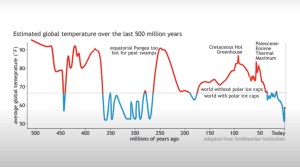
- In the graph above, the red lines represents those periods in the last 500 million years when the planet was so hot that the polar ice caps melted. The blue lines are times like now, in the ongoing ice age called the Pleistocene. Our current era is on the far right where you can see that it is as cold or even colder now than the last 500,000,000 years.
- Our current interglacial period, called the Holocene, came in like a lion maybe ~14,500 years ago. I see different numbers bandied about.
- The period before the advent of the Holocene is known as the Last Glacial Maximum. People then, like now, mostly lived by oceans.
- During the onset of the Holocene, temperatures rose dramatically.
- The poles, Greenland, and all glaciers went into a severe melting phase. While the Antarctic and Greenland ice sheets did not melt in total, all of our land glaciers melted over that 10,000 years of ocean rise. That means that every glacier we now have is less than 4-5000 years old.
- Ocean levels rose dramatically, as much as 400 feet. It was not a slow process every generation living by the ocean had to retreat often to stay above water. The 400-foot ocean level rise took place over a 10,000 year period.
- The Little Ice Age, a period of unusually cold temperatures in the Northern Hemisphere, lasted from ~1300-1850 AD. Since 1850, temperatures have been gradually rising. This gradual temperature rise, often in fits and starts, is going on to this day. It is much to our benefit.
- I have on hand here a record of temperatures in the lower 48 going back to 1918, kept by NOAA, the National Oceanic and Atmospheric Administration. It is done state-by-state. Without fail, it shows the hottest decade on record to be the 1930s, followed by the 1940s.
- NOAA, acting on orders I suppose, has gone back and altered past temperatures to make the past look cooler than it was. That way, they can say it is hotter now than ever before. In essence, they are cooking the books.
- A man named Bob Tisdale was able to download NOAA’s temperature data for the last 100 years (1918-2018) prior to their “adjustments” of past temperatures. This is the record I have on hand.
So the Associated Press is saying that July 22, 2024, is hotter than the transition from the Last Global Maximum to the Holocene, which saw melting poles and glaciers and ocean levels rising 400 feet. AP is saying that July 22, 2024 is hotter than any day in the 1930s and 40s, when the Dust Bowl and drought sent people en masse to points west and cooler climates.
I’ve often wondered why news outlets and supposed climate “scientists” are given carte blanche to make any statement or prediction no matter how absurd, without anyone except us skeptics fact-checking them. I think it boils down to Climate Change and warming being a propaganda campaign wherein each crazy statement or prediction is quickly set aside while another takes its place. It’s a strategy to keep us off balance. They won’t stop, but we can follow the 80s band Journey in their musical exhortation that we need to stop believing. Oh, wait. I guess the song was called “Don’t Stop Believing.” Bad song to choose.
However, “Don’t Stop Believing” could be the anthem of the climate change fanatics.
 Piece of Mindful
News is itself nothing more than a simulation of news. News died a long time ago. So, the non-news says ___________________, doesn’t matter, it’s all made up in the news studio. Simulacra: a copy with no original.
The end.
LikeLiked by 1 person
His-story repeats… except when they change it.
LikeLike
Fear sells better than peace, so seeing this doesn’t surprise me. It’s also a great way to keep the masses under control, which should go without saying. That’s what the whole “climate change” scare is all about. It has nothing to do with “saving the planet.”
And like I said previously, it doesn’t matter how absurd or sketchy such reportage on the matter is, because as long as they champion the official party line, they’re given a free pass to say whatever they please. The same is true for much of mainstream science in general.
LikeLiked by 1 person
Looking at the chart does that mean the Sun takes a break and becomes less powerful for millions of years, then becomes more powerful generating more heat for millions of years?
LikeLike
There’s quite a bit going on planet-wide … Milankovitch cycles, which are variations in the shape of the Earth’s orbit over tens or hundreds of thousand of years; eccentricity, which is the change in distance from Earth to Sun at its closest and furthest points over time; and obliquity – the tilt of the earth varies from 21-25 degrees over the course over 41,000 years. Each of these factors affects insolation, or the amount of heat (watts per meter squared) that various parts of the planet receive over time. We are currently in the Holocene interglacial period of the Pleistocene ice age.
Obliquity is an interesting one, as with each one degree tilt in the planets axis, more or less of the night sky becomes visible. Ergo astrological signs and the time of Jesus, which was Pisces (the fish) to the dawning of the Age of Aquarius, now. It was no accident that the Bible is full of fish references.
That’s the last 500 million years,, according to some government agency. Any time in red is a time when there is no polar ice, any time in blue is an ice age. We are on the far right right now, and our 14,000 year interglacial period is too small to see.
LikeLike