
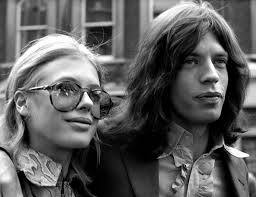
This is a celebrity I have Faithfully (heh) avoided for the entirety of my life. A feat I managed despite so-called “professional” music critics showering me with their enlightened opinion. But here I am, listening to her Greatest Hits for the first time, and two songs in, I’m experiencing full-body tremors and the early onset of musical PTSD.
Her full name? Marianne Evelyn Gabriel Faithfull. Which means if you’re a regular reader of this blog, you already know exactly where this is going.
She was married three times, but weirdly, the only spouse with readily available information is John Dunbar, her first husband. He was the son of a British filmmaker (insert posh accent here), and the two tied the knot on 5/6/65—a date that, once reduced, naturally gives us 11/11. Because of course, the strange numerology follows these people around like unpaid parking tickets.
Then, just six months later, she gave birth to their son on 11/10/65, but that whole “stable family” thing was way too boring. So naturally, she did what any reasonable woman would do: left her husband to shack up with Mick Jagger. Because, you know, when in doubt, date a Rolling Stone.
And if you think I’m being too harsh, here’s Faithfull’s own alleged explanation of this life choice:
“My first move was to get a Rolling Stone as a boyfriend. I slept with three and decided the lead singer was the best bet.”
A true romantic if I’ve ever seen one.
Dunbar, for his part, went on to co-found an art gallery and—because this story wasn’t chaotic enough—introduced Yoko Ono to John Lennon. Meaning he, in part, played a role in breaking up The Beatles. So, yeah, that’s his legacy now.
Sex, Drugs, and… Fur Rugs?
Once Marianne and Mick became rock ‘n’ roll’s most notorious couple, she made headlines when police raided Keith Richards’ house for drugs and found her wearing nothing but a fur rug.
Decades later, Faithfull would lament that the infamous bust had ruined her life:
“It destroyed me. To be a male drug addict and act like that is always enhancing and glamorizing. A woman in that situation becomes a slut and a bad mother.”
Now, I’d call her out on the hypocrisy of that statement, if any of it was actually believable in the first place.
Her Ancestry Is… Something Else
For those who think her questionable musical success was just the result of industry nepotism—think again! Wikipedia assures us that she actually grew up “underprivileged” and was a “charitably subsidized pupil“. So there, she earned it.
But let’s take a quick detour into her family tree:
- Her father, Major Robert Glynn Faithfull, was a British Intelligence officer (because of course).
- Her mother, Eva von Sacher-Masoch, was the daughter of an Austro-Hungarian nobleman from some old Polonized Catholic Rutherian aristocracy. (I barely understand what that means, but it sounds impressive.)
- Her maternal grandfather had ties to the Habsburg dynasty.
- Her maternal grandmother was Jewish.
- And her maternal great-great-uncle was Leopold von Sacher-Masoch, who wrote Venus in Furs, the erotic novel that inspired the word “masochism.”
The Name “Faithfull” Gets More Ironic By the Minute
In 1985, while still married to her second husband, she began an affair with a man who later jumped from the 14th-floor window of the flat they shared.
And, as if she wasn’t already a walking contradiction, in 2007, she had this to say:
“I’m not prepared to be 70 and absolutely broke. I want to be in a position where I don’t have to work. I should have thought about this a long time ago, but I didn’t.”
Now, on its own, that’s a relatable take, except she still lived in a flat on one of the richest Parisian avenues and owned a house in Ireland. And let’s be honest, did she ever actually “work”?
So yeah, I won’t be setting up a GoFundMe in her memory anytime soon.
I’ve only come across all this after her passing, so whatever arcane magic kept her in the public eye for decades will now have to work its wonders posthumously.
RIP Marianne Faithfull. You “allegedly” lived a life.
 Piece of Mindful
I don’t care what background artists have or what Masonic numbers can be seen in their bio, I don’t believe these things can artificially make someone an artist – I can’t know that but I simply believe that artists are born not made … which isn’t to say that a lot of them aren’t tied up in Freemasonry, etc – some of them obviously are but that doesn’t not make them real artists.
I think Faithfull is a genuine artist and the opening scene in the film, Montenegro by Dušan Makavejev, which I would have seen when I was about 21 – where the character walks along a pier into a lake with The Ballad of Lucy Jordan playing had a powerful impact. I see now that film is on YouTube although very poor copy so I might watch it again. Loved it when I saw it.
LikeLike
If she wasn’t “of the manor born” her so-called “artistry” would have never seen the light of day. She’s not that good…but there’s no accounting for taste…as they say.
I remember liking “Montenegro” when I was a teen. It was the early days of cable TV…I thought Susan Anspach was hot and the film was “naughty”. Perhaps a re-visit is in order, but I doubt it has stood the test of time.
LikeLiked by 1 person
Completely unwatchable—unless you find wealthy people complaining about their unsatisfying lives entertaining.
LikeLike
So what would you say disqualifies Marianne Faithfull as being an artist rather than someone who simply made it due to her background, Kevin? I know that we all have different tastes but even if you don’t like someone’s art you can still appreciate that they are an artist rather than a no-talent I think.
LikeLike
She had the perfect formula for success in show business—Jewish, Intel & Royal blood. If her ‘art’ appeals to you, it might be because expectations have been significantly lowered, with paid critics persuading audiences to admire it or risk being seen as a philistine. I enjoy plenty of art that others might dislike, but I’m growing weary of seeing the same kinds of individuals constantly promoted—often those with fabricated narratives and a talent for manipulation.
LikeLike
Sister Morphine has the nasty bite of a horror movie that’s hard to shake. MF’s version is much more queasy than the Stone’s version, mostly because of that weak, little girl voice.
LikeLike
And she sounds like she’s actually dying..so yeah…totally.
LikeLike
You didn’t answer my question, Kevin. What would you say it is about her actual work that disqualifies her as an artist?
LikeLike
No need for disqualification, like everything there are levels. I personally have no need for particular brand of artistry. Each to their own.
LikeLike
A descendent of Leopold von Sacher-Masoch is caught wrapped in fur for the press to devour. What are the odds? Not as great as Mick Jagger sleeping with women.
An American counterpart named Jackie Deshannon comes to mind. Similar character, close resemblance, but was Jimmy Page’s twist in the mid 60’s. Both read as beards/info mules for intel. Hardly irreplaceable talents.
LikeLiked by 1 person
Thanks. DeShannon…er..Myers is a perfect doppelganger-ish no-talent counterpart/example.
LikeLiked by 1 person
What sort of info would they be providing as “info mules” – backstage gossip about music biz insiders??
LikeLike
I would speculate that these superfluous talents serve other functions, like being told which doors to hold open for which people. Also, some agents are known to glean useful info during cuddle time confessions. Crypto-elites need their gossip just as much as Swifties. A quick gander at the two warblers in question, I’d say they were hired as much for their visual appeal as their atonal vocal stylings. Likely more so. Bearding seems a given given the names they were associated with.
LikeLiked by 2 people
What is a crypto-elite? An elite that’s slumming to get intel?
LikeLike
In my white bread world I only know the names DeShannon and Faithful, but never lingered on the music much less cared which rock star they were fuc … excuse me, bearding. But I sure enjoy the posts you bring to us Kevin, highlighting parts of my teens and twenties when I was trying to figure out where I belonged … certainly not in Billings, Montana. I know that now, conscience, so get off me, OK? Like, you know, I just got off your mother.
LikeLiked by 2 people
“…the strange numerology follows these people around like unpaid parking tickets.”
Truly one of the funniest lines in truther history!
LikeLiked by 2 people
“If she wasn’t “of the manor born” her so-called “artistry” would have never seen the light of day.”
True words.
LikeLiked by 2 people
I would say the Keith Richards’ house arrest event was fake. Too small amount of drugs found to be taken seriously even back then and a very wealthy neighborhood that police aren’t going to just raid. All charges were soon dropped. Comes across as a celebrity story for the media. Have to make those priviledged rich boys look like bad boys, so their fans buy into the rock n roll image they push out.
In all the early photos i’ve seen of the band and women with them they always had a cigarette. I assumed they inhaled and actually smoked, not just for show. Yet with all the reported drug, smoking, drinking abuse they all lived a long time with Watts passing in 2021, at 80 with cancer. And what about Brian Jones apart of the 27 club, hardly doubt that he died in the swimming pool. Marianne was also promoting the covid and vaccines.
LikeLiked by 2 people
Agree. I see enough evidence that celebrities like to “Party”, and many may be actual functioning alcoholics for a while. I do not believe they ingest anywhere near the quantities that are reported or “confessed” to.
It is part of the script. They are sales people selling a product to us normies. A product(s) of which they own the means of production and distribution or in some cases parasitically tax. “The Club” wants us as customers with the bonus of keeping us docile ‘n high.
The demands of any commercial enterprise let alone show business would not allow such drug use without impeding productivity to the point of failure almost immediately. (Though real drug abuse does happen at times.)
And to be honest “The Club” has an admirable work ethic and internal work hierarchy. One of the ways they are individually conditioned to keep their minds off their inner moral conflicts is to work, work, work, and keep their eyes on the prize. Where a lesser “Talent” like M. Faithful may not have much in performance chops, playing the role of that la-de-da character is a bit of work*. Watch the Mick Jagger Video for the song “Let’s Work” it’s more revealing about them than one might think…
* Not to contradict myself, I believe Faithful got the gig and the benefits of artist cred because she is “Of the manor born”. The requirements for that role did not lean so heavy that someone like say Kim Novack was needed. IOW there are positions for hard workers/talent and for spoiled brats a plenty.
LikeLiked by 1 person
Although I frequently criticize what you call “The Club,” I recognize that we, the non-members, ultimately bear responsibility for wealth and power disparities. If I were part of the Illuminati, I’d have little respect for those who simply complain and point fingers. I may appear to do just that, but I conduct my personal life as independently and free of their persuasion as possible.
“Ain’t gonna sweat for you, Ain’t gonna sigh for you, Ain’t gonna cry for you, If you’re lazy”
“Ain’t gonna slave for you, Ain’t gonna hurt for you, It just won’t work for you, If you’re lazy”
LikeLiked by 1 person
Yes I too feel the same. “Unplugging” from “The Matrix” Has been a very worthwhile endeavor for me mentally, financially and health wise etc.
As a side note, I am not referring to the Illuminati when I say “The Club”; a group that I do believe, aww fu**-it, I know are architects of our life’s burdens and are responsible directly. But that is only one way to see the big picture.
LikeLiked by 1 person
In my Janice Joplin work I suggested that she was not a drug addict or an alcoholic, and that all of that stuff was planted to suggest to us, when she did fake her death, that we saw it coming. She’s still alive and well, and very boring to boot!
LikeLiked by 1 person
Yes I remember specifically reading that as I read that article twice over the years. You may have been the one to put that concept for contemplation in my head in the first place.
Been reading POM for 4 years now. Finally got the nerve to join and look at me… plagiarizing… ouch!
LikeLiked by 1 person
You seem a bright fellow and perhaps I might suggest you’re not out of step here or in any way inadequate to the tasks at hand. You might be a little gun shy, but I cannot wait for your shots to be fired and hope I am not a target.
LikeLike
Thanks so much. I see only one enemy to aim for, POM is not it :). Just have to keep researching to know exactly…
Sent with Proton Mail secure email.
LikeLike
Also, since Ken was in the process of dismantling the 1970s, I will say please throw most of the 1960s into the dumpster please. In my opinion the films, music, and art were almost universally bad in that decade. Almost none of it is watchable today, with a few exceptions, like Star Trek, Motown, and James Bond films. Those films you were talking about from the 1960s with the glam crowd are particularly dreadful.
LikeLike
I was certain that you were exaggerating about the films from the 60s so I pulled up a list of the 100 best films…you are correct…mostly pretentious and unwatchable. I would only consider two Sergio Leone westerns, but they are also overlong and snail paced.
LikeLike
The high point was probably the Andy Griffith show. Nice show, but not exactly high art. I forgot the Twilight Zone – that deserves mention too.
LikeLiked by 1 person
A few weeks ago on the MIT lost and found show they played all the music from the 1965 Grammy awards. Just awful stuff, I believe the song of the year was “Taste of Honey” by Herb Albert and Tijuana Brass. My parents had some of their albums, which I definitely did not keep.
LikeLike
My favorite piece of 60s rock is Age of Aquarius by the Fifth Dimension, where they manage to elevate the usual goofy puppy love of that era to a higher platform, one of philosophy and historicism writ large into our history of Rock and Roll.
All right then, I’m fucking with you.
LikeLike
I subjected myself to this year’s Grammy Awards, at least as much as I could take- it was raining and a glum day in general- and save for an impressive rendition of “Fly Me to the Moon,” by the mutant from Wicked during a Quincy Jones tribute I would kill to have 60’s anything replaced the freak-off that is modern showbiz. Old Fogey over and out-
LikeLiked by 1 person
Yes you are right. I would take anything, and I mean anything from the 1960s that is being produced today. I am just contrasting the 1960s with the 1970s-early 1980s. For film and music I would bookend 1970-1985 as the high period for popular culture, based on the quality and originality of the output. There was a “realism” during that period that is absent from most the popular culture material produced before then.
Moreover I was thinking about how the 1960s were a nadir for architecture and quality of new house construction. Most houses and buildings built in that periods are now complete junk.
LikeLiked by 1 person
YouCanCallMeRay said: “For film and music I would bookend 1970-1985 as the high period for popular culture, based on the quality and originality of the output. There was a “realism” during that period that is absent from most the popular culture material produced before then.”
I completely agree. I’d like to add another important angle: the 1970’s were a “Golden Age” in the development of audio engineering technologies for studio and live applications.
The 1970’s had so many innovations. To name a few *:
1969 3M introduces Scotch 206 and 207 magnetic tape, with a s/n ratio 7 dB better than Scotch 111.
1970 The first digital delay line, the Lexicon Delta-T 101, is introduced and is widely used in sound reinforcement installations.
Ampex introduces 406 mastering tape.
16 tracks were starting to become standard, and 24-track machines arrived. Throughout the decade and into the ’80s, 24-tracks would be the rule. Many started to put microphones close to instruments, rather than capturing full-room sound, and sequestered musicians in separate rooms. “They wanted to eliminate leakage, so that every track was a discrete puzzle piece that they could swap in and out of the final mix or run through various processors to shape the sound,”
Musicians could buy Fender Rhodes electric Stage Piano model.
Mellotron Model 400
Bob Heil builds the Dead’s touring sound system birthing large-scale live sound systems, concertgoers grew accustomed to actually being able to hear a band’s music onstage.
1971 RMS and VCA circuit modules introduced by David Blackmer of dbx.
Technics SL-1100 direct drive turntable.
1972 Electro-Voice and CBS produce quadraphonic decoders
1973 Bob Heil talk box
1974 D. B. Keele pioneers the design of “constant-directivity” high-frequency horns.
The Grateful Dead produce the “Wall of Sound” at the San Francisco Cow Palace, incorporating separate systems for vocals, each of the guitars, piano and drums.
3M introduces Scotch 250 mastering tape with an increase in output level of over 10 dB compared to Scotch 111.
DuPont introduces chromium dioxide (CrO2) cassette tape.
1975 Ampex introduces 456 high-output mastering tape.
Bob Moog introduced the Polymoog.
1977 The Synclavier synthesizer.
The Sony PCM-1, regarded as the first commercially available digital recording system.
1978 A patent is issued to Blackmer for an adaptive filter (the basis of dbx Types I and II noise reduction).
3M introduces metal-particle cassette tape.
Higher fidelity and less static FM radio overtook AM in North America.
1979 Fairlight Computer Musical Instrument synthesizer/sampler.
Sony Walkman.
Much info taken from here:
https://www.aes.org/aeshc/docs/audio.history.timeline.html
https://pitchfork.com/features/lists-and-guides/9940-music-technology-of-the-1970s-a-timeline/
* Covering 1970’ innovations in guitar and bass guitar amplification systems (and onboard electronics) for both tube and solid state would have to be it’s own posting…
LikeLike
Thats a very good post and well researched. What you said explains why vinyl records sound so much better starting around 1971 and later pressings. Most of the 1980s vinyl I have sounds incredible, especially in comparison to the 1960s pressings. When I listed to the 80s stuff you realize what a shame it was they dumped vinyl right when they had the process basically perfected, for a clearly inferior, but convenient format of CDs.
LikeLike
When the CD was becaming the new standard, the side tracking (Direct drive) turntables had just hit the market. These turntables would have become the defacto standard IMO. They became a footnote along with many great technologies in history that came out just a bit too “late”.
LikeLike
Watching the Frisco addition being built in Mission Bay at the east end of the City, I can tell you from this example that architecture has found another level well below nadir. Stacked storage boxes, anyone?Also, If you want a decent filmmaker for today- and I rate Robert Altman above all other American filmmakers- I’d suggest many, not all, of the films of Steven Soderbergh. He has that kind of leisurely touch at times that lets the story play out without grandstanding.
LikeLike
Watching the Frisco addition being built in Mission Bay at the east end of the City, I can tell you from this example that architecture has found another level well below nadir. Stacked storage boxes, anyone?Also, If you want a decent filmmaker for today- and I rate Robert Altman above all other American filmmakers- I’d suggest many, not all, of the films of Steven Soderbergh. He has that kind of leisurely touch at times that lets the story play out without grandstanding.
LikeLike
Yes I watched McCabe and Mrs Miller and Nashville at least 10 times. I haven’t seen some of his other classics, like California Split, and I look forward to it.
I know what you’re talking about in the new architecture. On the other bookend of the coasts, here in the East in Cambridge along the Charles they are building lots of Euro Modern buildings, or whatever that terrible style is. Looks like someone took the ugly interiors of the 70s, like fake wood paneling and bricks, and put them on the outside of buildings.
LikeLike
The 60s films may have been pretentious, but “they” really started to lead us down a dark vigilante/revenge path in the early 70s with films like: Dirty Harry, Death Wish, Walking Tall, Last House on the Left…a film which affected my sister so profoundly that she would never set foot in nature alone again. Sad, really.
LikeLiked by 1 person
Since we are talking about the 1960s, I wanted to recommend a two part biofilm on Paul Simon I watched on a long flight recently: In Restless Dreams. Based partly on Mark’s suggestion, I explored Simon further, and am in agreement he is the best popular composer of the modern era, for his genre of music. What is striking is how genuine and authentic Simon is. He seems to have gotten mixed up with some powerful individuals over the years, with politicians like Mandela, and admitted he questioned if it was right. And he took a strong anti-war stance during Vietnam, but never in a false, strident way, but as a common sense opinion, and didn’t write songs explicitly about it because as he said it was just obvious the war was wrong. He is still making great music in his 80s , and moved to Austin Texas to be in the country and to setup a rustic music studio.
LikeLiked by 1 person
He has been married to Edie Brickell for a long time, so he scores some points (with me) based on that alone.
LikeLiked by 1 person