
My mother and father were raised on farms. On Mom’s side, there were seven daughters doing what I presume to be sharecropping (a word Mom never used) near Greenbush, Wisconsin. When the farmhouse burned down, 1928 or so as near as I can tell, none were harmed but they were homeless. My grandfather, George Leonard, contacted his brother Mike, who was dryland farming near Ekalaka, Montana. Mike, of course, offered to have him come out and work the farm. As the story goes, George did not tell Mike he was bringing his wife and seven daughters. Mike had a three-room house with an outdoor privy. Mom said Mike was usually in a bad mood, and reflectively said she could see why, having nine people move in on you. Mom said that when Grandma got off the train onto the platform after the long journey, she said “This is it?”
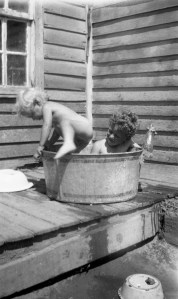
That lasted for a couple of years, I gather, before George and Marie moved their family to nearby Baker, to the spacious house, the front porch of which is seen above. That’s my two older brothers, and in case you lack detective skills I will tell you the day of the week … Saturday. The following day all would ride off to church. Saturday was bath day. (Thanks to my cousin, Eileen, who took photo negatives we found in Mom and Dad’s house after they moved to assisted living, and developed them. My towhead brother Steve has no genitals, so I can run this photo. Early Photoshop, that is.)
Dad, in the meantime, lived on a dairy farm near Great Falls, and drove a milk wagon to town each day before school. There were seven in that family as well, one of whom died in the Spanish flu. Their dad, Joseph, committed suicide by hanging himself in the barn, and Dad found him. Traumatizing, you might say.
I had noticed that there was nothing of written-word history with these people, and so in 1998 sat each down for interviews to tell their stories. They were reluctant, and even so, after some prodding, gave forth beautiful accounts of their lives and times. Mom went to Normal School in Billings, dad got a job as a neon glass bender for a sign company there, they met, etc. I am a Montana native as a result, not that I imagine place of birth is of any particular importance. It was beyond my control.
The interviews were done on cassette tape, lots of background noise. I eventually moved them to CD, and from there to my computer. But I noticed on the deaths of my older brothers that their computers and everything on them were ignored, and realized that if I wanted to preserve Mom and Dad’s history, it would have to be done on paper. So I spent several days transcribing, listening to a snippet, writing it down, and so forth, until I had each family’s story down. I then sent the paper copies to my cousins, and a couple on each side were interested and read them. But I was satisfied that there were paper documents in place, and someday in the future some interested soul might take a gander at the stories of these strong and hardship-enduring people who are their and my ancestors.
My older brother, the tow head, took time to listen to the cassette tapes, and told me after that the thing that most struck him was the poverty. They took it for granted. We are not a wealthy family by any means, but our lives were so much easier! I grew up having nothing, not a pot to pee in or a window the toss it out, as our neighbor Frannie would say. But we had more than Mom and Dad could imagine, Mom even saying one time that she knew she lived in a shack, but it was far more than she knew growing up.
We lived in a small stucco house on the west edge of Billings, and some time in the fifties or sixties they decided to put a truck stop in there, just beyond our back yard. What was once an empty field became a parking lot for semi trucks. There was no zoning in those days, at least not in poorer neighborhoods. Some might know that those big rigs need to run constantly, that starting them up is hard on the engines. So we often had trucks running all night out our back door while the drivers canoodled with whores, something that as a kid I surely knew nothing about. But that is part of the function of truck stops. Just so’s you know.
At times a truckload of pigs would stop for the night, and the squealing was so loud it could be heard for blocks away. That is part of childhood memories, that and the railroad track across the highway and how the whole house would shake as trains went by.
We got a TV in 1956, and the trains were so loud we could not hear the sound. Mom was very opposed to TV, always complaining as we sat glued, Dad with us if he was home. I distinctly remember a show that had General Washington in a tent at Velley Forge telling a young black soldier to be patient, that things would improve for him gradually. Mom walked out of the kitchen, stood in front of the TV and told us that they were pretending that people thought like that back then using “lines that were written yesterday!”
She was a smart woman, Dad for sure caught a long ball on that one. Were times different that same woman might have left him, gone to live with her sisters, or, you never know, finished college. She had untapped abilities. The only things available to her and her limited ambition were teaching young kids or nursing. She chose housewife. After Dad abandoned us for better drinking opportunities she wrapped meat for a grocery store to pay bills. It deformed her fingers.
But still, the house had gas heat, a yard, and after the truck stop moved in, a cement retaining wall for a back fence. We were postwar (hey Boomers!), and there were lots of kids around, lots of ball games and friendships, always an evening meal, never hungry. We even had a park to play in with a backstop for baseball. The problem with the park was that it was shaped like a piece of pie, with right and left fields missing. (I would have said shaped like a slice of pizza, but there was no pizza in those days in Billings, and anyway, going out for a meal was unheard of.) But we used the pie-shaped park. It is still there. Hitting a ball into the street was, I think, a ground rule double. Maybe if it crossed the street into one of the yards, it was a home run.
In the winter there was ice skating there too – they ran water and filled up a small square rink. For some reason we had skates, but none fit, and they were figure skates anyway! So there I was in dead of winter trying to skate, feet frozen to the bone, wearing white figure skates. What a sight I must have been!
Anyway, this was triggered by a newspaper article about frontier experiences of our ancestors, and I thought it a good opportunity to write down some memories of growing up in the Streeter subdivision of Billings, Montana. Out of my family came four boys, each with our own problems, as all people have problems and opportunities, but three of us graduated college, unheard of! On Mom’s side of the family there were 28 cousins, counting us, and we were the only ones who did that. (There were as many on Dad’s side, and I can only think of one who graduated college, but I am not as familiar with that side of the family.)** I think it was Mom’s influence on us that did that, her wanting us to stop watching the damned boob tube while Dad had deeper issues, perhaps that man found hanging in the barn that day. Each of us has a story, and I am hard on Dad, but there’s a story to tell behind everyone. I gotta forgive him someday.
_____________________
**Uncle Mike, who owned the farm in Ekalaka, was a college graduate. As told to me, it was a tradition in most families to have one child attend college.
 Piece of Mindful
Wisconsin?
The memories I have. Grew up in Evansville. Wonderful story. Thanks.
LikeLike
This comment disappeared … I wanted to respond. I hope responding to it here in the big comment bank brings it back. Otherwise I’ll run a screengrab of it … later today. First I had to find Evansville. You were down in Rock County, near the Illinois border. Current population about 5,700, idyllic if you ask me! Since you were so close to the border, are you familiar with the term “FIBs”?
LikeLike
LOL
Don’t feel bad Mark. I had to look up Greenbush. Too close to Milwaukee.
I am unfamiliar with the term FIB though.
My sister, who still lives in Wisconsin holds all of the photographic evidence (Polaroids) of our family’s existence.
We were born in numerical sequence. Older brother, 1957, myself, 1958, the sister with the evidence 1959 and last the spoiled baby sister, 1961. My mom, I think made my dad take a break.
So many memories. So many places and friends and all the times we had.
I’m retired in Katy, Texas now with a good woman and all the guitars I need.
I really enjoy your whit, humor and insight.
LikeLike
Enlightened by my cousin Kenny of Milwaukee, FIB means F****** Illinois Bastards.
LikeLike
LMFAO. Absolutely.
I often ventured to Rockford, where my mother lived. The city was more dysfunctional than my family.
LikeLike
Mark you must like that cold snowy weather. WI and your grandfather’s area is a much better place to live now I assume. I visited the Dells a few times it was very enjoyable, would like to live in that area. I guess we all have to migrate to where the jobs are, at the point in time when we need one.
LikeLiked by 1 person
Right you are – we don’t have a lot of say in location in younger years. But I do like a cooler climate. It’s getting difficult now with the insurers getting panicky, so we’ll see where we end up in the next couple of years. That all has to do with wildfires. I do like Santa Fe. My wife likes to be near water if we move, and I’ve told her that there are rivers and streams there. That’s not what she meant.
I do like the Dells, been there one time over Labor Day back in the 1980s. Traffic going south, was mostly “FIBs” as my cousin warned me, and was horrendous. The Illinois plates were aggressive lane changers, like it would make a difference getting them home.
LikeLiked by 1 person
Mark nice stories, I can tell some good ones about my grandfathers, born in Northern Vermont and Italy in 1909 and 1910 respectively. Both very tough, hard working men: my fathers side a lumberjack and owner of diners, and my mothers side from Italy working in greenhouses with flowers and all sorts of vegetables and seedlings in his greenhouse in the backyard of his house I visited all the time growing up. My lumberjack father used to work 10+ hours in the woods in New Hampshire winters with a bowsaw cutting trees – my fathers oldest brother basically left home to live by himself at 16 because he couldn’t stand being dragged into the woods and forced to work for him – it’s hard to imagine cutting trees with handsaws all day. Grampy used tell me stories how cold it was in Northern Vermont growing up, and having to use an outhouse on winter nights with your ass freezing to the seat.
Meant to mention if you’re looking to move may want to consider Maine. I will be retiring there half the year (summers) if everything works out. I know you went to Katahdin – my father lives in Maine now and I love visiting there. The beaches and mountains are outstanding, and people are very friendly. It’s probably even possible to find a place on a lake for an affordable price if you’re willing to live far away from the coast and New Yorkers. I like Maine humor too, when I was a kid I used to listen to these great tapes “Bert and I” about two lobstermen in Maine telling tall tales.
Bert & I – Wikipedia
LikeLike
I forgot to mention your house growing up reminds me of Jake and Elwood Blues apartment in Chicago in the Blues Brothers. I do hope you have seen this movie, which is one of my ATFs. I watch it once a year on long flights as a treat.
LikeLike
Fucking Illinois Bastards reminds me of calling everyone from Massachusetts a Masshole, especially as they began invading New Hampshire in the 1980s, and I would curse at them violently as they clogged traffic to go shopping at the outlets on the weekend while myself and my friends were heading to the White Mountains for hiking. And then I became one (sort of – i.e. a Masshole).
Speaking of pizza some of my fondest memories were working at the family restaurant in town as dishwasher/cook in high school. Place called the Tin Palace – a bit of a play on words as it was not a high end place. But it was somewhat large and had many opportunities for a teen and his friends who worked there to make the most of it. Like watching the Playboy channel in the basement lounge by satellite (this was the 1980s) on Sundays when the restaurant was dead. And learning how to make pizza in vast quantities, and eating a whole pizza plus plate of nachos when you’re 17 at work – because you could. Pounding beers in the walk-in cold room while you’re buddy guarded the door, or sucking down all the nitrous oxide from the whipped cream cans to get a quick high when getting something out of the cooler. And the waitresses would always be saying “why is there no pressure on any of the whipped cream cans?” as they tried to add it to the top of a pie slice, while me and my friend giggled (laughing gas, right?) since we had sucked it all down.
LikeLiked by 2 people
“… your house growing up” was not that, but a shack in Baker Montana. My dad was drafted and sent to the Pacific theatre, and mom took my two older brothers, in the photo, to the family home in Baker. That’s where the photos are from.
The house I did grow up in was not much better, but as I say, we were warm and well fed. And, 1956 forward, we had a TV!
LikeLiked by 1 person
You have to think that insurers know the score, the real inside skinny, whatever it is.. presumably they know that manmade climate change promotion at least is just a big herd management narrative (if that’s all it is.) But maybe they do think we’re entering a period of natural climate change and “extreme weather events”. Or they know it’s going to be simulated to some extent, with arson and fakery of some sort, and they’re playing a role in the herd management. Otherwise aren’t they “leaving money on the table” if they’re acting completely irrationally relative to whatever the facts of the matter are? I don’t know what their strategy is, but it seems like climate change skeptics more knowledgeable than me would be trying to work it out on something like these lines, moreso than I have seen them doing.. but I don’t follow those outlets very much so maybe that’s going on somewhere.
LikeLike
A couple of thoughts: One, within certain industries, scientific rigor is a bottom line necessity. Attention to detail is a must, and inevitable mistakes must be acknowledged and corrected, as they affect the bottom line.
Insurance seems such an industry. They deal in risk and have developed means by which they measure it. My question is, are they susceptible to politics? Because that’s all climate change is – a political movement backed by hidden hands.
In our area the fears are hail and wildfires, and it seems that the impetus was the Marshall Fire, 12/21, when a couple of people died, 1,000 structures were lost, but in the end, it was a grass fire fueled by very high winds. I would call it a hundred-year event, but the insurance industry took it as a message to leave the area, or stop issuing new policies, or to drop existing customers, leaving them high and dry. The rest of us they are just reaming. They now call it a wildfire in the sense that it was wild, and a fire, but not a forest fire, the risk of which has not changed in this area for many decades. It is measurable.
Of those homes that burned, most were underinsured, and I lay that right at the feet of the insurance companies. Isn’t that their job? To keep their customers up to speed? Many of them could not move back into their homes because they didn’t have enough insurance to rebuild.
Anyway, my point, has the insurance industry been subsumed by politics? Only to a modest degree. Most of it is fueled by irrational fear.
LikeLike
But Mark, who underwrites the insurance companies? Likely the banks. And if it’s the banks, then they are ostensibly controlled by the people who pretty much own everything, and can and do control human events. Meaning almost everything, as we are aware.
So if they aren’t running the insurance business perfectly, does it matter in the grand scheme of things? Because when insurance is not paying out then something else is. Like AI, which they will be the gatekeepers of, and use for their own ends, and profits.
And clearly there is collusion going on across the insurance company industry. As there is in pretty much every industry, especially the mature ones. There are industries where there does seem to be real competition, like computing power/speed/price, but not others like banking, pharma, doctors, optometrists, finance, etc.
LikeLike
Insurance companies collect premiums and then pay them out as claims, in effect, acting as banks themselves. They don’t need banks. They accumulate vast sums of money, and we expect them to have it on hand when there are major disasters.
Suppose the Climate Change movement, immensely powerful, infiltrated the insurance industry. To what end? To convince underwriters that things are bad and getting worse. A crisis! Isn’t that what they are telling us?
And my point here in Colorado, no crisis at all, but insiders are acting like there is one.
Recommended reading, just came out today,
https://rogerpielkejr.substack.com/p/the-climate-risk-industrial-complex?utm_source=post-email-title&publication_id=119454&post_id=180981808&utm_campaign=email-post-title&isFreemail=false&r=22vw2v&triedRedirect=true&utm_medium=email
LikeLike
I agree, they would have to know the score. Doesn’t it speak to the immense power behind the climate change movement?
If you haven’t, take a quick trip through Climategate, or someone’s rendition of it at least. What struck me is this: These scientists all got together and decided to fashion a huge lie, manufacture false science, attack anyone who disagreed, force scientific journals to go along with them, and get people fired. That does not compute unless they acted for pay and/or on orders from above. There’s also no reason to create false science unless there’s an ultimate objective, easily seen to be elimination of fossil fuels and thereby destruction of the modern world. We cannot survive without FF.
Most telling, to me, anyway, Michael Mann, writing to his colleagues, refers to “our closeted friends”. Typo, right? Or, a very clever typo.
LikeLike
Yes to your first paragraph question. I agree with Ray they probably will get oligopoly profits no matter what, they must have it gameplanned out somehow. For their lower level underwriters, they either genuinely buy in to the fear, or, they are given incentive structures to “believe” what their employer wants them to believe..
I read the PDF of selected climategate emails that some skeptic group put together. It was very damning, although a bit ambiguous in places. I’m still uncertain how 100% genuine climategate was.. maybe it was a bona fide leak, battle between competing Intel factions.. and not just stage managed kayfabe.
LikeLike
Always that possibility, though “kayfabe” is new for me. Petra would call it revelation of the method. But if you’ve sampled the emails, then A.W. Montford, was very good in great detail as he wrote about the subsequent cover-up. I’ve got two copies of his book The Hockey Stick Illusion. You’re welcome to one, free gratis.
Also, as I mentioned to Ray, the two most vociferous critics of East Anglia and Mann were Steve McIntyre and Ross McKittrick. MM, in case you are as jaded as me.
LikeLike
Wisconsin Dells!!! Used to go there in the 70’s!
America’s original tourist trap.
LikeLike
I don’t remember what we did there, where we stayed. I only remember the traffic getting back to Milwaukee that day.
LikeLiked by 1 person
Last time I went there was 1977. I took some “FIB’s” with me. LOL
We were there to see the brand-new screening of a new kind of “cinematic experience”. It was a half shell encloser and you stood holding onto a hand railing while you watched a roller-coaster movie filmed from the seat of the car. It was like being in the car. Awesome!
The movie was stopped about 5 minutes into the show when two people dropped and hit their chins on the railings. Damn. Next time I saw something like that was in Houston at a Surround Theatre. Even better. We were sitting down.
LikeLike
Kayfabe is a term from wrestling that many have applied to politics and other staged narratives. Wish I had saved some articles about it. Supposedly in the days when they still pretended it was real, wrestlers used the term as a coded way to refer to fakery. Heels are the villains, faces the heroes.. more fun wrestling lingo.
You sent me the hockey stick book already btw. It joins many other books in the past year that I only started on, no fault of the books, just my slow speed, lack of focus or time management, distractions, etc. Sometimes I do manage to get back to them.
LikeLike
I’ve got two thick books now I’m working on, ten pages at a time, early mornings, delightful. One is Lonesome Dove, 858 pages, by McMurtry, and to my good fortune I did not watch the TV series they made out of it.* The other is the collected stories of Raymond Chandler, who invented the detective Philip Marlowe, 1299 pages. It’s one of those that has a silk ribbon for a bookmark.
Sad to read that Chandler had a drinking problem. Ed Abbey, one of my favorites, died of cirrhosis, then Faulkner, then Hemingway, maybe just a narrow sample, but famous writers who drank. A lot.
*Taylor Sheridan, the force behind most TV that holds attention these days, wrote the intro to Lonesome Dove, saying how it inspired him, how he had read the whole series maybe three times. He says that TV followed the book precisely, meaning I don’t need to watch it except that it starred Robert Duvall, Tommy Lee Jones and Danny Glover, and so have to watch it for that reason alone. Do you suppose that JK Robbins, Tolkien were swills? Did Shakespeare drink himself to sleep at night?
LikeLike