
I don’t usually suggest that people drop what they are doing and read something because I read something. That tradition in mind, I am going to link to an article by Javier Vinos. He is author of the book Solving the Climate Puzzle, which I have sitting two feet from me. It is in a stack of books I have read for which I intend to look over Post-It flags and review, maybe even transcribe them. This, for me, is a memory device. Maybe it helps, maybe not. Vinos has written an article at the Judith Curry website called The 2023 Climate Event Revealed the Greatest Failing of Climate Science.
I do remember from reading the Vinos book about heat transport mechanism that move from the tropics to the poles, primarily the Arctic. When, in winter, there is no sunlight, most of that transported heat is dissipated into space in the form of OLWR, or outgoing long-wave radiation. Climate alarmists have used an assumption called Tropical Hot Spot theory, that the upper troposphere is warming faster than the lower troposphere, and that the lower is warming faster than the surface. This assumption was shown to be without evidence** in a comment on EPA’s repeal of the 2009 Endangerment Finding by Wallace III, MacDougald, and Menton. (Menton, for anyone interested, is also known as the “Manhattan Contrarian“. That is a blog where I am moderated, but not yet banned.)
I do not suggest you read this article. I don’t care what you do. I have my reasons for writing about it here – 1) I’ve long been curious about the effects of the December of 2021 Hunga Tonga volcanic eruption, which released 150 megatons of water into the stratosphere. For anyone wondering how much water that is, it is a lot. I saw one estimate that it was the equivalent of 58,000 Olympic-size swimming pools. I cannot fathom that number. 2) And, as I read along with the author I found his writing to be understandable and decipherable. That is not always the case with scientific-based writing. If I can grasp it, so can anyone with a reasonable intellect.
From the Vinos article, here is a list of events in 2023 that cannot be explained by Climate Science as we know it:
- Extraordinary ocean warming that models can’t explain.[1]
- Record-low Antarctic sea ice.[2]
- A record-breaking Amazon drought in 2023.[3]
- 31 atmospheric river events in the western US from November 2022 to March 2023. Nine made landfall in California marking the record in the 70-year database.[4]
- The snowiest season in 71 years occurred in California after a 1-in-54-year event.[5]
- NYC had the least snowy season on record, breaking a 50-year record on latest first snow.[6]
- Cyclone Freddy in the Indian Ocean was the longest-lasting tropical cyclone ever.[7]
- ITCZ [Intertropical Convergence Zone] displacement and unusual rains in the Sahara in 2024.[8]
- The first half of the 2024 hurricane season was surprisingly quiet, and models can’t explain it.[9]
- In 2023, 42% of the globe experienced heat exceeding two standard deviations. Louisiana, for example, had its hottest summer in 129 years of records.[10]
- 2023 was the warmest year on record, and 2024 was even warmer.
- In October 2024, the North Polar Vortex was the weakest in 40 years. The three sudden stratospheric warming events that occurred in the same season are a one-in-250-year event according to models.[11]
- The biggest global low cloud cover anomaly ever recorded occurred in 2023.[12]
The problem is that Hunga Tonga is not a routine, predictable event. It is, as Vinos explains, perhaps the most significant climatic event since the 1815 eruption of Tambora. Many will know that event to have caused the 1816 “Year Without a Summer”. Hunga Tonga was as significant, but climate models used by the UN and IPCC cannot fathom such a thing, as it is not routine. In the same manner, these same models cannot recreate, in retrospect, the Tambora effects. If it is not routine, modem climate science cannot do anything with it. Ergo, climate scientists place little importance on Hunga Tonga. I would suggest that climate models be shelved, as they have not accurately predicted anything, as seen below.
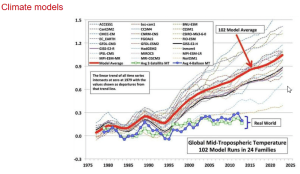
The spaghetti lines are predictions by UN/IPCC climate models through 2015. The blue and green line on the bottom are satellite and weather balloon data. This is a large discrepancy, so large that even AI tells us that we have a problem:
In summary, satellite and weather balloon data consistently show a slower rate of warming than climate models predict, with no evidence of the expected hot spot or increased radiation trapping. These observations suggest that current climate models may overestimate the magnitude of future warming, highlighting the need for improved model calibration and validation against real-world data.
Generally speaking, AI regurgitates current propaganda on almost every topic of interest to skeptics, but not this. I was surprised to read that.
Again, I don’t’ care if anyone reads the Vinos piece. I thought it worth writing about.
_______________________________
** The EF was based on three assumptions, the Tropical Hot Spot, global surface temperatures, and UN/IPCC climate models. The comment, submitted to EPA in Trump’s attempt to remove the Endangerment Finding, trashes all three assumptions.
 Piece of Mindful
NC regular contributor KLG – who has spent decades in biology research of some kind and writes on general science topics – had a review of Bill McKibbens latest book –
https://www.nakedcapitalism.com/2026/01/here-comes-the-sun-a-way-forward-if-we-take-it.html
I’m only linking to it because I learned something in the comments. If you scroll down to “htyul” (only if so compelled!) he gives a very mild-mannered dissent to McKibbens view that solar/ wind could replace fossil fuels in developed countries, using the concept of EROI – energy return on investment.
Of course I know ROI, and maybe heard of EROI, but its concept of “joules in vs joules out” as a way to compare energy sources, without introducing the vagaries of economics, subsidies, etc, was new to me. He quotes extensively from some journal in the topic. It seems like a good way to approach the question. Unfortunately no response from KLG.. another commenter does dispute it as tobacco industry style propaganda/ misinformation though..
LikeLike
Interesting thread, with some pop out nonsense. The “4 minutes” vehicle charge in China … they forget to mention they are talking about motorcycles. Sort of a big lie to tell, if you ask me.
There is so much doom, so much Chicken Little in the piece and in the comments, number one that Climate Change is real and we’re all gonna die. Number two, that fossil fuels are dirty energy, that it is still 1970 and coal dust still fills the air. Number three, that direct current supplied by wind and solar are easily incorporated into our grid. Number four, that nuclear died of anything but deliberately stoked irrational fear. I have long suspected that the oil industry was behind the death of nuclear … cui bono anyone? Which brings me to number five, that the oil and gas industry is phasing out. Only at our peril.
Here’s a little story to warm the cockles … we suffered through a long period called the Little Ice Age, with declining crops, mass starvation, migrations and wars over suitable habitats as people fled the Norse countries. Vikings once farmed Greenland and had to leave. It bottomed out, and we gradually warmed, and life got better. Since 1860 or so it has been warming, and we have prospered. Our population has grown, as has our food supply. Without fossil fuels, none of this would have happened.
Whenever you hear talk of climate change and warming and we’re ll gonna die, remember that the people behind the movement are eugenicists, and their ultimate prize is five hundred million people on their planet. We do not know the temperature of the planet. We cannot say that warming is caused by fossil fuels. I can only say that warming is a good thing.
And, I love my Tacoma. They will have to pry my cold dead fingers from the steering wheel.
LikeLike
On a lighter note did you see the ending of that Broncos game? Was the fix in for the Broncos? The interception by McMillian was a really rushed call, then two pass interference calls. Looks like the Patriots may be coming to Denver, that will be an interesting game.
LikeLike
33-30. How do they do that? Broncos did an amazing come from behind against Giants, 33-32 on 10/19, 33 points in 4th qtr. Again, how do they do that?
Anyway, Bo Nix is said to have broken his ankle. Even last night they knew he would be having surgery. How can they know so much so soon? Jarrett Stidham time.
LikeLike
Anyone watch the Bears/Ram game….That 50 yard pass to Kmet in the endzone for a touchdown in the fourth quarter that sent them into overtime was kind fishy. The game was tied for a long time too.
I’ve noticed over the last few years in other sports especially basketball they have tied games right til the end. Maximize advertising, concession sales and others would be an incentive to do that.
LikeLike
There was a period from the mid-80s through 95 of Superbowl blowouts, scores like 46-10, 42-10, 55-10, 52-17, 49-26. What happens then? Blowouts are boring, people wander off, play cards, go home early. Advertisers are steamed, and networks, who guarantee certain ratings, have to make rebates. More recently we’ve had nail biters, people glued to their screens. That’s more likely the goal of the league. Do they instruct the teams and referees to keep,it close, allow comebacks? I would. It is just good business.
Jake the Awake shows a lot of plays where defenders forget how to tackle, and I wonder in old days if it was instructed that OJ Simpson be allowed more yardage, and Pete Rose saw better pitches. And I am very suspicious of Bokonovsky Brat Tom Brady. Is he really a goat, or an untouchable?
LikeLike
Also don’t forget the in game betting will be much, much higher in a tie, or close game than a blowout. In game betting is a relatively recent phenomenon, likely only possible since high speed internet was made mostly universal (10-20 years?)
Also I happened to remember something today – the Sons of Lee Marvin. It’s supposed to be a little joke on how many celebrities resemble Lee Marvin. Mark, have you done face splitting on Lee Marvin? Seems like he would exist somewhere on the brat spectrum.
The Sons of Lee Marvin – Wikipedia
LikeLike
Sounds like fun!
LikeLike
MAG bitter truther did some great videos on breaking down OJ Simpson’s career in video. I like how he said OJ “couldn’t play a lick of ball”.
But anyhow if you watch the game where he passed the 2000 yard mark for the season they were handing it off to him virtually every play, and the defense looked like matadors trying to tackle him – jumping out of the way last second to let him hop, skip, and jump to long yardage rushes. He had the looks and charm, so he was the “Juice” and super-juiced. Until he had to pay it all back by being a fake murderer.
LikeLike
Compare that shite to Walter; a masterpiece of training and character.
LikeLike
Yes agreed. Pro football reference has Peyton (Walter) as #1 RB based on analytics. Surprisingly OJ is #6 but his career is interesting – first 3 years a nobody, 5 great years, and then 3 forgettable years. And he was eyeing Hollywood from early on, clearly he was more interested in being an actor than a running back.
Pro Football RB Hall of Fame Monitor | Pro-Football-Reference.com
LikeLike
Trump had a good line/ bit at Davos this morning.. he was saying that China makes most of the world’s windmills, but then exports them to “stupid people”.. making the point, if they had decent “EROI”, presumably China would use them themselves. I haven’t verified that though – does China have any significant windmill usage, or they just consider that Western BS propaganda? It sounds plausible because they always plead “developing nation” status when it comes to climate accords etc, and say they should be able to use coal or whatever the blank they want. It was a good little riff though, he kept repeating it in his fashion, telling the audience what dumbasses they were, to buy into the windmill malarkey
LikeLike
I wish I could think of some reason to trust Trump, as he is mouthing all the right words. But we do not elect our presidents, they are rather selected. He is carrying out a mission, and I fear that mission is to mollify us until his successor comes along to complete the switch to renewables. Then we suffer.
LikeLike
I agree, he’s playing an “anti” role in the dialectic.. to me the question would be whether he fully understands the script, and is trusted to write it and improvise himself.. total mastery of the alchemical process, like some kind of dark wizard or something – or, if he’s just a kind of strange media savant, a preternaturally talented snake charmer, who has to be directed and told what direction to take things..
LikeLike
I watched The Alto Knights a few months ago, where Deniro plays two roles, two warring gangsters I think it was – which confused me, because they didn’t distinguish them well enough with make-up – but anyway, the Frank Costello character had a delivery at times that reminded me of how Trump has delivered some gangster-ish remarks in the past year. It wouldn’t entirely surprise me if Trump was given Deniros performance as a model to study, or Deniro personally coached him.. or, maybe Deniro studied Trump (but it seems new to the Trump persona, so I don’t see that as likely.) Or maybe they both worked from some earlier gangster actor I’m not aware of? Seems odd they’d both hit on the same vibe by coincidence, but who knows how this stuff works
LikeLike
Trump used to be a Democrat, and went along with all those agendas, somehow his character turn coated into what we see today. He even switched on certain issues from his first term.
Trump provides a true case study titled “Politicians are nothing, but script readers”.
LikeLike
It’s shocking how “stupid”, if that is the right word, 99.9% of the public are about Trump. I don’t know a single person other than myself, and the people who post here, who understand Trump is an actor taking orders from someone. They all think him, and Putin as another example, are just these rogue actors, and without them everything would be rainbows and sunshine. That Trump, and perhaps a few close associates, have the power to orchestrate “operation chaos”, along with their ragtag army of MAGA misfits. To me, nothing exemplified the continuity of American leadership than the “assassination” attempt on Trump, which was sold. and purchased in toto by the 99.9% idiotic public. Demonstrating the continuity of bullshit the public eats up since Lincoln and Kennedy mind-fucked the public with their exits stage left, very much alive, and pulling a nice disappearing act.
LikeLike
I was playing cards last night with relatives, and they were talking about ICE and deportations, and hatred of Trump was seething. Then one of them said something, and my mind came alert, as they were saying that the Trump assassination attempt was faked. I asked if that was the subject, and they said yes, and I said yes, it was fake. Of course it was fake! We were in agreement!
I never expected such a moment.
LikeLike
Well in Hollywood some actors get to the point in their careers – or even when young, see Orson Welles – where they can produce, direct, contribute to scripts, etc. I suppose that might happen with some “lifetime actors”.. and even if the orange mafioso is completely taking direction, he’s still a talented entertainer… Slash, consensus reality creator..
LikeLike
Zbigniew Brzeziński is credited with having spotted Bill Clinton and bringing him to the attention of inner circles. He said, as I recall, that he was handsome and a good speaker, had a good memory, that last part being important. From there, and this is all me and not Zbig, it was decided that he would work, and so the stage was set, attention focused on him, he got the nomination, and Ross Perot came forward to take votes from Republicans, as there wasn’t going to be a majority for Clinton.
Clinton never got over 48% and served eight years, but that tells me, in retrospect, that votes were counted back then, and they merely had to be clever in manipulation to be sure the right person won. By the time Obama came along, the electronic voting process was in place, and the process was simplified. They no longer had to be clever. They just used Rube Goldberg machines to monkey the vote. But with Obama, same thing I suppose, someone spotted him, a bright man and good speaker, so they manufactured his education and background, maybe even gave him that lovely family. And a dog.
Fun to watch, if you ask me. Trump is designed to divide, enflame. Maybe he’ll be “killed” … I don’t even know who the VP is. I should bone up.
LikeLike