
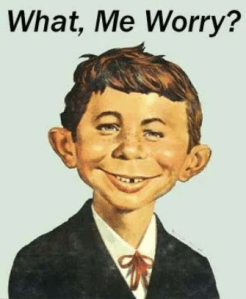
 I just clipped and saved the image to the left, and then when I went to download it to this post could not find it. Finally I traced it to a file in my photographs called “Family Photos”, and I was going to move it to another file and then realized, wait, that’s probably the right place for it!
The man in the photo is Alfred E. Newman, a creation of William Gaines, also the man who gave us Mad Magazine. It still exists, part of DC Comics, but, you know, like the Beach Boys, still on tour, it’s not the same as it was. I have just a couple of stories about Mad Magazine, the first of which involves urban legends.
I was led to believe that William Gaines was a talented artist and humorist who could not find employment anywhere in entertainment or publishing because he was Jewish. In fact, his father, Max Gaines, was the publisher of All-American Comics division of DC Comics. In 1947 his father was killed in a motorboat accident on Lake Placid, and so Gaines quit school to take over the family business, EC Comics. He did OK, and otherwise was on his way to a career as a teacher. Instead, he worked in comic books. I find that a nobler profession.
Comic books came under investigation during the 1950s, an uptight decade if ever there was one. Gaines was called to testify before the Senate Committee on Juvenile Delinquency, headed by Estes Kefauver. Here’s a transcript of his testimony, from Wikipedia, so grain of salt needed, of course:
[Chief Counsel Herbert] Beaser:
Is the sole test of what you would put into your magazine whether it sells? Is there any limit you can think of that you would not put in a magazine because you thought a child should not see or read about it?
Gaines:No, I wouldn’t say that there is any limit for the reason you outlined. My only limits are the bounds of good taste, what I consider good taste.
Beaser:Then you think a child cannot in any way, in any way, shape, or manner, be hurt by anything that a child reads or sees?
Gaines:I don’t believe so.
Beaser:There would be no limit actually to what you put in the magazines?
Gaines:Only within the bounds of good taste.
Beaser:Your own good taste and saleability?
Gaines:Yes.Kefauver:
Here is your May 22 issue [Crime SuspenStories No. 22, cover date May]. This seems to be a man with a bloody axe holding a woman’s head up which has been severed from her body. Do you think that is in good taste?
Gaines:Yes sir, I do, for the cover of a horror comic. A cover in bad taste, for example, might be defined as holding the head a little higher so that the neck could be seen dripping blood from it, and moving the body over a little further so that the neck of the body could be seen to be bloody.
Kefauver:You have blood coming out of her mouth.
Gaines:A little.
Kefauver:Here is blood on the axe. I think most adults are shocked by that.
This was all before the founding of Mad Magazine, which is what I wanted to write about. I was born in 1950, and Mad was a presence in my life. We must have bought it off the newsstand, but I don’t remember how I came upon copies. It was a treasure for me and my brother Joe, and we each read it cover-to-cover. I guess you had to be there, but this was early humor taken in a direction that was the beginnings of movies like Airplane, Animal House, and even TV shows, Saturday Night Live, for instance, where early cast members were influenced by it. Just as Monty Python took humor to places unknown before, Mad was the trailblazer.
So, first, to dispense with the idea that Gaines suffered from prejudice and persecution, it appears he came from a wealthy or somewhat wealthy Jewish family, and the world was open before him to do as he wished with his life. As with many if not most of us, he bounced off a few rocks, but landed where he wanted to be, publishing a magazine that made fun of important people and of news and entertainment in general. He was counter-cultural. Jewish people have given us so much, as education and careers are so important to them, but I am most grateful for their humor. Most really funny people are Jewish.
It’s an interesting subject, as there are so many powerful Jews around … just ask Mel Gibson. Mr. Mathis frequently and derisively identifies people as Jews. It would not surprise me if most of Hollywood was indeed Jewish, possibly including Mr. Steve Martin himself? He has a habit of marrying Jewish women, but then Jewish women are generally very attractive, so that is not another clue for you all. I enjoyed this Oscar presentation with Martin and Alex Baldwin, so watch it all if you have ten minutes, and have a few laughs. Or go to 7:20 to see why I chose to link it here.**
I would be Jewish if I could. My name, Tokarski, is in the Jewish registry. But membership, I’m told, must come down on the maternal side, and my mother was Irish and very Catholic. And anyway, I am neither talented nor wealthy, so they don’t want me.
Here’s an example of why I do not qualify as Jew, why they would look at us askance. My brother Joe and I were so enamored of Mad Magazine that we decided to take our allowances and subscribe. We each received a dollar a week, and in those days most dollars were “silver” dollars, and not paper. So Joe and I each put our silver dollar in an envelope along with the subscription form from the magazine, and mailed it off.
We never got our subscription. Some time, maybe in my late thirties, I finally figured out why.
_____________
** Also, go to 8:18 for mention of Matt Damon, Ben Affleck, and Jennifer Garner, and an odd joke … the three belong to our Bokanovsky Brats, virtually identical facial plates. Maybe their breeding is common knowledge in Hollywood
 Piece of Mindful
A Jewish friend of mine said most Jewish men are not attractive, but have money and marry for looks. Which is where the attractive women would come from. I think that’s a generalization though, there’s plenty of handsome Jewish men, since their ancestors had the money to find an attractive mate.
Mad magazine in the 1950s was indeed revolutionary. I found several very early Mads in my grandparents attic in the late 1970s when I was almost 10, I read them cover to cover and still have them. My brother and I also subscribed to MAD in the 1970s and early 1980s, I read it always. I used to love their parodies of films, and cartoon T&A was appealing to a young boy. From their send up of Saturday Night Fever I will always think of John Travolta as John Revolting.
LikeLike
Mark, you say you would be Jewish if you could, but I personally don’t think its any kind of privilege. Many of the Jews I know have a persecution complex, and suffer high rates of depression. It’s more like a burden for them, and they feel like everyone is out to get them. Moreover, I have heard at Jewish weddings a Jew say they are “Gods chosen people” which makes me cringe.
For what it’s worth most people think I’m Jewish from my looks and education, as I had all Jewish academic advisors – they used to think I was the son of my PhD advisor, which I had no issue with. I don’t take offense to it, but am glad I don’t have to deal with all that baggage.
LikeLike
To be honest Mark you’d be thrown out from any group of Jews in a New York minute. Because they police each other and do not tolerate dissenters. A jew always needs to stick up for another jew over a gentile, they are basically the original mafia. The rabbis have enormous power in their communities, and dissent from the mainstream results in expulsion very quickly. Independent thought is not tolerated. Which is why they are powerful. Choose one: power, or independence.
LikeLike
As Groucho Marx said, I would never belong to a group that would have me as a member.
I was in Boy Scouts for a few months as a kid … we met in a church basement. At one meeting some leader suggested we play games, and I piped up “How about ring around the rosie?”
A short time later a leader said to me “We don’t talk like that here.” I did not last.
I would not make a good Jew. I know that. I just admire them, at least the ones I know.
LikeLike
Do you mean within the orthodox community? Among secular Jews it seems like there’s plenty of diverse views and dissenting opinions.. for instance there’s a long-standing divide over support for Israel, recently becoming enflamed over the war there (whatever the reality on the ground, I have no idea.) Largely a generational divide, but not exclusively. Then too from watching Curb by Larry David, you see him present his relationship with Jewishness as somewhat ambivalent – he’s not big on religious observance or groupthink, but does identify with it in other ways – sort of like it’s his “caste” and he’s vain about that, while poking fun at it too..? I’m not sure exactly but it seems more like a “big tent” than what you describe imo..
LikeLike
Yeah i was too broad in the big tent assessment. There is a saying you can’t get two Jews to agree on anything.
They also advanced because they are cosmopolitan, and have a broad world outlook – again the ones I have known, I know there are more insular and parochial sects like the Hasidic. My Jewish friend I hung out with over the holidays (and they can be very generous) had an excellent observation about many of the Thais – where he has lived for some time – that their outlook is so narrow, and world experience is so limited, that they just don’t know a lot except what they have done – such as working on a farm, or factory. Self respecting Jews are always hustling, and clearly very business savvy. Something I underrated for many years, but now appreciate you need to be savvy about finance or this world will rob you blind, and you’ll get nowhere.
About the paranoia – here’s an example. My cousin is Jewish, or half Jewish – his mother is, but is secular. Several years ago we came back from a multiday hike in the Sierras, and someone had spray painted a swastika on the local synagogue. So from that one thing we had to go to a candlelight prayer, where several speakers yakked on and on about how outrageous the act was, and how they were going to catch the person and stop Jewish hate. All i could think was what if it’s some kid playing a prank, or one of their own trying to “divide and conquer” so to speak, and what about forgiveness? I noticed most Jews I knew were all outraged at the kidnappings, which to me seemed poorly done false flags, and nothing to get hung about, as John Lennon might say.
LikeLike
I have this speculative hypothesis about that comic book hearing as an “op”.. since I’ve read several books about the history of the industry, then combining that with fakeology and a Mathisian perspective.. what I wonder is if Gaines was playing a role in reshaping and engineering the industry to suit TPTB.
Consider the state of the industry pre-EC Comics – there were MANY small publishers employing MANY wild-eyed and marginal characters, fringe writers and artists who either couldn’t get more prestigious work, or, appreciated the Wild West freedom of the rambunctious young medium.. lack of tight editorial oversight, ability to say or express all sorts of offbeat, fringe views and visions.. things movies, magazines, etc were too tightly controlled to allow.
And in those early days, adults read comics – working class young people say on the subway or bus, there were newsstands everywhere loaded with this cheap entertainment, and they didn’t have smartphones. And these were “dangerous visions” relative to other media – cheap pulp printing, it was something “for them,” not prudish, prissy and respectable. And hard to control this teeming sea of content, threatening like the internet, not enough guardrails or safeguards, too many outlets.
So, Gaines was tasked with playing the bad guy (in the media narrative given the public, especially parents) – he hired many of the best artists and writers, “leaned in” on pressing the boundaries of taste so he could serve as an example. (I think his real personal interest was in the low selling science fiction tales he published in a few titles.)
Anyway the media ginned up fear and outrage in parents, and in the name of “protecting the children” the Comics Code was implemented with strict content limitations – overnight dozens of publishers went belly up, and the survivors were a few big companies publishing very anodyne content for young children. It was an op to rein the industry in and get tighter control over it, have fewer publishers, and those trusted insiders.. is my guess
LikeLiked by 1 person
Mark, I was thinking about one of your themes, and how I have a lot of evidence that you are correct. Which is that humans are not naturally violent, or prone to outrageous acts of violence, such as a murder, especially the concept of multiple murders at once, such as shooting spree, or cold blooded murder of strangers. My example – i grew up in a small town in New Hampshire, population about 10,000. New Hampshire is well known as the “Live Free or Die” state, and firearms are very much part of the culture. Growing up, I knew about 2/3 of the households of my friends, that I knew of, owned firearms. I owned guns by the time I was 10 years old, and have an enthusiast my whole life. Over my lifetime, 50+ years, I don’t know of a single murder in the town, or anyone even shot by a firearm, from the several hundred people I knew well growing up. And today I am a member of an outdoorsman’s club in Massachusetts that has been in operation almost 100 years, with never a fatal accident, or shooting, even though they have over 1000 members. Which is quite remarkable when one considers what pro-gun control advocates say: that humans are naturally violent. I was reading a lot on the gun control advocacy movement yesterday, and how after Sandy Hook for example they were saying they needed to ban assault weapons and guns in general because in every school there were potential Adam Lanza’s just waiting to crack.
If that were the case, there would be shootings all the time in a place like where i am from, or live now. Because firearms are ever present, and used often such as at the gun range, and yet no one in my personal history has ever just lost it and started shooting up the town. If you look up violent crime rates in the New England states, or Switzerland for example, you will find they are extremely low, even though private firearm ownership is very common. Therefore I conclude people are not naturally violent or prone to random, or even deliberate, acts of extreme violence. Of course in inner cities like Philly or New Orleans where the feds have dumped tons of guns and ammo and kids have no future you will get random acts of violence.
LikeLike
Stay tuned. I want to share an encounter I had some years back. I have to do some recall first, as it was profound, as I remember it.
LikeLike
Looking forward to it!
How about that game? New England looked like they weren’t going to show up first quarter.
LikeLike
Yeah, too bad. Stidham did not have enough, though I would not have wanted to be in his shoes.
Oh well, football is over for me this year. It’s been fun, even as I know 33-30 over Buffalo and scoring 33 points in the fourth quarter against the Giants are vewy vewy suspicious.
LikeLike
His name was Eric, I called him Straight, and how we met I don’t know, like he just showed up. He did amazing work, far beyond my capabilities. He’s the one who noticed the Matt Damon grouping, and I do not remember why we were both trying to figure out the Janice Joplin mystery, which was finally resolved by her being twins, and I said the other twin must have retired, and he showed up with a second Amy Goodman, the twin!
And then he just left. No sequence of events there, just. scattered memories. But he talked about a meeting he had with a person in NY, and they were talking about the Jewish community, and he said they take care of each other*. They don’t worry about money and if you are part of them you’ll ways have what you need. About intel and fake deaths and manipulation of the public, he said participation was voluntary, that if you didn’t like it they would not disown you, just let you live your life, and you’d still be well taken care of.
Anyway, he left because he could not deal with the negativity of my blog. Miss him still.
There’s more but I would have to share it privately, unrelated to Eric but perhaps Carol Burnett.
*Carol Burnett, middle name Creighton, lived in LA and wanted to go to school, and someone saw promise in her and gives her an envelope that had in it money for four years of education in NYC. That’s the kind of thing Eric was talking about. A stranger did that! Officially CB is not Jewish. I’d need to look up that middle name in the Jewish registry of names.
LikeLike
Yes, Creighton is in the Jewish registry. That does not mean she’s Jewish. My name is in there, and I am for sure not Jewish.
LikeLike
“Assault weapon” is scare talk. Those weapons look pretty impressive, but the reason they are legal is that they discharge one bullet at a time. If you want to shoot twice, you have to pull the trigger twice. You know that of course, but for the general news and entertainment-fed public, and assault weapon is a machine gun. They don’t realize that they are really after regular gun owners, target shooters, hunters,.
LikeLike
Mostly The Guns… but yes, some owners as well.
LikeLike
The backstory on MAD magazine is that it was really created by writer-artist Harvey Kurtzman.. originally published in comic book format. When the hearings tanked the industry, and EC quit publishing its profitable horror comics, MAD was one of its few viable properties it had to reinvent itself.
Around this point IIRC they switched to magazine format, getting shelved with material for older readers and escaping the Comics Code restrictions. At some point a feud developed between Kurtzman and Gaines over ownership. I think Kurtzman felt he was entitled to 50% ownership or something – maybe they had some agreement that Gaines didn’t honor, or Kurtzman just decided that with its success, I forget.
But it became a bitter point of contention, and Kurtzman eventually left to go try getting better deals elsewhere, with work he would own. MAD’s editorial was then directly overseen by another EC employee, Feldstein, and began a long era of widely-regarded as more lukewarm, tepid and formulaic material. But good sales.
Kurtzman never could recapture lighting in a bottle like he did there. He had some ambitious projects of other sorts planned with “real” publishers, but these “graphic novels” never got made. His humor magazine, was it HELP! or something, seemed to have a lot of spook ties, Gloria Steinem connection IIRC and many counterculture change agents involved.. then he tried humor mags Trump and Humbug bankrolled by Hugh Hefner, at least one of them?
But they failed. He eventually took what seems like kind of a patronage position writing/ laying out Little Annie Fannie in Playboy, painted by his longtime childhood pal and NY art school buddy Will Elder. Kind of a comedown from his early ambitions, and it seems he always resented Gaines and losing what he felt was his rightful ownership.
LikeLike
“We never got our subscription. Some time, maybe in my late thirties, I finally figured out why.”
Maybe the mailman or post office took it, not hard to feel a big coin thru an envelope.The “jews” in the magazine department, would want you to have their propaganda.
I don’t think just being jewish is what opens doors, people still have to participate in the networking. As there are many working class people that identify as being Jewish but are not receiving any extra benefits or huge priviledges the wealthy jews have access to. And not just networking such as fraternities, but organizations like the jewish federations, and various synagogue congregations where like minded individuals can meet help and mentor each other. We can realize that the word “jews” or “jewish” is inaccurate. These celebrities or wealthy people that claim being “jewish” are not really Jewish. That word didn’t come into play until the 1800’s. Possibly the Mathis description of Phoenician lineages or even the words of John 8:44 would be the most accurate description of what these people actually are. .Especially with all the ilk or self defined good taste that is promoted by these people and crammed into everyone’s brain.
Much information to study, hard to get a point across with one comment or article. Topics for reseach would be Hebrews and Israelites, Northern Kingdom and Southern kingdoms and realizing that the lost sheep, the real “jews” or the actual chosen ones would be the European Caucasians. Hence all the agendas to erase them out. There are soo many lies and much information that’s covered up, that most will never get the truth or knowledge. The words of the bible are the goto for many and are not properly translated. For example was Jesus a Judaen, a Galilean, a gentile, a rabbi, a teacher, a carpenter, the son of God? There are a ton of different answers from various experts, muddying up the waters. A regular person doesn’t know for sure, these days how could anyone? People are going on what they have been taught in church, school or persuaded to believe about the subject matter thru the media, the entertainment, popular culture and peer pressures from family, friends.The comic books industry is just a small form of media that helps persuade the public mindset, yet it needed to be controlled. And yes Newman is a “jewish” last name.
LikeLike
Interesting points. Yes, definitely a small industry today – more valuable for licensing content to Hollywood. American comics have relatively small sales and are mostly going downhill with an older readership and no new readers. The Japanese “manga’ style comics is more popular with kids, plus comics in book form from traditional children’s publishers. Back in the day they were a true mass medium, and very important and influential since they were shaping the next generation of adults. Culture creators would definitely want to control or co-opt them.
LikeLike
https://postflaviana.org/old-testament-intro-rev2/
This is a project to get through but worth it, IMO.
LikeLike
That’s intriguing and damn, I am going to have to read it. I have so many questions about how the gospels and bible were assembled and when. Does this address that?
Right now I am absorbed in Lonesome Dove, McMurtry. Some time, if you have never read it, just read the opening paragraph of LD, just that one paragraph. I can’t describe it without ruining it.
LikeLike
This is the first of a series of articles but this one addresses the creation of the jewish concept of The Chosen in the wider context of the great empires that contributed to this narrative, which the authors argue is totally inorganic. No gospel talk here as I recall but possibly in subsequent articles in this series. I have only worked over this first one but given the discussion in this comment thread, it might be of interest to the assembled.
LikeLike
Can’t get by the Jesus death at age 33.
LikeLike
Mark- Jesus is a typecast character. The sacrificial redeemer. JFK was similar. Real people adopt these rotating personas for political ends. The esoteric trappings around the fate of these figures weren’t supposed to be read by the polloi. Now we know and being excommunicated no longer has any teeth.
According, at one time, to Charles N. Pope: “The Roman identity of Herodian Aristobulus emerges as M. Crassus Frugi. He was the Herodian Jesus Christ/Chrestus”. (Also a member of the mighty Piso clan)
If I understand Pope’s work, this “Christ” was a possible heir of Caesarian and therefore a descendent of Julius Caesar which would place him at the top of the food chain. Which may be why his bloodline formed the Sangreal, the foundation of the Church.
According to Francesco Carotta, Xtianity derived from a Julius cult that by the time of the Flavians had waned and, according to Joseph Atwill, the Xtianity of the gospels was created to revive it for Flavian advantage.
But, according to Pope, Vespasian was a Julio-Claudian- if memory serves he was the grandson of Tiberius- I believe one of this grandson’s names was Drusus Caesar- and he supposedly died in exile but was repurposed as Vespasian, ultimately. The Dead Rock Star syndrome at work here.
https://books.google.com/books/about/Jesus_Among_the_Julio_Claudians.html?id=c7A3DwAAQBAJ
LikeLike
I liked the book, and even tv “mini-series” was decent.
LikeLike
I am so late to come around, and I hope I am not giving the impression I’ve stumbled on something new. People knew McMurtry long before I came awake to him. After I am done with Lonesome Dove I am going to watch the TV series. Missed that too, although when it comes to the part where they hang Jake Spoon, he spurs the horse to spare them the need, and Augustus says yeah, he died a fine death. I’ve seen that before, I am sure.
LikeLike
I see it’s venry long, which suits me fine, but we have a plane trip coming up, so I am going to wait for that opportuntity.
LikeLike
Rome and Roman history, its relation to Christianity etc is not a strong suit of mine.. Where would one start, to cut past all the BS and get to the heart of the matter? To have the best “true version” possible, as well as understanding its importance in official narratives and myth making? I’ve been wanting to read that Colleen McCullough historical novel(s) about Caesar, just to get the general story (and it seems to be very popular with readers.)
LikeLike
I haven’t read the McMurtry book but I’ll second DSKLAUSER that the miniseries is “decent”.. I would even say exceptionally well done.
LikeLike