
The older one gets, the more it becomes clear that it is a great mistake not to have been brilliant when very young. Difficult to arrange, I realize, but for the splendid saving of time it is to come into one’s intelligence early! Alexis the Tocqueville, who so handsomely did, is a case very much in point. He was not a traditional genius, at least not at the blazingly-high-IQ-learn-six-languages-while-writing-and-oboe-concerto-at-11-years-old sort of genius. The young Tocqueville was indeed a genius of perception, of the type that Henry James would describe as someone “on whom nothing is lost.” He was a man assailed by perceptions, observations, insights. Where others were confused by the jumble of life about them, he was fascinated by it; where they saw chaos, he perceived patterns. No phenomenon – be it a certain kind of personality, a common thread tying together a group, or the character of an institution – could pass before him without his working his way to a determination of its underlying cause, reason for being, ultimate significance. His was an intelligence organized for almost perpetual intellectual penetration. (Introduction to Democracy in America, by Alexis de Tocqueville, Bantam 2002 edition, by Joseph Epstein. Link to Gutenberg Book 1, Book 2)
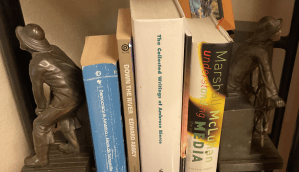 I read de Tocqueville’s Democracy in America years ago, and have always remembered the introduction, the opening paragraph which I wrote out above. I wished for years I had kept my copy, but it was not here, so I assumed I must have disposed of it in a routine book dump. Then, while cleaning my office last week, I stumbled upon it. It was in plain view, on display with a few other books I really liked, seen to the left here with ornate book ends … it’s the blue one on the left side … I’ve referred back to it many t … well, I mean … never. I did not know I still had it.
That intro struck me in several ways, one that I know without much thought that I was not brilliant when young, far from such a thing. That strikes me hard, I am afraid, as I had an older brother who was so, and I spent too much of my youth imagining that we had the same genes. Alas, we did not, do not, so that while I stumbled along waiting for good things to happen for me without the required diligence and hard work, he grew distant from me.
This older brother, who was born in 1942, was brilliant, and gay. Because of those two factors, he realized that life as laid out for him would not be easy, and due to Catholic education understood that the priesthood was a refuge for gay men. It allowed them to lead lives garnering respect, even devotion, of a flock of sheep. He also knew that to succeed as a priest, he had to be a leader, and also have within him a reserve of strength, compassion, and patience. He succeeded at all, to the point where in the parish where he was pastor until his death in 2011, there is a statue of him. A real metal (of some kind) statue. How many of us will have that left behind as we leave this prison planet?
I am speculating, and don’t know how much it has changed with the openness we now have towards gays, but I’ll say that two-thirds of Catholic priests are gay. (Pedaphilia is a different topic and I will not address it here other than to say it is wildly overblown.) Why would they not choose that profession? What about the other non-gay third? There’s a large dropout rate, and many of my older brother’s classmates who actually made it through the long education fell in love and got married after ordination. Even in these days of open homosexuality I imagine that many who enter the seminary are looking for male companionship. Looking back I came to see that my brother had friends who were more than friends. Yet, he professed to believe in celibacy. He wrote a PhD dissertation on qualifying young men for the priesthood, and in it recommended one year’s abstinence from sexual activity for straight and gay men alike, before entering the seminary. Did he practice it? Maybe in the 50s and 60s, when it was thought a perversion, but as the world loosened up, I doubt it.
He and a fellow priest once dreamed of a retirement as residents in a small Catholic Church in Cooke City, Montana, high in the mountains. He spoke of this one time at a family breakfast. I mentioned this to him one time later as we discussed retirement. He was taken aback, and said not to mention that ever again. Yes, I gather, the two were lovers.
Other things about this man who was brilliant when he was young … he knew how to impress. People who met him liked and remembered him. He was kind to a fault. Living in his shadow was hard, so much so that as I look back on that birth family, I should have struck out on my own after high school, left them all behind, and established my own identity, one that would not suffer in comparison to … the one. In school, in every area of life, I never measured up. I needed to vamoose!
We four brothers along with our parents, grew up in a small stucco house by a noisy truck stop and a busy highway, next to which were train tracks. Noise was constant. Two of my three older brothers had problems and were very unhappy. They were said to suffer from “manic depression.” I think that’s bullshit, I doubt that such a thing exists. But I do think that abuse exists. As I was the youngest, I do not know what I missed, but was knocked unconscious at age four by my nine-year older brother. I don’t remember any pain. I don’t remember anyone else being around when I came to. I remember that event clearly, getting knocked out, anyway. I wonder what I do not remember? I mentioned it to a therapist one time, who said it is not unusual in abuse situations to block out all memories, not only of the aftermath, but the event itself. Ergo, I have no memory other than waking up on the floor and all alone. Where were Mom, Dad? Did anyone know what had happened? I’ve no clue. It was never discussed.
Years later I read that in abusive families, sometimes a kid who is bright enough to figure out the lay of the land will assume the role of “perfect” child, and thereby avoid abuse. That seems to fit here. My priest-brother aspired to perfection in everything he did. He was a distance runner to the exclusion of other forms of exercise, and noticed once that he lacked arm strength. “I’ll fix that,” he said, and immediately began weight lifting. He had failed in his quest for perfection.
Being the one of four who achieved great heights, and ours being a devoutly Catholic family, our parents purchased a waist-high cabinet with curved glass, a beautiful piece of furniture. In it they kept a plaster-of-Paris bust of the Virgin Mary, and a photograph of our family priest. They had three other boys, and I asked Dad one time why our photos were stuffed away in a closet while the priest was enshrined. He did not answer, but I heard back from the priest himself, who informed me that the question was “hurtful.” I realized then that the role of parent-child had reversed with Mom, Dad, and their perfect son. I was to accept the hard reality of existence on the fringes of a screwed up family.
They are all dead now, buried in a straight row behind St. Pius X Church in Billings, Montana. My wife and I have planned everything out for us, and we choose to have our ashes lay side by side along with with her mother, my mother-in-law, a wonderful woman, at Christ Church Cemetery on Long Island. That family of six that lived by the truck stop and tracks in Billings, Montana, will be perpetually short one imperfect brother.
 Piece of Mindful
Please present the proof of your statement that I have italicised:
“I am speculating, and don’t know how much it has changed with the openness we now have towards gays, but I’ll say that two-thirds of Catholic priests are gay. (Pedaphilia [sic] is a different topic and I will not address it here other than to say it is wildly overblown.) “
LikeLike
First, I never use the word “proof”, and you shouldn’t either. Secondly, the background of priests might be of interest to you. They are locked down for most of their training, or were earlier on, cannot speak for now. They enter the seminary at age 18 or younger, and at that point, their sexual development, gay or straight, is interrupted. I would imagine seminaries of the 50s, 60s and 70s were masturbatory factories. Once ordained, they are set free, and sexual development picks up where it left off, usually with children in early stages of sexual development. So the encounters that priests were having were with teen agers, and not children. They were not pedophiles, and of course, just as there is no such thing as proof, neither is there all or none.
Was it wrong? Of course. Should they be punished? Of course. Was it largely a Catholic problem? No. It was a problem in any situation where adults have supervisory power over youth. I would imagine that public schools have the biggest problem, as they have the most students. But even the Amish are not exempt. Catholics were targeted for a school-wide problem, and while guilty as charged, they were hardly the worst offenders.
LikeLike
dont sweat the fools. You reckoned and the fool demanded proof. Funny thing is the wannabe clever folks have no idea about proof and/or logic.
LikeLike
The Cluster B topic, the role reversal is called “parenting”. I just came across a lecture tying it all together, the Bible and an overview of the psychology literature, on YouTube: Why They Hate You: The Metaphysics of Sibling Resentment (Cain & Abel) from Blake Anderson
LikeLike
hmmm … gotta take a look there. will he explain why my brother cold cocked me?
LikeLike
Off topic – someone on NC linked to this pretty interesting article from The Guardian – a long piece, with the history of how Robert Maxwell locked up much of scientific publishing, changed the industry, probably faked his death, etc (okay, reading between the lines on that last bit.)
Really juicy stuff for a mainstream rag. It admits he was British Intel, and the field was rife with spooks and “ex-spooks.” Looks like British intelligence saw a major choke point to control all or most scientific publishing in the English language, and he was their charismatic front for it (or it was partly or mostly his own ambition and entrepreneurialism, helped by his connections, and complicit with them, or something.)
This is an audio version, but has link to text –
https://www.theguardian.com/science/audio/2017/jul/07/is-the-staggeringly-profitable-business-of-scientific-publishing-bad-for-science-podcast
LikeLike
Ray was talking in some thread about the Mathis paper on Chomsky. Having read it now, my answer to MM as to why they maybe threw him under the bus after his long service.. I’m guessing that his flavor of counter culture programming, and criticism of the mainstream, was deemed suitable for previous generations of liberals/ Dems who started to fall away or see the charade – but somehow not what they want for younger generations of same.
He was someone you could cite for a while, when people were unaware of the ideas in Manufacturing Consent, and much else – a figure with some mainstream credentials and stature, so you didn’t have to bring up a marginal or unknown they would dismiss out of hand. But now he’s thoroughly tarnished. And I would guess he’s fine with that, if his whole career was being an agent and fake alternative anyway.
LikeLike
Getting hit by your brother is as Cain and Abel as it can be. The explanation given is “attacking an ideal”. These things can hardly be put into words. Life itself expresses ’em.
LikeLike
Well, he got me again when I was ten – first time I was four. Knocked me out cold again … he was left handed. Must have had a nice hook. Anyway, are you picking up on this here … that I’m brain damaged? Views differ on that matter.
LikeLike