

The above is a well-formed human skull. For most of us, this is what we have under our skin by age 20 or so, and will not change for the rest of our lives. Imagine this lies under all our faces.
Note a few things about this skull: The nose cavity is flush with the face, so that the human nose itself, made of flexible cartilage and other stuff, can be altered in appearance. It can be shortened or flattened, or a sharp piece of plastic can be inserted to make it pointier. Plastic surgeons often do this sort of thing.
But understand, the nose itself cannot be moved on the face. Bone structure prevents that.
Note the same with the ears – they too are made of cartilage and other stuff, and can be made smaller or be tucked. But their location on the head cannot be changed.
Most importantly for my purpose here, note the eye sockets. They too are in place by age twenty or so, and do not change throughout our lives*. They will always be in the same place on the head, and the distance between them will remain constant until death. They are, after all, bone material.
Knowing this, it is possible to use the eyes, more precisely, the distance between pupils on a human face, as a constant. I’ve been doing this for years, and the results have always been, well, controversial for others, but for me, very telling. By comparison of faces by reducing or enlarging them so that the eye pupils are the precise same distance as another photo for comparison, I can often judge that two people are really the same person, or more often, that two people are not the same person.
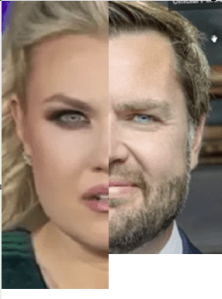
I recently received this facial comparison from a friend of the blog.

The two people there are Erika Kirk, alleged widow of the allegedly assassinated Charlie Kirk, and Vice President James Vance. Someone noticed a similarity in their appearance, and so did a face split and place half of each side-by-side.
That’s some nice, creative work, but whoever did this (it is circulating on Facebook, I am told), did not do their due diligence. Note the two faces above, which I have below straightened for comparison purposes.


For each, I have placed the pupils at the precise same distance.
That done, a mathematical “constant” if you will humor me, we can now make a real comparison of the two. Here’s what I get:

They do not have the same facial structure at all. Note that I placed the eyes on each the exact distance apart before performing this, and that whoever did the facial work for Facebook fudged things just to make it work.
Those two photos are not the best, as they are blurry, so i cannot precisely place the eye pupils. For that reason, I got two more photos from the thousands available on the internet:


It is difficult to find images where people are looking straight at the camera. For Erika Kirk, oddly, her eyes were always looking upward, as if a jet was flying over. For Vance, it’s an official portrait.
Here’s another face split:
And again, same result.
There’s been a lot of criticism coming my way over the years, but I do stand by this methodology. I am told that Internet photos are not reliable. That’s probably true. I am told that different cameras produce different aspects. That too is true. I am told the best way to compare photos is with the naked eye, but time and again I have seen the naked eye lie to me. I once had a writer here, Fauxlex, who produced two different photos of the mother of Miles Mathis, claiming they were two different people. Indeed it appeared that way on the surface, but as I applied the technology used above, the faces of the “two” people lined up perfectly, showing them to be one person.
Fauxlex was furious with me. He was sure I had rigged the images to arrive at that conclusion. But I did not. The naked eye can tell lies.
And anyway, suppose an person uses only the naked eye to compare photos. That method is subject to all the problems as my method, mentioned above. I maintain that person to be easier to fool than me and my chops. There is judgment involved and a desire to arrive at a preconceived idea, which I suspect the person doing the Facebook comparison suffered from. We’re all human, and all we can to is try to be rigorous and honest. That’s all I do. I do not fudge to obtain a desired result.
______________
*An exception to that rule: Stephen Hawking, who I suspect died in the 1985 and was replaced by an actor, had a skull that was badly deformed by his ALS. For that reason, it was impossible to compare his replacement to the original man and his replacement. Though my eyes told me they were different people, I could offer no evidence to that effect.
 Piece of Mindful
A guy named Dallas Goldbug, I think, did some analyzing, sort of like you did. However, I wasn’t convinced. Then again, your point as to cartilage being subjected to reconstructive surgery offer a valid point. I like your method. It’s able to, as much as possible, eliminate confirmation bias.
LikeLike
Odd as it seemed at the time, as I was new to the game, Goldbug appeared to be deliberately sabotaging facial comparisons. He did so by offering crazy oddball things like JFK becoming Jimmy Carter and Jim Morrison Rush Limbaugh, and he was all over YouTube, trotted out as a go-to whenever the subject came up, kind of a doorman for the hall of shame. He was a tool. He discredited the very idea of comparing faces.
Is he still around?
LikeLike
Absolutely. Yeah, the JFK to Jimmy was comical. I called him out on that one and asked him if were the controlled opposition. He banned me from commenting. Nothing ever quite worked that he did.
LikeLike