
Yellowstone was a very popular series that lasted five seasons on Paramount. By my count, it has now engendered two spinoffs:
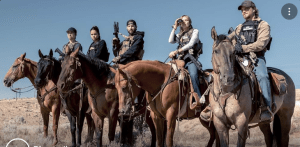
- Marshals starring Luke Grimes as Kayce Dutton, a special forces veteran subject to flashbacks and who was once married to a Chinese woman (Kelsey Asbille) who pretended to be a Native American in Yellowstone. Unfortunately for the series, Grimes doesn’t project much charisma, unlike Keven Costner, star of Yellowstone, so I don’t imagine the series will last. But who knows. I also see that the series is set in Montana, and that US Marshals there (1) draw much of their employment force from the Hollywood model pool, and these models are excellent shots and skilled horseback riders who can also carry their own in fisticuffs; and 2) that they do most of their work while riding horseback. I had it in my mind that the internal combustion engine had replaced horses, but in Taylor Sheridan’s world, four-wheelers do not exist.
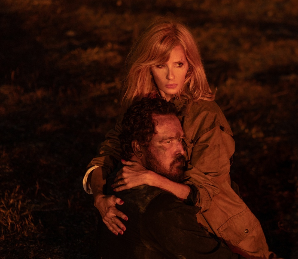 Dutton Ranch: This series brings back Rip Wheeler and Beth Dutton, two of the more interesting characters in Yellowstone. In the original series they had purchased land in Western Montana for ranching, but in the opening episode of this series, that ranch is burned out in a forest fire, and they are left landless. They buy a ranch in what looks like Western Texas, and it all begins anew, a murder, the corpse buried on their land, Rip dumping the body down a deep pit rather than calling authorities. The series features Annette Bening as matriarch of a large ranch, and Ed Harris as a local veterinarian. Bening, in my view, is not up to the part, but Harris has that certain something he’s always had. I expect this series will travel, if nothing else on the acting and sheer intoxicating beauty of Kelly Reilly, who plays Beth Dutton.
I am not writing this to act as entertainment reviewer, as all of that is subjective. I took great offense, however, when in episode four of Dutton Ranch, the Dutton’s are forced to kill their entire cattle herd, bury them in a trench laced with lime, and seal it all over. The cause of their malady: Hoof and Mouth disease.
I took offense because 1) the disease is rare, 2) it is said to be caused by a virus, 3) it is deadly, and 4) it is highly contagious, and 5) it can be prevented by vaccination. #1 there is true, the rest, at least to my knowledge, are false. However, in Dutton Ranch, while they write around it, they imply that the Dutton herd was infected due to an unvaccinated bull, of the hooved variety.
I found very little written about H&M, and so consulted AI. That was a good way to get a summary of current misinformation about the disease. I also wrote to Dr. Sam Bailey in New Zealand, and hope to get a reply, as she is pretty good about that. If too busy, so be it, but if I get a reply, I’ll post it here.** Hoof and mouth affects hooved mammals, and in New Zealand there are more sheep than people. I expect mthe Bailey’s to know a thing or two about it.
In Yellowstone, cattle were killed by brucellosis spread by the aborted fetuses of wild bison. A friend and former writer here, Steve Kelly, long ago said that there had never been a case of brucellosis transmitted by bison to cow. That’s no surprise if you don’t believe in contagion, as I do not. (The disease is said to be bacterial, by the way, and not viral). But politics enters the picture, and it gets complicated:
- Even though there’s no scientific evidence of spread of the disease from bison to cattle, mere mention of it is enough to cause quarantine of ranches and boycott of beef products. So real or not, ranchers have to contain it.
- There’s a movement afoot to keep bison off public lands, to effectively quarantine them in Greater Yellowstone, so that cattle grazing on other public lands is not affected.
- The game goes way back in American history, with eradication of bison herds that dominated the great plains so they could be replaced by cattle. This also deprived Native American tribes of one of their primary food sources, leading to their imprisonment on reservations.
- Montana and Wyoming are sparsely populated states, and many counties there are dominated by large tracts of land owned by ranchers. Because of districting by large tracts of land and not population, in Montana ranchers usually dominate the 50-member State Senate, which allows one senator for every two house districts, no matter the population.
- That translates into political power for ranching interests.
How that local political power translates into TV scripts for Yellowstone and its spinoffs, I don’t know. But in the series Yellowstone, brucellosis was indeed spread from bison to cattle, and the cattle shriveled and died as a result.
And, as we all know, if it is on TV, it is real.
_____________
** Says Dr. Sam Bailey: “Due to popular demand a video on this is coming very shortly!”


As much as I liked when the character of Beth, reminded other not-so-well endowed women of her mammalian prowess, I shant be subscribing to any spin-offs. Hollywood is and always will be monetarily influenced. Besides, I didn’t watch Yellowstone until 2026. It was free with commercials. Fast forwarding through the commercials was easy.
LikeLike
Not only Ryke Geerd Hamer’s opinion…
LikeLike
Not a spin off but he also has Landman, probably the same elements/ formula. They were talking about all these shows on NoAgenda, Dvorak dismissive of the flood of crap, Curry laughing that these showrunners have to strike while the iron is hot, when they have a hit. I guess you can’t blame him, for now he can get anything “greenlighted.”
Yellowstone seemed fresh and different at the time, a bit schlocky maybe but addictive and entertaining. Now inevitably they flood the zone and it will be hard to maintain the original appeal. But at least they have some shows appealing to the right leaning demographic, and can put some messaging in there for them-
LikeLike
If you can grab it, there is a scene between Michelle Randolph, playing Ainsley Norris, Billy Bob’s daughter, and a college provost at TCU. The daughter has been granted automatic admission as a cheerleader, and the provost is appalled at her lack of credentials. It is one of the most well acted and written scenes I have ever seen in all of television, and absolutely hilarious.
LikeLike
hey, don’t do that to me..! I was not planning on getting sucked into any more series TV at the moment. I looked up that Michelle Randolph though and she is pretty foxy so maybe I should change my plans.. Sounds like they have some cutting social commentary too from what you describe. Academia has long been a target of satirists, virtually back to its beginning. In its modern American form, Thorstein Veblen was an early critic. I always liked the title of his book about it – The Higher Learning in America. I believe he meant that in a dryly humorous way, sort in quotes, since the whole book was a scathing critique, apparently – I haven’t read it.
LikeLike
Theory of the leisure class was great. Thorstein’s nephew, Oswald, was a particle chasing payaso though.p
LikeLike
I took a course on something, kind of a survey, and the texts we used, among other stuff, was a two-set, The American Intellectual Tradition, edited by David Hollinger and Charles Capper. I kept the books thinking they are great reading, and they collect dust by the year. Part of the reading therein was Thorstein Veblen, The Theory of the New Leisure Class, which I just dug out, unlooked at since I took the class. I remember liking it, that’s all. Now I must read it again.
LikeLike
That’s his most famous book probably.. he coined the phrase “conspicuous consumption” and viewed his fellow man through an anthropological lens. Famous too for elaborate or precise prose style and unusual turns of phrase. I’d be curious how readable it is, been awhile since I tried. I remember too he had a theory of dividing people into engineers/ builders vs destroyer/ takers or something.. much of business activity he viewed as some sort of destructive barbaric pursuit.
LikeLike