Who’s got time on his hands today?
Category: American wilderness
Nattering nabobs of negativity
Not too many readers will remember the words in the title above. It is from 1970, and the words are attributed to Vice President Spiro T. Agnew. He acted as a distractive force for President Nixon, and was dispatched regularly to grab some headlines. The nabobs in question here were the sad lot of pundits known as “journalists”, said to be one of the easiest college degrees to attain.
Natter: To talk continuously for a long time without any particular purpose.
Nabob: An Indian ruler within the Mogul empire; someone of great wealth or importance; a person with a grandiose style or manner.
Agnew certainly did his homework on this one, drawing out two obscure words and making them memorable, so much so that I still remember the quote 54 years later.
Below the fold are some more quotes from the 31 pages I have preserved:
A magical Christmas

Christmas is mostly for kids, and I think it is perfectly OK to let their imaginations be filled with Santa and reindeer and chimneys. When my kids were little we had a tradition that lasted for a brief while until some cynical brat ruined it.
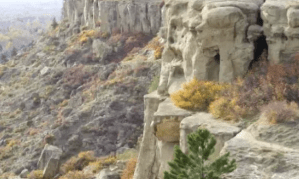
We lived in Billings, Montana. It’s a nice town, mostly, and is under what are called the Rims, a long geological formation, part of it seen above, that runs the length of the town. I am told that they formed as waves from an inland sea washed in and out, not unlike Galveston, Texas.
Orgies are vile …
Over the years I have been collecting bits and piece of witty snarks and insightful comments in a file I called “Wit and Wisdom”. I pulled it up last week and found that I had a little over one page of items, meaning I had lost the original. But wait! There were two files by that name, one with a different suffix, and it turned out to be 31 pages. I remember sitting at our dining room table in Bozeman when I first decided I needed a way to save stuff, and putting these gems onto my laptop. That it survived all these years, perhaps twenty or more, is no tribute to my competency, but rather to good luck, nothing more.
I’ve gone over those 31 pages now, and found quite a few items that I am going to repeat here, a few at a time. There’s a lot in there that I would not now take trouble to record, notably Edward Abbey, whose every written word (except some of his fiction, which I found over-the-top) I have read. I also made it a point to read everything written by George Orwell, but he does not turn up very often in this file. I suspect that is because somewhere I have a separate file for him.
The Christmas letter …
I came upon the following lines from an obscure source, quoting Horace, among the many legends of ancient literature whom I have not read.
“Parturient montes, nascetur ridiculus mus.”
The line translates to “Mountains will be in labor, and a ridiculous mouse will be born.” This phrase comes from Horace’s Satires (Book 1, Satire 8) and is often interpreted as a commentary on the disparity between expectations and outcomes. I am plagiarizing that last line starting with “This phrase…”.
Life before and after the 14th Amendment
One of the many atrocities that played out against us during Covid was the trashing of the Bill of Rights. Specifically, the following amendments were jettisoned:
First Amendment: Prohibition of the free exercise of religion. Churches were shut down.
First Amendment: Abridgement of freedom of speech. Facebook, YouTube, and even tiny Websites like NextDoor all forbade any criticism of the CDC or questioning of the existence of the virus.
First Amendment: Abridgement of freedom of the press, but don’t go there. It’s been a dead letter for ages.
First Amendment: The right of the people peaceably to assemble. Sports stadiums were shut down, along with indoor gathering spaces like concert halls and museums. Large gatherings were forbidden, along with even small family gatherings.
Ninth Amendment: Freedom to travel.
On being woke, the Great Awokening
I started out reading a book called We Have Never Been Woke, by Musa Al-Gharbia, and finally, on page 50, I thought “I can’t do this.” I cannot finish the book. It is well-written by a new PhD who is also an intellectual, and I am reminded that I am neither of those things, and that I’ve never been curious about people who claim to be “woke.” I think it is all self-aggrandized posturing, large-scale virtue signaling. It’s made its way on to campuses, but then most campuses have long ceased to serve intelligent function, that is, producing critical thinkers who are hard-working and serious adult humans. Instead (most) colleges offer a new kind of dumbed down.
Worse yet, Climate Alarmists have saturated campuses and schools, so that our graduating classes at all levels don’t know shit about climate and don’t know they don’t know shit. It is large-scale Dunning-Kruger. We’re in a new dark age. It’s quite a predicament.
Hugh Jass
Yesterday I had gotten no further than the title of this post when I came upon Kevin Starr’s delightful post on wokism. “I thought I can sit back now, he’s covered an important topic”, being “woke” versus “awake”. Here in the land of the free there is very little awakism going on. That’s always been the case.
Over a decade ago I was a fan of the NPR radio show Car Talk and its hosts Tom and Ray Magliozzi. Tommy sadly died of Alzheimer’s in 2012, and NPR reverted to reruns, and then relegated the show to podcasts only. It is still thriving even as the boys talk about cars of the 90s and before. The reason: Tommy and Ray were nice, honest, and funny. As Doug Berman, the show’s founder noted on Tommy’s death, they were “diamonds in the rough.” I lived in Billings at a time when Yellowstone Public Radio would host quarterly fund-raising drives, and I would contribute, but only tagging my money to Car Talk. Then and now I wanted nothing to do with NPR’s woke news and public affairs broadcasts, smug and humorless.
Starr Tracks: Top Albums of 1971 Ranked (Part 1 of 2)
I am very excited to welcome our old friend Kevin Starr back to the blog. My taste in music is pedestrian, right Karen and Richard? Keven is a student of rock and roll. He’s got more, much more to offer. Have fun!
___________________________________________
___________________________________________
Welcome to Starr Tracks! I’m Kevin Starr, your fearless (and totally amateur) guide on a mission to rank the top-selling music year by year, starting in 1971 and going… well, until I run out of steam.
“Who is Kevin Starr?” you ask. Well, I’m not a musician, nor a professional critic. I’m 62 and have spent decades listening to music and forming highly debatable opinions.
Thanks to modern technology, we now have access to the kind of epic record collection we could only dream about back in the day. In the ’70s, before the internet was even a twinkle in anyone’s eye, listening to music required buying a big, unwieldy contraption called an LP (short for long player). These discs spun at a mesmerizing 33 1/3 RPM and played sound using a tiny needle, or “stylus”—which was basically like playing music with a sewing machine, if you think about it.
Continue reading “Starr Tracks: Top Albums of 1971 Ranked (Part 1 of 2)”
Election oddity

Paper ballots are considered the gold standard of vote counting. Three states in the U.S. use them, Colorado, Oregon, and Washington. Other states claim to use them, but they are not reliable. Some just issue receipts repeating what the voter intended, but offering no guarantee that is what is recorded. Quite a few states offer nothing, just a smile and thank you to the voter, no assurance at all that the vote was even recorded, much less counted.
In the three states mentioned, voters hand-enter their choices on ballots, and the ballots are then run through optical scanners to tally the vote. It is not fool proof, as the scanning software can be corrupt, but the ballots are stored under lock and key for at least 22 months for recounts and perhaps study or statistical sampling. I think that 22 months storage is the law.