Thoughts on death

It was three weeks ago tomorrow that I ate beef carpaccio in Akaroa, New Zealand, and I now feel that I am through the resulting illness. It was probably a staph infection, untreatable by antibiotics, carrying with it smaller attacks on eyes, ears, nose, throat, along with body fatigue and a sense of malaise. I am seven pounds lighter. (That’s the good part.)

Obviously I don’t get sick very often. I haven’t up till now, anyway. The whole episode was so strange to me. I am used to things passing through my body, being gone in a day or two with little aftermath. Such an episode as this helps me realize how vulnerable we are, how easily anything in our environment can take us down. I saw my three brothers, one by one, succumb to cancer, and last year a friend to an untreatable strain of leukemia. Each of these people treated their demise with courage, but there comes a point when they must realize …“Oh my God, this happens to other people. Can it be? This time it is me?”

How profound must be the resulting finality. Maybe it’s a release too, I don’t know, but I will someday. I do know that our friend with leukemia said to his son as he lay in bed dealing with yet another symptom, “It would be so much easier just to be hit by a bus.”
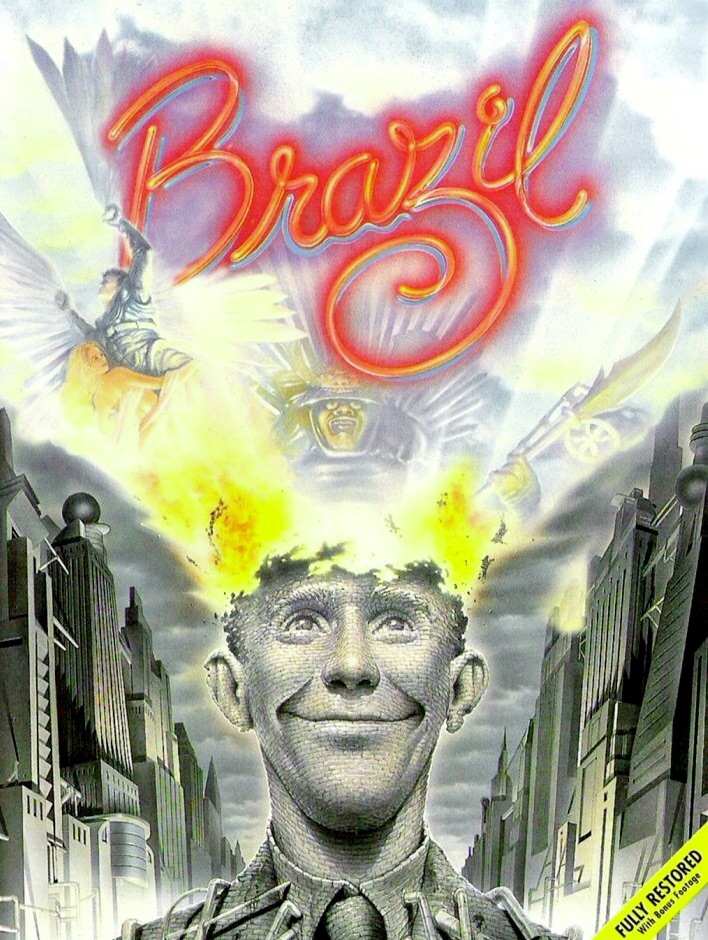
imageFormer Monty Python member Terry Gilliam has had a great career after those halcyon days, and directed and helped write the movie “Brazil.” (I just now learned it is considered a “cult classic.”) It’s a dystopian fantasy about an Orwellian society where the authority figures are buffoons, machines do everything but don’t work properly, and where a mere administrative error has brought imprisonment to the lead character. Unknown to the viewer, this one anyway, he is engaged in fantasy, chasing the woman of his dreams, and near escape when he awakens, realizes he’s in a chair, in prison, soon to die. The trivial administrative error cannot be undone.

That moment, that realization hit me so hard so many years ago seeing that film. It was so well done. It describes what I am attempting to say here, that we are all fools strutting on a stage. I am so thrilled to have come through my illness intact. But down the road, there’ll be another. Am I ready? Of course not!

We’ve been all over the world these last few years, living life to the fullest. We’re lucky, I know. Others are jealous, I know. One thing I know as we plan future travels, one place we are not going: Brazil.

I often don’t know when I sit down to write where a piece is going. So too this one.

Movies and TV present fantasy images of journalists

imageOne of my favorite movies of recent times is The Bourne Legacy. People had low expectations for it, as Matt Damon was not aboard to reprise his title role in this fourth Bourne movie. They brought Jeremy Renner aboard as Aaron Small and with Rachel Weisz, the results were stunning. The last half hour was one of the best chase sequences I have ever seen.

Robert Ludlum invented Jason Bourne – I was a big Ludlum fan too. His books were formulaic, of course, even predictable. What I liked, however, was that every good guy was a potential bad guy, and there were no saints. Americans were not exceptions. In the world of spycraft, they were all shits.
Continue reading “Movies and TV present fantasy images of journalists”

The 555 jolt back to reality

Have you ever been watching a movie or TV show and get caught up in it, and they have to give a phone number as part of the plot and it is always a “555” number? They have to do that of course, as there are no 555 numbers in the land so that no one is bombarded with phone calls after a working number is accidentally given mass exposure.

Even so, once that happens, poof! I lose interest. It’s like seeing a wristwatch on a cowboy – it jolts me back into the present and forces me to admit to myself that I am watching fiction. The fun is over.

Perhaps we can all agree on a certain allotment of dead phone numbers that they can use that sound real, or they can pass the number to each other on a slip of paper or have a car horn go off when they are saying the number or something – these are really clever people. They can do better.

Is this just me? Is anyone else bugged by this annoying habit?

Pondering life’s complexities (2)

I saw Lincoln on Sunday night, and with muddled head wrote about it Monday morning. I committed the cardinal sin of op-edding, failure to stay on message. I do that a lot, but with that movie, I want to give it a second shot.

lincoln-1067508-squareWe finally saw the movie Lincoln last night. I feared that the man would receive a royal Spielberging, or be drowned in excess sentimentality. There is some of that at the beginning and scattered about, but it’s an excellent film. Spielberg has embraced complexity – the use of evil means to achieve good ends. Sometimes that works.

It is difficult to get anything done in politics without duplicity. That’s why lying is a tool of the trade, and not an ignoble one. According to the movie, Lincoln did the right thing for the right reasons and by the wrong means. We can debate that sort of thing afterward, but Lincoln did not have the luxury of a Department of Philosophy and Ethics. He had to get things done amidst swells of turmoil, suffering and feverish emotions, and maintain a steady hand.
Continue reading “Pondering life’s complexities (2)”

Pondering life’s complexities

lincoln-1067508-squareWe finally saw the movie Lincoln last night. I feared that the man would receive a royal Spielberging (Lincoln turns as they watch the play and says “Molly, have I led a good life? Am I a good man?”*). There’s some of that right at the beginning and scattered about, but it’s an excellent film. Spielberg has embraced complexity – evil means to achieve good ends. Sometimes that works.

Politics, with all of its duplicity, can be a noble profession when used towards noble ends. It is difficult to get anything done, good or bad, without duplicity. According to the movie, Lincoln did the right thing for the right reasons and by the wrong means. Good for him.
Continue reading “Pondering life’s complexities”

Wag the Dog

wag_the_dog_ver1This is from VideoHound’s Golden Movie Retriever, a large book we have on hand that gives capsule summaries of several thousand movies:

Wag the Dog **1/2 1997 (R) Based on the book “American Hero” by Larry Beinhart and adapted by Hilary Henkin and David Mamet. Over-the-top Hollywood producer (Hoffman) is hired by White House officials to stage a military attack against the U.S. to divert media attention from accusations that the President had fondled a Girl Scout. Show biz insiders say Hoffman’s Motss resembles one-time studio head Robert Evans; Washington insiders wonder if it’s a documentary. In fact, the entire film is one big insider’s joke. Luckily it’s smart enough , and short enough, to avoid becoming tiresome. Look for cameos by Woody Harrelson and Willie Nelson. Filmed in a speedy 29 days at $15 million budget. 96 min. Dustin Hoffman, Robert DiNiro, Anne Heche, Woody Harrelson, Denis Leary, Willie Nelson, Suzanne Cryer, John Michale Higgins, Suzy Plakson, Kirstin Dunst, William H. Macy, Michael Belson. Director: Barry Levisnon.

I remember this movie so well – one, the big names that were part of it, two the incredible message: For events to be “real,” they do not have to actually happen. They only have to be on TV. Wag the Dog is a subversive movie that attempts to smuggle truth to the public, and also to have a good laugh at our expense. It struck a chord with me, DiNiro’s character, a CIA agent, saying in resignation at one point that “the war is over. I saw it on TV.”

The whole of the “war” was shot on a sound stage in Hollywood. Another group within the Pentagon or intelligence sees what is going on and decides to “end” the war, but it is resurrected again by the appearance of Woody Harrelson’s character, Sergeant William Schumann (“Old Shoe”) a supposed war hero actually retrieved from a mental institution. At one point Heche’s character is on a plane with DiNiro’s, and he’s explaining how reality is not really real, that television is our only reality. She mentions events like the Iranian Hostage crisis and the yellow ribbon phenomenon as an example of people rallying to support their government, and she gets a cold stare. “Oh my god, that too?”, she says. He does not answer.

In the movie, to make fun of the Yellow Ribbon scam, people are encouraged to throw old shoes up over power lines to show support for the military and its war in Albania. Harrelson’s character, Old Shoe, is a fake war hero supposedly rescued from behind enemy lines. Since he is actually crazy, he can’t be used in public and so is killed. Then a military funeral is staged vaguely reminiscent of the one that Ronald Reagan spoke at after 240 marines were blown to bits in Lebanon.

Hoffman’s character is so deriviative of Hollywood producer Robert Evans that Evans said “I’m magnificent in this film!” He is intent that his accomplishments be made public, and DeNiro reminds him not to toy with his life. He insists, and dies poolside of a heart attack.

Now and then in real life I see sneakers hanging from power lines, and realize there is an active subculture in this country that knows what is up. You might call it the “Sounds of Silence.” (It could also be kids having fun.)

Four years after this movie the U.S. would be subjected to a made-for-TV event, 9/11, which might be what led Washington insiders to speculate that the movie Wag the Dog was actually a documentary. It happened on TV, it is reality.

Red Dawn

There is a remake of Red Dawn playing in the theaters now. The original must have been made in the 1980’s as I remember the bad guys being Nicaraguans, the country we were attacking at that time. [Note: 1984.]

I haven’t seen the remake, and won’t. The premise is that The U.S. is invaded, and I will guess that Iran, Islam and some Arab countries are subtly implicated. Our young people take to the hills and become guerrilla fighters.

It’s an interesting contrast to the way that young people in other countries behave when we invade them. They are terrorists. Ours are patriots.

The absurd premise

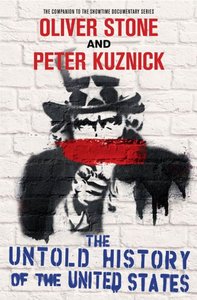
002388a5_mediumWe recently subscribed to Showtime, the pay channel, in order to watch Oliver Stone’s “Untold History of the United States.” It’s been a worthwhile investment. These pay channels offer a side street for a little subversion, as there are no advertisers hovering about. Companies that don’t want certain content aired have to sue the network rather than achieving their end by withholding advertising dollars.*

So Stone’s work has an outlet. Even with 200 other cable channels with absurd names like “History” and “Learning,” none would touch such an offering. Censorship in the United States is pervasive. We are so sheltered from the real world that Stone’s work, which would be part of a classroom discussion in a free country, seems radical.
Continue reading “The absurd premise”

Killing them softly

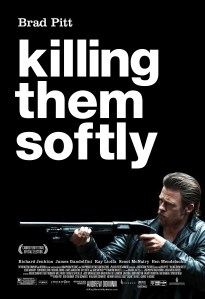
killing-them-softly-poster1I saw a movie that has hung around my consciousness longer than most. It’s called “Killing them Softly” and stars Brad Pitt. As he gets older Pretty Boy Pitt is taking on some gravitas. He has screen presence and commands the viewer’s attention. But the larger issue to me was the plot.

I’ve read two reviews of the movie, and neither liked it. Roger Ebert treated it as just another mob movie with a recycled plot, but made me laugh when he mentioned how odd it was that in the movie so may bars had CSPAN running in the background. That’s hilarious when you think about it. Filmspotters, a podcast I listen to, complained about the heavy-handedness of the inserted Obama/McCain dialogue in the plot and generally panned it.

I liked it, of course, even as I saw everything coming. I knew the young punks would get hammered. I was sure throughout that I was watching Casey Affleck putting up another excellent performance. That character turned out to be played by Scoot McNairy (not a typo), and I’ve never heard of him either, but he was good.

But to the larger plot, it revolves around some young punks who rob some mobsters, and then get their due. Things sink in with me only slowly, and tonight we were having a discussion about various things, and I mentioned Bernie Madoff – not that he stole money and is in jail, but rather that he is only in jail because he stole money from powerful people. And suddenly the movie made sense. Of course it made sense! It was about how people get away with crimes but only get punished if they choose the wrong victims. Which was why it was set in 2008 when all of those bankers involved in all of those crimes got away with it, and only Bernie Madoff went to jail.

I like Ebert – he’s really got some smarts going on and generally understands movies that I see on a far deeper level. I see a movie and then read his review and slap my forehead. But this one time only, I think I saw more of a movie than him. Possibly.

Stupid me goes to a Bond movie … stupid stupid stupid!

What he said.

What am I doing going to a Bond movie anyway? In the opening scenes Bond is shot in the shoulder, yet functions as if not even wounded. A bullet to that part of the body is disabling and recovery will take months. Later he is shot again, falls several hundred feet and lands on water, surviving. In movies, you see, water is soft. In real life, it is like landing on concrete.

It is Bond, I know. I was only there because I had time to kill before catching a flight and didn’t want to be at an airport.

Javier Bardem reprises his Anton Chigurh role (No Country for Old Men, a villain done right), this time as a blond. He overacts, or is over-directed. He works too hard at being bad rather than just letting it come out naturally. As Coren mentions, (link above) a young woman is first molested by Bond after showing no interest in him, and then is murdered after a terrifying ordeal in which men are shooting at a whiskey shot glass on her head, the name of the whiskey featured prominently. She is gut shot! It is a horrible, slow and agonizing way to die, and you have to wonder if Bond is sad that he can’t bang her again.

If only it stopped there … there are public hearings about secret intelligence, a subway disaster where not one victim is shown, and at least six security guards murdered like so many pawns … cars drive through crowded markets as if people did not matter. Do you ever wonder, like me, how long it takes the poor vegetable stand owner to recover his losses after Bond rolls over him in his Aston Martin? What about wrecked and stolen cars and cycles? It’s a police report/insurance claim nightmare.

And then the come final scenes at Skyfall. I can’t tell you much about that, however, as watching planes take off and land had more appeal at that point. What is it about movie critics? Journalists can’t do journalism in this country. That’s understood. Have critics gone down that road? Are they afraid to tell us when a movie is bad? Will they too lose their jobs if they do their jobs?

Maybe they are perception managers. If 94% of them say they liked it, will people imagine they liked it when they really didn’t?