We went to see the movie “The Help” last night. It’s a good movie – the characters are caricatures and the plot is held together by a thin piece of thread (having to do with a pie), but afterwards over pizza it led to some really good conversation that would not otherwise have come about.
The movie is about black maids in the south in the early 1960’s. These women raise white children during the day and their own at night. They must endure white attitudes about black people without the ability to speak up or out, a most undignified situation. Because it is a movie, bad people get what’s coming to them, good people prevail, and the people in the middle are changed for the good.
This video is making the rounds … I cannot help but notice as Rand answers Mike Wallace’s questions that she is totally devoid of compassion, taking about the fate of millions of people as if they were lice. (She is oddly very unsure of her own presence – see how her eyes dart about.) This might be her appeal to the modern-day capitalists – her call to go it alone, not to be burdened with concern for fellow humans. Given this and other known attributes of the woman, is is not a reach to suggest that she was probably a sociopath.
The movie Atlas Shrugged, part one of three, is a real snoozer I am told, with people standing around reading long contrived lines, much like the book itself. Do bad books make even worse movies? It is interesting that it is playing here in Denver at the same time as the movie I AM, which celebrates our caring, loving and sharing attributes, and makes the case that these are as much a part of us as competition and selfishness. I AM is Atlas Shrugged for the 96% of us who suffer those damned things called empathy and conscience.
We spent time back in Montana on our recent trip, and had meals out with everyone we wanted to see that we had time to see again in Bozeman. Each of those meals was a trip of its own, leading to long conversations that I wished would never end. My thanks to our good friends who read this blog and spent time with us. It was really fun.
One dinner companion had an interesting observation: Most people who read this blog don’t get it. Most Americans don’t get the kind of talk that goes on here. They don’t look behind the curtain, don’t suspect that greater minds than ours are about the business of managing our perceptions. That phrase itself is an insult, as each person presumes to know his own thoughts and to be the originator of those thoughts.
Christopher NolanI asked one meal companion, who doesn’t come here, if he had seen the movie “Inception.” He’s a movie buff, and generally our tastes run the same way. On this movie, his reaction was negative. He hated that movie. He’s smart and patient, so it isn’t that he didn’t get it. Quite the opposite – he got it. It offended him. The very idea that anyone could plant ideas in his mind was abhorrent. He claimed, with mock self-deprecation, that he believed himself to be too smart to allow such a thing to happen.
So we all think alike, and we all think the same things, and we are all the originators of our own thoughts.
Cuban propaganda posterIn most countries, perception management isn’t much of an issue. There’s some of it going on no matter where we live – the French and Canadians and Ruskies all believe in the essential goodness of their own homelands, and all turn a blind eye to their own weaknesses, just as Americans do. That is natural, and not a result of active thought management. But certain countries have set about to manage their populations so as to keep them contained and controlled – among them are the Russians, the Cubans, North Koreans, the Chinese, and the Americans.
American propaganda posterThis is not the same as totalitarianism, where brutal thugs threaten people who go astray. It’s much easier to think for oneself in such places as Saudi Arabia or Sri Lanka, as the only requirement is to shut up about it.
But to actively manage a population that thinks itself free is a much more difficult task. So it starts early, when we are very young. Our schools teach us a version of history that probably never happened, and it becomes our backdrop. We are also taught that our form of governance is the best, and that we had forebears that were saintly and courageous. We are constantly put through rituals, such as saying the Pledge of Allegiance and singing the national anthem, to reinforce those ideas. We monitor one another to see if the open displays of patriotism are appropriate – do our neighbors take off their caps, put hand over heart?
Most importantly, after our leaders are decided for us, we decide on our leaders. It is essential that we view ourselves as self-governing.
It is usually enough to reach a person in the primary education phase. Most will go on to ordinary workaday careers, the backdrop firmly in place. Their lives will be occupied with work and bills and children and sports. Many of the poorer classes will be called upon to become soldiers and participate in attacks on other countries, and will presume to know that the cause is just, and will demand honor and repayment for their dishonorable work.
A few of us are people who Napoleon referred to as being “of noble mind.” We think further and harder, and so it is not enough that we be swathed in patriotism as young children and let go. The process has to be ongoing, reinforced in higher education, and deeply embedded by the social reward system. You might think the intellectual class of people to be the hardest to manage, but they are not. They are Orwell’s trained circus dog. They actually teach themselves to jump through the hoop without the crack of the whip of the trainer. They self-indoctrinate.
He's really, really good at itI’ve had encounters with many of the educated class, and there is usually hubris littered about, and I usually react negatively. I’ve had run-ins with a manager of a public radio station, two newspaper editors, Budge, and many others. It is essential that the journalists serve the state, and that profession is buried under six feet of self-adulation. They are so sure that they have arrived at their own thoughts that the mere suggestion that anyone else was managing their perceptions causes them to not merely disagree, but to react with anger. Hence, our dinner companion, a genuinely nice man, did not just dislike the movie “Inception,” He “hated” it.
Not pictured: PowerEvery country has an intellectual class, and these people share certain characteristics. One, they cannot stand the idea of being “ordinary”, and so they go to great lengths to separate themselves from the masses. Two, they usually hook up with power, somehow serving the interests of non-intellectuals who can give them the proper rewards for their service. So, if you are one who haunts the cable news dial, you will see that it is loaded with members of this class, each pontificating in a serious manner on why the leadership of the country is right about this or that, why our wars are just, why tax policies that punish the working classes and favor the rich are appropriate. They work for power. It can be no other way.
If they are Republicans, they are critical of Democrats, and visa versa. When necessary, when new people take power, they switch positions, criticizing the same policies they once espoused, since that policy is now being carried out by the other party. The act of position switching, which recently happened on our resource wars in the Middle and Far East, and on budget deficits, is truly a wonder to behold.
This class is everywhere to be found in chatterland, with one exception: Anyone who eschews the two-party makeup is ostracized. Outside the two parties, you will find honest thoughts and observations, critical thought and true patriotism, which is the love of a land and people couple with a desire for the good will of others and prosperity and happiness for the entire planet.
Christopher Nolan, who wrote and directed the movie Inception, seems to be at once uniquely talented and smart enough not to openly challenge power and the perception management system. He is smuggling his message to us. Good film makers do this – David Russell with Three Kings, Barry Levinson with Wag the Dog, Stuart Rosenburg with Cool Hand Luke … the list goes on far into the night – The Wizard of Oz, Invasion of the Body Snatchers. Lesser attempts that more pistol-whip than smuggle include There Will Be Blood and Avatar.
Luke emptying Boss's holeBooks can also smuggle truth, but in a non-reading culture, who cares? Movies can reach us with smuggled messages because independent thinkers in that industry are let free to do their work, and are rewarded if they make money for their sponsors. The embedded message slips right by the power structure. Ad-based television cannot do this, though the pay channels occasionally offer up good fare. But it is in movies that we find embedded messages that sometimes hit their mark. In the anger that I saw in our dinner companion, there was evidence that the movie Inception succeeds in delivering its message.
For that reason, I am going to see it today. It must be quite good.
I have been urging my lovely wife for years to watch the 1993 movie Heart and Souls with me. Finally last week she did. As expected, she enjoyed it very much and even found it moving.
The movie features a very young and extremely talented Robert Downey Jr., who plays Thomas Reilly. He is befriended as a young boy by the spirits of four people who happened to be killed in a bus accident at the moment he was born. For unknown reasons, their spirits attach to him, and he spends the first six years of his life with four very real but invisible friends, As if by magnetism, they cannot move more than a few feet from him. He can talk and sing with him, no one else knows they are there.
Little Tommy’s parents begin to suspect he is nuts, and fearing that they may be harming him, the four decide they must go invisible on their young friend. In a heart-rending scene, they bid him good bye. Twenty years later they are still attached to him, but he has long forgotten them. An angel comes by to pick them up, assuming they knew why they had been stuck with Tom. They had no clue – someone in heaven screwed up, so that they did not know they could enter Tom’s body and use him to rectify their lives. They were supposed to use him to do the one thing they most regretted not doing while alive. The reluctant angel gives them more time.
The four ghosts are played by Kyra Segwick, who jilted the love of her life before dying; Tom Sizemore, who stole some valuable stamps from a young boy and was trying to make good when he died; Alfre Woodard, who never got to see her kids grow up, and Charles Grodin, a singer who was afraid to perform in front of people. As the story moves forward, Downey has to play each of the other characters as they “enter” him and do what they must do. He also has to come to grips with his own inability to give love to others, most importantly, a girl named Anne, played by Elizabeth Shue (perhaps the only one in the movie not exactly right for the part. She’s a little cold and distant.)
It’s a schlocky chick flick, predictable and emotional. And I loved every minute of it. It is one of my favorite movies of all time. Make of that what you will.
By the way, the scene of the five lead characters moving in harmony down the street singing “Walk Like a Man” is forever imprinted on my brain. It is beautifully done.
I’m having a hard time with movies as I get older – it is hard to sit through them knowing that something is either CGI or that there is a camera in the room with the actors. A movie like No Country for Old Men is such a rarity – I walked out of the having totally bought in – the acting, the illusion, the acting, all superb.
My favorite movie of 2009 was well done, well thought out, well scripted, poignant and inspiring: It was animated. They called it, simply, “Up.”
Here are some off-the-wall observations about movies and stuff. Please add your own.
Sherlock Holmes How dare they take a cerebral drug addict (played, interestingly, by a decidedly non-cerebral drug addict), and action him all up, making him into a brawling 19th century James Bond. I deliberately avoided that movie. Sacrilege.
Nicole Kidman: Refers to herself as an “actor.” Takes on parts that stretch her limited abilities. Is abominable. She ruined Cold Mountain. She should take off her clothes and shut up.
Meryl Streep: A woman who is so good at her craft that I cannot get over the fact that it is Meryl Streep. Aging well, however, and stays busy. If only I could forget, for one second, that I am watching Meryl Street act.
Paul Newman: Wonderful, common, kind and ordinary man who did what all people who become wealthy by means of the genetic lottery should do: He used is fame to help other people. He seemed to understand that he wasn’t worthy, and treated his good fortune with humility, paying it out to others. What a nice man he was.
A Hard Day’s Night: The Beatles transcended the camera, their charm poured out of the screen – well … John, Ringo and George, anyway. It turns out that Paul was dating a professional actress at the time of shooting, and she was coaching him on how to act. Consequently, they had to cut most of his scenes, as he was stinking it up. But I urge anyone too young to remember the Beatles in their prime to rent this movie. It’s a timeless classic.
ET:I went for a long period of time when the kids were young without seeing any movies. I did not see Rocky and Star Wars until years after the fact. One day I took my oldest two daughters to see ET, just on a whim. It was really fun. Then I saw the name “Spielberg” on another movie, and thought it must be a good one for kids too, and took them to see …
Gremlins: They were hiding under the seats. I had to leave very early in the movie, and complained that it was not suitable for kids. It was rated “PG”- later, they came up with the rating “PG-13” in response to parents who found themselves with their kids watching movies not suitable for young children.
House: Not a movie, I know. I just throw it in here because I’m curious how long they can go on with bad writing, an impossibly unrealistic plot construct, and shallow characters. House himself was somewhat interesting at one time, but he is surrounded by two dimensions at best.
I have often thought that House (patterned after Sherlock Holmes) would be better suited for a “Fugitive” type series – not the excellent movie, but rather the old David Jansen TV series where Jansen’s Dr. Richard Kimble was always on the run, meeting a new cast of people every week. House should be called all over the country to consult on unusual cases, meeting different doctors, nurses and patients. That way he could get rid of that awful, boring cast.
The Wire: My daughter turned me on to this now-defunct series on HBO, and I’ll never forget the words of David Simon, former journalist and co-creator. He said in a Bill Moyers interview that as a journalist he would put up stories, and they might have some small impact, and then evaporate. He wanted to convey the reality of the phony “War on Drugs”, and found that journalism simply did not reach people. So he chose to write a TV series instead. The Wire is far too complex to describe here, but incredibly worth investing your Netflix account in for months to come.
Showtime, HBO: Showtime has a series called “Californication” with David Duchovny that has some good nudity from time to time. HBO is struggling with a series called “Hung”, which also offers up nice flesh now and then. The two series are really the same formula – a plot line that allows for a wide array of beautiful actresses to pass through the screen and disrobe for us. I got tired of Showtime and switched to HBO, and every time that I switch to the guide for that channel range, I think “please, HBO – give me a reason not to cancel you!” Bill Maher is not enough, and dammit it, if you show one more hairy 70 year old dick or one more set of sagging 70-year-old boobs on Real Sex, I’m outta there. (Bryant Gumbel does serious and credible journalism in his “Real Sports” series. Too bad that it is only in the realm of sports where journalists feel free to openly challenge powerful people and institutions.)
Anyway, I am visiting kids and the baby is asleep, hence the ramble. Please take a minute and add your own thoughts below.
We went to see Michael Moore’s movie, Capitalism, a Love Story, this weekend. It was enjoyable and moving. If it were a speech, it would be called merely anecdotal. But that’s what art does – it tells a big story through a little one.
This is by far Moore’s best work. This is the film he hinted at with Roger and Me, strongly suggested with Sicko.
Our daughter-in-law hit us right off with what appears a glaring contradiction: Moore makes money with his films. She repeats the oft-misunderstood notion that our daily efforts to make money and stay alive are “capitalism”, which is also known as “free enterprise” which is the essence of “democracy”.
We all strive to make money. People everywhere are committed to this ideal – we must contribute as we are able to take care of ourselves. Earning something for doing nothing is not a healthy thing. But then, that is the definition of capitalism: Earning money on capital. Capitalism has made a religion out of getting something for nothing.
Earning money by means of labor? That is enterprise, for sure, but I do not place traders at Goldman Sachs in the same league with an ordinary plumber or Wal-Mart clerk. One can only earn what his labor allows, while the other can make money on the labor of others. One is a mere worker, the other a capitalist.
Moore takes us to houses in foreclosure, kids in private for-profit detention, workers on strike, and to a bakery in California where everyone earns a living wage. He squeezes every bit of emotion he can out of people removed from their homes and the bastards that do the removing. That’s entertainment 101 – heroes and villains. I especially liked the guy who offered to Moore when ambushed with cameras that he could do us all a service if he would “stop making movies”.
He’s a gifted film maker, and knows to build slowly to a point. And I did not see it coming.
Rep.Marcy Captor, D-OH, has a large part in the movie. She talks about the meltdown before the election last fall, and states her belief that it was a setup, done deliberately as the election drew near to frighten legislators into giving Wall Street the key to the Treasury. George W. Bush used the same scare tactics prior to that bailout that he did with Iraq – a speech predicting doom if we did not turn $700 million in funds (all borrowed) over to Henry Paulson’s Goldman people.
The surprise twist in the plot was the House Republicans. No one in the White House or on Wall Street expected them to balk. But they did. In an extraordinary act of courage, the House voted to turn down the bailout. The Dow crashed, sinking over 700 points in one day.
Here’s where Moore makes his most salient point, one that ought to make every Republican want see the movie. Failing to get what they wanted from the Republicans, Wall Street turned to the Democrats. And sure enough, Harry Reid and Nancy Pelosi and Barney Frank fell in line, as did Barack Obama. The issue was re-voted, and Wall Street got their money. But it was mostly Republicans on the Maginot line that tried to stop it.
Moore does his usual theatrics, ambushing people on Wall Street, demanding our cash back, speaking to buildings through a megaphone and cordoning off the area with “Crime Scene” tape. (This was clearly done on a Sunday). But he closes with a few thoughts that resonated with me:
One, no matter how bad it gets, it’s very difficult to energize the American public. Obama became the Pied Piper, leading us all down the wrong path, absorbing all the discontent and stuffing it. But beyond that, beyond merely getting people to vote, it is virtually impossible to organize here in the land of the free. We seem unable to get off our collective asses, and are morally bankrupt. Our forebears, even as recently as the 1960’s, knew how to throw fear into leadership. That impulse seems to have dissipated along with the expansion of bellies and preoccupation with John and Kate.
Two, Moore says something like “Hey folks – I can’t do this forever, and I can’t do it alone.” We don’t need leaders, we need organizers, and as the movie so well points out, organization through the Democratic Party is futile.
And finally, he makes clear, our choice is not Capitalism vs. Socialism or Communism. China makes it quite clear that capitalism and communism get along quite well. Capitalism, in fact, can exist comfortably in communist and fascist systems alike. But it threatens to undo our system.
I’m sure you’ve heard the old joke where Job asks the Lord why everything in his life is going wrong. Remember what the Lord replies? If you don’t remember the joke, ask anyone. I can’t prove it but I’m absolutely certain more than half of everyone on Earth has heard some version of that joke.
I am of the other half of the world. Can someone tell me the punch line?

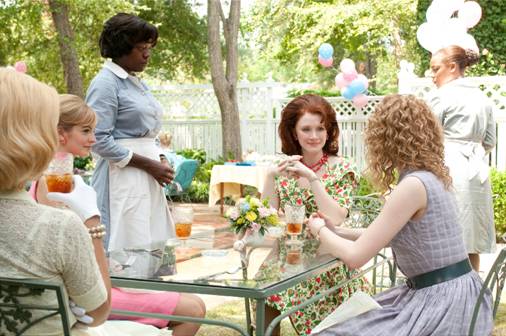 We went to see the movie “The Help” last night. It’s a good movie – the characters are caricatures and the plot is held together by a thin piece of thread (having to do with a pie), but afterwards over pizza it led to some really good conversation that would not otherwise have come about.








 Piece of Mindful