Rule by the illusion of choices

Michael Moore, speaking at a rally in Madison last month, mentioned that “Just 400 Americans — 400 — have more wealth than half of all Americans combined.” That’s an interesting statement, and coming from Moore instead of, say, Joseph Stiglitz, it needs to be analyzed carefully. (Try here.) But I think it is safe to say that there is probably more concentrated power each year nested in Bohemian Grove than at Burning Man, so that Moore’s statistic, while perhaps indicative of a huge imbalance of wealth in this country, is not worth haggling over. It’s a nice talking point.

The question can be rephrased in the following manner: Who has more power: The 69 million people who voted for Barack Obama in 2008, or the people who decided that our only available choices were to be Barack Obama and John McCain? That terribly oversimplifies a complex process, but the bottom line is this: If not those two men, it was going to be two others, and those two would be determined by an apparent voting process that was mere Kabuki Theater. There were perhaps a dozen viable possibilities, and none of that dozen would be objectionable to Bohemian Grove. Burning Man, on the other hand, was high as kite and could not care less.

The problem is academic: How does power work? Even more academic: What is power?

Power is the ability to make another person do things in your favor even if that person does not want to do those things. The essential power relationship is parent-child, where the child is dependent on the parent for sustenance. “Good” kids are submissive to parental authority. From there we enter school, and the authority transfers to teacher/coach/administrator, and the “good” students again, are submissive. From there it is the strained relationship that virtually all of us endure forever – boss/employee.

We are so inured to power that we accept it, usually without question. It never occurs to us that bosses should not have such power over other people – we accept it as normal. We accept absurdities as normal … health insurance companies can exclude us from access to the health care system; mobile phone providers can insist that we use only their phones and sign two -year contracts; the president, once elected, will abandon campaign rhetoric (and even acknowledge that much of it was a lie).

Wait a minute! We accept that campaigns are meaningless exercises?

Yes, we do. Just as parents in a household might allow children to have an opinion, schools have student councils, and bosses have a “suggestion” box, campaigns and elections are transparent fictions that willfully ignore the power equation. But we willingly go through them because, honestly, if we didn’t have that, we’d have nothing.

Moving on then, how do the people at Bohemian Grove* manage to exercise their authority over the rest of us, controlling our choices for elected office and rendering our vote meaningless? What are the mechanisms?

My thoughts on this subject pop up here every now and then, but are not well-developed. I fall back on ethereal notions like “propaganda” and “illusion,” each very real, but also vague enough to lack real explanatory power.

If I stop here and say that I don’t know how it works, but do know that it does work, can I get on with my day?

I’ll stop. I have so much more to learn. But a good starting point can be found in William C. Donhoff’s 2005 essay, The Class-Domination Theory of Power. The roots of this essay go much farther back in his career, and the essay is really just a capsule of a 1967 text book, Who Rules America.

I’ll have more to say, of course, as blogging is a Latin term that roughly translated means “Can’t STFU.”
_____________
*The annual gathering at the Bohemian Grove complex is a weird orgy of rituals and substance abuse, like Burning Man, but the phrase is used here to mean the 1/10 of 1% of us who hold real power.

An interesting Friday

Amazing and fortuitous error discovered by Possner operative!
Election fraud in Wisconsin: The discovery of enough votes in Wisconsin to assure victory for David Prosser, and further to give him just enough votes to be outside the range that would yield a mandatory recount, is nothing short of a goddammed miracle! The question is, will anyone do anything about it? I doubt the Wisconsin Attorney General is going to turn on Scott Walker, and the Obama Administration will stay out of it for some sniveling reason. The only hope for redress of that grievance will be the courts. Good luck, Wisconsinites.

It reminds me of something that troubled me when I heard that petitions were being circulated to do recall elections in that state. Our election system in this country is not secure, and in all the years since 2004, nothing has been done to fix any of the deficiencies. The precincts are still using easily hackable computer systems. When it appeared that Bush had stolen (yet another) election in 2004, I was curious why the Democrats were not concerned. In the succeeding years, I’ve come to appreciate that they are essentailly the same party, and though there may be inter-party squabbling for seats now and then, when the leadership of each party is in cahoots with the other, then the ability to turn an election can be useful at times to “both” parties against outsiders.

The failure to address election fraud in 2000, 2002 and 2004 essentially set the precedent, and the system is now open to hackery whenever needed. Machines that cannot be audited or kept secure are deemed to be reliable, per se, because the “other” party refused to do anything. Our elections, never anything to brag about, are not secure. It would be nice when they do they recall elections in Wisconsin, if they would call in international observers from say, Haiti or Libya, to assure that we are up to their standards.

So when 2008 came up clean (and I was surprised how the exit polls showed it to be clean it was throughout the fifty states), I was not reassured that we were having clean elections again. It just told me (and this is wisdom after the fact), that Obama did not challenge the leadership of either party.
_______________
Government Shutdown:And now they are going to shut down the government. It’s really hard to know what this is all about or what is in store for us. Some think that this is the beginning of a bipartisan assault on Medicare and Social Security, which will take place in the next two months. Some say that one or the other party will be “hurt” by a shutdown, but if there is only one party, that hardly matters.

This I know today, and not much else: It’s not about Planned Parenthood. Neither party gives a rat’s ass about the abortion issue. It’s pure wedge. Harry Reid has said that there is agreement on everything that will be cut, and that should be the focus of attention – that the Democrats have capitulated in this latest rollicking round of Kabuki Theater. But it’s not really capitulation if all they were looking for was a cover story for helping the Republicans cut or shut down a host of popular social programs.

It’s just business as usual here in our one-party state, and note well that there is no disagreement between them that the biggest discretionary spending program of all – the war budget, which is sacrosanct.

Glenn Greenwald wrote a bit on the “two-party” system, saying

I spoke yesterday at Harvard’s Kennedy School and was asked whether I’ve ever been told by MSNBC or any other television program on which I’ve appeared not to speak about a certain issue. I replied that the media’s narrowing of political debate doesn’t generally operate in such an explicit way (though sometimes it does); rather, by confining themselves only to those issues relating to the partisan conflicts between Democrats and Republicans, anything that exists outside of that sphere is simply ignored. Any positions that enjoy bipartisan consensus — or issues that the two parties jointly ignore — are rarely examined in establishment media venues.

So the media essentially freezes debate on issues to those issues raised by either party, and since so many crucial issues are not disputed between them, the media does not cover them either.

Ah, the wonders of our two-party system that is really one.

Napkin Economics

Earlier this year I submitted two 650 word op-ed pieces to the Denver Post as part of a contest they were running to find some new writers for their pages. The results were just announced and I was not among the winners. It was a long shot, as Denver is a big city with many talented writers, but I gave it my best. This is one of the pieces I submitted:

Napkin Economics

I am an accountant. To outsiders, my profession is boring and obtuse. For insiders … ditto. It takes a person with a special tolerance for gobbledygook to do this job.

Even given my bent for specialized jargon, I find economics incomprehensible. Economists chart our behaviors and predict the future, but are so rarely right that their official symbol ought to be the dart board. They don’t even agree among themselves. For every political philosophy from Karl Marx to Ayn Rand there is a “school” of economists to support it.

Even though economists don’t offer sound advice or agree among themselves, they don’t seem to suffer professionally. When advice turns up bad and predictions wrong, they simply move on to new predictions and advice.

I was a good college student and studied hard. But economics seemed detached from reality. The theories did not hook up with the real world. If economics was a nail, my head was concrete. The teachers were smart and sincere and hammered hard, but it did not matter. Those courses (and Greek) were a drag on my GPA.

For the last thirty years, we have been governed by people who offer us “supply side” economics. It is the idea we should live in a low-tax environment with few government regulations. This, they say, fosters growth and prosperity.

The economics behind it is best illustrated by a graph called the “Laffer Curve,” drawn on a napkin in 1974 by economist Arthur Laffer. Lunching with him that day were Jude Wanniski, Dick Cheney and Donald Rumsfeld, who would later implement the napkin solution.

The Laffer Curve is a simple thought experiment: Two tax rates yield zero revenue: zero and one hundred percent. As rates move towards one hundred, revenues decline. Therefore, tax rate cuts will produce additional revenue for government.

Of course, it would be good to know where we are on the curve before implementing drastic tax cuts, but the men lunching that day have never suffered from lack of certainty. Cheney and Rumsfeld came to power under Ronald Reagan and the Bush’s, and the theory was put into practice.

It didn’t work. Reagan cut taxes for the wealthiest among us, and what followed was decades of massive deficits. He was constantly caught short, and after implementing the cuts had to sign into law tax increases in six of eight years (including a massive tax hike on low-to middle income working people via the Social Security tax).

But the failure of the theory in practice doesn’t matter. The only cause-effect that seems to correlate with the Laffer-based tax rate cuts for the wealthy is an increased concentration of wealth in the upper strata coupled with a shrinking middle. It doesn’t take much surface scratching to find economic distress among the rest of us. People are suffering. In addition, we are prone to more (and more extreme) boom-bust cycles. Our public institutions are starving, and our bridges and levies collapsing.

In a staff lunch one day in 1998, the writers of the TV show South Park came up with their own economic theory: The Underpants Solution. It was business model sketched on a napkin:

1: Collect underpants
2:???
3: Profit

It works every bit as well as the Laffer Curve.

Instead of napkin (or underpants) economics we need a theory that works for all of us. We had it once. It was based on the lessons of the early twentieth century: Our economy is an engine capable of generating incredible wealth. But like fire, capitalism can either serve or destroy us. It must be tempered to minimize excesses. Regulation of economic activities serves as a damper.

And there’s no magical economic mystery to taxes. We should tax higher earners at higher rates, but give them socially beneficial ways to avoid those high taxes, like investment credits and charitable deductions.

It’s not complicated. We should concentrate on what has worked, and ignore what has not.

He said that?

I am reading Obama and the Empire, by Fidel Castro. It’s a collection of short essays, maybe even reprinted op-ed pieces from Granma.

He is a smart man, or would not still be defying the empire fifty years after taking power. On this side of the pond we have only been allowed to see the Cuban response to American aggression. Without the other half of the story what they do indeed seems like aggression, repression and tyranny. Taken as a whole, it is a story of a large and powerful country trying to retake a happenstance breakaway republic. There have been crimes, high and low. Castro is no saint. But most of those crimes originated in Langley. When others do those same crimes to us, we call it “terrorism.”

But I’m not going to spend a great deal of time with this book. Castro is interesting and well-versed, but not deep. The following snippet, slightly poignant, jumped out at me this morning, however.

Nuclear power plants are among the sources of energy [Obama] promises to hastily develop. These are already opposed by a great many people due to the high risk of accidents with disastrous consequences for life, the environment and human food. Moreover, it is absolutely impossible to prevent some of these accidents [from] occurring. (Essay dated February 4, 2009)

7th Day Objectivists

Dan Ariely is a behavioral economist and author of Predictably Irrational. He contends that we make decisions that allow us to think we have more control over our lives than we do. We are essentially irrational beings in the face of a complex and indecipherable world, but he argues that this is not necessarily a self-defeating trait (look at how many of us there are!).

He was recently interviewed by Skeptic Magazine for their official podcast, Skepticality. (See #149 – it’s about one hour long, and so not immediately gratifying). He was asked if he thought we would ever give up our comfortable beliefs, such as correlation being causality, the existence of miracles, or drawing large conclusions based on tiny evidence … no, he said. We will not. Irrationality offers great comfort.

Rob Natelson 'The Perfesser' offers sophisticated irrationality
Have you ever encountered the Randian? I have – they haunt the blogs – one guy even calls himself “Ann Rand.” Ayn Rand’s book Atlas Shrugged fed right into our need for self-validation by providing a system of economics that is 1) cannot be tested, and 2) would always yield good outcomes if put into practice. Thus the Randian smugly asserts that s/he has a capsule of answers that, when dropped into Kool Aid, produces a hearty brew that cures the world. Like religion itself, Randianism is comprised of splinter groups and sects, and some like to keep their distance. But it is religious faith, or belief without evidence, and so requires huge doses of confirmation bias to sustain the think tanks and the legions of followers that are invested in it.

It’s an odd turn of language, but Rand’s “objectivism” provides no objective evidence of its value, and so sends its Heavens Gate throngs on futile missions in search of validating evidence. They can only return with empty buckets, and yet are so in need of a fruitful harvest that their mythology is their sustenance.

That’s me, and not Ariely, providing Ayn Rand in a nutshell.

Here’s a snippet from the Ariely interview:

Skepticality: The discussion of “meaning, as you said, either with a big or a little “m”, it shows [that] we put more effort into activities where we’re assured will have the most meaning or impact, because that’s part of what motivates us. But what about people who are motivated by things that are unknowable, trying to find proof of things that may never be proved? How do we get meaning from that?

Ariely: The people who do these tasks do find meaning in that, and you can think about religion on one hand, and economics on the other, in which there’s some things we just can’t prove. I recently had a debate with the guy who runs the Ayn Rand Institute [Yaron Brook], and one of the discussions was about regulations in the market. His statement was that of course you saw all these bank failings, but that it was not that there was not enough regulation, but that there was too much regulation. And he said that if you only avoided every possible regulation, if there was not a single regulation on the banks, then you would see how magnificently they would behave and operate.

And of course nobody can test that. We can’t have a reality in which banks have absolutely no regulation just to see if it really works. It’s an incredibly expensive experiment. But he finds meaning in chasing the ideology. The fact that it’s very hard to test only helps him maintain his ideology.

What we find in those cases is that … people who benefit from believing that the world works a certain way adopt those beliefs and hold them in a strong way. But they are self-serving beliefs. Because they are self-serving, they are even harder to overcome.

Like belief in miracles, ghosts, UFO’s and secret friends, Randians will never go away. (We can only hope that one is never again appointed head of the Federal Reserve.) The Millerites of the 19th century believed that Jesus Christ would return to the earth in 1843. He didn’t show, but Seventh Day Adventists are still with us … 168 years later. In fact, they are the twelfth largest religious body on the planet. That blind belief that they exhibit is either our doom or salvation, or both at once.

Opening day

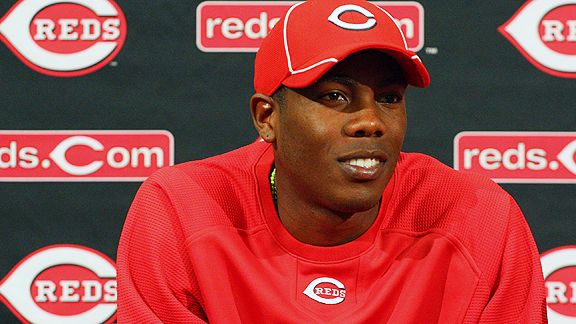
Aroldos Chapman
Today is opening day, and as a loyal Cincinnati Reds fan, I take note that it is usually the only day of the season on which the team is tied for first place. I love the game of baseball, with all its nuances, intricacies and traditions. Outsiders find it boring, and I get that. It’s a pastoral sport, played by people who are not worried about a time clock. Its roots go far back beyond those of American football with its industrial era time clocks and smash-mouth demeanor.

A few years back, the Yankees were in the World Series and Alex Rodriguez (“A-Rod”), in trying to make it safely to first base on a ground ball, reached out with his hand and tried to jar the ball lose from the first baseman’s glove. It was considered a low act, and he was rightly scolded by the media and opposing fans. Imagine that, football fans – that’s about the extent of physical brutality in the sport of baseball.

The talent is superb – the ability to hit a ball thrown at you at 90+ mph in a fifth of a second rests on only a few. Owners would replace them tomorrow with lesser-paid players if they could, but the talent is rare enough to support the salary structure of baseball, ludicrous as it is.

The Reds have a young pitcher, Araldos Chapman, who is a Cuban defector. They signed him two years ago to a $30 million five-year deal. Last year was his breaking-in year. He was uncomfortable, and did not understand such concepts as “investment”, as in the team being concerned about his health for financial reasons. He would try to play injured, and the manager and pitching coach had to watch him carefully and convince him that his body was a temple. Chapman did not know who to trust, and did not understand American culture.

A full year later, he is more comfortable, and his delightful personality is coming out. He loves American fast food. He has formed friendships on the team and is learning English. The Reds’ GM, Walt Jocketty, is amazed at how well educated Chapman is – did he suppose, along with most Americans, that Cubans are merely the raw meat of a dictatorship?

Oh, yeah, last year Chapman threw a 105 mph fastball, the fastest pitch ever recorded in baseball history.

Who wrote the following?

1. Is it right for the president of the United States to order the assassination of any other person in the world, whatever the pretext may be?

2. Is it ethical for the president of the United States to order the torture of other human beings?

3. Should state terrorism be used by a country as powerful as the United States as an instrument to bring about peace on the planet?

4. Can the United States do without immigrants, who grow vegetables, fruits, almonds and other delicacies for US citizens? Who would sweep the streets, work as servants in the homes or do the worst and lowest-paid jobs?

5. Is the brain drain – the continuous theft of the best scientific and intellectual minds from poor countries – moral and justifiable?

A: Nelson Mandela
B: Jean-Bertrand Aristide
C: Fidel Castro
D: Barack Obama
E: Araldos Chapman
F: Michele Bachmann

The author of those words also notes that ““…today, the United States has nothing of the spirit behind the Philadelphia declaration of principles formulated by the 13 colonies that rebelled against English colonialism. Today, it is a gigantic empire that could never have been imagined by the country’s original founders.”

I see in baseball a passion for life expressed in pursuit of excellence and respect for others. It holds my interest even as I know that they are just throwing the ball, catching the ball. It is sullied in some ways – I don’t like that they feel the need to “honor America” with the national anthem before each game. Military flyovers at big games are an abomination. Regular season games, with the flashing lights and pre-recorded spontaneous enthusiasm, are often visual and aural pornogrpahy. But it otherwise preserves our best traditions.

We recently sat through four games in spring training in Arizona. During those games we chatted and laughed with perfect strangers, often losing track of events on the field. When the woman sitting next to me yelled “can of corn!”, I quizzed her on her basic knowledge of the game – turns out she also knew “chin music,” “hum batter,” “rope” and “parachute.” There was no anger expressed at events on the field, and of course every spectator possessed Superior Knowledge of the game over that of the the manager and general manager of each team.

It’s a splendid little game, made for the American way of life that existed before we became a military/industrial behemoth. Of course football is more popular by a hundred cubits. That doesn’t necessarily speak well of us.

Confused about Libya? Me too.

Perhaps a better man than we knew
It’s very difficult to understand events as they are playing out, as the people who drive public opinion don’t often tell us anything about the people who drive events. But the attack on Libya is showing a crack in the armor. The military is either forced to act or doing some “shock doctrine” opportunism. The propagandists are caught short, and are ad-libbing.

First, the attack was not planned. There was no demonization campaign, as with Saddam/Milosevic/Noreiga et al. They just went ahead and started bombing, meaning that they had no part in the uprising, and had no time to make up a good cover story. This took them by surprise. (“Them” is ubiquitous – the Pentagon, the White House, Wall Street, London … a very large group of powerful people.)

We don’t know who or what they are bombing. It’s a bit complicated, as with Iraq pre-2003, where they wanted Saddam Hussein in power to keep things in a state of “stability” until they could move in with the muscle. So we’re hearing now that they do not want regime change. They want their stability. They are, however, going after military hardware, which means that they do not want Ghaddafi to completely quell the uprising. And yet, given the anti-American sentiment that exists in Libya and just about every other Arab country, it is safe to assume that they do not want the rebellion to succeed.

Confused? Me too.

Watch out for them civilians!
The only thing I’ve heard out-of-the ordinary is a radio interview as I was working today, done locally in Denver, and with whom I do not know. But the guy being interviewed said that he thought that the the U.S. Southern Command is making a play to establish military bases in Africa. That has some legs, as bases and power projection behind most of what we are doing elsewhere.

Some are saying that Obama is merely imitating his idol, Ronald Reagan in doing this attack. This presumes that Obama has the power to make such decisions. If there is any power left in that office, there is no resolve to use it, so that it’s highly unlikely that Obama had anything to do with this decision. He’s just the ribbon cutter.

Oh, yeah – and now they are saying this is a NATO operation. That’s a ruse, of course, but there’s a real reason for it: They did not go through the motions of getting that perfunctory joint resolution from Congress authorizing the act. So it’s an illegal war. Hence, it’s “NATO’s idea.” But since NATO is submissive to the U.S., it’s window dressing.

I’ve come to believe two things during Obama’s presidency – one, that Gates at Defense and Geithner at Treasury were used as signals to the world, and Wall Street, respectively, that nothing had changed with his election, and two, that Rod Blagojevich is probably a decent guy, and that’s what cost him.

But who knows. In American politics, if good guys exist, they are like children, seen but not heard. But I can’t get over this feeling that Blagojevich was caught in the path of a steam roller.

… Oh yeah, almost forgot … human rights. Let me think about that … no, they don’t care about that. Must be something else.

The exclusion principle

There are no “free markets.” Some of us know this, but the phrase is so clever! What is better than to be free? By equating their market capitalism with more basic freedoms, like speech, religion, and privacy, it becomes one of our founding principles. But it was never meant to be such.

The essence of “free” markets is exclusion. In order to force (or entice) some to pay for something, I have to be able to limit the quantity of an item and access to it. So, for example, if I have a well, and it happens to be the only well in a dry area, I can forced others to pay me for water. But if there is a river nearby, then my well has no value.

Exclusion plays an important role in our lives. For instance, only a few of us can own Rolls Royce’s. The limited quantity and high price excludes most of us. That is as it should be. If we could all have them, they would not have much value.

Exclusion is useful and creates desire for people to be more productive. The principle of “free markets” merely carries exclusion to an extreme. It says that it should apply to all commodities at all times, including even our drinking water. Before Enron went down, it was heavily invested in water supplies.

But here’s the deal: If Enron is in charge of our water, then Enron is going to exclude people from having access. After all, many people in many countries have nothing, and so cannot afford to pay for water. Enron cannot give things away, and so ropes off the water supply where it controls it, and people suffer accordingly.

The alternative to exclusion is inclusion. This idea, when carried to an extreme, has been called “communism.” The very idea that we should all have equal access to all commodities is an anathema to any thinking person.

The ideal society moderates between exclusion and inclusion, holding out most things for private ownership based on ability to pay. But some things, like water, basic foodstuffs, health care and modest housing and pensions, should not be subject to exclusion.

We call this ideal society “socialist,” but the free marketers have done a pretty good job of poisoning that well, saying that socialism and communism are evil stepsisters, or at least that the former inevitably leads to the latter.

It doesn’t, of course. Canada, Western and Northern Europe, Japan, and now China, are finding the precepts of socialism lead to an orderly society and a generally happy population. There are rich people aplenty in all of these lands, but wealth is spread more evenly and and more people enjoy better lives than the American system offers.

The latest battle ground is called “net neutrality.” As with water, our latter-day Enrons want to cordon off the internet so they can charge more for access for some, and exclude others. The rest of us, left in the middle, will have a mediocre product.

That’s how the free market works. It’s surprisingly Orwellian, as the least amount of freedom comes from the greatest exposure to “free” markets.

How I spent the last hour

To: Denver Post, Open Forum
From: moi

Please consider printing the following letter:

Wisconsin governor Scott Walker is widely thought of as a “conservative”, but is nothing of the kind. Conservatives are humble people who know that we cannot fully comprehend the workings of complex social structures. So they are cautious. Change is important but should be gradual and carefully monitored to avoid doing more harm than good. Conservatives respect the people and wisdom of the past. Those who preceded us were not fools, even though we don’t always understand why they did what they did.

Frequently spins in grave
There aren’t many conservatives around. Governor Walker is a wild man who might harm hundreds of thousands of people for decades to come. Yet he’s absolutely certain that he is right and so does not listen to or negotiate with people who hold different views.

The modern right wing was born in the turmoil of the fifties and sixties. Far from offering any wisdom, they are mere reactionaries. The fervor, the recklessness, the absence of a thoughtful grounding philosophy – all of this makes them dangerous.

We are allowed only two parties here in the land of the free. One is comprised of radical reactionaries. The other most often shows no grit, no fight.

What a country.

Will NPR go down? Will it be missed?

Tom and Ray Magliozzi
I can see our living room TV out of my office here, and have it on to keep up on the Japan tragedy. It’s an ad fest – I switch between CNN and MSNBC, and odds are that I find advertising on both. This is news American style. Advertising is not only pervasive, but also a major filter for broadcasting and news. Has Time Magazine yet reported of the link between lung cancer and cigarettes? It’s absurd that at one time two major weapons manufacturers reported to us on our wars and the propaganda campaigns leading up to them. But this is America – we are so used to absurdity that we take it for granted.

There is no courage in American news reporting, so I have mixed emotions on the funding cutoff for NPR. Having spent a good part of my life in Billings and Bozeman, Montana, NPR was to me hours and hours of classical music, occasional news, Click and Crack and Warren Olney. But they would leave regular programming to cover major events free of advertising, including congressional hearings and floods. Their “here’s what you should think about this” commentary was kept to a minimum.

Now that government funding will be cut off for NPR, I wonder what will happen to all that band width. NPR will still exist, for sure. It took on corporate overlords years ago, so its news has not been any different than the commercial outlets for decades. But they did provide high quality programming in the non-news areas, including Fresh Air, Car Talk and Wait Wait.*** But hell, I can easily live without all of those. Perhaps the government funding was so small that it won’t be much affected – I do remember NPR getting a $200 million grant from the Estate of Joan Kroc. I even thought at the time that the money might give them some independence.

But to those who say “Why should I have to pay for news outlets that I don’t watch and blah blah blah, all I can say is “F*** your wars that I’m paying for, and my kids and grandkids.

NPR came about in the wake of the sixties, a deliberate attempt to tighten the reins on private radio outlets that had been unpatriotic during that time. Community broadcasting was an important outlet for information and education. It also undermined the propaganda system. Even so, by its very nature, not constrained by advertising in those early years, NPR did some very good work. This is attested to by the fact that the right wing went into hissy fits now and then, and programming was condemned on the floor of the senate and house.

It’s long since gone over the hill to the other side. The wine snob Ron Schiller, who was taken down by the video hit man last week, is all too typical of the limousine liberal fare of that network.

By the way, have you ever noticed that the pay channels often broadcast subversive programs, like Bill Maher’s Real Time? Bryan Gumbel and Real Sports is highly critical of the NFL. Such disrespect is not allowed on regular channels. Oliver Stone is going to run a series called The Secret History of America on Showtime, unless billionaire Haim Saban forces the network to shut him down. Because subscribers pay for those channels, some of the filtering is removed, and some honest and controversial programming slips in. * **

So what happens now? I suppose that NPR chugs along, more subject to corporate financing even than before, and eventually becomes just another crappy radio outlet. Perhaps some of the affiliates will have to go local for programming, and community radio will reappear. That would be a good thing.

But in the end, my only real thought about the loss of NPR is this: Are Tommy and Ray real mechanics, or is that just their radio persona?
___________________
*Sixty Minutes was drooling all over itself after the 1999 movie The Insider came out. It dealt with some explosive inside information about how the tobacco company Brown and Williams knew how deadly their product was and spiked cigarettes with chemicals to make them even more addictive. Several attempts were made to stop the broadcast, but it was aired anyway. That’s what the movie is was about – the 60 minute heroes. Here’s what they forgot to say: Brown and Williams was not allowed to do TV advertising for tobacco products, and had no other divisions besides tobacco, and so had no financial leverage over CBS. That’s why the report even got through in the first place. B&W had to resort to an old-fashioned lawsuit to stop the broadcast, which they eventually lost.

**I believe that it was HBO that showed the movie “Waco: Rules of Engagement“, a documentary about that event that would never make its way to regular TV, as it accused the government of mass murder.

*** When I got satellite radio, I learned about Bob Edwards, Diane Rehm, Brian Lehrer, Talk of the Nation … yawn. Rehm is especially nondescript, but the others place a close second. PRI gives us This American Life with Ira Glass – that is great programming.