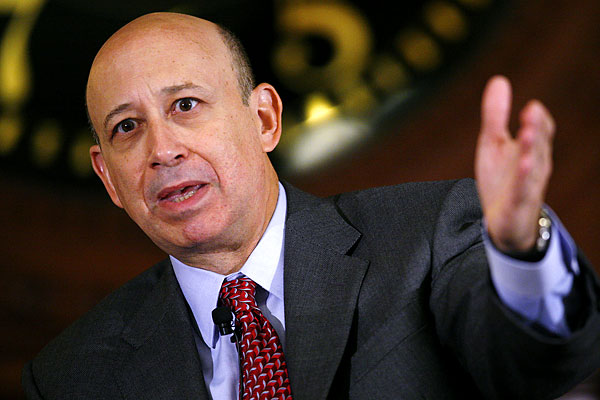
Lloyd Blankfein worked tirelessly behind the scenes for Iraqi freedomFrom Politico:
FIRST LOOK: WALL STREET IN IRAQ? – Secretary of State Hillary Clinton and Deputy Secretary Tom Nides (formerly chief administrative officer at Morgan Stanley) will host a group of corporate executives at State this morning as part of the Iraq Business Roundtable. Corporate executives from approximately 30 major U.S. companies – including financial firms Citigroup, JPMorganChase and Goldman Sachs – will join U.S. and Iraqi officials to discuss economic opportunities in the new Iraq. Full list of corporate participants: http://politi.co/kOpyKA
This is what the Iraq war was about, beginning, middle and someday, end. All the rest was lies. Always keep in mind, as we watch American policy makers at work, the maxim that has guided me through the past 23 years: “They lie, they lie, they lie.”
We are witnessing an interesting phenomenon going on right now – the first phrase that comes to mind is “selective indignation,” but that really doesn’t cover it. The focus on Anthony Weiner is not merely hypocritical. It’s indicative of the selection system for high office. Weiner has been found unqualified, and it has nothing to do with his sexting.
First, the supposed “crime:” I’m speculating based on personal experience here, but Weiner is young and attractive. Monogamy is not in the nature of a man – it is a learned behavior. He’s in a new marriage, and is slowly coming to grips with the notion that he is confined to one vagina for the rest of his life!!! It’s the first year of marriage, and not the seventh, that is hardest for most of us. But also, for most of us, there are not a lot of alternatives. We’re happy that even one woman wants us.
But Weiner has other options. He’s in Washington, DC, a sexual playground. Like Hollywood, it is hard to maintain a normal relationship with all the distractions. He is either going to settle into this marriage and find out its true meaning, or he’s going to Clintonize. He might also go through a divorce, which is unfortunate when a child is involved.
All of that is none of our business.
The drumbeat that is going on now is not natural. It’s contrived and reserved for special cases. This is the “many could be called, only a few are chosen” phenomenon. On any given day, maybe a hundred members of Congress could be caught in flagrante delicto, but are not. (How do I know this? It’s elementary: Washington is a place where there is power, money, women, lobbyists, and intrigue. Duh.) The media, directed from above, can either focus our attention or allow it to naturally dissipate regarding Weiner. No matter the public’s interest, which is directed by television coverage anyway, Weiner’s indiscretion could easily fade into the background. But instead it’s being showcased, the ‘other’ party wants his scalp, and his own party is abandoning him.
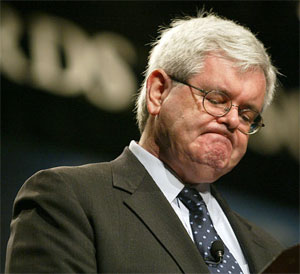
Consider this: David Vitter was caught paying for sex with prostitutes. We know about it, but it was not put in our headlights, and he’s still in office. Without media focusing our attention on the matter with incessant coverage, the matter withered and died. Newt Gingrich is famous for serial affairs, but he tends to marry his concubines. Orrin Hatch is said to be a wild-hare penis on a perpetual scent trail. John McCain’s marriage is rocky at best, his wife the philanderer as his appeal diminishes with age. George W. Bush was a cocaine abuser and drunk who sponsored at least one abortion. These are some of the few we know about, and I only mention them because the media backed off, and no resignation was demanded of these powerful men.
Chris Lee did something similar, and quickly stepped down. Don’t know what to make of that, as I know nothing about him other than that he was new in office and not powerful.
Randomly caught - honest - randomly!I don’t care about sex, as random encounters simply don’t matter. It’s just sex. Men and women in marriages have to work this stuff out, privately. I don’t care about prostitution, as it seems a woman’s business whether she wants to sell her favors. Who am I to say that someone should be denied an economic opportunity due to mere prurience? So I don’t care about Vitter or McCain or Clinton or Bush or Gingrich or Gary Hart or John Edwards or Elliot Spitzer or Anthony Weiner in that regard. It’s none of our business. Men are men. Answer for yourself: Given opportunity and certain knowledge of not being discovered, would you? Would you? We who are happily married don’t actively seek what Charlie Sheen calls his “strange,’ meaning unfamiliar nooky, but don’t sit there and tell me that you, if you are a man, are immune to this stuff. You know what’s real here.
My only questions are these: Given that so many could be called, why are so few chosen? And why, with Gingrich, Vitter, McCain, Hatch and Bush and so many others, does the dog not bark?
____________ Footnote: Media managers (both in government and the media itself) are known to use stories as a distraction to avoid covering other stories, even to invade a small Caribbean island that grows nutmeg, for example, to distract the media from marine deaths in Lebanon. (The Obama White House used this tactic in December of 2010, inviting Bill CLinton to a press conference to deflect attention from House Democrats rebelling against his tax deal.) So the Weiner story could be a mere distraction, in which case the question becomes: What else is going on? Yemen is the only story that comes to mind. It is big, but not as big as the Weiner story, obviously.
Information in the US is tightly controlled, an amazing feat given our perceived freedom of the press and easy access to information.
The means by which this is accomplished appear twofold: a media environment where even the incurious are overfed with useless information, and journalists who are rewarded for servile behavior.
Americans are no more or less intelligent than anyone else in the world, but we are provided with an abundance of distracting information daily. Even if we are naturally curious there are discouragements in place: Subversive information is not easily available. We have to know what we are looking for. We’re not going to stumble upon it in USA Today. And anyway, there are a thousand other interesting things going on in media. Distractions abound. It’s easy not to know anything and still be busy as hell about it.
Mainstream media outlets are rigidly controlled. Naturally curious journalists are dispatched over time. They leave either by outright dismissal or or for perceived failings such as “lack of objectivity” (code for natural curiosity). It’s easy to predict that the editor of the local newspaper will be the least intellectually curious person there, and the most willing to submit to the dictates of the publisher or owner. Mediocrity is the trait that leads to advancement – it’s the “Russert syndrome.”
You’d think that the Internet would solve these problems and free us up to know anything we want to know. It has indeed, and those who are naturally curious can now surf the world. It’s a glorious revolution. But the Internet is mostly a source of distractions. It is dominated by cheesy entertainment, pornography, gambling, social networking, music and movie piracy. People scanning the globe for information are relatively few. The Internet has introduced the naturally curious to one another, and that is revolutionary. It’s a hard thing to manage – the only real threats I’ve seen to Internet freedom are government and corporate hacking to shut down pesky websites, “net neutrality” battles, and routing of massive amounts of data through a few outlets, which allows for shut-down of service when there is a threat to entrenched power.
A correspondent whom I only know because of the Internet forwarded an AlterNet piece by Rania Khalek called “5 WikiLeaks Hits of 2011 That Are Turning the World on Its Head — And That the Media Are Ignoring.” That tone … “and that the media are ignoring,” is a tiresome cliche’ in left wing journals. It implies a failing in the American media. But in not covering the stories in Khalek’s piece, media are merely doing their job.
And anyway, Alternet is part of the media, and the information is there for us. Only a few seek it out.
KhalekHere are Khalek’s five WikiLeaks-driven events of 2011:
1) The Arab Spring*: Information is power. It all started in Tunisia, where existing unrest was exacerbated by WikiLeaks revelations of government corruption, well known. Add an immolation, and presto! Uprising.
2) The ‘worst of the worst’ included children, the elderly, the mentally ill, and journalists. These are Guantanamo detainees, horribly abused, most guilty of nothing even beginning to justify their treatment. (Terror and torture are never justified anyway.) Since our perceptions are carefully managed in the US, most of us think that Guantanamo detainees are both guilty and well-treated.
3) US allies are leading funders of international terrorism. These would be Saudi Arabia and Pakistan. It is not surprising if one understands that the US itself is engaged in terror and torture, does not care about – even fears – democratic governance.
4) World leaders practically lighting a fire under the Arctic. Far from having any concern about the consequences of global warming, The US, Canada, Russia, China, Norway and other countries intuitively understand that the Arctic will be the source of resource wars in the coming decades. (I’m having a hard time conjuring up a Norwegian demon to justify bombing that country. Will we learn to hate the scourge of the Norseman as we do Muslims? Will we be told that Bjørnstjerne and Sonja are forming cells?)
5) Washington would let them starve to protect US corporate interests Hugo Chavez has control of oil, and uses it to promote relief of hunger and poverty and to free Latin American countries from the oppressive interference of the International Monetary Fund. The rotten son of a bitch. Venezuela and Haiti had an agreement whereby the latter saves $100 million a year, a tenth of its budget, on the cost of oil. Haitians getting uppityExxon and Chevron were pissed about that, and as the little lamb followed Mary, the US State Department has intervened and interfered in that agreement. WikiLeaks also exposed how the US interfered in Haitian government attempts to raise the minimum wage there from 24 cents to 61 cents per hour. This, according to a US official, did not reflect “economic reality.”
It’s not hard to understand the dynamics here, why Julian Assange is under house arrest in England, why the US (via Sweden) is trying to bring him here for a show trial which will be followed by imprisonment, even death. He’s committed a crime that is rarely seen here in the land of the free: Journalism.
_____________
*How’s that Arab spring going? Egypt is out of the news, but the US must be making some progress in restoring the old order. For a brief period of time, Egyptians were letting Gaza’s de facto prisoners escape via the Rafah border into the Sinai, but the gates have shut again. Bahrain is subject to brutal and violent suppression, with aid from Saudi Arabian troops trained by the UK. It is, after all, home of the US Fifth Fleet, so the revolution is not being televised. Libya is under attack by NATO, supposedly to aid the rebellion, but more likely to merely get rid of Gaddafi’s government and replace it with one friendlier to US oil companies.Yemen’srebel forces are currently being bombed by the US, as we open up a fifth war, four of them against Muslims. (The fifth, Colombia, is also not televised.) The US has long wanted regime change in Syria, so that revolution is being televised and widely covered here, even in Time Magazine! Abuses, which are real, are routinely exposed. I watched with horror a couple of days ago to the news that there are refugees leaving Syria. Then I remembered that the US caused some two million refugees to flee Iraq, not covered here, and then remembered too that all US news is bullshit read from teleprompters and transcribed in newspapers by toadies and lackeys.
ht/lb (PS: Woke up with an extreme case of attitude today.)
Never earned a dime, wants to be presidentThis is a comment I made below which exhausted my allotted effort for thinking [sic] today. It’s all I got.
I am struggling with an even deep[er] anti-Reaganian ideal – that beyond a certain natural limit, it is impossible to “earn” money. It’s an invitation to totalitarianism, I know. But the primary means of earning large sums of money are due to inheritance, scaling, and mere proximity.
Scaling is the ability to take a product sold one-on-one, and repeat the act of selling that product without additional effort. Effort is involved in writing a computer program, scaling comes about when you have the ability to market it by merely putting up a web site . If you are a writer you can read your writing to someone and charge a fee, read it to a large group and collect a number of fees at once, or get it published, like Dan Brown, and watch the public engage in a crap-feast.
Hard to quantify, but pure luck has a lot to do with rewards in that type of activity. How many authors better than Dan Brown never get published?
And then there is proximity – this includes inheritance, but also banking, real estate – any type of transaction where you can place yourself at a bottleneck and charge for passage of that money from one set of hands to another. There’s a lot of calculating in that, but not what I would call socially useful skill. As a banker you are managing other people’s money, and charging a fee for taking from one group and lending to another. Whoopti-doo. That ‘skill’ would not amount to a dime’s worth of income were it not for the fact that the banker is close to the money.
There’s a whole class of people who are merely in the hunt for bottlenecks. We call them “entrepreneurs”, but that is something else entirely. These people don’t invent, they merely fence off goods or services and charge for use – wireless Internet or cell phones are a good example – the “skill” involved in those activities comes from lawyers who rope us into complex contracts of little benefit to us, but huge benefit to the people who stand at the bottleneck.
It’s a part of my justification for high tax rates on high incomes – the idea that for the most part, high income is due to clever calculating without much societal benefit in the outcome, or mere luck. From a moral standpoint, I can justify high taxes on high incomes if we allow people to avoid those taxes by doing socially useful things with their money, like investing in plants and equipment and people, or giving it to charity. You [know], like in the 1950′s, when we had a better system of shared prosperity than now.
Never earned a dime, wants to be presidentTo add just a bit: What about the people who perform valuable one-on-one services, earning a certain amount of income from each transaction? This would include lawyers, carpenters, prostitutes, even us accountants, but that’s all redundant, except for carpenters. I am talking about “earning” in the sense of sale of raw ability rather than harvesting the labor of others for profit, which is the true underlying nature of the employer-employee relationship.
There was a concept in play up until Reagan took office, a distinction between “earned” income (wages, self-employment) and “passive” income (interest, dividends, royalties, etc). Passive income was taxed at higher rates than earned income.
Republicans, tools that they are, are now promoting the idea that passive income ought to be exempt in total from taxation. It’s perverse, but a natural product of the idea that mere proximity is the same as earning, and therefore ought to enjoy privilege. Indeed there should be a reward for saving and setting aside for one’s future, but this should not be confounded with inheritance, luck, and proximity. God what weird times we live in.
Carl Sagan made science accessible to me and so many others. Much of his appeal for me was his humility. He did not denigrate ignorance, only willful ignorance. He did not look down on religion. In his Shadows of Forgotten Ancestors, he expressed admiration for the people of past ages whose only tool for understanding the world was religious mythology. Since no other tool existed, what they were doing was reasonable. Their minds were no less capable than our own. Our modern science is just a tool for understanding reality, as was the religious outlook. But science is not “truth.”
Sagan had “respect for wisdom of the past,” said to be a tenet of conservatism. Those in this country who call themselves “conservatives” are really something else. (“Radical reactionaries” works for me.) But as we look at the past, there are some really ugly things that went on that we don’t do as much anymore. Things have gotten better.
Slavery, though still practiced, is no longer defended. Racial prejudice, still rife among us, is submerged into the subconscious. The modern "conservative"(It is there inside me, but I quickly suppress it when I feel it rising up.)
And, “democracy” is the guiding principle of our age. But like a beautiful loaf of bread that has no salt or sugar, it should sit in the bakery window and not be eaten.
Technology is real, and our knowledge continually expands due to better tools and the scientific method. But people have not changed. Not an iota. True, we no longer jeer at and lynch Negroes, and Jews are now employed in daily life and in our universities. But all that hatred we used to unload on them has merely moved over to Muslims. It has to come out somewhere, and Abdul has replaced Hymie and Jimarcus as the whipping boy of the age. Progress is an illusion.
I wish to express something that many of us feel but are not free to say openly: Voting is not democracy, and not everyone is qualified to vote. Our ruling class knows this. Elections merely reinforce our belief in voting while at the same time rendering it pointless. People need to feel that they have a voice, but that voice cannot be heeded. Have you looked around you? Have you listened to talk radio? Have you heard the conversations on the bus? People are not born stupid – far from it. But the absence of meaningful dialogue does foster the growth of an idiot culture. Is that what we want running this country?
Around the time of the founding of this country, people were less circumscribed about their attitudes toward the “common man.” Voting in most states was reserved for men, and only to men of property. Attitudes about women are hard to fathom, of course, but the ownership of property implied an education. It did not rule out thoughtless people, but it did minimize their impact.
These were not stupid people who set up those rules. They expressed Enlightenment ideals, and believed deeply in them. “The Rights of Man” was not an inauguration speech, but rather a real outline of concrete goals. And yet voting, which we now believe to be our most profound expression of the democratic ideal, was reserved to just a few people.
Bertrand Russell did not try to undo the modern impulse to let every fool have a vote. He merely reduced it to its essence. He said that the only real importance of voting is the prevention of aristocratic rule. Office holders are forced to step down on a regular basis. But it hasn’t really worked out that way here in the United States. Because we allow money to rule politics, we’ve been reduced two parties that are really one. The people who step down after each election are replaced with mere clones, either themselves aristocrats, or tools of that class. Democracy in this country is an illusion, even in Russell’s sense.
When I was forty years old, I felt that my most useful purpose was to join the struggle to preserve a few wild lands in their natural state, and so devoted my spare energy to wilderness causes. That is a worthy cause with many serious and dedicated people hard at work on it, but I moved away. It’s been hard to replace that ’cause’ with anything more substantive, but I realize now that something else had taken its place when I worked for Ralph Nader: meaningful democratic governance. It goes back to Russell again – we should have democratic rule, and voting should matter, even if only to force people to move on. With the two-party system, the ruling class never has to move on or move over. That needs to change.
Here is another tenet of conservatism: change should be gradual and done through laboratory experiments. States and cities need to run experiments in things like fusion voting, charter schools or single payer health care. The results of successful experiments will spread, just as Tommy Douglas’s Saskatchewan health care system took over Canada.
Meaningful democratic governance is a good cause. It’s a good way to spend my remaining days (not to sound morbid – I hope I have a lot of days left).
So I’m really deep-down a conservative! Who knew? It was hard to see, as there are so goddamned few of us, and we often go by other names.
Without the habit of correct observation, no one can ever excel or be successful in his profession. Observation does not consist in the mere habitual sight of objects – in a kind of vague looking-on, so to speak – but in the power of comparing the known with the unknown, of contrasting the similar with the dissimilar, in justly appreciating the connection between cause and effect, the sequence of events and in estimating at their correct value established facts. (Thomas Hawkes Tanner on the methods of medical diagnoses, 1869)
It’s been interesting to observe American behavior in the wake of the “killing” of Osama bin Laden. There’s been no objective evidence put forth around the event. There’s no body. “DNA evidence” is said to exist, but is not made available. There is no independent verification. Standard denigration propaganda has been offered up – drugs and pornography, and there might be “evidence” of this, as if such evidence could not be manufactured by any normal American teenager.
And yet to doubt official truth is to be subjected to ridicule. Hawkes above wrote in a pre-mass media era, so that world view could only be the subject of verbal evidence, spoken and written, and a few pictures. So much has changed since that time. It is possible now for “reality” to be entirely supplied by artificial means. Television is a window, but one that is easily filtered to offer a controlled vision of reality. I would imagine that if Hawkes had been told that a villain of his time, if such a thing even existed, had been killed, body disposed of, no autopsy or independent verification offered, he would have laughed heartily.
The problems that a normal inquisitive person encounters are not lack of evidence, but an overabundance of evidence, and ridicule. The latter is the most off-putting facet in the management of public opinion. Obtuse and incurious dolts can sit back and jeer at normally curious people, saying “That’s some conspiracy theory you got there,” as if doltism conferred superior intelligence.
Life in a controlled media environment offers countless avenues for discovering hidden truth. This makes living an inquisitive life a delightful journey. The notion that we should not be curious, that we should not stray from gray, monotonous fealty; that we should all be “journalists” and accept the words of public official at face value, is an intellectual death sentence.
Of course, the problem with living on the curious side of life is the temptation to think that we have captured all that we need to know, and that we are able to advance theories based on what we think adequate evidence. That’s the rub – adequacy of evidence is always going to be subject to personal failings. We are fallible humans. We make mistakes, presume too much. I made a mistake in the post immediately below, presuming, failing to note the facts that are not subject to interpretation by media outlets. But that path that led me there, the surveillance state, evidence of massive eavesdropping on American citizens, testimony of an NSA official that virtually every high profile journalist in the country is being spied upon … stands.
But I maintain that given the thousands of clowns who have bought, with all the absence of credible evidence supported only by the words of authoritative officials, that Osama bin Laden was “killed,” that I live in a sane place in an insane world. I’ll defend that idea against all comers. I can say with certainty that bin Laden is dead, as all he would have to do is make an appearance to set the record straight. The question is, when did he die? And if indeed he died almost ten years ago, as I suspect, then his having been kept alive for ten years in our virtual reality is a path of inquiry that every thinking person needs to travel.
Just for sake of example, imagine that you are a low-level employee at the NSA, National Security Agency, and that your job is to monitor the behavior of elected officials. You have access to technology that allows you to eavesdrop on their land lines and mobile phones, and have planted bugs in their offices and homes. There are 535 of them, so that you have only 15 on your list, and each week you make a list of questionable activities, and this information travels up the NSA food chain. That agency, by this activity, has at its disposal the ability to intimidate and blackmail every member of Congress – perhaps except those who live exemplary lives.
It’s a right wing country, and the National Security State exists to advance a right wing agenda. This includes the wars and ongoing covert operations in countries that do not toe the neoliberal agenda. Those members of Congress who hold the national security state to strict account would be the ones to bring down. They are troublesome. Further, if they are bright and charismatic, they can be even more troublesome.
Assume, for the sake of this example, that of the 15 men in your keeping, that 13 have succumbed to the host of temptations available in DC – drugs, bribes (real and disguised), prostitutes provided by lobbyists, canoodling staffers and even staffers planted for the sake of blackmail. But of those 13 who are misbehaving, say that 12 are voting correctly, not introducing pain-in-the-ass legislation to undermine the security state, the ongoing wars or tax policy. They are not harassing, investigating, or otherwise attempting to intimidate high officials. The one that is misbehaving does not know that his private activities are under surveillance. Thirteen are available for sandbagging, only one goes down.
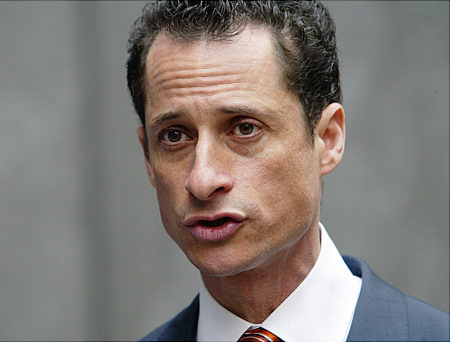
His name is Anthony Weiner. He’s a good man, bold and effective, a strong and smart and well-spoken progressive, and a pain in the ass to the executive branch.
Sexual dalliances NOT exposedSex is no big deal in Washington, but in our post-Victorian prissy country, normal sexual behavior is treated as mortal sin. Bill Clinton was likely sandbagged by Linda Tripp, showing that the National Security State can reach into the highest office to bring a man down. Sexual misbehavior is the most common failing of powerful, narcissist men who tend to be drawn to politics. Sex is, frankly, no big deal. But in DC, sex is one of many tools available to control the behavior of elected officials.
I know – this is paranoid fantasy. Elected officials are not under surveillance, and sting operations are never run for purposes of entrapment. Anthony Wiener’s sexting just happened to be exposed, John Edwards just happened to have a concubine and his activities, as opposed to say, Newt Gingrich’s or George W. Bush’s, were exposed. Senator David Vitter is still in office, but then again, he was exposed by Larry Flynt, known to go after public hypocrites for non-political reasons, and so gets to stay in office.
I am speculating. We do have a super-secret agency that is capable to spying on any one of us. The common assumption here in American-exceptionalism-ville is that even given that kind of power, people don’t use it. Caught, not punishedOf course it would be highly useful to keep tab not on just office holders, but also journalists. They have the ability. Russell Tice worked fro NSA during the Bush Administration, and after that time became a whistle blower. He was fired, of course, and then made public appearances as the one above with Keith Olbermann, and on the Daily Show with Jon Stewart, where I heard him say that the NSA had 24/7 surveillance going on all American journalists.
What followed the Daily Show appearance was silence. Only Olbermann seemed interested, and his MSNBC interview was a mere pebble on the window trying to get our attention. The issue died.
Now, imagine that NSA has unsupervised power to keep watch on every journalist, every office holder, and collect information on them. The most common ‘failing’ of people, men especially, is sexual meandering. Men are by nature sexual polygamists, and we stay in line for two reasons: 1) lack of opportunity, and 2) fear of losing something valuable. Even a man who loves his wife and does not want to hurt or lose her will succumb to opportunity, especially if it appears he will not be caught.
He's going downSo Anthony Weiner was caught sexting a picture of his unit … it’s pretty common, and for an elected official or journalist, kind of stupid. But it’s not evil. It’s not harmful. It’s just sex. A drumbeat is starting up now to remove Weiner from office. He will leave office. That is the whole point. There was no drumbeat when Vitter was exposed. The silence is deafening.
Maybe I’m paranoid in saying that a powerful secret agency that has the ability to spy on powerful people and use that information against them actually does so. But I suggest that not to wonder about that is polloyannish.
I’d like to take this opportunity to ask all liberals and progressives of all stripes, all talk show TV comedy show hosts to do me a favor: Stop complaining about Fox News.
Here’s the deal: Fox News viewers do not go anywhere else for their news. So when Jon Stewart does a particularly funny bit about them, only the people who watch Jon Stewart know about it. Fox viewers never watch the Daily Show, and do not know about the bit, and will not find out about it second-hand. Similarly, when Fox lies or does photo-imagery trickery to misstate the nature of events, the trickery is well exposed among liberals. But it never graces the eyes or ears of Fox viewers. And when Fox does something stupid, as using the image of Tina Fey as they discuss Sarah Palin’s presidential aspirations, Fox viewers don’t recognize Tina, and probably do not even know that the image is not precious Sarah.
So please, let Fox be Fox. They have a captive audience, and know what they are doing. It may appear stupid from the outside looking in, but since the inside never looks beyond that outlet for their world view, it is merely an alternative reality.
I was put into Little Flower Catholic grade school in Billings, Montana, at age six. I also attended Billings Central Catholic High School. My teachers in grade school were Dominican nuns. That order would not normally have come to Billings, but my maternal great aunt, “Sister Faith,” was the Mother Superior of that order, and so had the power to send her foot soldiers our way as a special favor to our family. This is what my mother told me, anyway.
Catholics at that time were protective of their youth. Deep religious indoctrination was a common practice, and thought to be a good thing. It protected us from worldly influences. Our school had its own special bus, even though public school buses were available. They scheduled the school day so that we did not get out at the same time as Garfield, the public school one block away. They did not want us mixing with the public school kids on a daily basis.
It all seems innocent, and the nuns I had for teachers were wonderful people. They had the best of intentions. We were taught that the Catholic faith was the “one true faith,” and that once we became aware of that fact our choices were to stay in the faith or leave the faith and face eternal damnation. There was a real place called “Hell” that had real fire that really burned, forever.
It scared the shit out of us.
Most kids I went to school with are still Catholics. Even as mature adults that fear-based indoctrination resides in our subconscious. Leaving the Catholic faith, which I did at age 38, was stressful. I was afraid that I was going to be punished and that my life might be destroyed. I took a leap of faith, so to speak, to the other side.
As it turns out, the “other” side is a nice place. But I could not know that. Youthful indoctrination kept me in the faith for twenty years after the end of my Catholic education.
That’s a common experience, but perhaps my family was more religious than most, so I got a heavier dose. That lock they had on me – a child’s fear of burning – is extremely powerful. Richard Dawkins has gone so far as to call it child abuse, and I tend to agree, but only to to a degree. Most people who lead the mainstream religious faiths are not bad people. They love their flocks, and recognize the flaw in human nature: The need to follow and obey authority. To the extent that they lead people to better and happier lives, they can be forgiven. To the extent that they use this power to take our money, bugger our children or taint our world outlook to their political liking, they should burn in hell.
All of this leads me to what made me sit down here – thought prisons. Over the past few blogging years I have had numerous encounters with both Democrats and Republicans, and have found the former resolute and certain of their beleifs. Most Republicans are not conflicted by party adherence. Being a Republican appears easy, and these folks generally have no trouble punishing leaders who do not adhere to the faith. Also, they don’t much question the faith. That’s really comfortable.
Democrats are different. They are faced daily with contradiction, as their leaders behave like Republicans even as they talk like Democrats. This creates internal discomfort, or cognitive dissonance. So the party is constantly torn apart by internal dissension. Will Rogers’ lament that he did not belong to an organized party, but was rather a Democrat, hints that this is not a new phenomenon.
If not a Democrat, what am I? I have but two choices. If I leave the party, there is … nothingness, a void, a form of hell without flames. So party faithful are caught in a mind prison not much different than the conflict of the captured Catholic child. Staying is comfortable, but thinking is not allowed. Leaving is scary, and thinking is hard, even painful.
So, to my Democratic friends and enemies alike who continually ask me “If not this, then what?”, I answer “Uncertainty. Can you deal with it?” It’s not easy not belonging, to have to think and judge independently. Abstaining from casting a vote for either party seems nihilistic, but if neither offers anything productive, is that not nihilism as well?
The two-party system is a natural byproduct of money-control of politics, as no third party can amass the resources to gain critical mass and challenge it. But we don’t have to belong. It might appear that outside the two-party system there is nothing. But it is inside the two-party system where nothingness resides. Outside that system is eternal optimism of the spirit coupled with pessimism of the intellect. There is life out here, just as there is life for young Catholics if only they are willing to take a leap of faith, and leave the faith.
Ratco Mladic, the Serbian military officer responsible for the deaths of as many as 8,000 Muslem men in the Bosnian wars of the early 1990’s, has been apprehended. His crimes were committed as NATO and the Clinton administration looked the other way.
Search is still underway for war criminals Donald Rumsfeld, Richard Cheney, Alberto Gonzales, and George W. Bush, thought to be responsible for the deaths of as many as 1,200,000 Muslims. They are suspected of hiding in the United States, a rogue country that is known to harbor war criminals. Tony Blair, also complicit, was last seen living in luxury in Great Britain.