Post hoc, ergo propter hoc

I do not need to instruct most of my readers on the meaning of the Latin phrase used as the title of this piece. For the few uninitiated, post hoc, ergo propter hoc is a phrase used to describe a logical fallacy, one of the most common in use. It translates to “after this, therefore because of this.” Better to illustrate by example rather than ‘splain, John Brown, the man who initiated the beginning of the US Civil War by attacking the weapons storage facility at Harpers Ferry, was supposedly superstitious and guided by stars in the heavens to dictate his moves. If they aligned, he moved. The fallacy here is that stars had anything to do with his movements. That translates to after this, therefore because of this.

I worked on John Brown quite a bit, assisted by Kevin Starr, who added much more. My initial trigger was the fact that the armory at Harper’s Ferry on the night of the attack had but one guard on duty, and was in essence left unguarded. That told me that the event was staged, and that both Northern and Southern elements were in on it. Then we learn that Brown was juiced, part of the British peerage, and that it does not take much sleuthing to realize that his public hanging was staged, and that he walked away. It then logically follows that if the trigger event of the Civil War was staged, that the war itself, while costly in terms of lives and property, was a planned event. Lincoln, who would later fake his death, was in on it as well. The object of the war? Another time, another story. Slavery was part of it, but the driving force was a new kind of union of the states, and a major rewriting of our governing document, the Constitution. Power was transferred from the individual states to a new and powerful federal government.*

Continue reading “Post hoc, ergo propter hoc”

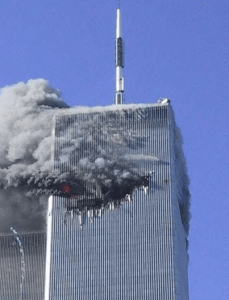
A conversation with AI about 911

AI is programmed to repeat the essential arguments of propaganda surrounding the events of 9/11, and as such is just another Wikipedia, a LOOT, or Lies Of Our Times.

_____________________________________

Me: On 9/11/2001 three jetliners were said to have crashed into the Twin Towers and the Pentagon, and another to have vanished in an old coal mine in Pennsylvania. The latter aside, what we saw on TV, the airliners leaving behind Wiley Coyote-type holes in the building, violates Newton’s Third Law, that every action is met by an equal and opposite reaction, so that the object with the greater mass will prevail, and the aircraft should have been annihilated and left on the streets of Manhattan.

AI: Newton’s Third Law of Motion states that for every action, there is an equal and opposite reaction. This law is universally applicable and is not violated in any physical scenario, including the events of September 11, 2001. The holes formed by the aircraft in the World Trade Center buildings do not violate Newton’s Third Law. When the planes hit the buildings, the planes and the buildings exerted equal and opposite forces on each other. The planes were destroyed due to the high-speed collision, while the buildings, though damaged, did not collapse instantaneously due to their structural integrity and the distribution of the impact force.

Continue reading “A conversation with AI about 911”

Nattering nabobs of negativity

Not too many readers will remember the words in the title above. It is from 1970, and the  words are attributed to Vice President Spiro T. Agnew. He acted as a distractive force for President Nixon, and was dispatched regularly to grab some headlines. The nabobs in question here were the sad lot of pundits known as “journalists”, said to be one of the easiest college degrees to attain.

Natter: To talk continuously for a long time without any particular purpose.

Nabob: An Indian ruler within the Mogul empire; someone of great wealth or importance; a person with a grandiose style or manner.

Agnew certainly did his homework on this one, drawing out two obscure words and making them memorable, so much so that I still remember the quote 54 years later.

Below the fold are some more quotes from the 31 pages I have preserved:

Continue reading “Nattering nabobs of negativity”

A magical Christmas


Christmas is mostly for kids, and I think it is perfectly OK to let their imaginations be filled with Santa and reindeer and chimneys. When my kids were little we had a tradition that lasted for a brief while until some cynical brat ruined it.

We lived in Billings, Montana. It’s a nice town, mostly, and is under what are called the Rims, a long geological formation, part of it seen above, that runs the length of the town. I am told that they formed as waves from an inland sea washed in and out, not unlike Galveston, Texas.

Continue reading “A magical Christmas”

Good Calories, Bad Calories

The above title of this post is also the title of a book published in 2008 by science writer Gary Taubes, full title Good Calories, Bad Calories, Fat, Carbs, and the Controversial Science of Diet and Health.** At 609 pages (counting bibliography and index), I guess we could call it a tome. However, I found it hard to put down.

We had moved to Colorado, and sometime prior to 2011 we went to Boulder to hear Noam Chomsky speak. We got probably the last two tickets and were at the very back of the balcony. I remember it well because I had a hard time squeezing my fat ass into my seat. Some time after that I told my wife that I had to change my eating habits. I had read Taubes’ book, and it made sense to me. Here’s a partial list of the things I gave up:

Pizza, cookies, ice cream, spaghetti (all pastas), bread, beer, pizza, donuts, candy, candy bars, chocolate, potatoes, pizza, onion rings, French fries,  … man I love pizza. Also, many fruits and vegetables have high carbohydrate value. Here’s a link to a site that lists good low-carb fruits and vegetables. Strawberries are always in season at our house. White wine is a safe bet over red.

Continue reading “Good Calories, Bad Calories”

Orgies are vile …

Over the years I have been collecting bits and piece of witty snarks and insightful comments in a file I called “Wit and Wisdom”. I pulled it up last week and found that I had a little over one page of items, meaning I had lost the original. But wait! There were two files by that name, one with a different suffix, and it turned out to be 31 pages. I remember sitting at our dining room table in Bozeman when I first decided I needed a way to save stuff, and putting these gems onto my laptop. That it survived all these years, perhaps twenty or more, is no tribute to my competency, but rather to good luck, nothing more.

I’ve gone over those 31 pages now, and found quite a few items that I am going to repeat here, a few at a time. There’s a lot in there that I would not now take trouble to record, notably Edward Abbey, whose every written word (except some of his fiction, which I found over-the-top) I have read. I also made it a point to read everything written by George Orwell, but he does not turn up very often in this file. I suspect that is because somewhere I have a separate file for him.

Continue reading “Orgies are vile …”

A bad reaction to a minor insult

I put up a comment on Watts Up With That to the effect that Michael Mann’s PhD was premature, and also citing a paper by Nikolov and Zeller stating that there was no heat transfer within our atmosphere even as more CO2 accumulates, as the process is  “adiabatic” which means that the process in our atmosphere and in all of our rocky planets occurring without loss or gain of heat. Global temperatures respond to many forces including insolation and increases and decreases in the planet albedo. I also concluded with the statement that many people, including scientists, “lead with their chin” when they start out their debate by conceding that there is “some” warming caused by CO2 and the GHG effect, that is, green house gases.

Continue reading “A bad reaction to a minor insult”

The Christmas letter …

I came upon the following lines from an obscure source, quoting Horace, among the many legends of ancient literature whom I have not read.

“Parturient montes, nascetur ridiculus mus.”

The line  translates to “Mountains will be in labor, and a ridiculous mouse will be born.” This phrase comes from Horace’s Satires (Book 1, Satire 8) and is often interpreted as a commentary on the disparity between expectations and outcomes. I am plagiarizing that last line starting with “This phrase…”.

Enough of that. It brought to mind a file I used to keep and update that I called “Wit and Wisdom”. I went looking for it, and sure enough it has survived all of the new computers that I have used over the past years. The W&W file is quite voluminous and reflects what I was doing and thinking at any given time. I’ll cite two of scores of quotes:

Continue reading “The Christmas letter …”

Facial exercises

Kevin Starr recently suggested a strong facial resemblances between Earl Holliman (who just died a couple of weeks ago at age 96) and Paul Rudd. I thought there was something in Holliman that looked familiar, so I thought I would run him against the Bokonovsky Brats. But first, Holliman/Rudd:

They eyes, nose, ears, hairline, facial shape and chin all align quite well, but not the mouths. Struck out.

Continue reading “Facial exercises”