
Author: Mark Tokarski
Just a man who likes to read, argue, and occasionally be surprised.
Laugh of the day …
 I’m not going to look this up. I laughed when I heard it, as it is apparently straight news, which makes it even funnier. What I heard was this: “Democratic party organizers have arrived in Madison this weekend.”
I swear – it is not from the Onion.
_______________
Do you suppose they are there to talk them down, urge the protesters to give it up and go home? Are they carrying a message from Obama that says “I said hope for change. I did not say to actually do anything. Now go home!”
Democrats play dirty!
CNN”s Parker-Spitzer last night had interesting coverage of the protests in Madison, Wisconsin. Elliot Spitzer was absent, and in his stead was CNN’s Ali Velshi.
Fourteen Wisconsin Democrats have fled the state rather than face certain passage of of a Republican bill that strips benefits and collective bargain rights from state public employee unions. Their absence means no quorum, and no vote. Velshi was visibly upset about this, and confronted John Nichols, a journalist from the Capital Times, a Madison newspaper. He said that the voters had spoken last year, that there were no surprises going on, and that it was time for the Senators to come back and face the music.

Wisconsin is not facing a budget crisis, which makes all of this even more interesting. They are running short about $150 million, all produced by bills passed by the legislature this year to give tax breaks to businesses and wealthy people. It’s almost as if they are following the Bushies’s game plan, which is to create massive deficits through tax breaks and military spending, and then demand a crackdown on social programs to make up for the resulting deficits. It is all Kabuki theater right now in DC, but this also appears to be Obama’s game.
Anyway, I am proud of the Wisconsin Democrats, as they are playing dirty. They are Democrats, of course, and as I’ve often noted, being a Democrat is much like sitting in the center of a bowl of Jello. Will they fold? Most likely. They are, after all, Democrats.
But their gesture also exposes the lie of the Democrats in DC, 2006-2010, that they could not get anything done due to mean old Republicans. They always had plenty of available weapons, among them the ability to play dirty. They chose not to fight hard. This is because, in my view, the leaders of the Democratic party are complicit with Republican ideals. Up at the top, it’s really only one party.
Democrats, oh Democrats, wherefore are thou Democrats?
 Governor Scott Thompson of Wisconsin has set off huge demonstrations and blowback with his state budget cutbacks. There are throngs of state workers who object to his cuts in benefits, his anti-unionism, and especially his threat to call out the National Guard to disperse the crowd.
In Colorado, Governor John Hickenlooper has proposed similar cuts, but there’s not outrage, no demonstrations, nothing.
 Both Thompson and Hickenlooper are radical right wingers who are afraid to challenge wealth, hold unions and workers in contempt, and are smitten by the anti-gubbmint neurosis so effectively marketed from 1980 forward.
Why is it that one encounters such resistance, the other not? Could it be that Thompson is a Republican, and Hickenlooper a Democrat?
Could it be that Democrats, as usual, are asleep at the wheel when a guy with a “D” after his name holds office?
Of course. Democrats are, after all, the problem.
____________________
PS: Years ago, not too long after Bush took office, Karl Rove talked about building a “permanent Republican majority.” I scoffed a little bit, knowing Republican’s proclivity to self-destruct. Little did I understand back then that the road to that permanent majority was going to be through the Democratic Party. It’s easy to see looking backwards, however. Merely change the “R” to a “D”, put them in office, and they do your work for you while the base sleeps.
Old Pol
 Project Censored’s top censored story of 2009 was the death toll in Iraq, said to be close to 1.2 million dead in the wake of the 2003 invasion. It was a poll done by Opinion Research Business, a British polling group whose results are generally thought to be reliable when they do not contradict official truth. The true number of dead in Iraq will never be known, just as we now only speculate about the casualties of the Vietnam War. It’s considered bad taste – we do not investigate our own crimes. Only those of others.
I’ve been round and round with that at a number of sites over the years, and am familiar with the mindset/reaction that follows. The only research-based studies put forward are by groups like Lancet and ORB, and there are no counter-studies. Instead, there is hostile denial, and accusations that I wear a shiny hat. So all of the research is on one side, and only denial on the other. It is a classic emperor’s new clothes environment.
I’ve long accepted that the death toll is much, much higher than anyone acknowledges. (And note the ease with which hand-over-heart patriots accept lower tolls like only 65,000 or 100,000 – as if that was acceptable!).
But the mechanics are troubling – American bombs are not nearly as accurate as the Pentagon says, and targeting is not only at “combatants,” as in counterinsurgency, the domestic population is the enemy. So death from the sky accounts for quite a bit of carnage. But even Lancet said that such deaths were a minority of the casualties.

[ORB] points out that the logic to this carnage lies in a statistic released by the US military and reported by the Brookings Institute: for the first four years of the occupation the American military sent over 1,000 patrols each day into hostile neighborhoods, looking to capture or kill “insurgents” and “terrorists.” (Since February 2007, the number has increased to nearly 5,000 patrols a day, if we include the Iraqi troops participating in the American surge.) Each patrol invades an average of thirty Iraqi homes a day, with the mission to interrogate, arrest, or kill suspects. In this context, any fighting age man is not just a suspect, but a potentially lethal adversary. Our soldiers are told not to take any chances.
According to US military statistics, again reported by the Brookings Institute, these patrols currently result in just under 3,000 firefights every month, or just under an average of one hundred per day (not counting the additional twenty-five or so involving our Iraqi allies). Thousands of patrols result in thousands of innocent Iraqi deaths and unconscionably brutal detentions.

And then there is the exodus:
Iraqis’ attempts to escape the violence have resulted in a refugee crisis of mammoth proportion. According to the United Nations Refugee Agency and the International Organization for Migration, in 2007 almost 5 million Iraqis had been displaced by violence in their country, the vast majority of which had fled since 2003. Over 2.4 million vacated their homes for safer areas within Iraq, up to 1.5 million were living in Syria, and over 1 million refugees were inhabiting Jordan, Iran, Egypt, Lebanon, Turkey, and Gulf States. Iraq’s refugees, increasing by an average of almost 100,000 every month, have no legal work options in most host states and provinces and are increasingly desperate.
Yet more Iraqis continue to flee their homes than the numbers returning, despite official claims to the contrary. Thousands fleeing say security is as bad as ever, and that to return would be to accept death. Most of those who return are subsequently displaced again.
The underlying tragedy is that those who flee are those who can afford to flee. Iraq’s educated classes are leaving, the professionals, the doctors, civil engineers and other professionals who had turned Iraq into a burgeoning and wealthy country by 1989. If the object of the U.S. attack, 1990 forward, was to return the country to the stone age, then indeed George W. Bush was right: Mission Accomplished.
Comments are opened again
My apologies to Black Flag and Max, but that was just not what I wanted this blog to be. They each have a unique perspective, and each should have his own blog where I can come harass them.
To my other reader, comments are free and open again.
Privatizing Social Security: Holding out raw meat for Wall Street
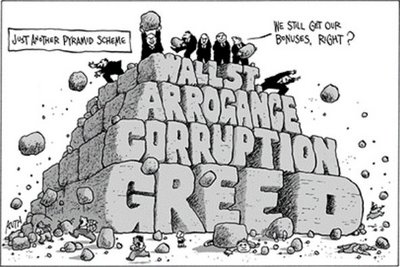 I’ve been reading a paper presented in 1999 by Peter Orszag and Joseph Stiglitz called “Rethinking Pension Reform: Ten Myths About Social Security Systems.” It’s over my head, of course. It deals with five “macroeconomic” and five “microeconomic” myths, and treats the matter of pensions from very high above in addition to ground level.
If I may, I’ll assemble my strawmen right off: The thrust of the far right is the idea that without the link between contributions and individual pension payments, retirement benefits amount to nothing more than welfare. And anytime we give money to non-bankers and non-corporatists (who are immune to corruption), we destroy individual character.
Orszag and Stiglitz deal with the matter with much more subtlety, comparing and contrasting defined benefit versus defined contribution, and equating savings rates under both – that is, defined contribution plans displace savings in one area and replace them in another, but so do defined contribution plans.
The other strawman is the idea that government is too inefficient and corrupt to run a pension plan. Set aside the fact that the American Social Security system negates that contention, and remember the lesson of the recent crash: Government failed to regulate Wall Street, and Wall Street went crazy. If we turn our pension system over the Wall Street, someone is going to have to regulate them. If government is corrupt and inefficient, then we need another mechanism.
Good luck on that.

… even in industrialized economies with relatively efficient governments and well-developed financial markets, the scale of the regulatory challenge should not be underestimated. For example, according to Arthur Levitt, Chairman of the Securities and Exchange Commission in the United States, more than half of all Americans do not know the difference between a stock and a bond; only 12 percent know the difference between a load and no-load mutual fund; only 16 percent say they have a clear understanding of what the Individual Retirement Account is; and only 8 percent say they completely understand the expenses that their mutual funds charge. The investor education and investor protection measures required to ensure that an individual account system operates well despite these knowledge gaps seem substantial.
Take a sophisticated fund salesperson, give him an easy mark, and expect that he will behave. What could possibly go wrong?
Take two examples of countries that experimented with privatizing their public pensions: Chile and the United Kingdom.
An alternative approach would be a decentralized system of individual accounts, in which workers held their accounts with various financial firms and were allowed a broad array of investment options. Under such an approach, costs tend to be significantly higher because of advertising expenses, the loss of economies-of-scale, competitive returns on financial company capital, and various other additional costs. The Advisory Council estimated that administrative costs under such a system would amount to roughly 100 basis points per year. Such costs would, over a 40-year work career, consume about 20 percent of the value of the account accumulated over the career.
Experience from both Chile and the United Kingdom is consistent with these predictions and indicates that a decentralized system of individual accounts involves significant administrative expenses. Both Chile and the United Kingdom have decentralized, privately managed accounts, and administrative costs in both countries have also proven to be surprisingly high. … Taking into account interaction effects, Murthi, Orszag, and Orszag estimate that, on average, between 40 and 45 percent of the value of individual accounts in the U.K. is consumed by various fees and costs. Given the fixed costs associated with individual accounts, furthermore, costs for smaller accounts (e.g., in developing economies with lower levels of GDP per capita) would be even higher relative to the account size if the U.K. experience were replicated in such countries.
There is a drive to privatize Social Security in this country that goes back to 1980, when Reagan took office. When Republicans have tried (Reagan in 1983, Bush in 2005), they have failed miserably. (Reagan parlayed the failure into an opportunity to raise middle and working class taxes, giving us the largest tax increase in history in exchange for that failure. Which of his faces does the right wing want to put on Mount Rushmore?)
Because we live in what is essentially a one-party state, with private corporate wealth financing the “two” parties, the thrust for privatization is two-pronged. On one side, the Republicans brazenly confront the system, and unify support for that system. As seen, that approach is not effective.
On the other side, the “enemy in our camp” approach, Democrats appear to support the current system but are its deadly enemies. By luring supporters to comfort, they can launch a surprise attack from within, and gut the system before opposition crystalizes.
This indeed was the approach that was taken by Bill Clinton, who before leaving in office in 2001 had in place an elaborate plan to privatize Social Security. He was only derailed by the Monica scandal, after which he became the program’s biggest supporter in order to rally support and save his sorry-ass presidency.
Such plans must surely be in the works now with DLC Democrat Obama as under Clinton. Without eternal vigilance (and Democrats are not vigilant when Democrats are in office), the program will not survive, and we will join the Chileans and Brits in seeing our pockets picked while Wall Street lines its own off of our private retirements.
Dissonance central
 February 9, 2011
Memo
From: Mark Tokarski, malcontent, party disloyalist
To: All Democrats, liberals and progressives who will automatically vote for Obama because
eventhoughheisnotsohothe’sbetterthan__fillintheblank__
Please note that House Republicans voted down extension of the USAPATRIOT ACT, and Obama is fighting to keep it in place.
Please adjust your perceptions.
Lying, lying, lying, 24-7. It’s how we live.
Note to reader: This is kind of long. You might want to just skip it and get on with your day.
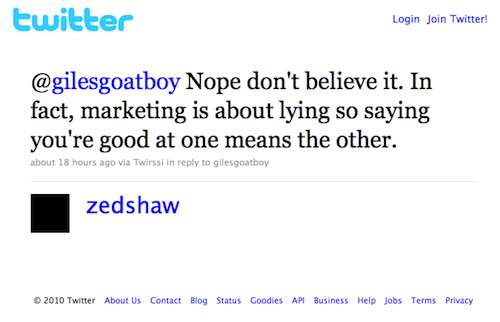
 “Marketing” is lying writ large. Everything around us is a lie in some form. Nothing is ever really on sale, prices are never really reduced, no matter the amount of advertising used to entice us into buying a product. Ultimately, we are ruled by “word barf” documents that we don’t understand when we buy something. There is no negotiating anywhere – if you want a product you sign their contract.
Perhaps the ultimate expression of this idiocy is the contract we are forced to sign merely to use a motel’s Internet service, or worse yet, Apple’s ITunes agreement, over fifty pages long and frequently updated. We are asked if we have read it and agree to it – of course we don’t read it. The exchange is not worth the effort – a very large amount of time expended for a very small service? They know this. Get real.
(Reminds me – we were in Alaska last summer, and were going to fly a puddle jumper across a bay to see some bears. Before embarking, however, we were told to read and sign a waiver – so I actually read it. It said that if anything happened, even if it was due to the pilot’s negligence, they were not liable. Of course, saying that doesn’t mean anything, as they cannot waive their own liability for negligence. Nonetheless, while the guy was not looking, I drew a line through that clause, and initialed it. Then, before we got on the plane, I called my daughter and told her that if anything happened, that I had altered the waiver.)
We’ve been doing some major purchases now and then for our new home. No matter where we go, merchandise is always on sale!!! We looked at couches and recliners at American Furniture Warehouse last November. They were on sale! We picked out some we like, and my wife suggested that we should go ahead and commit to buy, as the sale would end soon. I suggested that there would be another sale after the current one, and sure enough, the fall clearance was followed by inventory reduction by some other nonsense. Now it’s February, so somehow Abe Lincoln and George Washington are going to inspire them to offer yet another sale!!!
In the meantime, the price of the furniture never changed. Their only object is to give us a reason to buy now instead of later. It’s called “the close” – sales people can push and push and push, but the art of selling is to get us to make that decision to jump. To help us along, they put that feeling in our guts that we might miss out on a deal. It is the universal bait. It’s never true. Nothing is ever on sale. It is always a lie.
I needed a windshield replaced up in Bozeman. One company offered a big magnetic ad on the cover of the phone book that offered $100 off, and another was in the Yellow Pages just offering windshields. I priced them both, and it turned out that the $100 coupon actually meant spending more for a windshield! Get outta here!!!

Some are pushy and annoying – Best Buy is higher in price than anyone around, as we learned – a TV that was $560 at Wal-Mart was $900 at Best Buy, “marked down from $1,300,” and “on sale!” Walking in the door at Best Buy we were immediately accosted by sales staff, wanting to “help” us. We repeatedly turned them down. As we later learned, Best Buy’s business model is one-on-one high pressure sales – that’s how they get away with ridiculous prices. Most people act on impulse and don’t shop around, and Best Buy knows this and so is committed to doing everything they can to pressure us into buying before shopping.
But suppose that you do buy an overpriced item at Best Buy and learn that you paid way too much. You can just return it. Right? Wrong. Best Buy charges a 10% “restocking” fee, which is nothing more than a way to keep their “gotcha!” cemented in place. That’s their true business model – the restocking fee. It’s in the word barf contract, but few people know about it.

The best deal going on right now is called “Craigslist.” We needed a good snow plow to live up here on a mountain. I shopped around, learned about them, found out that there are really only two on the market, one sold by Lowe’s, one by Home Depot, that they are remarkably similar, and oddly enough, remarkably similar in price! I decided on the model we needed, and got on Craiglist, and found one that was one year old and used only to plow a cement driveway. We negotiated – that is, he asked a certain price, I countered with another, and we settled in the middle. We both walked away happy.
If it turned out that I bought a defective product, I have no recourse, but oddly, I’ve learned a great deal about the plow, and now know how to disassemble its parts and put it back together to keep it working. It is, after all, in my own best interest, as with Craiglist I know the seller doesn’t give a shit after he gets my money. Merchants only pretend to care.
Craiglist is polluted, of course, by regular merchants masquerading as real people. Even there you have to watch yourself. One product that we have looked and looked for is a home sound system with with a Blue Ray player that will operate on the wireless system. Information is hard to come by and confusing, and there are quite a few products out there that seem to offer something, but don’t. I went to Craigslist, but it’s not the kind of product that turns up there often. (EBay seems almost entirely merchant-driven now.) But I did find one offered, still in the box, and had some emails back and forth with the “owner.” We were almost ready to bite, and so did the one thing that we are not allowed to do with a merchant – offer less than the ask. He wanted $500 – I offered $400. “He” quickly wrote back and said “sorry – we just sold our last two.”
Two? He didn’t say he had two! He sounded like some guy who was getting rid of something he couldn’t use. Turns out he was a merchant, and this was his business model – to pretend to be a regular person. The system he wanted to sell, which “sells for $799 in stores”, actually sells for $500 in stores. No matter the store, it’s $500. $799 is the “manufacturer’s suggested retail price”, which, like Diogenes’ honest man, is something that does not exist here on terra firma.
Buyer beware, everywhere. Craiglist is our best bet these days, and you must understand that regular merchants are offended by it. Investors have tried to buy it, and are infiltrating it. But for now, prior to it being pirated by Best Buy and the others, it is the best place to go for the exchange of goods and services.
One final note – the “rebate.” The concept came into being in the 1970’s, I think. The idea was that manufacturers wanted to unload merchandise, but did not want to undermine their price structure. So they did two transactions – one, to take your money, the other, to give it back. It worked, in no small part due to the fact that people were buying on credit before credit got so easy, so that the rebate was really a loan at a better rate than credit cards offered.
Now, rebates are everywhere. I bought some antifreeze last week, and the shelf-offer was “buy one get one free”, or what I like to think of as “half price”, meaning that the shelf price is twice what it would sell for if there was really any competition around. But what the hell – it doesn’t hurt to have an extra gallon on hand, so I grabbed two and checked out and the price was $21, and I said “wait – it is buyonegetonefree, and the guy said – oh – that’s a rebate offer. I said “My kid will graduate from high school before I see that rebate,” and gave one back. I paid $11 for a $5 product. But it’s really the only choice out there, you know. There’s no antifreeze on Craiglist.
I had an eye exam, and it took a while to find the right set of contact lenses, and during the exam and trial process the eye doctor put in contacts and took them out and threw them away, and I asked if those things don’t cost a bit of money to toss away like that. He kind of shrugged, as if the lenses were free. We did find the right combination, and I bought a bunch of Coopervision contacts for $160, way too much, but it’s a trip into Littleton for a different deal. And, there was a $40 rebate!
Crap, $40 – why not, so I jumped through the hoops, cut the ends off the little boxes, copied the sales slips, filled out the forms and sent it in. I got an email saying they had received the forms. That was last November. I sort of forgot about it, but then checked back a few days ago in my email, and there was a rebate number to check, and so I went to the web site and plugged in the number, and it said that my rebate had been denied. They said I had not presented them with the date of purchase of the lenses or the date of the eye exam.
 That’s bullshit, of course. I gave them both. I kept all my paperwork, as I’m not very trusting. Everything was there, every hoop jumped through. Here’s the business model: Coopervision offers eye doctors a way to generate more business. By offering a rebate, the doctor has room to jack up his price. So ultimately, he is partially the beneficiary of the $40. On their end, Coopervision doesn’t want to mess with fulfillment, and so turns it over to a third party. They don’t actually pay $40 for $40 – it’s something less because Coopervision knows that not everyone who is eligible for a rebate will actually apply for one. And the clearing house knows that if they take a long time to fulfill, that most people will forget. So I would bet that Coopervision is actually paying $10-$20 for each supposed $40 rebate. And this creates an incentive for the fulfillment house to do everything they can to avoid paying the rebate.
So oddly, when I was denied the rebate, they didn’t actually tell me it had been denied, though that would have been extremely easy to do, them having my email address and all. Instead, they put a note on the file, and waited for me to remember that there was some rebate last year, and to check back. It expires here in a week or so, so they are almost home free.
I called the doctor’s office, and told them that there wasn’t any fulfillment going on with the rebate arrangement, and was told that yeah, they get that complaint quite a bit, and tough luck. So next time I go to Littleton, and I hope someday that Eye Consultants of Colorado understand the nature of the annuity – that each customer represents a series of payments over years, and that blowing one customer off is to end that series of payments. A mere $40 claim can cost hundreds of dollars in present value of future cash flows.
Anyway, it was cage rattling time, as I will get my fricking rebate. Here’s the exchange that has ensued:
Me: My rebate (439508933) was rejected even though I carefully jumped through every hoop, so I called my practitioner, and they said many of their customers have this problem, and tough luck. So I told them that they should pay me the $40, and they should deal with you, and that if you make a practice of not honoring rebates, that they should stop dealing with you. I also told them that if they don’t reimburse me the $40, that I am done dealing with them too. See what problems you create? You make people unhappy, and it just spreads around.
Coopervision: Dear Mark Tokarski: Tracking number: 439508933
Mr. Tokarski, we apologize for any bad experience you have with this rebate process. It is not our intension [sic] to make people unhappy. The reason why we have not been able to process your rebate is because our system shows that we did not receive the receipt showing the purchase location, purchase date, eye exam purchase date, and the product(s) purchased.
We are willing to honor your rebate if you could send us a copy of what we are missing. The receipt, along with your name, your complete mailing address, and the Tracking number at the top of this email, may be mailed to:
Rebate Special Services
P.O. Box 540156
El Paso, TX 88554-0156We appreciate your participation in this promotion. If there is anything else we can do to assist you, please contact us at rebates@parago.com. We are always happy to help.
You can also track the status of your rebate, using the Tracking number above, at http://www.coopervisionrebates.com.
Enmanuel
Promotions Customer ServiceMe: I have already jumped through your hoops. I was very careful, copied everything. I know how you operate. Your business model is built on the assumption that people forget. That’s why it takes you months to honor a claim. When someone rattles your cage, you pay. You operate right above the legal line. It’s all highly unethical, but of course legal. Outfits like yours are all over behind the scenes running these little scams. It’s so seedy!
Now pay me the damned rebate and stop prattling about how honorable you are. You’re exposed. Honor the deal and I’ll shut up.
Enmanuel actually read my message, as he used the expression “make people unhappy,” which were my words. But he is just some guy, probably in Mumbai, who is doing his job. The notion that I did not provide them with the information required is what they say to everyone.
It’s only $40, and if I make them mad enough, they might just not pay to be pissy. Because you’ve got to understand that while all of this marketing is going on where we are constantly trying to screw one another, it is very important to be polite.
Aetna pulls out

The health care reform bill was a mixed bag – the insurers mostly got what they wanted: There is no public competition allowed, and there is no regulations on costs. They got a mandate that individuals citizens be forced to buy their products, and only a scintilla of regulation of the quality of coverage offered. In the coming years, their intent is to push us all into expensive and crappy high-deductible high co-pay products.
But there are some parts of the bill that have merit. One is a prohibition against denying coverage to children with preexisting conditions. Another is the elimination of lifetime caps on coverage, and still another that they spend at least 85% of premiums in small-group markets on actual health care.
 And there is another part, one that leaves me a bit confused: Effective in 2014, insurers will not be allowed to deny coverage to anyone based on a preexisting condition. I have not taken that part of the law seriously, as that part of the insurance business model is sacrosanct – in order to be profitable, insurers have to be able to avoid unprofitable clients. So I assumed that there is some way around that, and settled on the idea that in 2014 we who have preexisting conditions would still be rejected coverage, and instead forced into the local exchanges, where adverse selection would create unaffordable premiums. This is what is now happening in the state exchanges where insurers send their rejects.
The devil is in the details. Much of the law was left deliberately vague, with the 2014 regulations to be written by the executive branch. The assumption is that if it is Obama people that write the regs, they will be more charitable than say Romney or Huckabee people. I have no idea why anyone would think that.
Back to Aetna: Here in Colorado, and I assume nationwide, the company is pulling out of the private placement market. They will no longer offer individual policies in Colorado, and those in existence will be terminated on their anniversary dates. Before now, they stopped offering policies to children, and also to small-groups. Now anyone who is not part of a large group need not apply to Aetna.

Anjie Coplin, Aetna’s regional director of communications, did not specify in an email to the Denver Business Journal why the company had decided to end its presence in Colorado’s individual health market.
But she noted that the company will continue to sell large-group plans and dental and life products and said that officials “believe we remain competitive in these markets.”
And in a Dec. 21 letter to the Colorado Division of Insurance, Aetna General Counsel Mary Anderson said that Aetna “can no longer meet the needs of its customers while remaining competitive in the Colorado individual health insurance market.”
And blah blah blah. Read: Delivery of health care interferes with the business model. The problem with for-profit health insurance will not go away. It is not hard to understand. It is “the profit motive.”
4.29% of Colorado residents have been unceremoniously dumped. But thank God we don’t have Canadian-style health care.
 Piece of Mindful