Don’t be shy – choose your category

I am reading Foucalt’s Pendulum, by Umberto Eco. It is a slow walk, as I find my self looking up quotes at the beginning of chapters written in foreign languages, and lots of words that are new to me. For instance, see below, idée fixe, meaning an obsession. I’ll try using that in a sentence later today, and see if it impresses. This morning I came across the following, and am now wondering which of the four listed categories I fall in. Am I a cretin, a fool, a moron or lunatic? I have to be one, as the speaker, Belbo, claims we are all one of them. Or, worse yet, am I a hybrid? Reminds me of the Andy Williams song, What Kind of Fool am I? Honestly, given mistakes I make, and the great certitude I apply, I can only be a maroon, Bugs Bunny’s word for moron.

I transcribed what follows and skipped around, eliminated quotation marks and other punctuation.

Continue reading “Don’t be shy – choose your category”

When you gaze long into the abyss the abyss also gazes into you.

I am no example of freedom of thought, as I came of age when TV first came on the scene, and even though it was black and white and grainy, I was completely invested. Dad fought it, but he was never around to control it, so he left messages behind, called “directives”, which my brother and I scoffed at. One time he monkeyed with the wiring on the set before he left for his private drinking town 115 miles awaay, and I quickly figured out what he had done and fixed it. We never talked about it.

My older brother and I were latchkey kids. Mom had to work to pay the bills so we came home to an empty house and the TV each day. But it was Three Stooges, that sort of thing. One time in the evening we were watching some show about the Revolutionary War, and it showed General Washington in a tent at Valley Forge with a young black soldier, and he was telling him that he should be patient, that things would get better, but only gradually. Mom came marching out of the kitchen and stood in front of the TV and said something like “They are showing people from back then saying words that were written yesterday.” That was memorable, it is called, I know now, “presentism”, and it is everywhere. She had a brain, never really applied it to anything however. These days she would have been in college.
Continue reading “When you gaze long into the abyss the abyss also gazes into you.”

April 1, 1967: Nurnad speaks out

Note to Readers: I had for years heard about a CIA Memo that recommended use of the words “conspiracy theory” in dealing with critics of the Warren Report on the death of President John F. Kennedy. I have printed it in full below. Note that 1) There is no person by the name of Clayton P. Nurnad, author, anywhere on Earth, and 2) the document is dated April 1, 1967, April Fools Day. Further, I learned after writing this post that the document was released by CIA after a Freedom of Information Act request by the New York Times. I regard the newspaper of record to be spooky itself. Taking all of this into account, I conclude that there is nothing to the memo, that it has no impact and no force, and was CIA merely having a laugh at skeptics expense. What a waste of time!

______________________________

Use of the term “conspiracy theory” is in wide circulation now, and was first used in the post-JFK era in 1967 in a CIA memo since made public. The document can be found online, and I have reprinted it below. As used these days, the term gives ordinary people a tool to use to attack smarter people who suffer natural skepticism in the face of official “truth”.  These are generally people who can think properly and who are naturally skeptical. I am not referring to flat earthers or people running around claiming that every other beautiful starlet is a man in drag. I am referring to people who deal with the “truth” of the major events of our times, like JFK/RFK/MLK, 9/11, Covid and on and on, and who are simply skeptical. This is our sin: doubt.

These days the term appears everywhere, and in practical use has the effect as a “thought stopper”. As soon as some clown says “Watcha got there, a conspiracy theory?”, the term “tinfoil hat” makes its way into the conversation, and the skeptical person is cowed into silence by those of lesser intelligence. In other words it is a tool, used by clowns, to prevent smart people from speaking their minds in public. It is simply brilliant.

This morning I took a trip through the 1400-word memo. It was written by Clayton P. Nurnad, and there is no biographical data available on him. Ancestry.com turns up no information on such a person. Forebears.io/surnames, with a database of 31 million names, turns up no Nurnad. Given that, I think it safe to speculate the name is made up, typical of a spook agency. We have no idea who wrote it.

I have underlined various sentences and phrases I found interesting.  I note with interest that:

  1. The document relies on the two-party system and disagreements between them as a real thing, so that it says that Gerald R. Ford, a Republican, would not hold his tongue for sake of Democrats, and likewise Senator Richard Russell, a Democrat vs Republicans. CIA surely knows this to be nothing more than a masquerade.
  2. Further, it states that Oswald was a loner, and so would not /could not be a CIA employee. (Not necessarily that, but this man Oswald, an actor, was a good one.)
  3. Finally, it suggests CIA employ “propaganda assets” to negate and refute critics of the Warren Report. (I do wish this Nurnad guy had named them.)

There’s more than that to digest, of course. But do note that the word “conspiracy” appears only six times, and “conspiracy theorist only once. However, since the time of this memo, the words have become common fodder for those of lamer perceptive abilities to crush detractors by use of the CT meme, and other pejoratives like “tinfoil hats.” Did this memo intend to set off such a parade of num-nuts in charge? I doubt it. That came later. However, while TV and crime and news shows often show conspiracies among Arabs (terrorists), Mexicans (cartels), pedophiles (Epstein), Italians (mobsters), Chinese (everywhere!!!), and on and on, they do maintain the fiction otherwise expressed in the memo, that conspiracy on the large scale would be impossible to conceal in the United States. This I assume because someone would talk, and further that we have a real journalists and a burrowing news media.

A guy with a name like Nurnad surely knows of what he speaks.

Continue reading “April 1, 1967: Nurnad speaks out”

Lies of the eyes

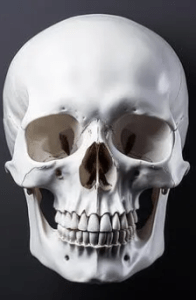
The above is a well-formed human skull. For most of us, this is what we have under our skin by age 20 or so, and will not change for the rest of our lives. Imagine this lies under all our faces.

Note a few things about this skull: The nose cavity is flush with the face, so that the human nose itself, made of flexible cartilage and other stuff, can be altered in appearance. It can be shortened or flattened, or a sharp piece of plastic can be inserted to make it pointier. Plastic surgeons often do this sort of thing.

But understand, the nose itself cannot be moved on the face. Bone structure prevents that.

Note the same with the ears – they too are made of cartilage and other stuff, and can be made smaller or be tucked. But their location on the head cannot be changed.

Most importantly for my purpose here, note the eye sockets. They too are in place by age twenty or so, and do not change throughout our lives*. They will always be in the same place on the head, and the distance between them will remain constant until death. They are, after all, bone material.

Continue reading “Lies of the eyes”

The knockout punch

The older one gets, the more it becomes clear that it is a great mistake not to have been brilliant when very young. Difficult to arrange, I realize, but for the splendid saving of time it is to come into one’s intelligence early! Alexis the Tocqueville, who so handsomely did, is a case very much in point. He was not a traditional genius, at least not at the blazingly-high-IQ-learn-six-languages-while-writing-and-oboe-concerto-at-11-years-old sort of genius. The young Tocqueville was indeed a genius of perception, of the type that Henry James would describe as someone “on whom nothing is lost.” He was a man assailed by perceptions, observations, insights. Where others were confused by the jumble of life about them, he was fascinated by it; where they saw chaos, he perceived patterns. No phenomenon – be it a certain kind of personality, a common thread tying together a group, or the character of an institution – could pass before him without his working his way to a determination of its underlying cause, reason for being, ultimate significance. His was an intelligence organized for almost perpetual intellectual penetration. (Introduction to Democracy in America, by Alexis de Tocqueville, Bantam 2002 edition, by Joseph Epstein. Link to Gutenberg Book 1, Book 2)

Continue reading “The knockout punch”

The Newman Chronicles

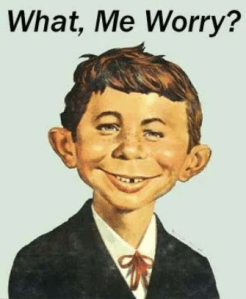
I just clipped and saved the image to the left, and then when I went to download it to this post could not find it. Finally I traced it to a file in my photographs called “Family Photos”, and I was going to move it to another file and then realized, wait, that’s probably the right place for it!

The man in the photo is Alfred E. Newman, a creation of William Gaines, also the man who gave us Mad Magazine. It still exists, part of DC Comics, but, you know, like the Beach Boys, still on tour, it’s not the same as it was. I have just a couple of stories about Mad Magazine, the first of which involves urban legends.

I was led to believe that William Gaines was a talented artist and humorist who could not find employment anywhere in entertainment or publishing because he was Jewish. In fact, his father, Max Gaines, was the publisher of All-American Comics division of DC Comics. In 1947 his father was killed in a motorboat accident on Lake Placid, and so Gaines quit school to take over the family business, EC Comics. He did OK, and otherwise was on his way to a career as a teacher. Instead, he worked in comic books. I find that a nobler profession.

Continue reading “The Newman Chronicles”

2023: A Tambora kind of year

I don’t usually suggest that people drop what they are doing and read something because I read something. That tradition in mind, I am going to link to an article by Javier Vinos. He is author of the book Solving the Climate Puzzle, which I have sitting two feet from me. It is in a stack of books I have read for which I intend to look over Post-It flags and review, maybe even transcribe them.  This, for me, is a memory device. Maybe it helps, maybe not. Vinos has written an article at the Judith Curry website called The 2023 Climate Event Revealed the Greatest Failing of Climate Science.

I do remember from reading the Vinos book about heat transport mechanism that move from the tropics to the poles, primarily the Arctic. When, in winter, there is no sunlight, most of that transported heat is dissipated into space in the form of OLWR, or outgoing long-wave radiation. Climate alarmists have used an assumption called Tropical Hot Spot theory, that the upper troposphere is warming faster than the lower troposphere, and that the lower is warming faster than the surface. This assumption was shown to be without evidence** in a comment on EPA’s repeal of the 2009 Endangerment Finding by Wallace III, MacDougald, and Menton. (Menton, for anyone interested, is also known as the “Manhattan Contrarian“. That is a blog where I am moderated, but not yet banned.)

Continue reading “2023: A Tambora kind of year”

Mercator maps, some Beatles fun

The above image illustrates what is called “Mercator Projection,” created in 1569 and named after Gerardus Mercator (1512-1594). On the right is the standard view we get from flat maps. But true map coordinates are based on a circular globe, so that longitudinal lines approach one another in distance until they meet a the poles. By making them equidistant on a flat map, we distort the size of landmasses closer to the equators. See how, on the map above, Greenland appears larger than Africa.  In reality (unless you are a flat earther, in which case, vamoose!), Africa is fourteen times the size of Greenland. This explains why when we flew to Nairobi last year it took nine hours from Paris. The two places appeared much closer on the map.

The explanation for this is that Mercator projection is more practical for navigation on the high seas, giving better angles … I’m repeating what I read and don’t really get that, but accept it, as Mercator maps are all about and in use.

Continue reading “Mercator maps, some Beatles fun”

The Cave Allegory

“Behold!  human beings living in a sort of underground den, which has a mouth open towards the light and reaching all across the den; they have been here from their childhood, and have their legs and neck chained so that they cannot move, and can only see before them; for the chains are arranged in such a manner as to prevent them from turning round their heads. At a distance above and behind them the light of a fire is blazing, and between the fire in the prisoners there is a raised way; and you will see, if you look, a low wall built along the way, like the screen which marionette players have before them, over which they show the puppets.

I see, he said.

And do you see, I said, men passing along the wall carrying vessels, which appear over the wall; also figures of men and animals, made of wood and stone and various materials; as of the prisoners, as you would expect, are talking, and some of them are silent?

This is a strange image, he said, and they are strange prisoners.

Like ourselves, I replied; and they see only their own shadows, or the shadows of one another, which the buyer throws on the opposite wall of the cave?

True, he said: how could they see anything but the shadows if they were never allowed to move their heads?

And of the objects which are being carried in like manner they would see only the shadows?

Yes he said.

And if they were able to talk with one another, with enough suppose that they were naming what was actually before them?”

The Republic of Plato, Book Seven

Continue reading “The Cave Allegory”

On sheltering in place out of fear of what will happen for not believing in [the] virus[es]

Petra wrote a post in the aftermath of Bondi Beach, obviously knowing the event was fake, but also wondering about the phrase “Shelter in place.” I first saw that phrase in 2020, after the Colorado state government ended the lockdown after 30 days. I did not wonder about it then, but since I had not locked down and had no clue how to shelter myself from something that cannot be seen, tasted, smelled or felt, I ignored that too. Below is a wordy (moi?) comment I left for Petra, our friend and co-conspirator.
Continue reading “On sheltering in place out of fear of what will happen for not believing in [the] virus[es]”