
The above is a screen grab on an iPad, best I can do this morning. I was looking at the photo above, said to be the women of NASA, the so-called “hidden figures.”
Continue reading “Why the sudden emergence of “hidden figures?””
How easy it is to make people believe a lie, and how hard it is to undo that work again! (Mark Twain)

The above is a screen grab on an iPad, best I can do this morning. I was looking at the photo above, said to be the women of NASA, the so-called “hidden figures.”
Continue reading “Why the sudden emergence of “hidden figures?””
There’s a website called Lies are Unbekoming, and it seems to have a following judging by the number of likes and comments the post I am going to refer to generates. The post was brought to my attention by our friend Dave Klausler, who knows me well enough to know I would not be able to leave it alone. The post is called The Replacement: Examining the Evidence that Paul McCartney Died in 1966. In it the author, “Unbekoming”, recycles the evidence that has been churned now for over fifty years. To me, it looks like a reboot, a whole new generation of people being brought into the hoax. This would make Unbekoming an agent, and also makes me wonder if Paul will ever die for real so that they can put this psyop to bed.
Reading through the comments it is plain that people are as naive now as ever about the Beatles, how they came about, how they happened on their music and who played their instruments. It’s innocent chatter, but also shows off the power of a psyop to continually churn through the ages, bringing in new people. As psyops go, it’s a fun one. No one gets hurt. The work behind it showed off great talent in writing the songs, putting together album covers, and even musical references that played to the hoax. Searching for that kind of stuff can be scintillating fun, especially for kids. (No, of course I never did that!)
Continue reading “Paul, would you please goddamn die already?”
To say that what I do is compulsive is akin to saying a Marathon runner really enjoys running. He/she doesn’t enjoy the suffering, I don’t imagine, but feels a need to conquer some madness inside, some burning desire to excel at something that most people don’t think or care about, running. I read a lot, but not compulsively, that is, I feel no urge to complete a book start to finish, and if I don’t like what I’m reading, I set it aside. If I really don’t like what I’m reading, I ceremoniously toss the damned thing in the recycle bin. I would easily drop out of the marathon at mile marker 3.0. I don’t suffer that burning desire, and don’t understand those so motivated.
Anyway, when I encounter a book I like, I shortly thereafter forget its contents. I can actually read it again and it will hit me as brand new. So, long ago, I developed the habit of revisiting a book I liked not too long after finishing it, and transcribing passages I had read and flagged. The idea was that manually typing out those passages would seal them inside my cranium with some permanence. It works! Sort of. These days I use transcription software, so typos abound, often comical, often hard to rectify without going back to the page of the crime.
The book I read recently is called “Can You Catch a Cold?”, Untold History of Human Experiments, by Daniel Roytas. (Video link here, Amazon link here.) I’m not big on credentials, but do note that the author lacks a “Dr.” before or a “PhD” after his name. But that does not matter if the only thing that matters is content. I also note that the book is not indexed, a true defect in my mind. Indexing is a time-consuming but worthy exercise. There are also some annoying typos contained within, not uncommon in this time of self-published works. The “Forward by Dr. Samantha Bailey” helps some, as I like her and her husband Mark, but living on the outside of their chosen fields must be degrading, with the resultant preaching while in exile being more like circle jerking than actually reaching anyone. Nonetheless, truth is where it is found, and I tip my hat to those who labor onward.
All that in mind, I am going to cite a long passage from this book on the Spanish flu of the post-World War I era, as I found it revealing and gripping. Read it too if you can, or not. I seldom follow orders, and when someone tells me I need to read this or that, I usually continue on doing what I am doing without heeding the advice. I made it through high school in that manner, and yes, I missed a lot in the process, but agree with Paul Simon that most of it was crap.
So, if you start to read what follows and then say “Ah, fook this,” I get it.
Have fun! Or not. There is a payoff at the end, so skip there if you want. Or skip it all and go to my own brief observations at the very end, and share your own in the comments. I know of one person, not sure who, claiming that the Spanish Flu was a hoax. I do not believe that. I believe it real, and just as with polio and micro encephalitis and God only know what else, was blamed on a virus as a cover-up. That is, really, the true function of viruses.
“Back in 1820, Felix Walker, who represented North Carolina’s Buncombe County in the U.S. House of Representatives, was determined that his voice be heard on his constituents’ behalf, even though the matter up for debate was irrelevant to Walker’s district and he had little of substance to contribute. To the exasperation of his colleagues, Walker insisted on delivering a long and wearisome “speech for Buncombe.” His persistent—if insignificant—harangue made buncombe (later respelled bunkum) a synonym for meaningless political claptrap and came later to refer to any kind of nonsense.” (Merriam Webster)
“History is more or less bunk.” (Henry Ford)
“The most trusted fact-checking websites on television programs go to some expense to maintain their reputations and are often useful to check on inconsequential urban legends or threats of computer viruses. However, providing many true statements for each ruse, along with disproving false rumors, they also claim to “debunk” (a trigger word to make people believe them) proof of scams perpetrated by specific treacherous corporations.” (The Memoirs of Billy Shears, author unknown).
Con Game: “a swindle involving money, goods, etc, in which the victim’s trust is won by the swindler; a shortened form of confidence game.”
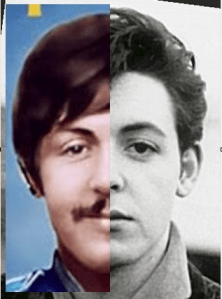 I made it through all 666 pages of the book Memoirs of Billy Shears, by Thomas E. Uharriet some time ago. To the left is a face split between the image on the cover of the book, and a 1957 photo, said to be of Paul McCartney, but actually the one I call Mike. In the book “Billy” claims to have undergone plastic surgery to implant plastic to create the illusion that he looks like “Paul”, or the man we know now as “Macca”. But it appears to me all they have done is take the original Mike and draft an image based on that. I see no plastic sticking out.
The book is written in two voices, that of “Billy”, who claims to have been a studio musician before the death of the original “Paul” on 9/11/1966, to have played in various bands under other names, to be a trained musician who can read music and who has written all of the songs of the Beatles (after 11/22/66) that are not separately attributed to John Lennon, George Harrison, or Ringo Starr. That part is made-up nonsense, but there is an overshadowing of truth admitted to in the time alluded to that came before the fake death on 9/11/66:
NOTE (Page 167): The Beatles’ music will evolve from the most naïve that their writers could imagine to the most liberated. The first hit in America ( being their second in the UK) credited to Lennon-McCartney, though far beyond their writing skills, was Launching the engineered social transformation that sold over 15 million copies worldwide. [MT Note: this must refer to either I Want To Hold Your Hand or She Loves You.]
I remember a few years back when I was doing this kind of work, I would take two subjects and grab ten photos of each, preferably looking at the camera. I would then go to Photoshop with each of the 20 photos and straighten the heads so that the eyes were level. I would then go to Microsoft Paint and adjust the head size of each photo so that the eyes were set at one-inch apart. Then I would construct two files each containing all ten heads for one of the subjects, and then bring in one-half of the face from the other subject, and compare it two the ten in the file in front of me.
That might come off as humorous, but all I can say today is that it brings back memories of neck pain. I have stenosis, so that doing tedious work like this places a strain on my neck. But I persist, as it was only by this kind of tedium that, for instance, I was able to identify Buddy Holly as a set of twins, and then later ID these twins as having morphed into 1) musician Gram Parsons (Birds, Flying Burrito Brothers), and 2) to identify the separate twins has having become a) film and music mogul David Geffen, and b) movie mogul Jeffrey Katzenberg. (See this post.)
Continue reading “Comparison, Astronaut Resnick and Professor Resnick”
I have to wonder, when deeply buried secrets are uncovered, how they got uncovered. Clues Forum years ago revealed that six of the seven Challenger astronauts who supposedly died on January 28, 1986 were still alive and well. I will repeat in this post the facial work I did before, but first want to wonder aloud … how on earth was this discovery made? Who would think to ask? Who would know to do the research, to run down the participants, and expose them to the (cognitive) world?
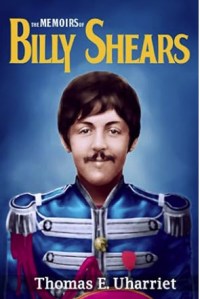 I am reading this book on the presumption that no one else I know will do so. I’ve worked my way up to page 150, and when i say “worked” I mean less than that, as it is both interesting and annoying. It covers the history of the Beatles from a fan’s perspective, one that idolized them and believed in certain aspects of the group that I’ll list below. It’s annoying in that in order for me to believe every word of it, I would have to be quite stupid or, as with a good movie, offer up willing suspension of disbelief. There is no “Billy Shears,” there was no death of the original Paul, and no replacement. There were two Paul’s, identical twins, from the beginning.
In the fall of 1969 radio disc jockey Russell Gibb, WKNR-FM in Detroit, received a phone call from “Tom,” who told him that Paul McCartney had died and had been replaced in 1966 by a lookalike. Thus began a cottage industry that continues to this day, now called “PID”, or Paul is Dead. It is continually churned, new clues added now and then.
It is misdirection, designed to get us asking the wrong question. Paul McCartney was indeed replaced by a virtual lookalike, and I know who the replacement is. It was not hard to discover. If I could do it, so too could all of the sleuths (including Mike Williams, the “Sage of Quay”) who make those PID YouTubes and run those PID web pages. Why don’t they? It is, I suspect, because they are tasked with keeping the mythology alive. They are disinformation agents.
I ask the readers’ indulgence as I work on some aspects of Mike Williams’ work concerning the fictitious person he calls “Billy Shears”, also known as “Bill Shepherd” or “Vivian Stanshall”. The work below is based on the book The Memoirs of Billy Shears, by Thomas E. Uharriet, said to have been born in about 1960 (Ancestry does not give a precise date) and living in Los Angeles. Uharriet has quite a list of books on the market, seen here. Amazon returns a similar list. From this I open the possibility, and only that, that Uharriet is a real person. However, I am skeptical.
Continue reading “Paul McCartney/Billy Shears: Some preliminary work”
Below the fold you will find what was said to be Kurt Vonnegut’s 1997 commencement address to undergrads at MIT. It begins, after an opening quote, with the words “Wear sunscreen.” It closes with “But trust me on the sunscreen.” It is clever and even contains good advice, like “Do one thing every day that scares you” and “Keep your old love letters, throw away your bank statements.”
The original piece, published in June of 1997 in the Chicago Tribune, was unsigned. Mary Schmich of the Tribune later claimed authorship. The whole thing was weird, as the piece went viral as a real Vonnegut commencement address. It seemed unprofessional to allow it to go unsigned and to print it without Vonnegut’s approval. The Tribune is a high profile outlet, so that practical jokes are beneath it. But only later did we learn that Vonnegut had never spoken at MIT. Schmich then tried to contact him to explain the situation, and when they finally spoke he said it was “spooky.”
“Two questions: Why use Vonnegut? And why sunscreen?
 Piece of Mindful