Hiking the Dolomites

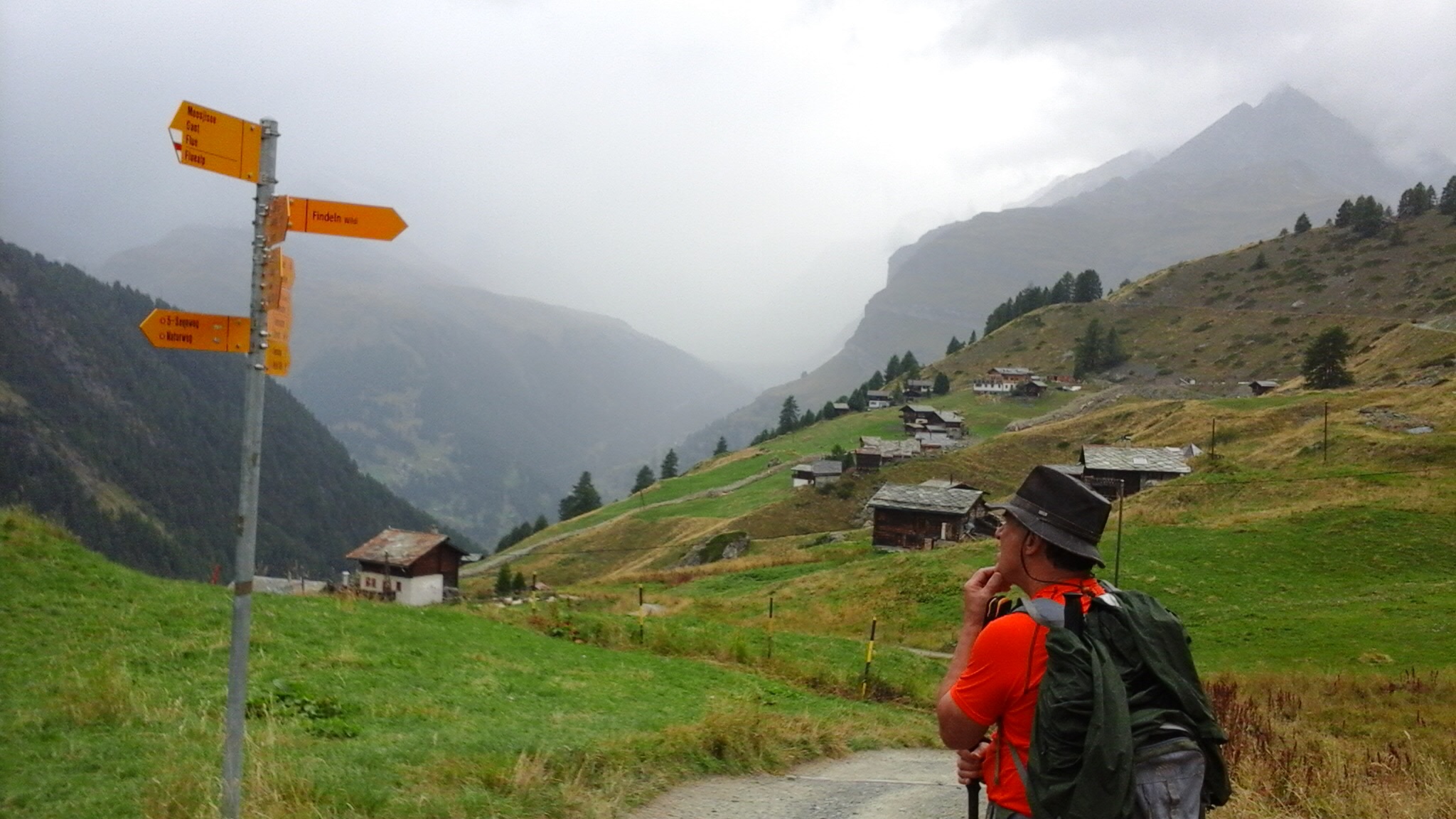
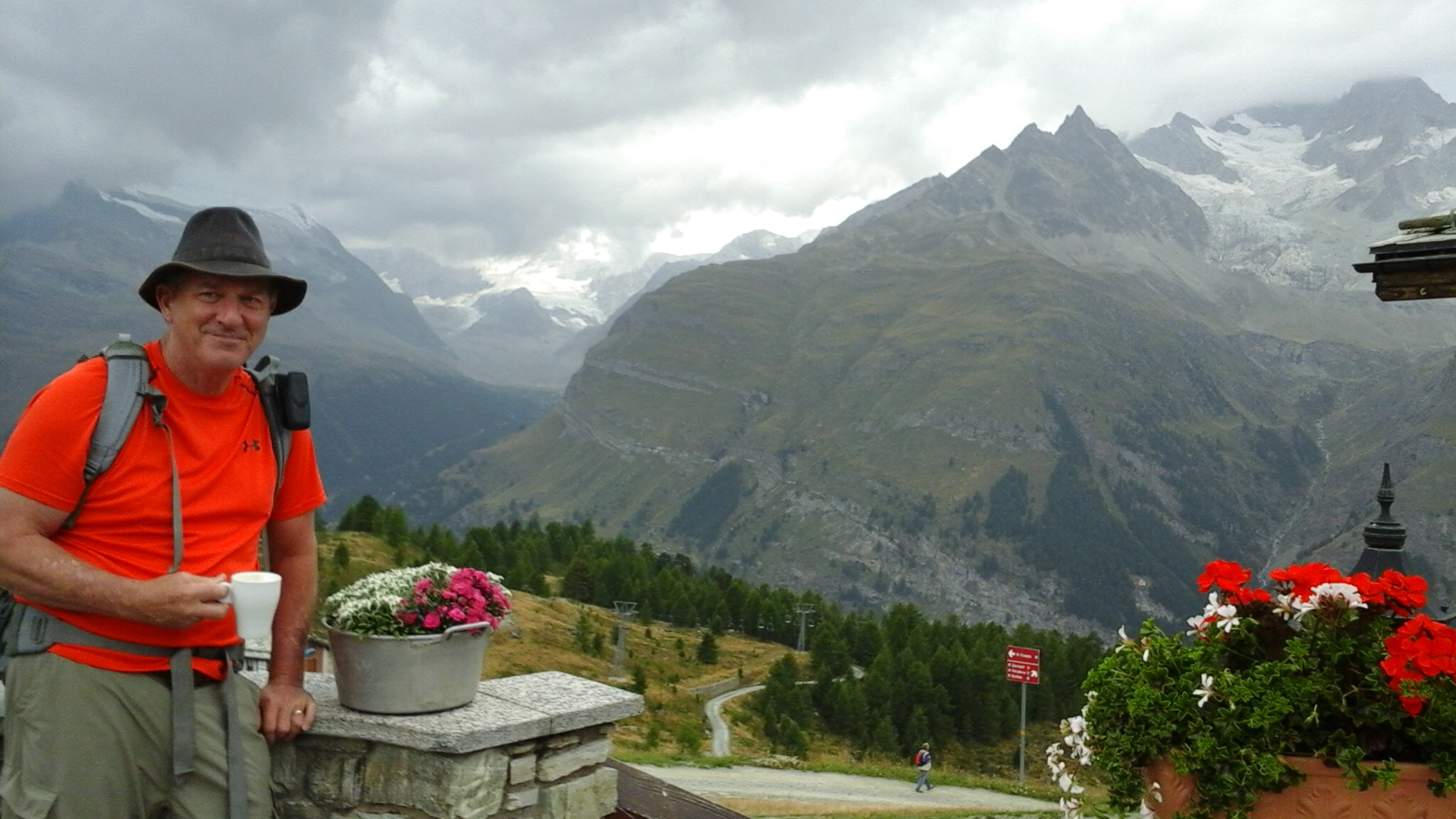
We are hiking across a small portion of the Dolomites, and tonight will be in Cortina again. The hikes are long, many ups and downs, the scenery unforgettable. These are a rock formation of very light material with white peaks and landslides all about. The peaks have a castle-like quality about them, that is, those that are not honed by glaciers. It is all spectacular.

I was thinking yesterday about the distance I’ve come from – as a young guy in his thirties I laid in bed one night and decided I was not only not going to be a Catholic any more, but would not even believe in God. I then did something so simple as to be part of the manifesto of basic human freedoms: I told my kids they were free themselves to believe or not believe, to explore and make up their own minds.

To this day I think it backward and enslaving to demand that kids believe in our God, go to our church, believe as we do. Long before there was a Bible, there was good and evil. The Bible is not a source of goodness as much as a collection of important essays of high literary quality with a smattering of history here and there. Very little of that.

I went through the usual steps after rejecting religion, being angry at what the priests and nuns had done to my young mind, critical of all religion, and highly cynical of the TV preachers and pretentious fools that preach to the rest of us as they live debauched materialistic lives.

And then slowly came around again. I’ll never be a believer as I was brought up to be, but I’ve come to a point where I am not so critical of truly religious people. They may only be hoping, or may be connected to an ethereal communication channel that eludes me. But I remember the words of my brother, a priest, on a camping trip shortly before his death, that there are means of transmitting important truths from generation to generation. Science is one, mythology another. He valued mythology over science. He was not an ignorant or unread man, and knew of the important truths uncovered by science since Galileo.

Anyway, we have a long hike ahead today, mostly a 4,500 foot drop, but it looks gradual. Should be another day lending itself to deep thought. Today I’ll try thinking about football.
Big tent = no substance

James Conner used an expression I have heard often before, “big tent,” which refers to the need to win elections over advancing any ideology. (He uses the opposite, “small tent” to criticize a fellow Democrat.) In theory, it means that politicians have to forge coalitions of people often at odds with one another, the real talent required in that profession, necessitating the art of the well-told lie.

In practice, it opens the floodgates for Republican leadership of both parties. It’s an odd thing to watch, but Democrats are absorbed in partisan sniping based on party name only. The policy pursued by Senator Conrad Burns was vile, the identical policy (with a new name) pursued by Senator Jon Tester is thoughtful, wise, well-considered and only opposed by “purists.”

In the “big tent” there is only one objective, winning elections. Those events are fraught with high emotion, as if life and death were at stake, when in reality either party is bound by financial backers and the corporate-owned media to pursue the same objective, exactly contrary to anything they might have campaigned about.

This system of fake elections goes back in time to the introduction of the mass franchise and use of mass propaganda in the early twentieth century. In theory, everyone’s vote mattered. In reality, voting ceased to matter.

Day seven: Zermatt

image

This was our last full day here so we made the most of it. We took a tunnel tram up the mountain, up to about 8,500 feet, and then walked back to Zermatt, a 3,000 foot drop over about eight miles. It was delightful.

Rain set in in early afternoon, but it is warm and we are equipped for that, so it was not a problem.

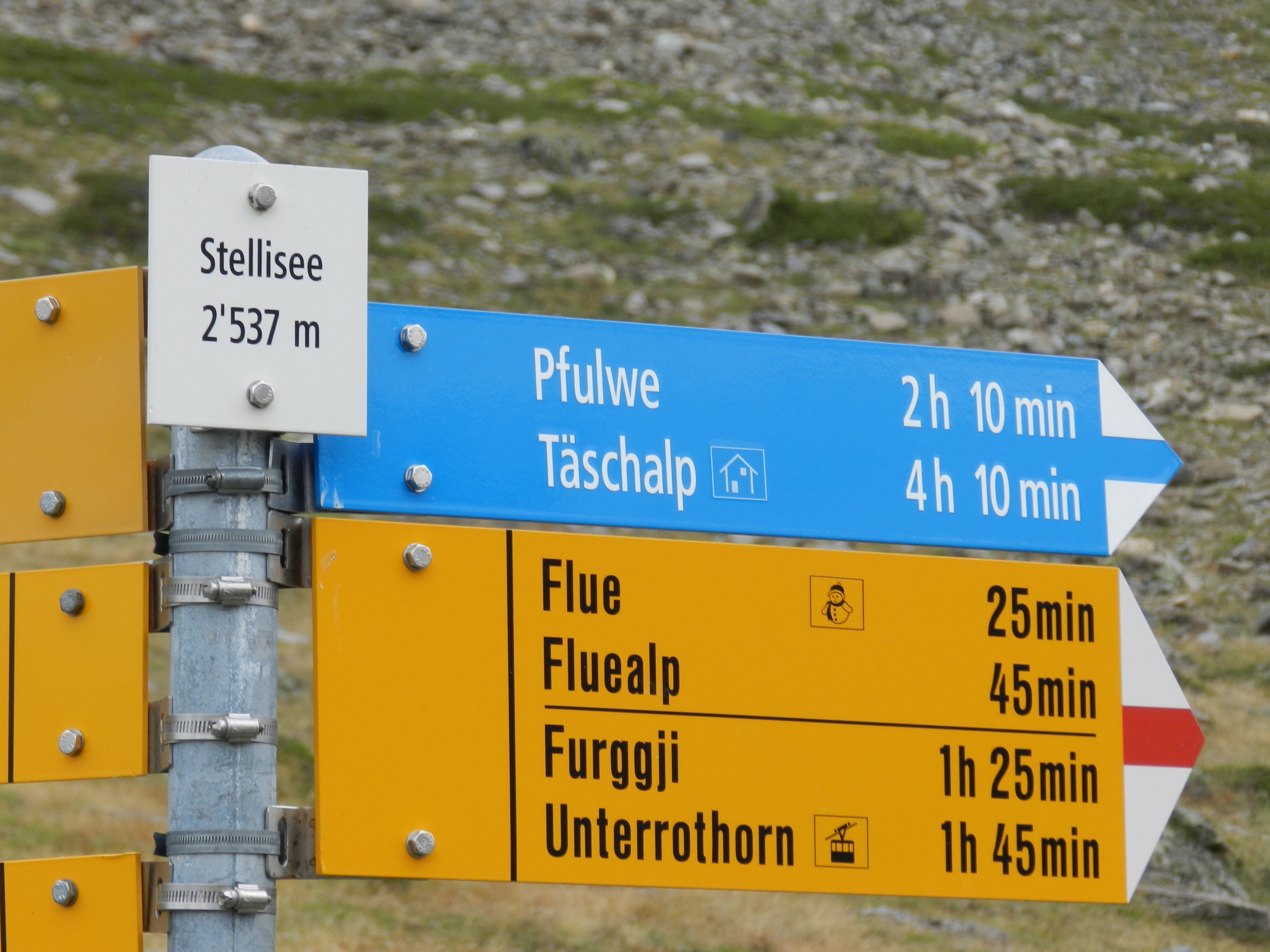
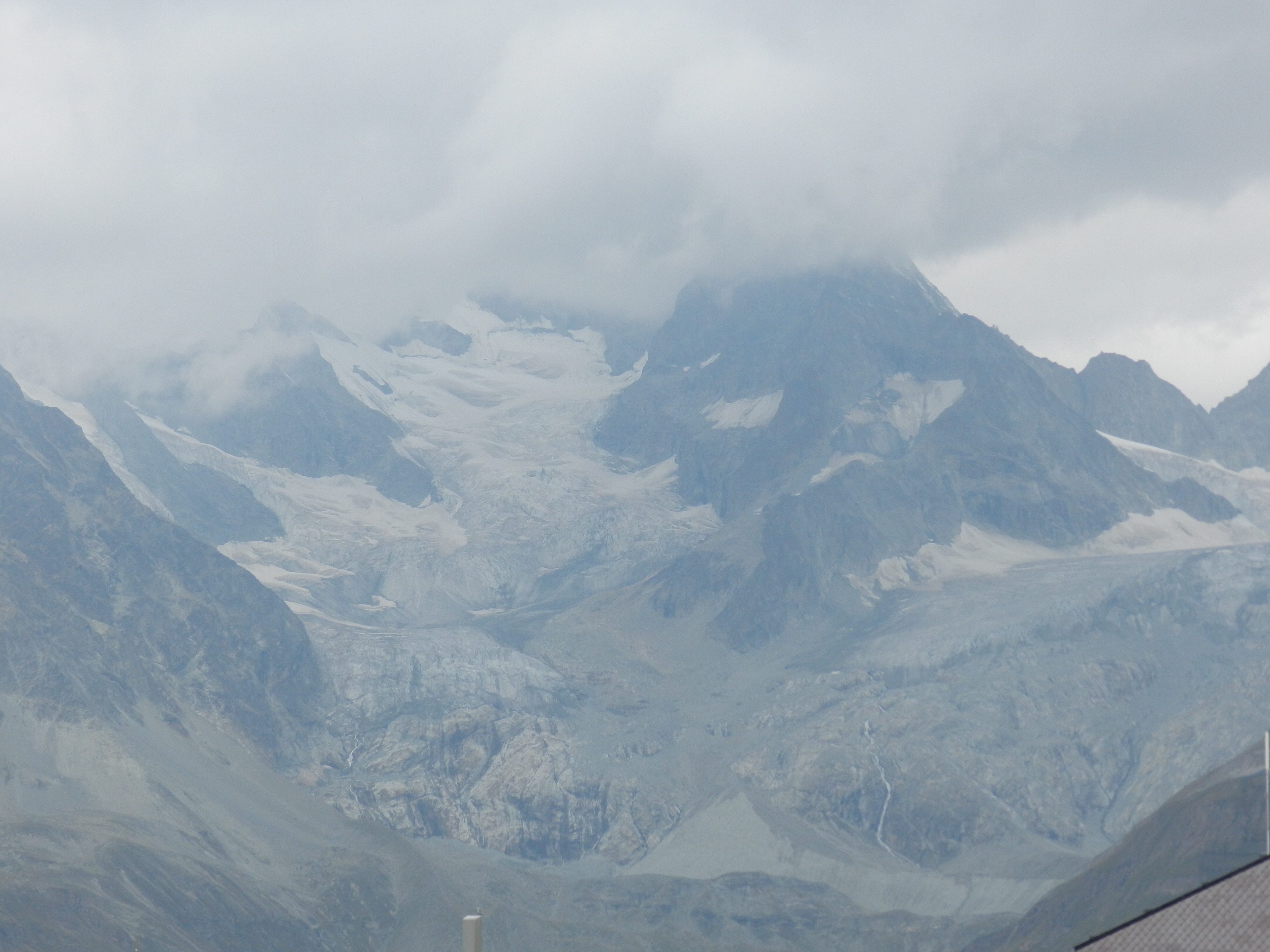
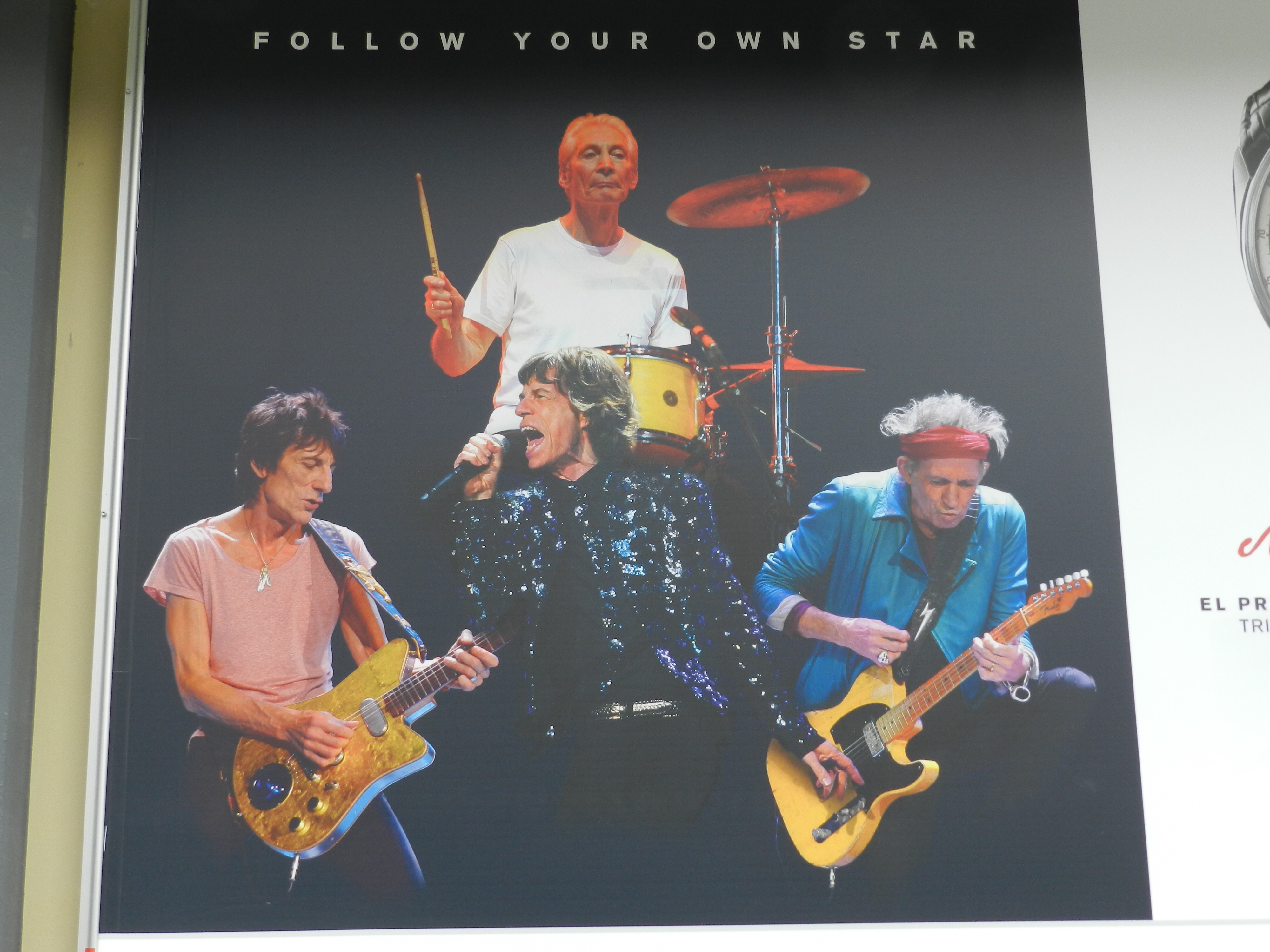
Here are a few photos from yesterday and today:

image

image

image

image

The Stones are as old as the Matterhorn. The poster did not announce any appearances. So must be there for mere inspirational purposes. It was on a display here along with some other performances going on.

Analysis of moral cowardice

I wish to throw down a gauntlet here. I write on this blog for my own benefit, but know that others read it, and also that some of the things I write about nag at the underpinnings of serenity. For instance, only a fool believes the official stories of 9/11 or Boston or JFK, but fools cling to these stories for dear life (even undoing Newton in the process). Why?

William James, a man of clarity, offered up some ideas in this regard. I’ll use him to my advantage.

What I offer here are moral choices. But just as a Shakesperaian tragedy starts out as a small matter, so too do the choices I offer demand a showing of intelligence and character once it is seen that they are not small matters. Not many people are up to it.

James boiled it down to options, 1) living or dead, 2) forced or avoidable, 3) and momentous or trivial.

  1. If I say to you that you should be a Republican or Democrat, it’s a dead issue. Either choice offers the same rewards, primarily group support. But if I say to you that evidence does not support the official story of 9/11, it is live and active and forces you to make a decision that will affect your comfort, acceptance in your group, and faith in your intellectual capacity. No matter your decision, it affects your being.image
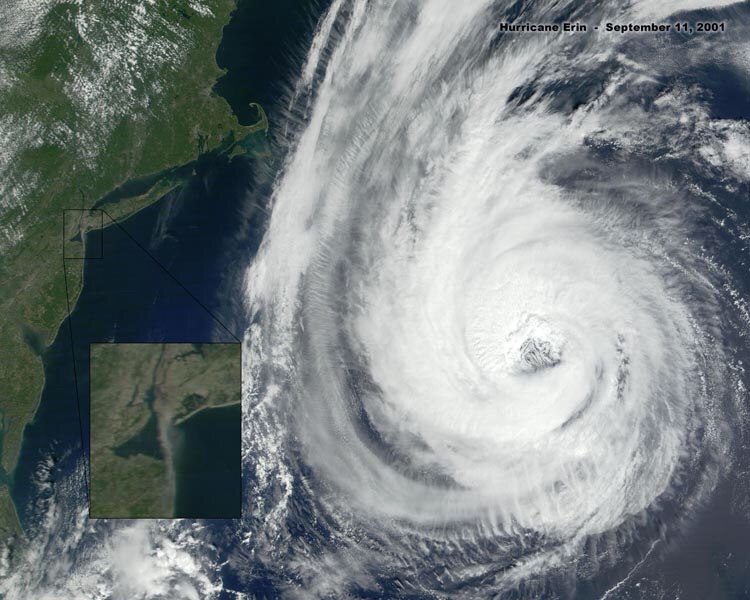
  2. If I say to you “your views on the matter of religious belief should not be kept silent, you can fall on one of many sides, none of which impact your being. You can simply avoid the issue, saying “it is not knowable.” You can decide to become an agnostic, and there are no ramifications. But if I say that there is evidence of a large and unreported hurricane off the shore of Long Island on 9/11, indicating control of weather, preplanning and pre-knowledge of the event among a wide array of government and private power centers, you cannot thereafter avoid knowledge of the hurricane. It was there. It is proven. You are no longer free to be ignorant by someone else’s fault. It’s on you.
  3. You are now placed in a position where you have to make a decision. It is, in regards to your own self esteem, momentous. Knowing of the hurricane and its implications, you can choose to ignore it and continue to believe the official story of events of that day. That is moral cowardice. Or, you can face the reality, and begin to deal with the implications. That is entirely a personal journey, and I have no advice. It’s not for namby-pambies.

It is hard work. people will criticize you, ostracize you, but they will not, because they can not, argue the facts. In choosing that route you will always have this: Honor, and dignity. You chose the hardest path, and we’re not swayed by the opinion of others or lack of faith in your own abilities.

You’ll be a person of character and strength, and one possessed of the trait called moral courage. As Mark Twain reminded us, physical courage is common, but the moral variety a rarity.

Day three: Geneva

imageFinally over jet lag, feeling rested. I really like it here in Geneva even despite the ungodly heat. We took a tram up a few thousand feet over the city yesterday to get a view and hoping to cool down. It was as hot up there as down here.

We did not realize up there that we were in France until we read the signs. Crossing borders here is like crossing state lines in the U.S.

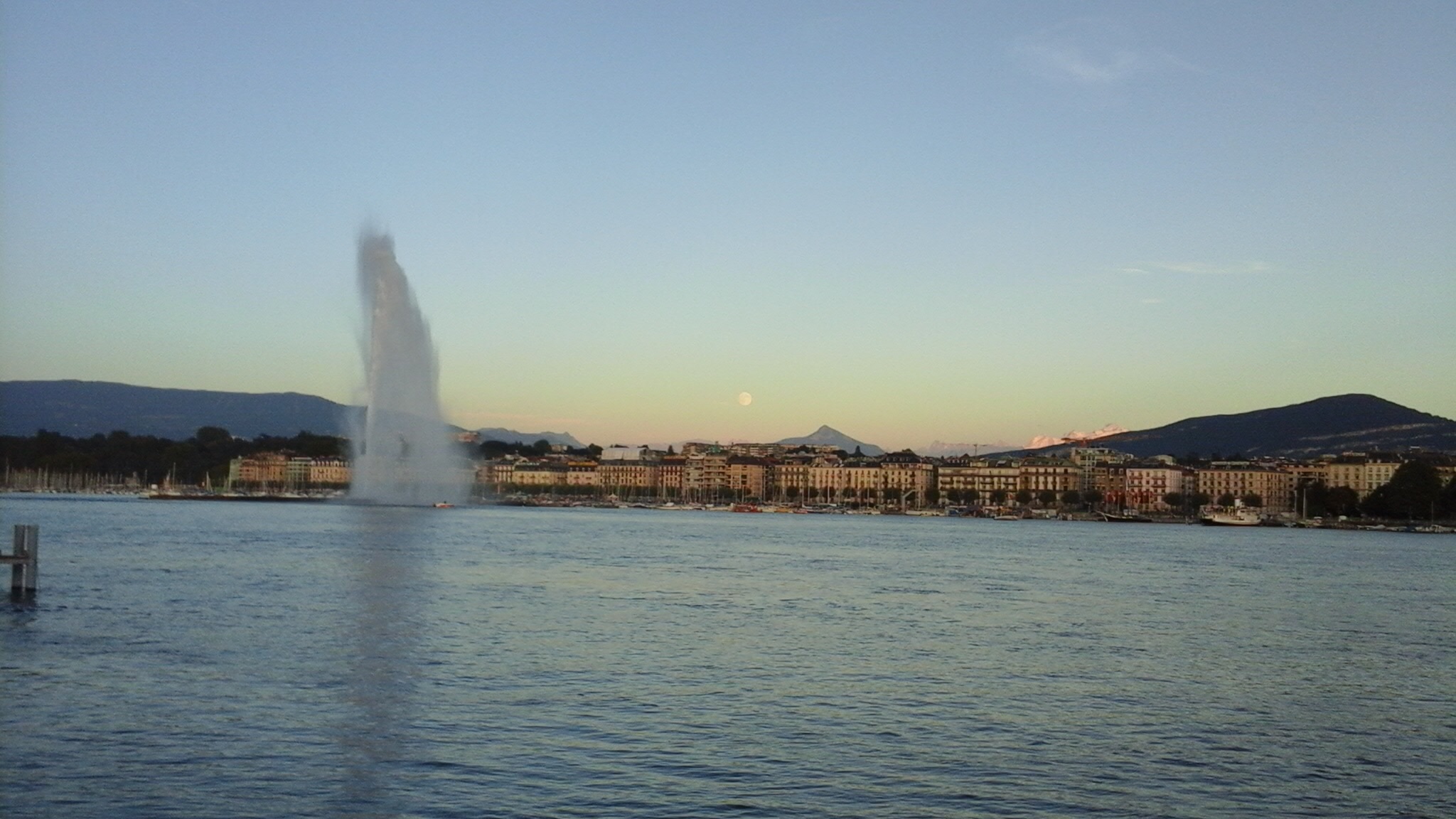
We had dinner last night lakeside. The fountain above is Jet D’eau, and has been on constantly since we arrived. It is a trademark of Geneva, part of the landscape. The photo was taken with a Samsung Galaxy, and needs to be cropped. It does take sharp images, but is hard to zoom.

My own camera is a Nikon Cool Pix, but I cannot at this time move photos from there to this device, as this iPad does not trust the little adaptor that holds the camera card. I use a non-Apple adaptor to convert from the old wide slot to the smaller one on newer devices.

I speak fluent Apple. They want more money.

In the shot above, the full moon was an added bonus, and protruding above the landscape on the right is Mount Blanc, the highest peak on the continent. (It is still illuminated by the sun late in the day.) We hiked about half of the circuit around it several years ago, the beginning of my love affair with this place. It’s a hundred miles around in total, we did about did about fifty I suppose, staying in huts and hotels in the towns around the base. The entire circuit would have taken over a week, and we wanted to see other places too, so we limited that part of our trip to a half-circuit.

There is an annual run around Mt. Blanc, the entire circuit. That’s for the truly ambitious, like my son and his soon-to-be-wife. They run marathons and stuff, and I do not understand them. That doesn’t make any sense!

Yesterday, walking a short distance after taking a tram up Mount Saleve,  my legs were tired and I wondered how in the hell we are going to do our Dolomite hike, thirty steep miles over three days. But the legs come around. There we will be several thousand feet higher, and the heat will not be as oppressive. There will come a day when we have to rest on memories, so we have to make them.

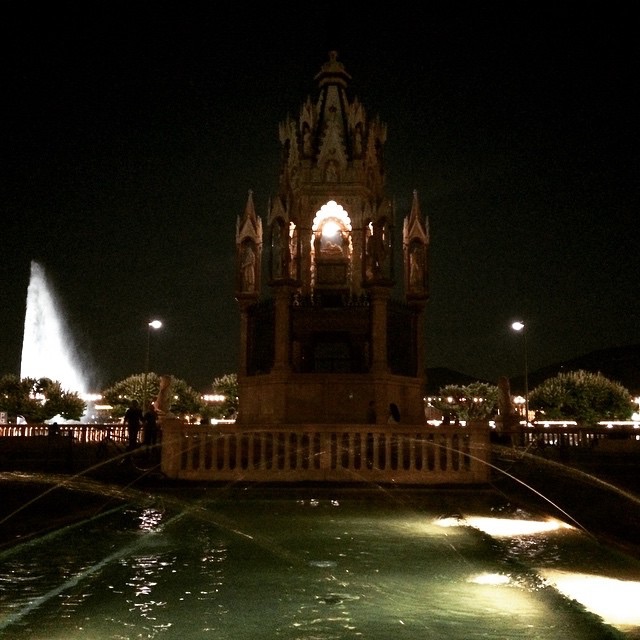
The photo below was taken by our daughter with her iPhone, and seems unremarkable except that the lower part of the light in the center of the monument is the full moon. There was about a six-minute period that the shot was available from our table. I did not bring the Cool Pix to dinner last night, but would have liked to try to capture that event. I forgot the strap and don’t like carrying it in my hand.

Little things. I suppose I should buy an Apple or Nikon camera strap, complete with logo. What are they – like $250?
image

Day two: Geneva

imageIt is 4:30 am here (8:30 pm Denver). We decided to spend a few days in Geneva to  spend time with our daughter, who works here. It is a good time to relax and acclimate. She could not get much time off, but has been generous with the time she has.

Last night she took us to a local wine and cheese gathering a short walk away. It was crowded, and the average age was probably 30. She navigates easily. She stood in line to get us our wine glasses and a bottle of Swiss sauvignon blanc. We then wandered around until we found some clear space, she set the bottle on the ground after the pour, saying this is how you do it. We stood and chatted for a long time until space opened up on a short retaining wall nearby.

I decided to dive in, broach the language barrier, and so found a cheese table, and by adroit pointing managed to secure two excellent samples, one sloppy like a sauce, the other hard and coated with delicious herbs and spices. I do not know their names. I then went to a bread booth and said “baguette!” However, it turned out to be brittle and hard to eat, so I went back and again by use of pointing finger, got something more chewable.

We were going to go out for dinner, but had our fill of bread and cheese. After maybe ninety minutes, daughter introduced us to one of her friends, and we left them to enjoy the rest of their evening.

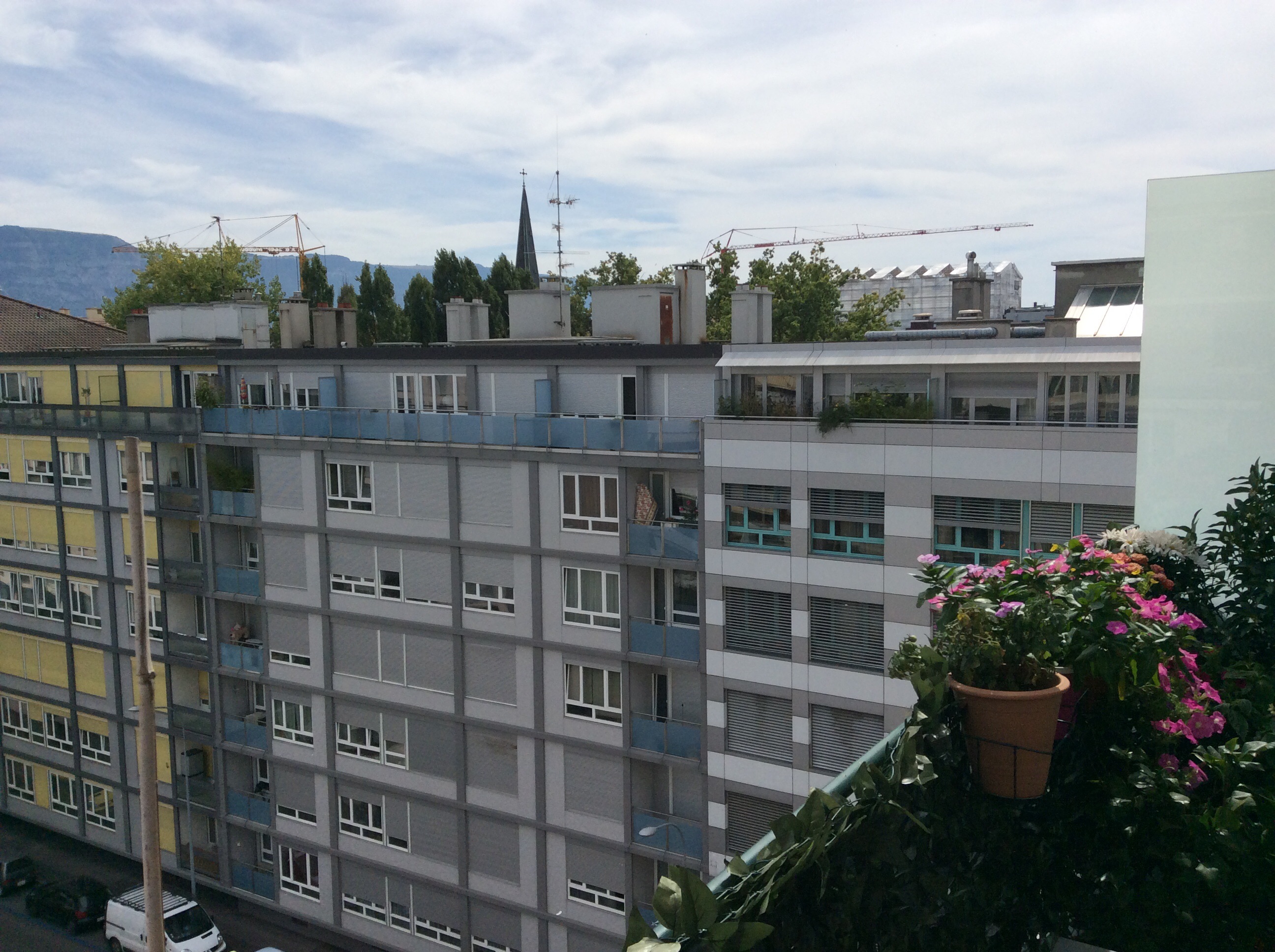
We are staying in a small apartment we got via Airbnb.com, a great way to travel. It is a sixth story flat that has three rooms and a small balcony. There is no view to speak of, ergo the photo above. Lodging is very expensive in this city, so people make the most of small spaces. This place, owned by a single woman, is lovely and has everything we need, and no microwave.

Our daughter’s work takes her to various places – without getting into specifics, she taught us last night about the Geneva Accords and how they came about. Geneva itself was taken over by Napoleonic France in another century, but achieved independence after that and has become a center for international organizations. The UN has a substantial plaza here. The dominant language is French,

The altitude is about 1,200 feet even as it sits at the base of the Alps and Jura. Lake Geneva flows “back” into the Rhone at the outlet, meaning the headwaters are further up. If there is a climate of comparison in my limited experience, it would be the low-lying areas of Northwestern Montana, mountainous but brutally hot in the summer, and offering a great growing climate. The Swiss wine industry, small compared to other areas, is centered here.

Today we are on our own and so will purchase a transportation pass and see as much of the city as we can. We will jump off a twenty-foot bridge and into the lake later on today. After hitting the water, we drift down the lake to a place where we get out, get a glass of wine, and wander back for another jump. This will be the extent of our physical challenges this beautiful day.

Day one: Geneva

Our flight was uneventful, Denver to Washington to Geneva. I have gotten used to the long overseas flights, so times goes fast. We had but one bit of unpleasantness – a woman behind was was a non-stop talker. Even as the lights were dimmed and people had their blind folds and head phones on, she rattled on. I turned my music up and could still hear her voice, so decided I would do everyone a favor. I turned to her, one aisle over and behind me, gently placed my hand on her knee, and gave her the “shhhh.” I tried not to be obnoxious or overly assertive. She looked at me like I had a booger.

It reminded me, and this is oddly enough true: Non-stop talkers usually do not know they talk as much as they do. She rattled on for a while longer, and then stopped, I think. I did fall asleep.

It is easy to travel in Europe – their cities and towns are well-suited for buses and trains. Here in Geneva we will spend ten francs (about $10) for a pass that gets us on all local trains, buses, and boats over the lake to the other part of the city for the whole day.

But we’re tired today – I am going to take a short nap and then try to stay up until nine or ten this evening (Denver is eight hours behind us). I hope to be over the time difference tomorrow morning. We are here to visit a daughter, so that we won’t be hiking, but swimming is appealing – Lake Geneva is very inviting. It is in the 90’s here, so water in the shallows is very comfortable.

Something I have noticed about European cities … well several things. The people are attractive – mixed races and all, deep rich black to Swedish pale, but all thin and fit. Restaurant portions are small here. People eat less. Liquor is available everywhere, but people buy single cans of beer rather than six or twelve. Wine is inexpensive and very good. They are not so uptight about booze as in the states, where even I get carded by the overzealous behavior police. No doubt there are people here who drink too much, but if there is a problem, it is hidden from view.

And police are rare. I am yet to see a cop car. There were no swinging night sticks at the airport. The U.S. over the years, due to agitprop and fear, has developed into a police state. It is not unusual in Denver to see three or four cop cars arresting one person. As Ferguson learned, if there is potential for civil uprising, the cops are militarized.

Maybe they are just kept out it sight here, but I do not see police anywhere.

And now for something completely different …

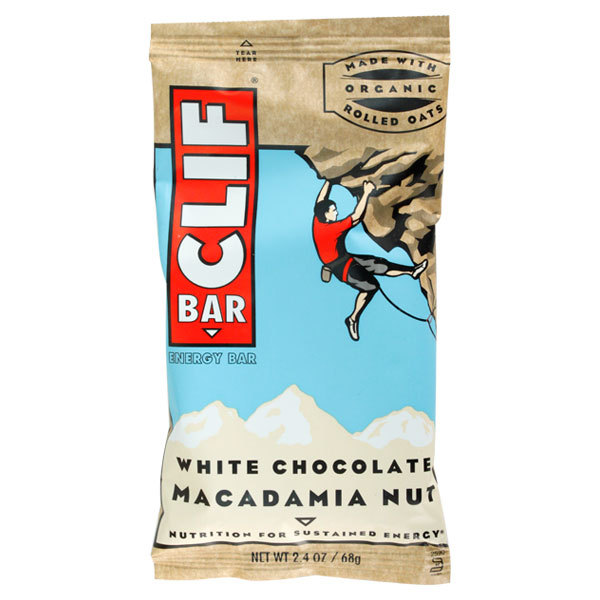
Clifsnickers-fun-size-candy-bars-127643-wWe usually keep a Clif bar on our kitchen counter, and I grab a nibble several times during the day. I do not like them, but we don’t keep other candies around, so that’s what it has to be. I live by house rules.

If you put a Clif Bar on a shelf and let it just sit there, it might eventually go good on you.

So I was asked yesterday to pick up some Clif Bars at the grocery store. I could not find them in the candy section. A clerk pointed me to another aisle where Clif Bars are sold under a sign that reads “Health and Nutrition.” Yikes!

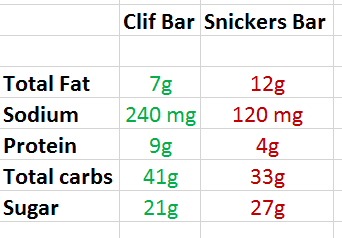
Clif Bars are just a not-very-good candy. My favorite candy is Snickers. Let’s do a side-by-side comparison:

CandyFat and sodium are non-issues. Dietary fat, no matter the source (animal or vegetable) is good for us. Sodium, for some people who are at risk, can be a bad thing, but salt has largely been decriminalized. Protein, like fat, is harmless, essential to our bodies. It is abundant, found in all meats, some vegetables, and fricking tofu.

The key here is “carbs,” or carbohydrates. Carbs from sugar, which are “simple,” are the main culprits in the American diet. Candy, soda pop and fruit juices are the main delivery vehicles.  But “complex” carbs, found in bread and pasta, pizza and french fries, are equally bad for us. Our bodies take longer to digest complex carbs, but in the end they are just another form of sugar.

Overloading on carbs, as Americans tend to do,  causes our bodies to produce a hormone called insulin. It is insulin that is makes Americans gain weight. It signals the body to store body fat rather than letting it (stated delicately) pass through.

The Clif Bar, an inedible hunk of complex and simple carbs, has more protein than a Snickers Bar, which is what makes it so disgusting. It also has non-digestible fiber, in current vogue thought to be good, but not. These two ingredients allow the makers of Clif Bars to pretend that their product is not just a bad form of candy.

The Snickers bar is an honest treat, tasty, satisfying the craving for sweets, and loading our system with sugar. It does not pretend to be good for us. We need to be moderate about eating Snickers Bars. (They are especially tempting in bit-size pieces, as we tend to eat more that way. Marketers know that too.)

The Clif Bar loads our system with sugar, but by moving it from the candy aisle to a different part of the store, the advertisers changed our perceptions. It is just a tasteless disgusting candy bar, but one found in the backpack of every hiker.

Ah, marketers, you fooled us yet again.

The Bernie riddle, another angle

A commenter makes the point that Bernie could be running merely to bring progressives back into the system after having dropped off the voting roles during the eight years of Obama’s right winging it. Bernie gets them to register, and then they will be available to vote for Hillary after he drops out.

Could be. What do I know?

Kids – stay out of school and learn!

We are on Thunder Bay Beach on Georgian Bay, the southern part of Lake Huron. I have been here a week now with my wife’s family. I realized yesterday and last night that this is my family too. I love them all, even with all their faults and foibles (which are not as pronounced as mine). They are lively and energetic, even if they don’t delve into the mysteries of life as I do. I am the weird one, but they accept me without question. As long as I can play cards and whip up some breakfast, I fit in.

I remembered back when my son’s teacher wanted him tested for ADD, a disease invented to help teachers deal with the problem of bright kids. I fought them. He was in a Catholic school but they were going to send him to the big school district in Billings for testing. I did an end run and paid $300 for a doctor at the Children’s Clinic to test him. I did not have $300. The doctor was kind enough to let me pay him $50 a month for six months.

The verdict? “The kid is bored!” The school’s answer was to set him aside to do some more challenging reading when other kids were … I don’t know … doing easy reading? The real answer, which I did not see at the time, was to get him out of his desk, out into the world, to let him explore. Sitting in a desk is the problem. Sitting, under control, bored, thinking it important to internalize boredom and be a good factory worker … that is the point of industrialized schooling.

Standardized testing (and our overlords surely must know this) is about answering questions. Learning, on the other hand, is about asking questions. It does not matter if the answers are found. Searching is far more important. To ask a question is the key.

The most important answers are never found. Is there an Atlantis? A God? A God particle? What happened to the Pueblo tribe? Why do dogs know when we are angry, even when we try to hide it? Who killed JFK? How exactly does money control politicians? Why are journalists not curious about important matters? Why is there not one identifiable part from four supposed plane crashes? Why do people hide and pretend that there are no conspiracies? How can they be that blind? How does television control our perceptions?

Over the years I have taken countless tests, studied, done my homework, but haven’t learned much. That part of “education” is rote and pointless. Asking questions just about the JFK murder, for example, has led me to question everything I see and hear. My sense of wonder and curiosity never leaves me. Life is a beautiful mystery.

My advice to youth: Quit school. It’ll ruin you. You’ll end up like your teacher, thinking you are educated, not realizing you’re just another brick in the wall.