Look here. Not there.

I am having a bit of a chuckle here this morning as I read the Western media from my perch in Italy. The manipulation is so clear! It is classic “look here, not there” journalism. At the center of everyone’s concern now is the Syrian refugee crisis.

Why?

Well, for one thing, it’s a nice distraction, and a good framework for blaming the enemy of the day, currently the Russians. Consequently, we get to wring our hands, see bodies and bombed out neighborhoods.

The media could easily have show photos of bodies and neighborhoods in Iraq, Libya, Somalia, Lebanon, but did not. They could talk about millions of refugees from those countries bombed by the U.S. and its agents, but they don’t. Do not look there! Look here.

Who is bombing out the neighborhoods, killing the children? The U.S. and it’s agents. Why? What has Syria, the Assad government done, to warrant such a bloody attack?

Nothing. Just like Iraq, just like Libya, nothing. It is aggressive war. It is a contemptible crime of the highest order, the type of crime for which toes twitched at the end of ropes at Nuremberg. It is the U.S. and it’s agents at work. Again.

But now our controlled media says “Oh the carnage! Oh, the humanity!” The hypocrisy is of historic proportion.

Why? Please answer, any one of you foreign policy experts, especially those of you who think party politics has any influence in these matters. Why?

Silence. If you are suddenly concerned about the refugee crisis in Syria, but blissfully unaware of the cause, and if you are not aware of similar and much larger crises among Palestinians and Kurds, Iraqis and Libyans and soon enough Yemenis, please be silent. I will know by the lack of comments below who you are.

Have fun, but use protection

I write about certain matters as if I am on common ground with readers. Perhaps not. Perhaps we need to define the nature of the “sociopath.”

Such a person is not “mentally ill.” Being in such a state of existence merely allows them to view life from a different pedestal. But they are interesting to observe. Sociopaths are a minority among us, perhaps 2% of the population. I’ve heard more, and that the U.S. has a larger percentage due to our being a seeded colony, the mother country dumping its problems. (Australia should then exhibit the same tendency, no?)

They do not experience the same emotions as we do. They do not “fall in love” as we do, though they certainly experience sexual needs. From a young age, as they try to find their place in the world, they learn the art of imitation. As they are a small minority in our population, they need to fit in, and to do this, they must pretend that they are like us.

The common thought is that such people become killers, soldiers, criminals. But they enjoy running free, as we all do, and penalties are severe. Just like everyone, they hate jail.

They need to find a place where they can pursue their own joys in life, which are not like ours, and avoid punishment. Even better, they need a world where their unique traits are rewarded. The natural path for them is the business world. Their specialty is the game, the deal, constructing elaborate traps, and springing them. The springing of the trap is their ultimate pleasure. Business + sociopath = nirvana.

The latest incarnation of Sherlock Holmes, the excellent portrayal by Benedict Cumberbatch, describes himself as a “high-functioning” sociopath. We are seeing more and more acknowledgement of sociopaths in entertainment. But it is important to know that most are not “high functioning.” Like all of us, they come in gradations, most of them average. Most probably lack self-awareness, and merely survive.

The two most likely places to encounter them are in the market for love, and on the job.

In love, a sociopath will often engage in heavy courting, the object of which is a conquest perhaps, maybe access to money and property. They have families, but their relationship with their children is above my pay grade. The Bush and Kennedy families are case studies for advanced degrees, in my view.

On the job, the sociopath will build a nest, and protect it. S/he will see potential enemies, and engage in preventive war. Traps will be set. Sex might occur, later to be used as weapons to force compromise or allow advancement.  Such people often work their way into positions of authority over others, and it is hard to fathom as there is no distinguishable talent there. But that is the nature of the game. It is part of the reason why there are so many incompetent bosses out there.

The further up one progresses in the business world, the more financial success  encountered, and the more sociopaths. It truly is a world for predators.

I tend to think of them as adaptations. In our tribal past, I can see a need for the heartless killer who has command of others, who orders the village next door to be wiped out, a surprise attack at dawn, carnage. The reward: preservation of the gene pool.

I’ve read a few works on the subject, but not enough to be anything more than a sponge. I wonder about that faction within the Meyers-Briggs pop psychological grouping called the “ISTJ,” introverted, sensing without the ability for abstract thought, [tough minded], and able to command respect and organize the activities of others. Stalin was, I read, ISTJ. That is, however, highly oversimplified. (The popular book outlining all of this is “Please Understand Me.”)

Martha Stout of Harvard wrote “The Sociopath Next Door.“There is also Robert D. Hare, “Without Conscience.” Jon Ronson has “The Psychopath Test.”  Those are just the ones I have read. There are many others.

Popular works of fiction like “No Country for Old Men” and “The Talented Mr. Ripley” are about sociopaths. Oddly, Hannibal Lecter does not really fit the bill, nor does Charles Manson, a deer in the headlights. TV’s Dexter is a weak portrayal, as the man is devoted to his family and even falls in love, albeit with other killers.

In real life, Bernie Madoff is obviously one, and George H.W. Bush and Donald Trump certainly exhibit symptoms. George W. Bush tortured animals as a child. People like Bill Gates and Steve Jobs exhibit emotional shallowness coupled with highly developed business skills.

The only useful outcome of this knowledge is self-protection. Here’s are a few clues to watch out for:

  • Intense courtship behavior, unrelenting and overwhelming attention, followed by indifference.
  • Emotional shallowness, that is, the ability to imitate feelings, but not really very well. Something is missing.
  • Setting and springing traps.
  • Sexual appeal – for reasons unknown, male sociopaths often have a mating advantage over the rest of us. Life and people are complex. Women say they want a kind man, but are as often drawn to the cold and calculating ones. Male sociopaths often have a long list of sexual conquests.
  • Invention of outrageous lies about their past.
  • Cruelty to animals.

Other and better lists exist. Those are drawn from my own experiences.

Do have fun! Use protection.

Comment with photos

The comment below printed but the photos did not at Reptile Dysfunction. So I print it here. People who would not look at the photos anyway can now avoid coming here to see them.
____________________
Steve, you can slap them in the face with evidence, which I will do one time here, and they won’t (can’t) look at it. They take solace in ridicule. Our crime, the thing that makes us “conspiracy theorists” is thinking. if this were the 1600’s we’d be labeled witches, in the `1700’s jailed as Quakers, in the 1950’s and 60’s we’d be labeled “communists.” Americans historically hate people who think.

The photo below is a thermal image of Ground Zero with some overlay showing the actual size of the buildings compared to what was left that day. Normally a demolition leaves about 13% of the original size in debris, so that the rubble should have stood perhaps thirty stories high. There is perhaps two stories of debris. There has been no time for the steel to have been “shipped to China,” a false lead and part of the cover-up. It is not buried underground, as photos from that day clearly show the basements of the buildings mostly free of debris and intact. Firemen were wandering around down there after the buildings disappeared.

Green image

These photos below, a section of tower of perhaps 70 stories in height that turns to dust before our eyes.

Dusty

The evidence is there, easy to find, and people avoid it. Why? What power of mind do the people who did this crime have over the population that they can make them stare at their shoes? It is thought control, that’s all, really interesting to watch but painful to endure.

A “duh” moment

I recently stumbled on some words that are so pregnant with obvious truth that I slapped my forehead with a “Duh!” *

During the Civil War Lincoln virtually emasculated the Constitution. Historians forgave him, since we were at war. 9/11 was seen as justification for a pre-formed Reichstag-like enabling act that set aside most constitutional guarantees.

Other examples abound, as Eugene Debs might attest.

The point is that our supposed form of government, a democratic republic, is quickly set aside whenever there is trouble.

If when we have trouble we set aside our form of government, isn’t that an admission that our form of government does not work? After all, if it isn’t there when we need it, it might as well not be there at all.
_______________
*The words are by Dr. Walt Brown: “…if that diagnosis is accurate, democracy as a system is a pathetic failure. And when it shuts itself down in a crisis – that validates failure.” He was referring to the unending need of our two parties to tear each other down whether those in power are doing a good or bad job.

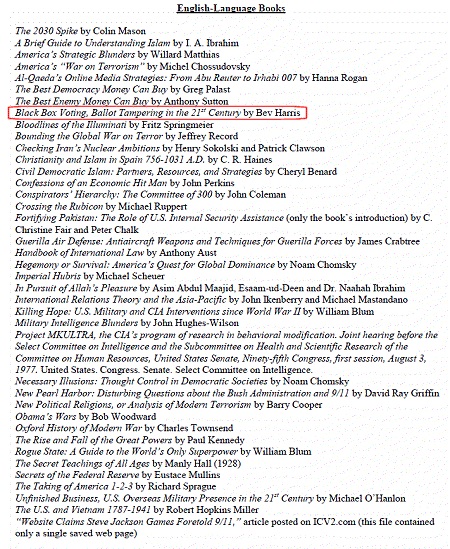
The list

image

I’ve read quite a few of these. But first, people, please: Shake your heads, get rid of the cobwebs. There’s no “Osama,” he wasn’t killed, there was no library. They just make this shit up. The question is, why?

My first thought, given the range of work covered here, that some are thrown in for believability sake – some of the Arab titles, Bob Woodward, hardly a threat to anyone in power. But the intended audience is English-speaking, and the message appears to me to be sinister. This is after all, CIA, our mind masters, our Murder, Inc., the people who wander the landscape killing off people who might disrupt the orderly flow of lies. They are thought police, Gestapo, image masters, a lie factory, and the murderer of presidents. (Their Motto: No Person, No Problem.)

What’s the point of the list? Scorcisi’s Last Temptation of Christ was going nowhere until Christians picketed it. He might have hired them. Putting these books on the list draws attention when our dreamweavers would much rather the norm, that people just don’t know about these books.

But then, this is The United States. People don’t read.

OK, I’m confused. It will clear up over time, I hope. But now, I merely pose the question: WTF?

Also, why is Chomsky still alive anyway?

Seeing through American “news” coverage of Russia

russia-argentina-local-currencies1.siFor anyone viewing American news with the proper jaundiced eye, the above photograph tells us everything we need to know. It is Russian president Putin alongside Argentina’s president Cristina Fernandez after meetings these past few days.

American vulture funds are shaking down. Having purchased Argentinian debt for pennies on the dollar, they want full compensation. They are willing to use full faith and credit of the Obama Administration to get it. (John Oliver does a credible report on this matter behind HBO’s pay wall.)

If you want to understand the real reason for the aggressive posture the US and its agents are taking against Russia these days, look no further than the photo above, and some accompanying text.

“We agreed to hold extensive consultations on the question of using national currencies in trade payments between states and between commercial partners,” the Russian President said.

Russia has set up similar schemes with China, Iran, Egypt, and Turkey to cut out the US dollar, the so-called middleman used in most transactions.

In October, Russia and China agreed a currency swap worth over $20 billion, in order to increase trade and business between the two.

Russia, China agree on more trade currency swaps to bypass the dollar

Earlier in April, Russia proposed setting up a similar system with Vietnam and Indonesia.

We need read no further than the words “to cut out the US dollar.” Such a move created the urgency to invade Iraq, destroy Libya, and encircle Iran. It’s all about propping up an empire in decline, and its floundering currency.

Historically, this has meant war. Right now it is causing the international banking community to attempt to bring Russia down, and Ukraine is merely the lever.

A tale of two religions

It does not hurt, if we are going to be discussing the lies of our own times, to reflect on times past. The humble assumption is that people alive now are no smarter than those who came before. I assume that thought control is a product of our modern mass media, but how can that be?

I was raised a Catholic, and as a child my head was filled with notions of a risen savior and virgin birth. Such beliefs, designed for the mind of a child, are easily overcome with maturity except that while I was indoctrinated, I was also inocculated. I was told that anyone who told me the teachings of the Church was false was an agent of the devil. That made it very hard to mature intellectually.

It was done to me in the 1950s and 60s, and also to children throughout history, pre-mass media. Religion is a thought control regime. It is mostly benign. All of the wars that are blamed on religion really just hidden leaders using religion as an excuse.

But religion still exists and is powerful because people

  • need authority figures;
  • are suggestible;
  • and want simple answers.

Those simple answers do not exist. But religion supplies them anyway, and that makes people happy. So be it. Religion does far more good than harm.

Religious leaders throughout history have zeroed in on human weakness. Imagine then that leaders of civil society understood humans as well as religious leaders do. We might then expect that in civil life we would be supplied with mythology, images, dogmas, hallowed leaders and simple answers, just like a religion.

Americanism is a religion, just like Catholicism, and we are all indoctrinated and inoculated from birth. It is mostly benign in purpose, to bind us together as a nation, allowing us to live in harmony. It works. Montana has never invaded or bombed North Dakota, and probably won’t.

But what if our American religion were not so benign? What if our mythology was designed to make us warlike, acquisitive and aggressive, seeking to take control of resources of others? Americanism then might be a problem for the rest of the world.

GMO’s and vaccinations – how the PR industry manages public debates

A while back, due to my children residing in Portland and being on Facebook, I was aware of a ballot issue out there to label GMO foods. It failed. What struck me was how the issue was being framed. Posts were appearing excoriating those people so stupid as to believe that GMO foods cause cancer. I immediately spotted public relations at work.

GMO foods do not cause cancer. But that was one “side” of the debate they were having. The other side was that GMO foods are OK. The real issues, capitalist enclosure of the food system and over-reliance on a few strains of seeds for our food supply, were never discussed. Monsanto no doubt wanted it that way. That made the subject win-win. They could point out the stupidity of the debate without ever having the real issue discussed.

That’s how public relations works – an outfit like Monsanto does not cast its fate to the wind and hope for the best. When there is a debate, it wants to own all sides, to “frame” it so that real issues are not discussed.
____________

Jenny-McCarthy-11This came to mind last night as I reluctantly listened to a podcast about the vaccinations debate and the Playboy bunny Jenny McCarthy. That issue too has been framed for our benefit. How many of us, me included, have automatically sided with the drug companies rather than a silly model who poses nude? I was surprised to learn that McCarthy is not anti-vaccination, and does not claim to know that there is a link between that and autism. Something much more interesting is going on, and the arrows point at the usual culprits – not Monsanto this time, but the drug cartel, PhRMA. It is managing the debate by cashing in on public fear of disease.

All I can say at this point is that the podcast opened my eyes a little, so that I have to pay more attention to the issue and stop judging based on stereotypes. McCarthy and others who have taken on the drug giants want to know why the regimen of childhood vaccinations in the United States was expanded from ten of to 36 around 1989 or so. Most other industrialized countries, with reliable public health systems, stuck with the basic ten, including measles, mumps, diphtheria, etc.

McCarthy is suggesting the PhRMA seized the initiative. Because we are a business-run society, decisions about U.S. public health are not made with public health in mind, but rather corporate bottom lines. McCarthy said that it was a $13 billion industry now. She claims that most of the additional 26 vaccinations that have been added to the regime since 1989 are expensive, unnecessary, and not even known to be safe. Research, double-blind studies, have been done on only one, maybe two of the 36, which is the sole “science” behind industry and the AMA’s claim that all vaccinations are safe.

Jenny McCarthy’s entrance into the debate, especially during a time she was dating Jim Carrey, walked us right into a PR trap. Such people can be automatically discredited. I make no claims about McCarthy’s intelligence or sincerity, but rather the public image of a Playboy bunny in a serious debate. It’s born to lose.

Just as Monsanto took control of the Oregon GMO debate by having stupid people appear on public forums claiming that GMO foods cause cancer, so too has PhRMA taken control of the vaccination debate by having Jenny McCarthy as the spokesperson for the opposition. She may be just an unwitting tool, most likely, but the debate needs to get above and beyond her.

Parroting intelligence

Another person, not me, took the words of our friendly resident sociopath wherein he attacked me for the umpteenth time, and noted that he doesn’t seem to be able for formulate thoughts in a coherent manner. He’s going through the motions, using words that seem to fit … but not quite. He’s imitating. There is no native intelligence.

That’s was a potent observation. If it were just him, I’d not bother writing here. But it couples with other thoughts I’ve had in dealing with so many others on the blogs … they don’t change! They don’t get better. They don’t move forward. If they believed eight years ago that the moon is a balloon, they still believe it. No amount of evidence will sway them.

I look back occasionally on things I’ve written in the last eight years, and I am generally happy with content and sentence construction, but also see that there was much advancement in store in the future. For instance, I was writing favorably of Obama back in 2008, and I would not just become disenchanted with the man, but come to understand that the office has zero power, so that only craven actors can have “successful” presidencies. Looking back, I see I have covered much ground in understanding. I’m happy about that, because it means I have purpose in my writing, that I am moving forward.

I remember the words of Kevin Costner in the movie JFK, that what happened on 11/22/63 was coup d’état, a line delivered with excellence by a highly skilled actor. I did not understand it. After all, we still had elections and anyway, coup d’état is what happens when men in bling-bling uniforms go on TV and tell us we have a new government.

I understand the line now. He was right.

Forward movement, better understanding, each day pushing the ideas that are so hard to grasp. Understanding only comes if I keep pushing, and yes, with each new breakthrough comes a bigger problem. Now I am confronted with not just a crime, coup d’état, bad actors and a riddles inside conundrums, but Oglesby’s words, “…the corruption and criminality of the state itself.”

And I will keep on pushing for better understanding. I love writing, of course, but more importantly, I love the idea that in so doing, along with reading and thinking, that I am moving forward in life.
____________________
Here’s a troubling thought: Swede says global warming is a hoax. He needs to follow through on that, but won’t, of course: A hoax to what end? Why do so many scientists lie? Are they all dishonest? Are they so shallow that they are bought for a few grants here and there? Do they have no integrity? Swede is badly in need of forward movement, a breakthrough. because frankly, I think he’s on to something. He has merely reduced it to its simplest elements, people lying for money.

Most people are not like that. There are people who knowingly tell lies and get paid for it. But all of those men and women who are advancing climate change are not bad people. They studied too hard for too many years, and pride themselves on intelligence, insight and integrity. There’s something more going on there. I am not going to worry about it, but do ask that Swede come forward now and advance his ideas on the subject with the idea that while he has spotted a problem, he needs to push it harder to reach a better understanding. It’s work.

I don’t say that because I have the answer. I don’t. Maybe the scientists are right. Here’s where I am at: Many years ago I sat on our couch reading, and I remember a moment like a wave of fresh salty ocean in my face. I realized that my fear of communism, embedded in me by news, school and entertainment, was based on lies. There was nothing to be afraid of, and that dark foreboding menace, the Soviet Union, was nothing to be feared. I could relax. It was a breakthrough!

So too have I come to realize that this foreboding nightmare that so many smart people, even Chomsky, are prattling about, climate change, is something that I can do nothing about. Buying a Prius won’t help, nor will these annoying fluorescent bulbs that don’t put out enough light. I am relaxed. I don’t care about it.

I want to know more. Al Gore is not a man of character, in my view, so that his decision after 2000 to become the climate change guru was probably calculated for some unstated purpose. But the lack of integrity of one disingenuous man is not enough to base a whole outlook on. If climate change is a hoax; if we have nothing to fear, then what is going on? It is more than money. Is it groupthink? Cultism?

Answer please, Swede.
_______________
The clip below the fold here is inserted for its entertainment value.

Continue reading “Parroting intelligence”

Does Reading Matter?

Again I’ve no inclination to write here, so went back to 2007 for this piece. The comments are interesting. I lived in Bozeman when I wrote this, and Bon Garner took trouble to introduce me to Steve Kelly, and then went and died. Bob was quite a character, a nice man, and I have fond memories of our brief interlude before he died. I remember his house was full of books.

He told me of the time that he worked in Vargas, a local book store, and they had a customer tie up his dog outside and come in and browse. A cop saw the dog and came in to reprimand the man for neglecting the pooch, and Bob seized the opportunity. He dialed 911 to report an armed man was harassing a customer. Three squad cars arrived at once. Hilarity ensued. For Bob, anyway.
_____________________
There’s an interesting op-ed in yesterday’s Wall Street Journal called “Does Reading Matter?” I reprint it in full below, as the Journal online is subscription-based. The National Endowment for the Arts released a report on reading that said that the average 17-24 year old in this country spends seven minutes a day doing voluntary reading.

I’ve read these reports before, and for years have witnessed the hand-wringing on the subject. Some implications are clear – people get their information by watching TV and listening to radio, and lately, via their computers. These media are not filtered in the same way as the printed word, and people are much more susceptible to indoctrination via TV and radio than books, which are filtered at the source. Pictures go straight to the brain. Words are filtered, contrasted with ideas, accepted or rejected based on other knowledge and prejudices.

So the logical inference is that people who digest information via reading are better informed than those who do so via TV and radio.

How do we process information, and how many of us process it at all? Frankly, those who are not reading are being manipulated by various media. Can’t be helped. It appears as though very few people have the inclination to pick up a book at the end of a long work day. Most turn on the tube. And they don’t want to be hit with hard issues with complicated resolution. They want the easy stuff. They want to relax, and who can blame them.

It’s a free market, and the market gives them what they want: Damned little to think about. But it leaves our society as a whole subject to the worst sort of leadership – people who use images to control opinions. We leave ourselves open to that when we do not read, filter and process information.

Where does that leave those of us who do read and digest and think about things in any depth? We have some power. We’re in charge of ideas. We advocate for policy, but the mainstream is brought along by the most thoughtless media of all, TV. In the end, it’s not ideas that sell policy – it’s images. The Bush Administration (along with FOX News) is very careful to control images coming out of Iraq. They know that even though words accompany the images, it is only the images that matter. No flag-draped coffins, no dead civilians. That’s how they manage public opinion.

There’s more to it, of course. The primary means of manipulating public opinion is to filter it down via opinion leaders. That’s the same way they sell fashion – people see important people wearing different clothing, and change their own style. It’s the same in the arena of ideas – most people don’t think for themselves. They look up the food chain. TV is a great medium for handing down information. It’s how we elect our presidents.

Are we a literate society? Hell no, of course not. And we were not a literate society when Tom Paine hit the streets with Common Sense. Only a relative few read it, the opinion leaders, and those few made all the difference.

Back to the beginning – does reading matter? Yes, it matters a great deal. But there are now, as in 1776, only a few that can process information and think critically. The rest are along for the ride. Things have not changed much, then to now.

————————————————————————

Does Reading Matter?
November 29, 2007; Page A18
By: Daniel Henninger

Time-pressed Christmas shoppers who visit Amazon.com nowadays see a homepage pushing Kindle. Kindle is Amazon’s “revolutionary wireless reading device.” This ambitious ($400) and ultimately admirable gadget springs from the hopes of Amazon’s visionary founder, Jeff Bezos, whose e-company began with books but in time found that profitability required the selling of things that people prefer to do with their ever-dwindling free time.

It was hard not to notice that Kindle was born unto us about the same moment the National Endowment for the Arts released a report on reading’s sad lot in our time. Amid much other horrifying data, it revealed that the average 15- to 24-year-old spends seven minutes daily on “voluntary” reading. Cheerfully, this number rises to 10 minutes on weekends.

An earlier, equally grim NEA report, “Reading at Risk,” announced the collapse of interest in reading literature — basically books. This newer study widened the definition of “reading” to include magazines, newspapers and online leisure. No matter. Even if the definition of literate life includes persons who spend their seven voluntary minutes with “InStyle” magazine or online reviews of HDTVs, the report still suggests that unmandated reading is heading for the basement.

As someone whose professional hero up to now was Johannes Gutenberg, I’m obviously cheering for Mr. Bezos’s Kindle, whose pages appear in a book-like technology called E-Ink. It must be counted as good news that Amazon’s Web site says the first run of the Kindle machines is sold out. (A spokesman said they won’t disclose how many. Hmmm.) Still, one must ask:

Are Kindle’s early adopters the leading edge of a new literate future, or a small, fanatic band of bookish monks, like those in Walter M. Miller Jr.’s 1959 sci-fi classic, “A Canticle for Leibowitz” (not yet available on Kindle) who preserved books in a post-nuclear apocalypse? Are we in a post-digital apocalypse for serious reading?

And if so, does it matter?

The NEA authors posit “greater academic, professional and civic benefits” with high levels of leisure reading. In other words, readers profit, at least in their souls, from time spent with works of the imagination or with books that explain the past. I agree.

Herewith, however, an anecdote that may suggest one reason for the decline. At a Wall Street Journal focus-group session awhile ago, the facilitator asked young professionals, readers of the Journal, about their reading habits. I was struck by the comment of a 30-something woman. “Look,” she said, “I spend my entire day at work on a computer. When I go home at night, I just want to read something.”

She, no doubt, would be one of Leibowitz’s monks. The fact is that many people who used to read a lot today have jobs that require staring at a screen. Smart people work long hours, mostly onscreen, ingesting things like legal documents, commercial leases, prospectuses for initial public offerings, Yahoo headlines and whatever computer engineers read. Then they crawl home at night to play video games or watch season three of “24” from Netflix.

Rolling your eyeballs across endless snowdrifts of pixels 10 hours a day, even for good money, is tiring. Thus post-pixel reading defaults to absorbing the synopsis on the back of a DVD box. If you can read Angelina Jolie’s name, what else do you need to know?

One criticism of the NEA studies is that they don’t capture the “new” ways people read away from work. This means the Endowment doesn’t validate new pastimes, such as reading text messages on cell-phone screens. Add the input-output of text messaging to the data base of readers and the daily voluntary reading time likely rises from seven minutes to six or seven hours.

Is this literacy? In 50 years, no one may ask.

This is an inventive age, though, so it was inevitable that smart people would devise a response to the flight from literature. French professor Pierre Bayard has written (a book) called “How to Talk About Books You Haven’t Read.” He suggests we skim, rather than read, the classics. A less-suspect fix is the Web site DailyLit.com. It’s a site for people beset with guilt because they don’t “read” anymore.

Select one of their classics, or poetry, and they’ll push five minutes of it to your email box each day at the same hour. I read F. Scott Fitzgerald’s “The Beautiful and Damned” this way. The story was fantastically depressing, but the expiation helped.

One wonders if reading’s status isn’t more complex. Unlike 30 years ago, when most of one’s acquaintances could at least talk about Cheever, Malamud, Updike, Plath, Baldwin, Mailer et al., there is no longer a common conversation about literature. Today, it’s come down to one book: Harry Potter. Maybe two, “The Kite Runner.” And yes, a million people will read David McCullough’s grand “1776” and talk about it. But other than Oprah, the institutional agenda setters and critics that created the common conversation are gone.

Anecdotally, though, there seems to be an amazing amount of real reading going on.

A recent phenomenon on the streets of New York is people walking, amid crowds, their nose in a book. One sees it all the time. The subways are full of people reading books. On just one subway car this Tuesday one saw: “Tales from Da Hood” by Nikki Turner, “The Catcher in the Rye,” “Don’t Know Much About History” by Kenneth Davis. Small book clubs abound, as do book Web sites. There are small presses dedicated to writers “no one” is aware of beyond several thousand loyal acolytes. But they are reading.

It isn’t just books. There’s no common conversation about popular music either; music’s subcategories now are endless and arcane. Other than movies, still seen together in theaters, cultural interests once widely shared have subdivided into many discrete communities.

But the NEA’s broader policy issue still holds: Will people who simply stop “reading” be at a disadvantage? Yes. In the future, I suspect that the adept “readers” will be telling the non-readers what to do. A canticle, perhaps, for the next Leibowitz.
• Write to henninger@wsj.com.